Looks brilliant-your sketch. I wonder if this Church is visible from the Tate. Have you read “Mudlarking” which is very entertaining on the history of the Thames and objects contained therein?
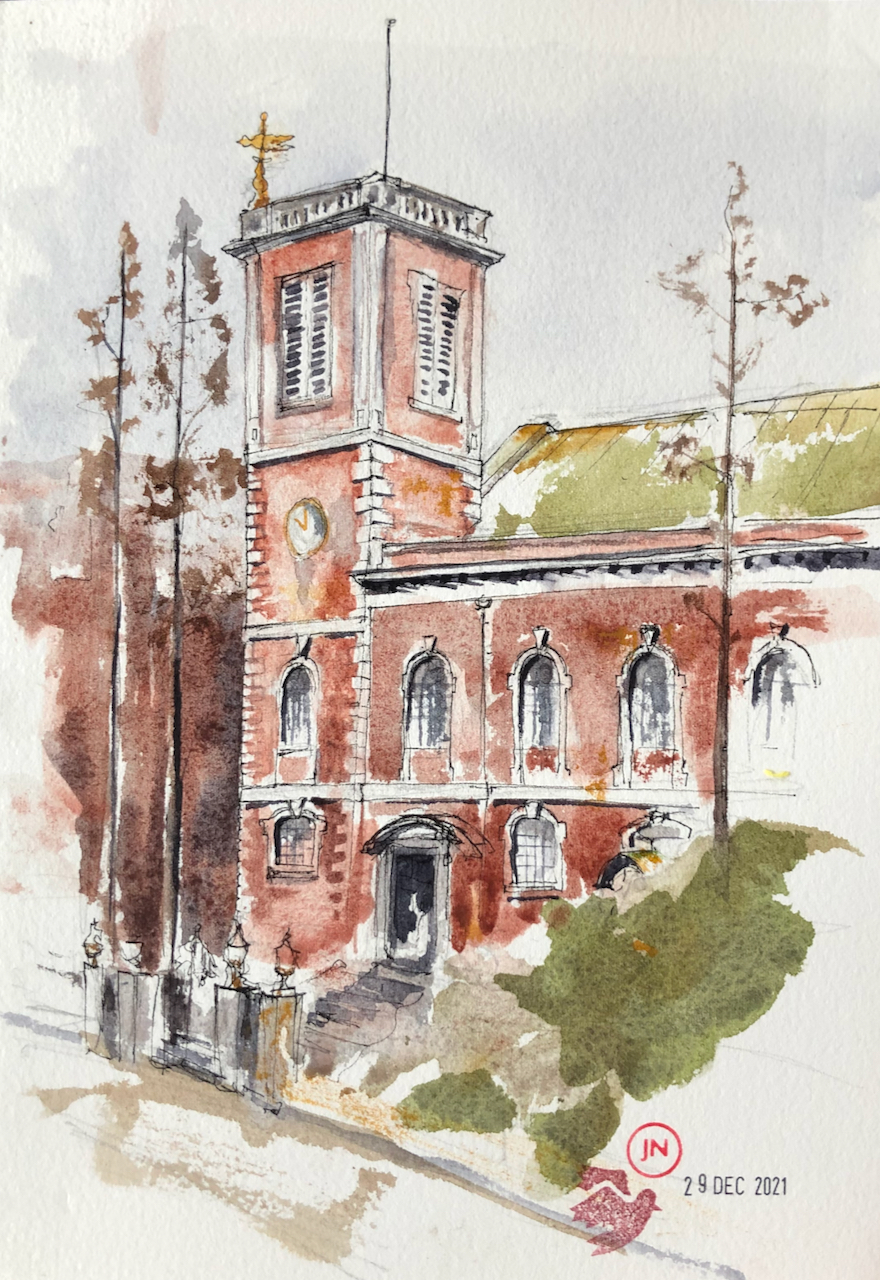
This lovely church is on Queen Victoria Street, a busy thoroughfare in the City of London.
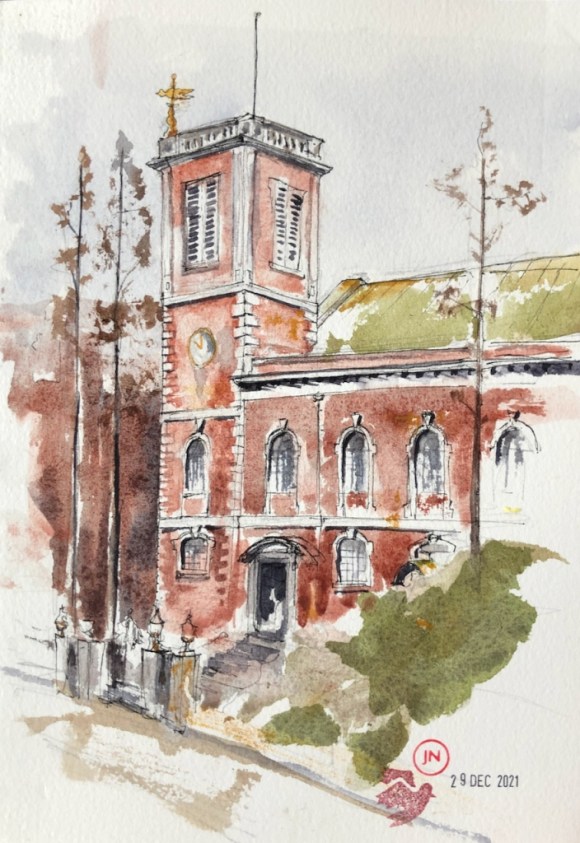
St Andrew by the Wardrobe EC4, 29th December 2021 2pm. 10″ x 7″ in Sketchbook 11
This church was first recorded in 1244, destroyed in the fire of London 1666, rebuilt by Christopher Wren in 1685-93, then destroyed again in the 1939-45 conflict, rebuilt again, and re-hallowed in 1961. It is now closed for refurbishment, and due to reopen in May 2022. When it re-opens it will become the London Headquarters of the Egyptian Coptic Orthodox Church, this use being shared with the Anglican parish activities. I read this news on the church website.
Note the magnificent trees! These trees should feature on any London Tree Tour. I think they are larches but I am not an expert.
Yesterday, London was quiet. I sketched the church from podium level on Baynard House on…
Nadezhda Andreevna Udaltsova (December 29, 1885-January 25, 1961) was a Russian avant-garde painter and educator. Udaltsova was affiliated with Cubism and later with Suprematism. Biography on Wikipedia: https://en.wikipedia.org/wiki/Nadezhda_Udaltsova
Have been reading Christina Rosetti’s verse recently. I was struck by how her perceptions and attitudes were influenced by having been immigrants from Italy. Must give this more thought- lovely portrait.
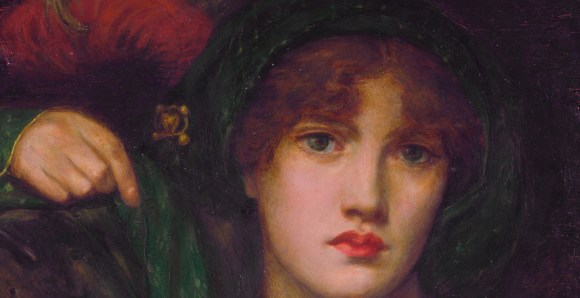
My Lady Greensleeves by Dante Gabriel Rossetti, oil on panel, 33 x 27.3 cm (13 x 10 3/4 in.) ,[Public domain], Harvard Art Museums/Fogg Museum, Bequest of Grenville L. Winthrop, Image Source: Wikimedia (details)
Image Source:
My Lady Greensleeves by Dante Gabriel Rossetti, [Public domain], Source: Wikimedia
‘In my beginning is my end. […] In my end is my beginning.’
From ‘Burnt Norton’, Four Quartets, by T.S. Eliot
So begins (and ends) ‘East Coker’, the second of the four poems which make up T.S. Eliot’s Four Quartets, which now receives a major solo rendition in the West End, self-directed by Ralph Fiennes. Widely considered Eliot’s last great poetic work, it is a text deeply concerned with time, beyond the limitations of human perception – influenced by traditions and texts ranging from the Pre-Socratics in Ancient Greece to Hinduism, Julian of Norwich and his own ‘anglo-catholic’ beliefs (as he self-described, without the customary capitalisation, in 1929).
Eliot writes with an after-dinner wit and a focused philosophical seriousness all at once, which is dryly conveyed by Fiennes’ manner, fluctuating between offhand and earnestly supplicatory at a moment’s notice. Lines such as ‘You…
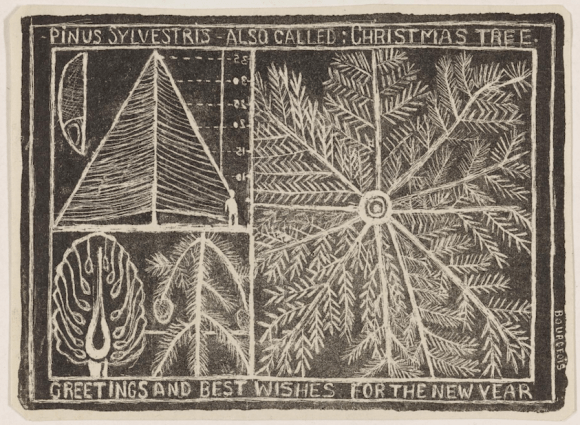
Louise Bourgeois (December 25, 1911-May 31, 2010) was a French-American artist. She created sculpture, installation art, drawings, and prints, but is probably best known for her spider-like Maman sculptures. Biography on Wikipedia: https://en.wikipedia.org/wiki/Louise_Bourgeois
Gisèle Freund (December 19, 1908-March 31, 2000) was a German-born French photographer, famous for her documentary photography and portraits of writers and artists. Biography on Wikipedia: https://en.wikipedia.org/wiki/Gis%C3%A8le_Freund
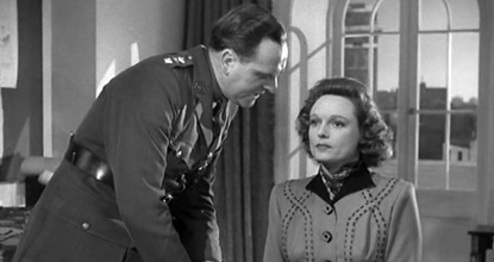
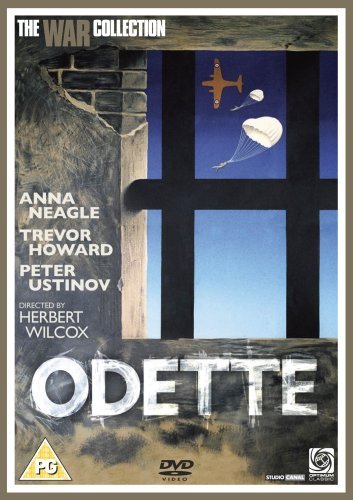
Odette is a 1950 British war film based on the true story of Special Operations Executive French agent, Odette Sansom, living in England, who was captured by the Germans in 1943, condemned to death and sent to Ravensbrück concentration camp to be executed.
However, against all odds she survived the war and testified against the prison guards at the Hamburg Ravensbrück trials. She was awarded the George Cross in 1946; the first woman ever to receive the award, and the only woman who has been awarded it while still alive.
Also known as Odette – Agent 23 or Odette – Agent S.23.
Outline
In response to a radio broadcast request for photographs of France, mother of three Odette Sansom sends a letter to the Admiralty, but an addressing mistake brings her to the attention of the Special Operations Executive, who need French people to go back to their homeland…
This was an outstanding read which introduced me to Irmgard Keun. I think Weidermann has just written another book which I do hope will be translated- also literary history.
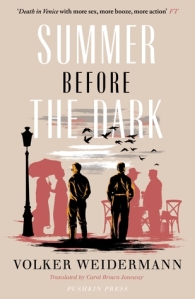
It is the fate of too many of my Kindle editions that, without a physical presence on my shelves, I forget all about them. Back in 2017 after reading Stu’s review at Winston’s Dad, I bought a Kindle edition of Summer Before the Dark with plans to read it for German Lit Week, but it never happened. What I’ve just finished reading today is the Pushkin Press edition from the library, though the cover art is by Richard Bravery; it’s not the one with the gorgeous ‘railway poster art’ cover that Stu read.
Stu was right: this is the story of writers as ordinary people slowly waking to what was happening back home as the Nazis tightened their grip on power. The novella is set in Ostend, 1936, and the subtitle of the German edition is ‘summer of friendship’. Years before, the impoverished but ambitious Joseph Roth had made…
Memories of the recent past may not always be resurrected with pride. Indeed, they may be suppressed in an attempt to avoid guilt and pain. When it comes to the rough treatment of young women, unmarried and with child, in the years before the establishment of the Welfare State, recalling matters grows still more uncomfortable. The recognition of the catalogue of penury, ignorance and pain which led to unwanted babies, abortion and infanticide in the not so very distant past is not easy to absorb. However, there are advantages in looking over such painful issues. Firstly to discover that other brave women, in the form of a local society whose members responded to give succour at a time while others simply condemned “moral weakness”. Secondly, some such misfortunes; broken relationships, fear of infection and addictions plaguing our Grandparent’s generation remain today. What then can be usefully learnt from the records of the “Refuge for Girls in Trouble” set up in 1907 in Penzance?
In assembling an overview of the work of the Penwith Rescue and Preventative Society, Jenny Dearlove clearly demonstrates the often makeshift approach to the social care of young women in dire distress through unwanted pregnancy. It outlines one solution by the good folk of one Cornish town. This story contains an interesting medley of personal statements from care workers, committee members and others attempting to relieve distress. In giving a panorama of these dark times, it is necessary to deal with the uncomfortable details of dire distress; abortion, drunkeness, severe poverty, prejudice, dirt and disease. However, without such charitable interventions how much worse would the situation of these girls and babies have been?
It seems that often the young women were moved out of the area, quite often separated from their babies. Many alternative institutions beside the Penzance Rescue Society appear somewhat dire. The photograph of Madron Workhouse ( the text is liberally illustrated) in particular looks like the forlorn last hope that it undoubtedly was. In addition to illustrations there are several appendices with a very useful timeline that conveys the benefits of the development of the Welfare State and changing regulations toward contraception. Material inventions such as effective plumbing, electric cookers and later still, the washing machine were an obvious boon even when relationships between the occupants of the care homes and hostels were not always as they might be.
Doubtless, one beneficial aspect of this book are the questions which it raises. For certain men do not come out of the account with any credit.Not only those who left their girlfriends with unsought pregnancies but those who had forced their attentions on vulnerable women. Women’s suffrage and following campaigns, although limited at first, helped create a climate for change which went on to benefit children. Additionally, the book encourages thought about the difference between un helpful moralistic stances and more neighborly generosity expressed by giving practical assistance.
Some of the most interesting issues concern the differences between the organisers and what would nowadays be called, front line staff. There is early evidence of multi[ple pressures on the latter. Professional Social Work really only took off in the 1960s and its resourcing remains subject to political control and financial cuts. Currently, bearing in mind profound lapses in child care and paucity of welfare provision we might do well to acknowledge rather forgotten women who got down to the task of sustaining others who, in the parlance of the time, were considered to have “fallen”……..
All are one now, roses and lovers,
Not known of the cliffs and the fields and the sea









 It is the fate of too many of my Kindle editions that, without a physical presence on my shelves, I forget all about them. Back in 2017 after reading
  gorgeous ‘railway poster art’ cover that Stu read.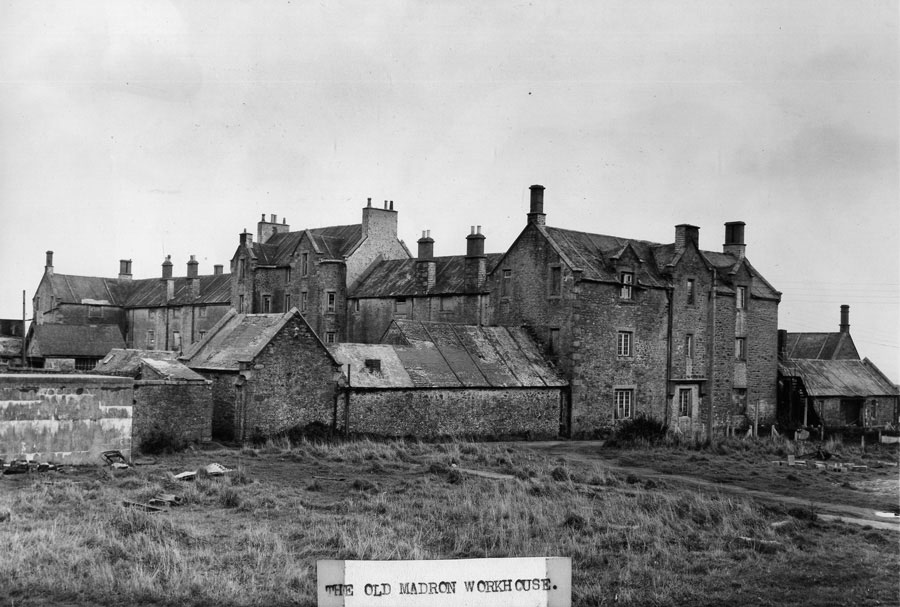

 penwithlit
