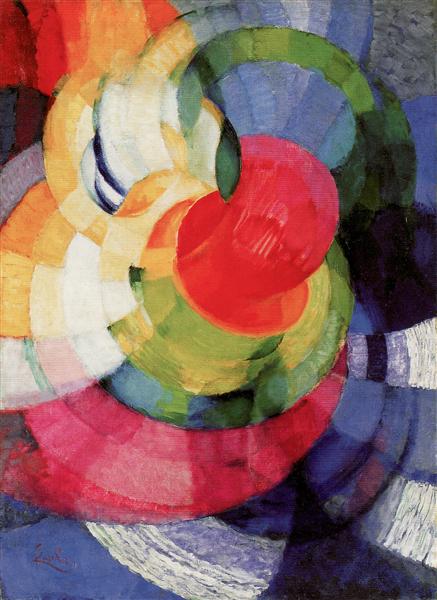
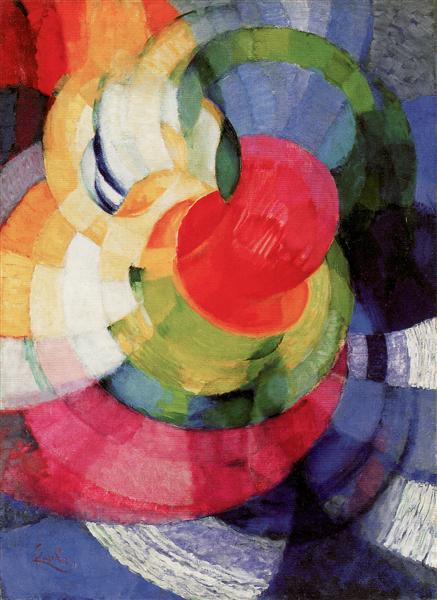
Disks of Newton, Study for Fugue in Two Colors, Frantisek Kupka (c.1911), Orphism, Philadelphia Museum of Art, Philadelphia, PA, US, 77.5 x 73.6 cm, Image Source: wikiart, public domain
Mirages: Sabine Devieilhe – French Opera Arias. Album out 10 November 2017: http://wnrcl.me/mirages
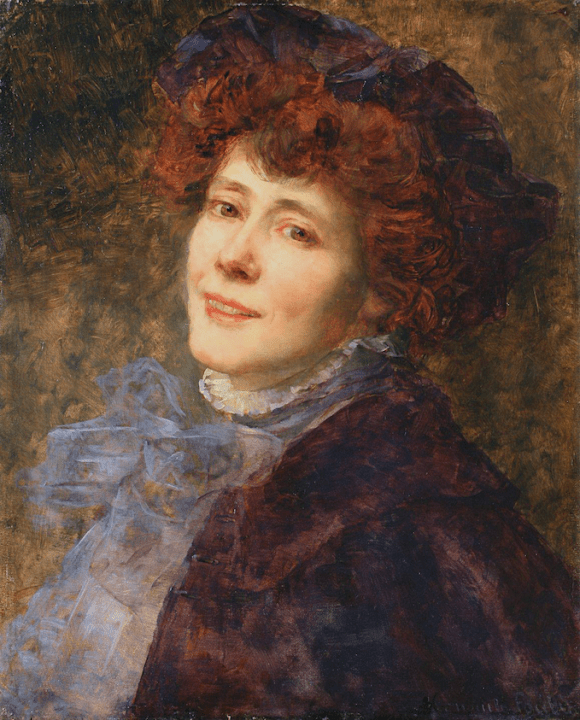
John La Farge (American, New York 1835–1910 Providence, Rhode Island), Date: ca. 1885, Culture: American, Medium: Watercolor, gouache, and charcoal on off-white wove paper adhered to wove paper, Dimensions: 8 1/4 x 7 in. (21 x 17.8 cm), Credit Line: Bequest of Miss Louise Veltin, 1937, Image Source: TheMet
Too Beautiful For Words…
Thierry de Brunhoff, piano (Bechstein) Recorded in 1973
Interesting- I recently read White’s book on the 18th Century -The Age of Scandal” which I found brilliant. Apparently he taught at Stowe- that engaging Public School where George Melly had been an eccentric pupil.
Terence Hanbury White was one of the founding fathers of fantasy in the twentieth century, producing nearly twenty-five novels, including the beloved modern Arthurian retelling, The Once and Future King. Still, much of T.H. White’s life remains a mystery and there has been little scholarship on his work. This gap stands in contrast to the Inklings, where, especially in the case of J.R.R. Tolkien and C.S. Lewis, there is a large and robust field of scholarly works. While White’s Arthuriad has not invited scholars and biographers in the way that Lewis’ Narniad and Tolkien’s Middle-earth has done — and despite the fact that he does not have seem to have met the Inklings in person — T.H. White’s life intersected with the Inklings in intriguing ways.
Born in 1906 – 8 years after C.S. Lewis – White died in 1964, outliving Lewis by less than six months. Like Lewis…
An early start with the book group choice for next month, and what an astonishing book this first novel by Rebecca West, published in 1918, was. As First World War literature was one of the topics I specialised in teaching towards the end of my career, I was surprised never to have encountered this short novel, but since the Great War is only incidental to its plot, perhaps this is not surprising.
An officer suffers from shellshock, and all memories of fifteen years of his life have vanished; he has no recollection of his wife, the death of their small son, any of the changes which have taken place at his home. His memories are stuck on the idyllic happiness of his first love years back, and the first message from the field hospital contacts her… you can imagine the complexities West has set up…
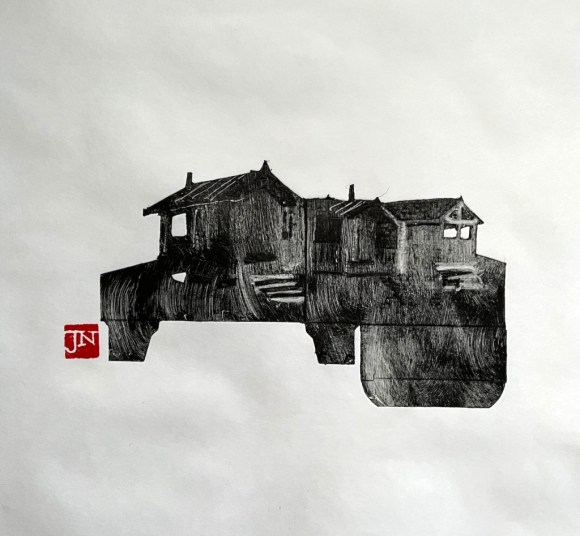
Here is a “packaging” monoprint I made of the huts in Walberswick.
Walberswick huts, monoprint, image size 8″ x 5″ [Available]
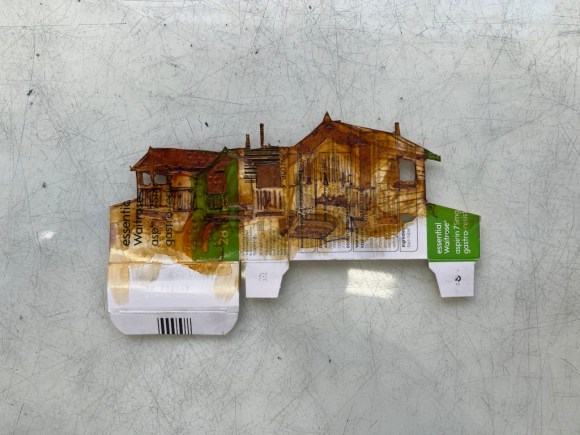
The print is made using a discarded carton from a box of aspirin. It looks like this:
Walberswick huts, plate made from aspirin carton.
The brown colour is shellac, a varnish which helps make the plate last a little longer. I make the picture on the shiny side of the medicine packaging, by cutting off the shiny surface to reveal the rougher cardboard underneath. The plate is very thin and fragile. This plate made 5 prints. I lost one of the chimneys during the process.
Here is an 11-second video showing the print coming off the plate:
The ink is JS Gutenberg Carbon Black etching ink from Intaglio Printmaker in Southwark. The paper is Gampi smooth from Shepherds of London, in Gillingham Street.
















 penwithlit