Categories
Uncategorized

Die Kerzen brennen fröhlich weiter…

Richly romantic!

Wolfregen & Constanze's avatarDas poetische Zimmer

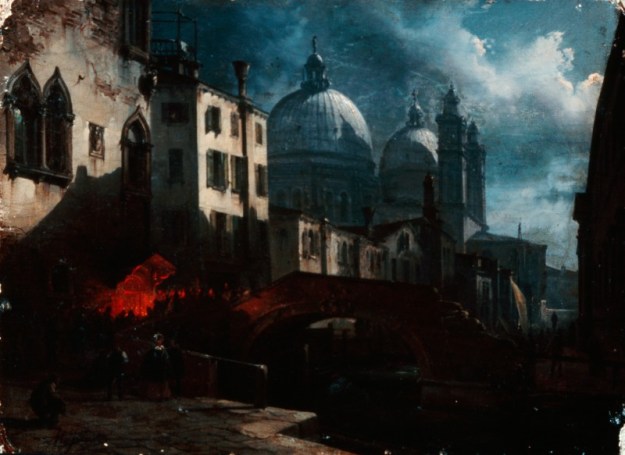
Giovanni Migliara: Scene veneziana (ca. 1830)

Perücke, Spiegel und Masken

Die Angst geht um in Schön-Venedig,
Denn hübsche Frauen, jung und ledig,
Verschwinden spurlos in der Nacht;
Es trifft nur bessrer Häuser Töchter,
Ein Mörder geht, nur diese möcht er,
Ist bald schon schrecklicher Verdacht.

Man findet lange keine Leichen,
Wie sich die Taten aber gleichen:
Ist immer stiller Mondenschein,
Kein Wind weht her aus der Lagune,
Das Wasser ruht an Pfahl und Buhne,
Die Gondeln schimmern schwarz und fein.

Vergeblich ihre Eltern warnen,
Dass sich die schlimmsten Teufel tarnen,
Auf Bälle gehn die Töchter doch;
Dort steht er, der die Angst verbreitet,
Maskiert und tadellos gekleidet,
Das Haar gepudert noch und noch.

Er schaut sie an und spricht sehr vage
Und tanzen kann er ohne Frage,
Er scheint aus einem noblen Haus,
Ist höflich und auch gut erzogen –
Wie sehr der Anschein doch gelogen,
Er sucht ja schon…

View original post 215 more words

Categories
Uncategorized

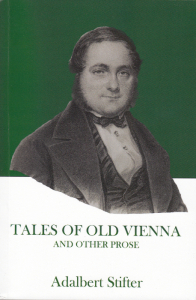
‘Tales of Old Vienna and Other Prose’ by Adalbert Stifter (GLM VIII)

Very interesting!

Jonathan's avatarIntermittencies of the Mind

At one point I was seriously considering reading Witiko, Stifter’s six hundred page book set in medieval Bohemia, for this year’s German Literature Month but in the end I plumped for this shorter book, a collection of stories and prose which was published in 2016 by Ariadne Press in California. The contents of Tales of Old Vienna and Other Prose were translated by Alexander Stillmark who also provides an introduction. This collection contains five short stories and four short prose works including a personal account of an eclipse of the sun in 1842. The first story in the collection is The Condor (1839), Stifter’s first published story, which is quite interesting initially but one which soon becomes a pretty standard nineteenth century story of doomed love. The shortest story, at only five pages, is Confidence an entertaining tale of unwitting parricide followed by suicide. But the bulk of the…

View original post 1,333 more words

Categories
Classics Literature Poetry

The Oriole-a nature poem by Emily Dickinson

  1. One of the ones that Midas touched,
    Who failed to touch us all,
    Was that confiding prodigal,
    The blissful oriole.

So drunk, he disavows it
With badinage divine;
So dazzling, we mistake him
For an alighting mine.

A pleader, a dissembler,
An epicure, a thief, —
Betimes an oratorio,
An ecstasy in chief;

The Jesuit of orchards,
He cheats as he enchants
Of an entire attar
For his decamping wants.

The splendor of a Burmah,
The meteor of birds,
Departing like a pageant
Of ballads and of bards.

I never thought that Jason sought
For any golden fleece;
But then I am a rural man,
With thoughts that make for peace.

But if there were a Jason,
Tradition suffer me
Behold his lost emolument
Upon the apple-tree.

Some beautiful lines in this poem and I find myself wondering about what sort of mine might be “lighted”. Also, verse 4 which puzzles me but I find entirely beautiful too.

Categories
Uncategorized

Nikolai Bogdanov-Belsky: The Schoolgirl

Charming portrait!

At Sunnyside - Where Truth and Beauty Meet's avatarAt Sunnyside - Where Truth and Beauty Meet

bogdanov-belsky, nikolai petrov children sotheby's l18112lot9rzccen Nikolai Petrovich Bogdanov-Belsky (1868-1945), The Schoolgirl, , signed in in Cyrillic l.l., oil on canvas, 158 by 119cm, 62 1/2 by 46 3/4 in., Image source: Sotheby’s.

Successful Exhibition 1917-1918

Nikolai Bogdanov-Belsky showed his paintings, including The Schoolgirl, at the 46th Itinerant Exhibition in 1917-1918, which was a time of great social and political upheaval. According to Sotheby’s catalogue, the success was surprising:

 Against all odds the show was a great success:
‘We assumed that during the revolutionary events people would be indifferent to art and that we would struggle to sell anything. Fortunately, we were wrong… our exhibition was well-attended and many of the works sold. […] Connoisseurs flocked to the venue, so much so that the exhibition administrator could hardly keep up with the purchases, and all this despite the high prices.’ (quoted in V.Vegenov, ‘N.P. Bogdanov-Belsky u «peredvizhnikov»’, Russkii vestnik, no.13 (79), 1943, p.4).

13bogdanov-belsky, nikolai petrov children sotheby's l18112lot9rzccen Nikolai Petrovich Bogdanov-Belsky, The Schoolgirl, (1868-1945), signed in in Cyrillic l.l., oil on canvas, 158…
View original post 166 more words

Categories
Literature Poetry

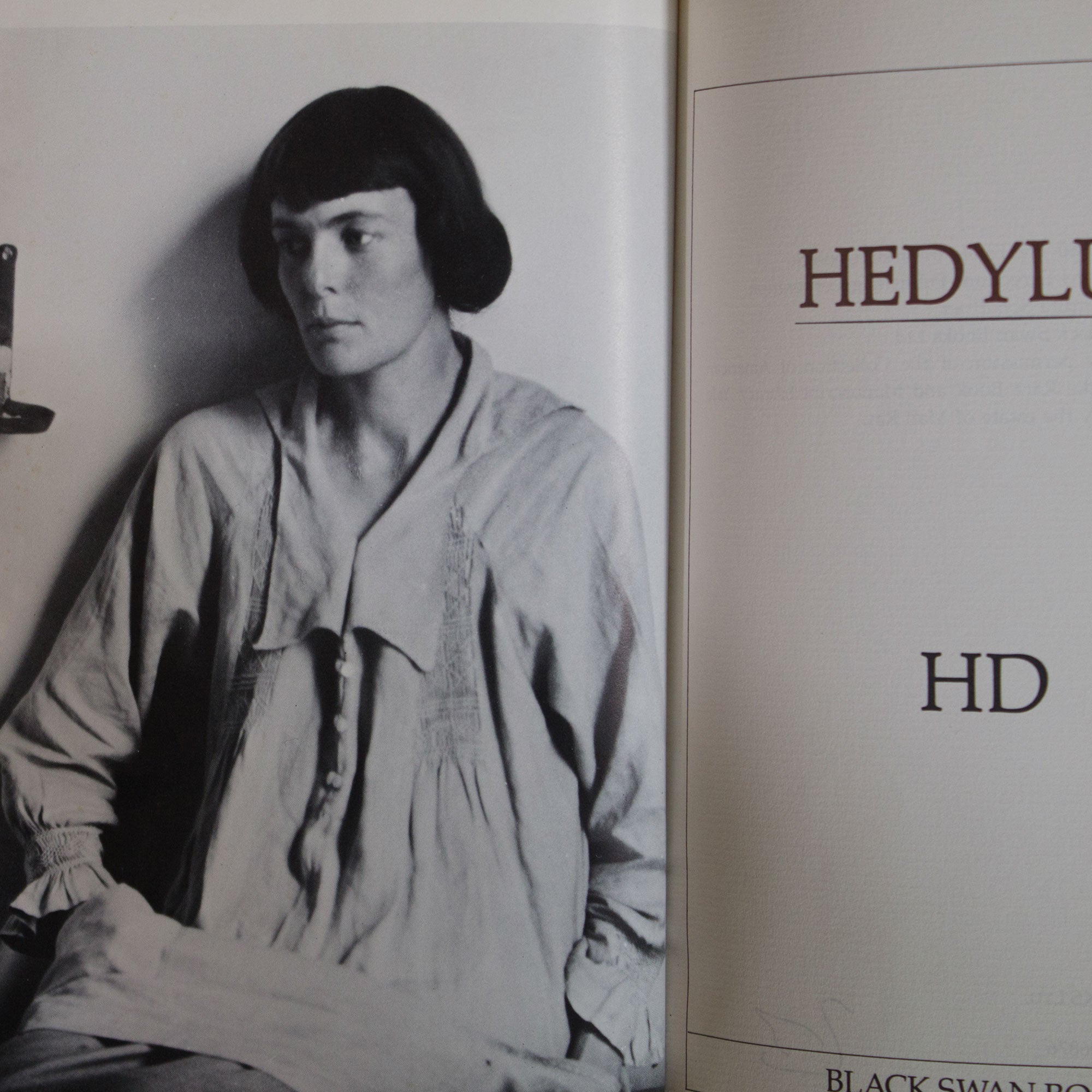
Sea Poppies by H.D.

Amber husk
fluted with gold,
fruit on the sand
marked with a rich grain,
treasure
spilled near the shrub-pines
to bleach on the boulders:
your stalk has caught root
among wet pebbles
and drift flung by the sea
and grated shells
and split conch-shells.
Beautiful, wide-spread,
fire upon leaf,
what meadow yields
so fragrant a leaf
as your bright leaf?
Hedylus
Categories
Uncategorized

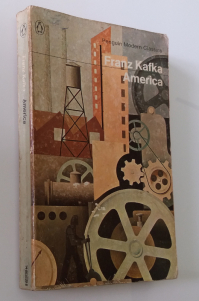
‘America’ by Franz Kafka (GLM VIII)

Jonathan's avatarIntermittencies of the Mind

Although I would class Franz Kafka as one of my favourite authors I haven’t read anything by him for many years and I know very little about his life. The Trial was the first book that I read by Kafka which was then followed with The Castle, Amerika (I’m sure the copy I initially read retained the Germanic title though it must have been the same translation as here) and a few short stories including Metamorphosis, of course. I remember finding Amerika a bit dull in comparison to the other novels but recently I had begun to wonder what I’d make of it now—so I thought I’d read it for this year’s German Literature Month. My Penguin copy makes use of the 1938 translation by Willa and Edwin Muir together with an introduction by Edwin Muir and a short postscript by Max Brod, Kafka’s literary executor, both…

View original post 1,188 more words

Categories
Uncategorized

Out of the Shadows: Form and figures

Highspot for me this year was seeing the magnificent paintings of Joseph Wright in Derby.

hoakley's avatarThe Eclectic Light Company

According to ancient legend, the person who ‘invented’ painting was not a man, and did so by tracing the shadow of her boyfriend.

Dibutades, a maid of Corinth in Greece, was about to see her boyfriend sent away from the city on military service. As the daughter of a potter, she devised an ingenious way of making a portrait to remember him by: when he was asleep, she positioned a light to cast his shadow against a wall behind him, then she traced the outline of that shadow in the plaster. Once he had gone, her father then transformed his painted silhouette into the first relief sculpture by daubing clay within the silhouette.

jwrightcorinthianmaid Joseph Wright of Derby (1734–1797), The Corinthian Maid (c 1782-5), oil on canvas, 106.3 x 130.8 cm, The National Gallery of Art, Washington, DC. Wikimedia Commons.

In 1778, William Hayley told this story succinctly in his poem

View original post 1,503 more words

Categories
Uncategorized

Cornflower

apolla13's avatarNames Throughout the Ages

Cornflower is the name of a flower (also known as bachelor’s button) so named because it grew in cornfields. It’s made up of corn (a grain or seed of a cereal crop such as oats, wheat, and barley) which comes from Proto-Germanic *kurną (corn, grain, cereal) derived from a PIE root word meaning “grain”; and flower. Cornflower blue is also a color of a bright blue with a tint of purple.

Origin: Proto-Indo-European

23477d52214ac5792411234afcde5db5Pinterest

Variants:

  • Kornflower (English)

View original post

Categories
Literature Poetry Uncategorized

An Emily Dickinson -There is another sky

There is another sky,
Ever serene and fair,
And there is another sunshine,
Though it be darkness there;
Never mind faded forests, Austin,
Never mind silent fields—
Here is a little forest,
Whose leaf is ever green;
Here is a brighter garden,
Where not a frost has been;
In its unfading flowers
I hear the bright bee hum:
Prithee, my brother,
Into my garden come!

by Emily Dickinson

Categories
Uncategorized

Im Tunnel – Obdachlos – Zeichnung von Susanne Haun

Susanne Haun's avatarSusanne Haun

Der Tag der Eröffnung der Ausstellung Querbrüche Obdachlos nähert sich. Morgen ist es schon soweit (siehe hier).

Ich möchte euch nicht meine Arbeiten der letzten Woche für die Ausstellung vorenthalten. Alle ausgewählten Arbeiten sind inzwischen gerahmt, es war nicht so einfach zu entscheiden, welche Arbeiten in in das Café Motte und welche ich in der Schillerbibliothek hängen werde.

Die Austellung Querbrüche Obdachlos wird am 2. November 2018  im  Café Motte , Nazarethkirchstraße 40, 13347 Berlin ab 19 Uhr eröffnet.

Das Café Motte ist gleichzeitig Café, Bar und Galerie und wurde im Mai diesen Jahres von der Familie Kottmann eröffnet. Hier im Weddingweiser erfahrt ihr mehr über dieses ungewöhnliche Café darüber.

Die Kunsthistorikerin Meike Lander wird eine Einführung in die Ausstellung geben.

Die Ausstellung im Café Motte ist vom 2. – 11. November zu besichtigen. Öffnungszeiten von 12 bis 0 Uhr.

Gleichzeitig werden Werke von uns in der Schiller-Bibliothek, Müllerstraße 149…

View original post 25 more words