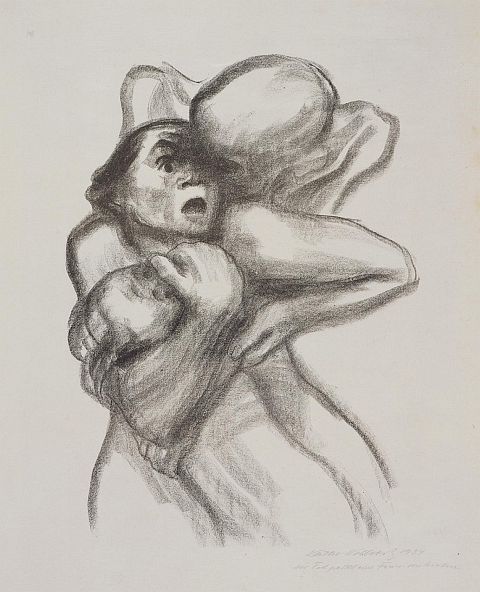
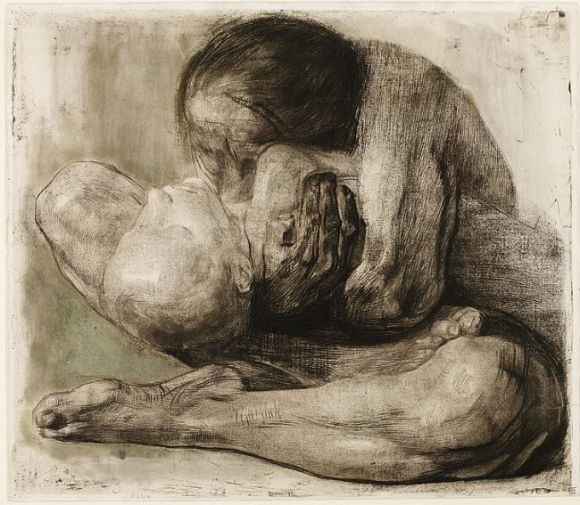
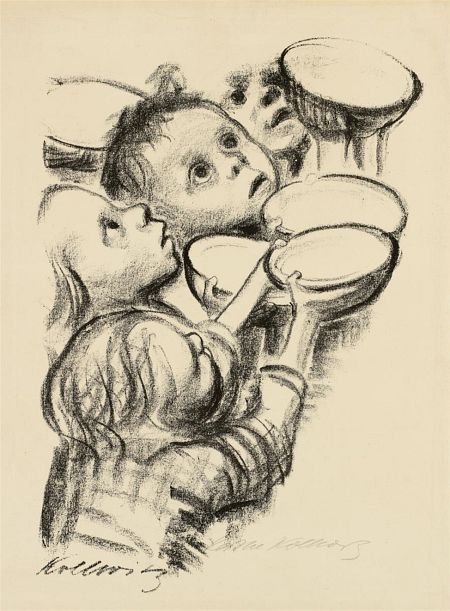
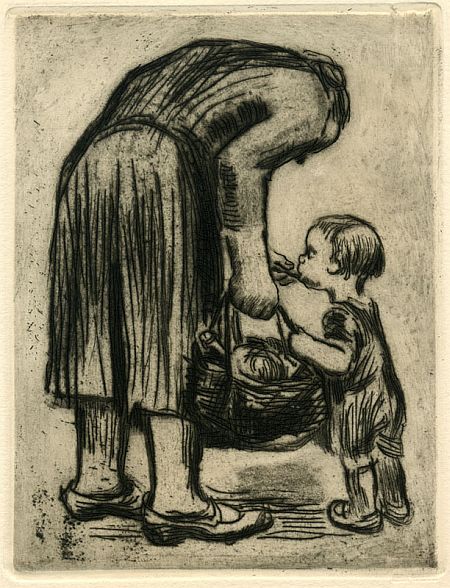
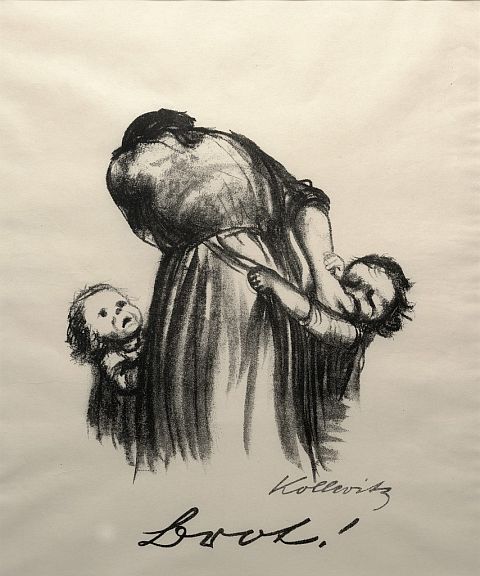
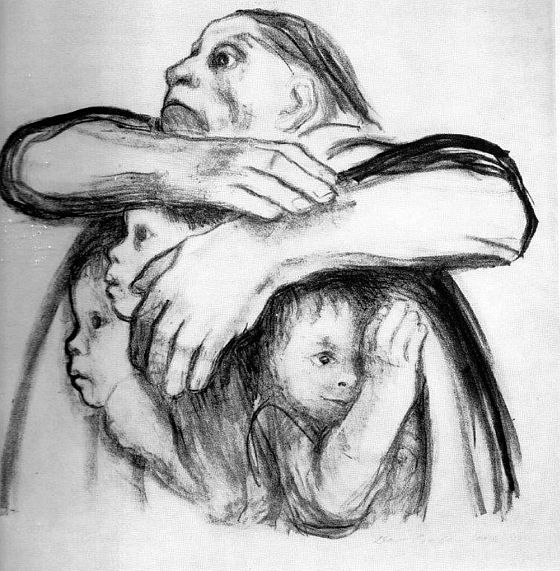
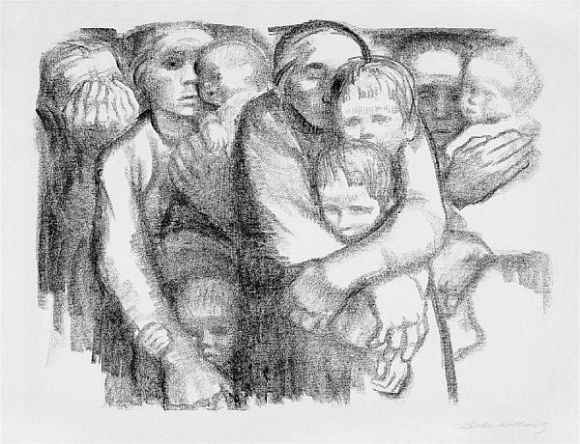
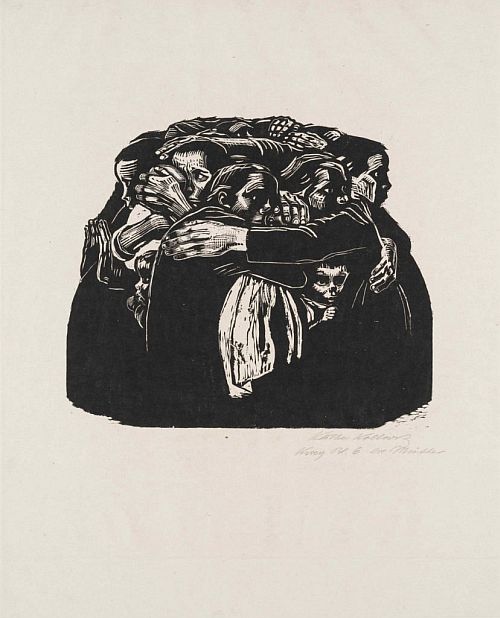
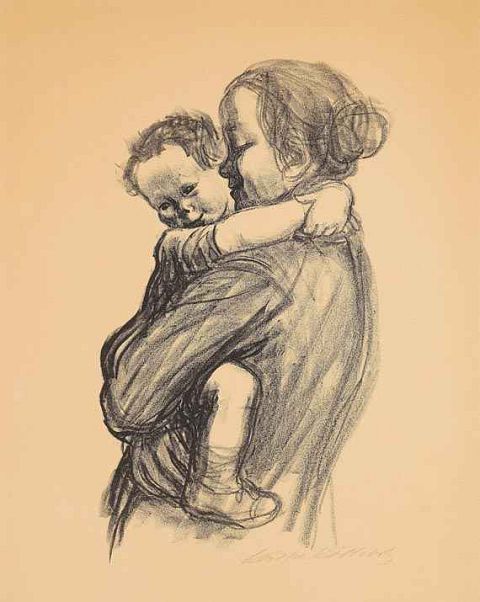
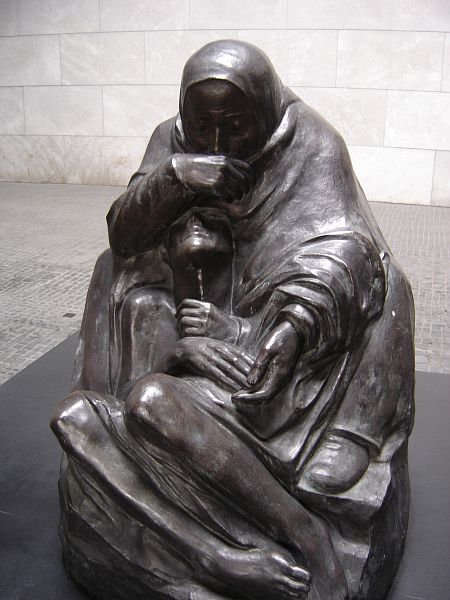
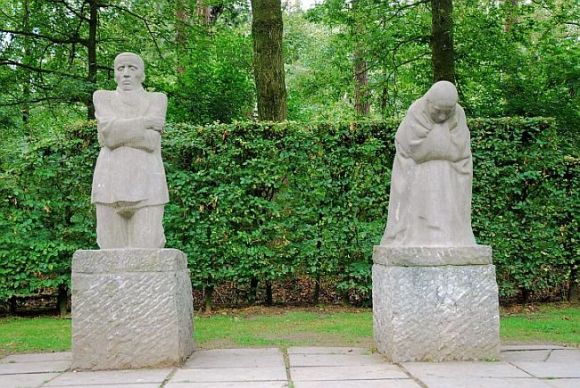
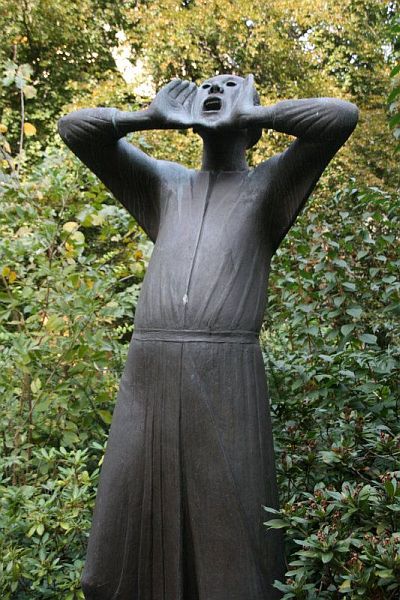
Upon first seeing these paintings by Pierre Paulus I was put in mind once again of the dark and dramatic work of Kaethe Kollwitz (1867-1945) about whom I posted recently. Then the chunky expressive style depicting largely industrial scenes reminded me of Zola’s Germinal which was written between April 1884 and January 1885. The broad lines and dark colours seems well-suited to the scenery of cranes, docks and canals. The dark buildings, however contrast with the white snow-so the expressive aspect is sometimes conveyed through this wintry aspect. Paulus too is a great painter of the intensity of heavy industrialisation-human figures huddled under gigantic mills or stark against Blakean forges. The clip below is enlivened by Puccini’s Madam Butterfly.
Pierre Paulus was born in Châtelet in 1881 into a family of artists. He studied architecture at the Academy of Brussels, where having graduated he dedicated himself to painting, his only true passion. At the age of 15, he already had a considerable mastery of painting. It was not until he was 25 , however, that he became the painter we remember today, the painter of the Black Country, with its industrial and industrialized environments: mines and islets on the banks of the Sambre, steel factories throwing their flames and the background smoke … he also painted nature, people, still life and everyday scenes.
He met the acclaim in 1911 at the Charleroi exhibition of the general public, and his notoriety began to grow. During the First World War, he took refuge in London.
The interwar period was released in Europe and the United States. He devoted his whole life to Expressionism but also to other forms of art such as lithography and posters.
In 1913 he drew the rooster used as the flag of Wallonia. (With thanks to Inesvigo)
Have your ever felt like you’ve
Wanted to be insatiable,
Unobtainable,
Untouchable,
But your wings are glued to your back and
Your tongue is tied by the invisible thread
Binding your words, or
Have you ever felt like screaming your heart out
Lyrically and passionately,
But weren’t able to find the “appropriate” word,
Or the “correct” synonym,
Because I have.
I’ve wanted to be reason I’m awake at night,
The reason I’m haunted by the all the words
Choking my throat,
All those thoughts I’m swallowing, and
All those beliefs trying to claw their way out
In the form of a free verse,
Without being stopped by rhymes,
Or the correct punctuation,
Without being told my sentences can’t
Reach a page they don’t belong to.
I want my words to roam around,
To string themselves into stanzas
Freely,
To lose themselves in the world of passion, And to morph into…
Quand, les deux yeux fermés, en un soir chaud d’automne,
Je respire l’odeur de ton sein chaleureux,
Je vois se dérouler des rivages heureux
Qu’éblouissent les feux d’un soleil monotone ;
Une île paresseuse où la nature donne
Des arbres singuliers et des fruits savoureux ;
Des hommes dont le corps est mince et vigoureux,
Et des femmes dont l’œil par sa franchise étonne.
Guidé par ton odeur vers de charmants climats,
Je vois un port rempli de voiles et de mâts
Encor tout fatigués par la vague marine,
Pendant que le parfum des verts tamariniers,
Qui circule dans l’air et m’enfle la narine,
Se mêle dans mon âme au chant des mariniers.
Ain’t no sunshine when she’s gone
It’s not warm when she’s away
Ain’t no sunshine when she’s gone
And she’s always gone too long…Wonder this time where she’s gone
Wonder if she’s gone to stay
Ain’t no sunshine when she’s gone
And this house just ain’t no home
Anytime she goes away
Wonder this time where she’s gone
Wonder if she’s gone to stay
Ain’t no sunshine when she’s gone
And this house just ain’t no home
Anytime she goes away
This song has been in the background of the Kaffeehaeuser -and I like that term-as I sometimes, in my Walter Mitty manner, like to imagine Penzance as a sort of Vienna. Sometimes the conversation feels as good as that in the heyday of the Cafe Central! As the darkness of twilight looms with the storm clouds and the sense of life’s losses becomes more a melancholy nostalgia. Outside the colours of the sky are glorious and then the song begins with its evocative repetition of the third verse:-
And I know, I know, I know, I know,
I know, I know, I know, I know, I know
I know, I know, I know, I know, I know
I know, I know, I know, I know, I know
I know, I know, I know, I know, I know
I know, I know,
Hey, I oughtta leave young thing alone
But ain’t no sunshine when she’s gone
The only other song that seems to have a similar effect is, of course, Stormy Weather, which once brought tears to my eyes in -banal and bathetic note– Pizza Express in Truro!
Ain’t no sunshine when she’s gone
Only darkness every day
Ain’t no sunshine when she’s gone
And this house just ain’t no home
Anytime she goes away
Anytime she goes away
Anytime she goes away
Anytime she goes away
Although people seem to be unaware of it today, the development of the faculty of attention forms the real object and almost the sole interest of studies. Most school tasks have a certain intrinsic interest as well, but such an interest is secondary. All tasks that really call upon the power of attention are interesting for the same reason and to an almost equal degree. ( On the right use of School Studies with a view to the Love of God)






 penwithlit