Well, I’ve finally finished The Magic Mountain. I’ve been reading it for ages, about 70 pages a week, along with a group at GoodReads. It’s an amazing book.
The plot is actually quite simple. A young man, Hans Castorp, goes to visit his cousin Joachim in an exclusive TB sanatorium in the Swiss Alps, but is diagnosed with the disease himself and ends up staying there for seven years. The sanatorium is a microcosm of European society just before The Great War – which provides Mann with the opportunity to explore an astonishing range of philosophical issues. The novel is often satiric and witty, it bristles with ironies, and there are symbols lurking everywhere. It’s the kind of book you could read many times and still discover something new each time you read it.
But I have only read it once, so I must leave the sophisticated analysis to those who…
Edith Tudor-Hart’s fascinating oeuvre is finally on display in her hometown. The photographer – who died in 1973 – grew up in Vienna but left the city during the 1930s, an explosive time as far as political and sociological developments are concerned.
Her impressive portraits of life in the Austrian capital in the 1930s – street vendors, jobless people and the residents of slums – are currently shown at the Wien Museum. Furthermore, the exhibition “Im Schatten der Diktaturen” (In the Shadow of Tyranny) features images taken in London, Wales and northern England.
Tudor-Hart, who supported communist ideas – was born in 1908. She managed an English doctor and fled to Great Britain in 1933. By using the force of photography, Tudor-Hart decried poverty, injustice and imbalances in society.
The exhibit comes around two years after the Wien Museum – which is located at Karlsplatz square in Vienna – presented…
Théo (Théophile) van Rysselberghe (23 November 1862 – 14 December 1926) was a Belgian neo-impressionist painter, who played a pivotal role in the European art scene at the turn of the century
Peter Mortimore’s thoroughgoing analysis of the absurdities of current educational practice and prescriptions for finding a far better alternative deserves a wide readership. It is not just an organisation which is under siege but as his personal anecdotes indicate, more vigorously than his rigorously argued statistics, people are suffering. Parents are anxious, teachers badly led and burdened with confused policies and worst of all pupils are pressurised from early infancy. Reading his book you might be forgiven for wondering a) why so many young students are being abused by such distress and b) as Cicero might have asked, Cui bono, to whose benefit? Professor Mortimore outlines the positive alternatives suggested by international comparisons especially with Scandinavian methods. He argues that their procedures are more effective, that support students and produce a fairer, harmonious society.
The strengths of our very varied system are examined in a fair minded, respectful and considerate manner. What we can hope to attain from our education system, theories of learning, what we can say about the many and varied aspects of intelligence and ability are all clearly outlined. As the references and citations are particularly clearly laid out, this section would be most useful to first year education students. The open-minded account will invite readers to critically examine his propositions. For instance, some readers might disagree with the emphasis on sport and consider if literature, imagination and the development of critical abilities might not deserve more emphasis. It is difficult though to argue against his case for good modern language teaching and sensible health education. Nor could anyone question the author’s proposition that schools must be enjoyable, encouraging and effective.
Whilst celebrating the rich variety of approaches and methods of schooling, it is not clear that this is best achieved by the plethora of schools in the current system. Studies show pupils unhappy and underperforming. In Mortimore’s very clear and useful chapter on this topic we discover the Grammar Schools, Middle schools, Faith Schools, Voluntary Schools etc. with which many will already be familiar. However, there are also Free Schools, University training schools, Studio schools and lots of even more baroque alternatives. If they are in your area! These naturally are not to be found evenly distributed around the country. There are easily ten different types of Secondary School and in some areas parents have to put down the names of their offspring for private tuition to access, if they can afford it, from the age of three or perhaps move house. How did this come about? Can it possibly help parents or their interaction with their offspring?
Education was once the shared responsibility of teachers, who had the freedom to design courses and exams to help the children in front of them to make progress. Head teachers, Governors, Inspectors and in particular a reasonably funded Local Authority were also included. Over time the Secretary of State for Education has assumed stronger central control. Inspectors were removed and education became subject to the whims and dictates of individual Ministers.
The regulator became Ofsted, whose officers have indeed been accused of bullying their own staff, operating a system which is supposed to be independent and regulate intense competition between schools. In something like 50 years there have been 25 Ministers of Education. The inverted commas apply here because the job description has sometimes included Science, Innovation etc. The ministers have included a number of controversial figures from Hailsham down to Gove but few have had any experience in teaching itself.
Peter Mortimore argues that in Scandinavian countries devolution works effectively. As an experienced statistician, he quotes from careful international research such as PISA that such a mind-set is actually very successful in raising standards as well as promoting a tolerant, socially coherent society. Clearly, this provides economic benefits to these countries. A reader is bound to wonder how in Britain where some 7 per cent of pupils are educated privately, with something like ten times the resources in, for instance, textbooks, is ultimately to prosper. Our system appears to throw up large numbers of pupils that are disaffected, illiterate and mathematically ignorant.
Professor Mortimore has written a propitious summary of educational policy in this country. He joins the line of radical educationalists from the Resistance fighter Harry Rée, to the late lamented Ted Wragg. Without doubt he is passionate about education and indeed, his writing impresses most when he freely airs his formidable reservations about current practice.
Who might benefit from all this mess? Doubtless corporate lobbyists, as before did PFI investors, will hope to prosper from further privatisation of schools? Have the Finns and the Danes really resisted such blandishments? This book provides us with pressing arguments for breaking the siege of greed and imagining and striving for a better future.
Since January, I have been making a concerted effort to read books about Austria–history books, travel books, and the nebulous “general interest” books, all together in a somewhat indiscriminate jumble of Austrian-ness. Now, because my inner scholar/librarian is pushing at me, I’m organizing that jumble into a casual annotated bibliography.
If you are interested in Austrian history and culture, or if you’re thinking about making a trip–here are some books you might want to look at (and a couple you might want to skip).
HISTORY/BIOGRAPHY
The Reluctant Empress: A Biography of Empress Elisabeth of Austria, Brigitte Hamann, trans. Ruth Hein (1986)
Yes, I’ll admit it: I have Sisi fever. If Austria was a novel, Sisi would be my favorite character. She is provoking, even infuriating, but her intelligence and independence make her a fascinating figure. This biography does an excellent job of presenting a balanced portrait of the empress, neither…
I’d like to thank Caroline of Beauty is A Sleeping Cat for picking The Heat of the Day for March’s War and Literature Readalong. Now only has she brought me to London to coincide with a visit IRL but she has also restarted my 20th century challenge. (100 years, 100 books, 100 authors. Full list and progress report here.)
The book is set in war-time London – primarily in 1942, in the quiet time following the Blitz of 1940 and the smaller one of 1944. Stella, a well-heeled lady has been enjoying her love affair with Robert for two years. They are comfortable; they have not married and are happy to live separate lives outside the time they spend together. Stella’s piece-of-mind is disturbed, however, with the appearance of Harrison and his claims that Robert is a spy. He lets Stella know that, for a price, he won’t turn…
Bientôt nous plongerons dans les froides ténèbres;
Adieu, vive clarté de nos étés trop courts!
J’entends déjà tomber avec des chocs funèbres
Le bois retentissant sur le pavé des cours.
Tout l’hiver va rentrer dans mon être: colère,
Haine, frissons, horreur, labeur dur et forcé,
Et, comme le soleil dans son enfer polaire,
Mon coeur ne sera plus qu’un bloc rouge et glacé.
J’écoute en frémissant chaque bûche qui tombe
L’échafaud qu’on bâtit n’a pas d’écho plus sourd.
Mon esprit est pareil à la tour qui succombe
Sous les coups du bélier infatigable et lourd.
II me semble, bercé par ce choc monotone,
Qu’on cloue en grande hâte un cercueil quelque part.
Pour qui? — C’était hier l’été; voici l’automne!
Ce bruit mystérieux sonne comme un départ.
II
J’aime de vos longs yeux la lumière verdâtre,
Douce beauté, mais tout aujourd’hui m’est amer,
Et rien, ni votre amour, ni le boudoir, ni l’âtre,
Ne me vaut le soleil rayonnant sur la mer.
Et pourtant aimez-moi, tendre coeur! soyez mère,
Même pour un ingrat, même pour un méchant;
Amante ou soeur, soyez la douceur éphémère
D’un glorieux automne ou d’un soleil couchant.
Courte tâche! La tombe attend; elle est avide!
Ah! laissez-moi, mon front posé sur vos genoux,
Goûter, en regrettant l’été blanc et torride,
De l’arrière-saison le rayon jaune et doux!
— Charles Baudelaire
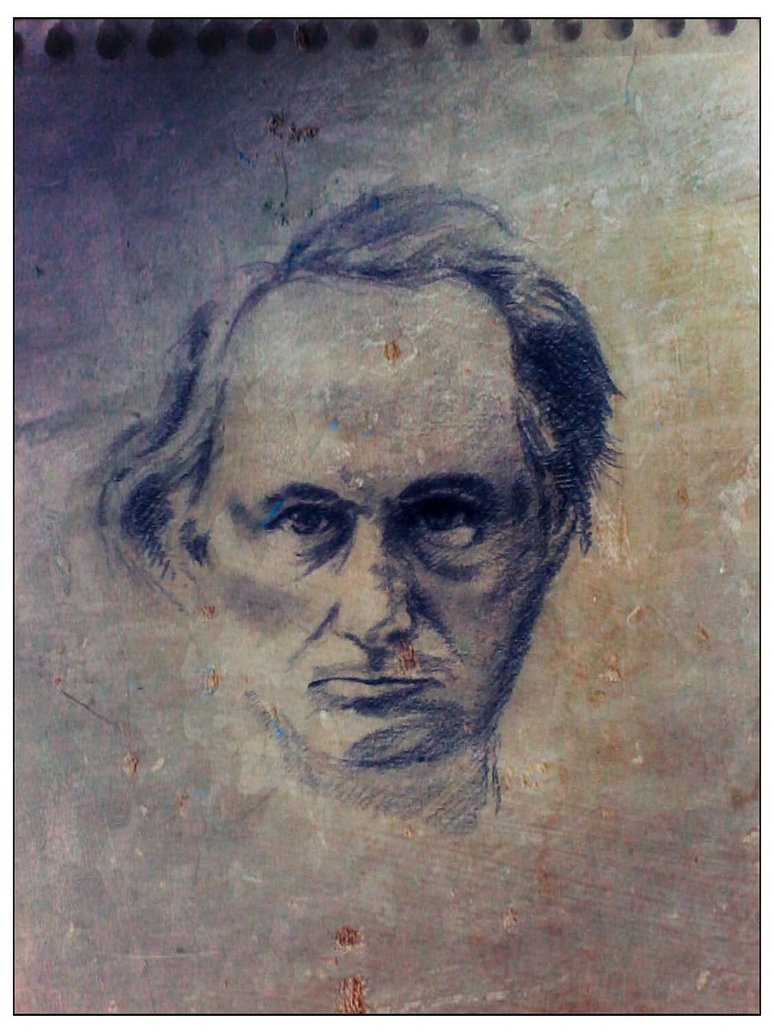
Charles Baudelaire_ by_Piccola Braci
I
Soon shall we plunge ‘neath winter’s icy pall;
farewell, bright fires of too-brief July!
even now I hear the knell funereal
of falling fire-logs in the court close by.
once more on me shall winter all unroll:
wrath, hatred, shivering dread, Toil’s cursèd vise,
and like the sun in his far hell, the pole,
my heart shall be a block of crimson ice.
I wait aghast each loud impending log;
thus, criminals ‘neath rising gibbets cower.
o dreadful battering-ram! my soul, agog,
quivers and totters like a crumbling tower,
till to my dream the cradling echoes drum
like hammers madly finishing a bier.
— for whom? — June yesterday; now fall is come!
mysterious dirge, who has departed here?
II
I love your long green eyes of slumberous fire,
my sweet, but now all things are gall to me,
and naught, your room, your hearth nor your desire
is worth the sunlight shimmering on the sea.
yet love me, tender heart! a mother be
even to an ingrate, or a wicked one;
mistress or sister, be as sweet to me
as some brief autumn or a setting sun.
’twill not be long! the hungering tomb awaits!
ah! let me — brow at peace upon your knees —
savour, regretful of June’s parching heats,
this balmy soft October, ere it flees!
— Lewis Piaget Shanks, Flowers of Evil (New York: Ives Washburn, 1931)
Bald wird man uns ins kalte dunkel flössen ·
Fort! schöner sommer der so kurz nur währt!
Schon hör ich wie mit unheilvollen stössen
Das holz erdröhnend auf das pflaster fährt.
5
Der ganze winter dringt in mich: bedrängnis
Hass zorn und schauder und erzwungner fleiss.
Der sonne gleicht im nordischen gefängnis
Mein herz · ein roter block und starr wie eis.
Ich höre zitternd jeden ast der schüttelt –
10
Ein grabgerüst giebt keinen dumpfern hall –
Und an dem turme meines geistes rüttelt
Des unermüdlich harten widders prall.
Es scheint mir von dem hohlen lärm umgeben
Dass man in einen sarg die nägel haut …
15
Für wen? gestern war sommer · herbst ist eben ·
Wie abschied klingt der rätselhafte laut.
Ich liebe deiner augen grünen schimmer ·
Du sanfte · doch nur bittres fühl ich heut ·
Nicht deine liebe nicht kamin und zimmer
20
Ersezt das sonnenlicht aufs meer verstreut.
Und dennoch · zarte seele · lieb und hüte
Auch den der undankbar mit bösem drang ·
Geliebte · schwester! sei die flüchtge güte
Von herbstesglanz und sonnenuntergang!
25
Ein kurzes werk … das grab ist gierig lauernd.
Ach ich will knieend dir zu füssen sein ·
Des weissen dürren sommers flucht bedauernd

 Well, I’ve finally finished The Magic Mountain. I’ve been reading it for ages, about 70 pages a week, along with a group at GoodReads. It’s an amazing book.



 penwithlit