Categories
Art and Photographic History German Matters Literature Penwith

Thoughts on history in the making

We seem currently to be going through a period of iconoclasm which has an interesting history itself. One of my favourite plays is “Forty Years On” by Alan Bennett. It often seems to me that British, and particularly English, society resembles some sort of minor public school. Hence I can easily hear John Gielgud intoning Ecclesiastes 44-1:-

Let us now praise famous men, and our fathers that begat us. 2The Lord hath wrought great glory by them through his great power from the beginning. 3Such as did bear rule in their kingdoms, men renowned for their power, giving counsel by their understanding, and declaring prophecies: 4Leaders of the people by their counsels, and by their knowledge of learning meet for the people, wise and eloquent are their instructions.

Now, when I googled this a moment ago, I discovered that the first six words of the title refers to a book written some 75 years ago by Agee and Evans with photographs of tenant farmers and their dreadful plight in the depression. The verse from Ecclesiastes was obscured and immediately raises the question about how the meaning of the past can be changed or indeed obscured. It also raises the questions about for whom history might be written, recorded or commemorated.

However, before examining the text, consider the last sentence….” meet For the people, WISE and ELOQUENT are their instructions”. Well it would be nice if the present incumbents of the senior management team were wise and concerned for the people and by no means can the repetitive bumbling be described as eloquence.

(Incidentally, I remember hearing that controversial Cornishman D.M. Thomas remarking once that we had moved from reading Isaiah to watching dire television in two generations!)

Now before we start praising famous men, let alone building statues to them, we also need to consider women and children. The statue which really brought pimples to the skin and still does was near the Friedrichstrasse in Berlin which shows those children going to the West in the Kindertransport and those from whom they have been sundered, facing the death camps in the East. Then, also very moving is the statue by Kathe Kollwitz. This sculpture is under an oculus and exposed to the rain, snow and cold symbolising the suffering of civilians during World War II. It is a pieta- a woman with her dead child. She had lost her son, Peter on the battlefield in the First World War.

At this point I should like to recommend a book and close with a couple of quotations which I think are worth pondering. The book is by Rachel Hewitt and is called “A Revolution in Feeling” It deals with the changes of feelings during the 1790s. To quote from the dust jacket;” Every society in every age, feels differently, and from the seismic shifts of the 1790s Britain emerged the contours of our contemporary attitude to need, longing and emotion”.

Now from that complex but original thinker Walter Benjamin, This is how one pictures the angel of history. His face is turned toward the past. Where we perceive a chain of events, he sees one single catastrophe which keeps piling wreckage upon wreckage and hurls it in front of his feet. The angel would like to stay, awaken the dead, and make whole what has been smashed. But a storm is blowing in from Paradise; it has got caught in his wings with such violence that the angel can no longer close them. This storm irresistibly propels him into the future to which his back is turned, while the pile of debris before him grows skyward. This storm is what we call progress.

WALTER BENJAMIN, Theses on the Philosophy of History

Here we return to eloquence again, a reminder that style in historical writers engage our interest from Hazlitt-

The history of mankind is a romance, a mask, a tragedy, constructed upon the principles of POETICAL JUSTICE; it is a noble or royal hunt, in which what is sport to the few is death to the many, and in which the spectators halloo and encourage the strong to set upon the weak, and cry havoc in the chase, though they do not share in the spoil.

WILLIAM HAZLITT, Characters of Shakespeare’s Plays

Finally

Finally, I listened to a radio programme last night about refugees in camps across the Channel in France desperate to escape persecution and many of them, children in conditions cramped as in a slave ship. What are we going to do to alleviate their situation?

When German trains saved Jewish kids - EXBERLINER.com

Käthe Kollwitz's sculpture 'Mother with her Dead Son', Neue Wache ...

Notes

On Iconoclasm https://en.wikipedia.org/wiki/Byzantine_Iconoclasm

There may be elements of magical thinking in relation to monuments as clearly their destruction does not entail the erasure of the past or the racist structures still in existence. It might be argued that in their removal they can become instrumental towards that aim. Some may also consider that they are works of art which raises further questions about aesthetics – content and form etc.


Categories
Literature Penwith Poetry St Ives West Cornwall (and local history)

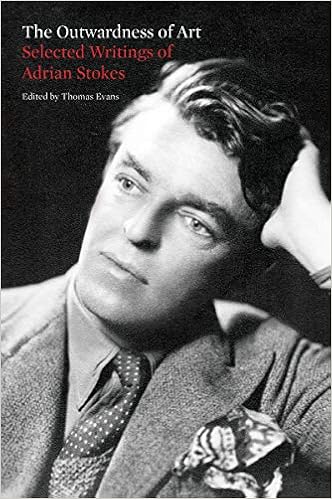
West Penwith by Adrian Stokes

This poem interests me and looks fairly simple – let us  consider one or two lines and see if we can explore some more deeply. Indeed, this is a poem about surfaces and depth with a number of words that suggest rest- abolish pace, slow, apart and torpor. There is too a general feeling for sculpture as is expressed in his remarks about stone and it’s weathering or erosion by water. Details about Stokes may be found at his Wikipedia entry where it states about his early writing;” In The Quattro Cento he characterized the intense Early Renaissance feeling for material and space as ‘mass-effect’ and ‘stone-blossom’. The stone—deeply respected as a medium – is, he said, ‘carved to flower’ thereby bringing to the surface the fantasies the artist reads in its depths.” Let us continue to dig beneath the surface of these lines.

There seems to be a general feeling of relief perhaps reflecting Stokes returning to Cornwall. The lines about outhouses and stone retrace unmeagre time seems somewhat demanding. Does this mean that such structures seem and suggest aeons of time? Meagre is a synonym for sparse. So this may mean that the scene implies the extensive nature of time. As Stokes studied philosophy, then it is quite possible that some sort of Bergsonian concept of time.{See https://www.bbc.co.uk/programmes/m0004s9w }

In the next line herd is somewhat unusual- maybe the light from the shining mica in the granite is being collected by the eye. It also is a homophone for heard which brings a whimsical feeling of  synaesthesia together with the metal clang of time colliding with rhyme. In the next stanza there is hoard and heart which may be associated with the unusual word hurd, the coarse parts of flax or hemp that adhere to the fiber after it is separated. — called also hards. This sounds very much like the Golden Fleece and adds to the reference to the early Cornish tinners. A milksop is a person who is indecisive and lacks courage. Milksop can be a piece of bread dipped in milk. The flower might mean a milkwort  or just a general term for any flower in a field which may have cows in it!

Cow Dairy Happy Stock Photos - Download 2,051 Royalty Free Photos

The word also brings to mind that Stokes was deeply interested in psychoanalysis and was in fact an analysand of Melanie Klein whose work focused around infantile phantasy at the breast. He was also a friend of Barbara Hepworth whom he brought to St Ives where he lived near The Cornish Arms pub with his wife Margaret Mellis, The feelings of support, skin texture and associated tactile imagery come out in the second section where closeness is increased by the use of our. This underlying emotion of support and nursing passivity brings to an end this interesting poem.

The background about Adrian Stokes and his leading contribution to modernism in St Ives may be found at https://www.stivesart.info/lyrical-light/

A useful discussion on Margaret Mellis is at http://www.artcornwall.org/interviews/Margaret_mellis.htm

The Outwardness of Art: Selected Writings of Adrian Stokes: Amazon ...


Categories
Art and Photographic History Art Exhibition Reviews Penwith St Ives West Cornwall (and local history)

Harry Ousey-Neglected Colourist amongst the St Ives Artists


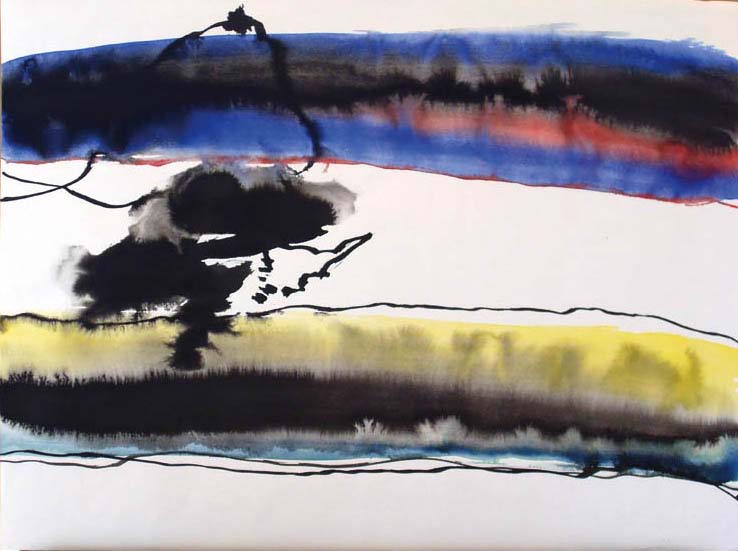
Very recently I attended an intriguing talk by Sue Astles, Ousey’s neice about this little known Northern  Artist. I found myself wondering just how such a brilliant colourist could seemingly be rather overlooked. Further information and background can be found at

https://www.lancashirelife.co.uk/out-about/harry-ousey-exhibition-at-the-salford-museum-and-art-gallery-1-4082392

and at https://en.wikipedia.org/wiki/Harry_Ousey

There are two possible factors which one might surmise for this aberration. Firstly, it seems that his interest in experimenting in so many various styles may have mitigated his being recognised for any definite style. His restless interest in both conventional and abstract work is not difficult to recognise. There is a certain interest in certain themes such as stone wall construction and the sea horizon. Certain influences seem to be lurking in the background from Miro, Dufy and perhaps Rothko. However, the multiplicity of his painting styles, doubtless including original work, could have inhibited proper recognition.

Such recognition might have been easier if he had access to gallery display. My second point is that I surmise that the influence of more recognised and prominent figures in the St Ives nexus made this difficult. Artists like Denis Mitchell and Terry Frost would have understood this. There was a social class barrier to surmount and I am fairly sure this is a pressure that a less wealthy northern painter would have encountered this even in the more enlightened postwar period. A glass ceiling even amongst progressives and bohemians!

Image result for harry ousey artist

Image result for harry ousey artist

Ousey’s later interest in environmental compositions reminded me also of the not dissimilar work of Margaret Mellis. (Not to be confused on grounds of alliteration with the abstract Penwith artist Marlow Moss!)


Categories
Art and Photographic History Penwith St Ives West Cornwall (and local history)

St Ives in the 1950s as portrayed by Hyman Segal

This uniquely illustrated pamphlet of around 20 pages offers a brilliant summary of life in St Ives just after the War. The town’s Silver Age it might be termed. This fascinating time period is manifest in the vivid sketches by the well-known St Ives artist, Hyman Segal. https://cornwallartists.org/cornwall-artists/hyman-segal   

Segal is probably best remembered for his African paintings as well as for his skill in portraying cats with sweeping economical lines. A Daily Mirror photographic  frontispiece shows him, an Art Therapist at West Cornwall Hospital, helping the recovery of a young lad at Tehidy Sanatorium in Camborne. This classic photograph by Bela Zola indicates the pride in the newly created NHS.{Zola was a leading photographer who recorded later the Aberfan Disaster and the profumo Affair among other renowned assignments.) https://www.worldpressphoto.org/collection/photo/1956/28663/1/1956-Bela-Zola-GN1-(1)

The first sketch in the pamphlet is of our celebrated Town Crier, Abraham Curnow -here just 54 years old. This is accompanied by a sketch of his Father-in-Law, Ernest James Stevens, popularly known as “Jimmy Limpets”. This drawing with others by Segal now hangs in the Sloop Inn.

On the following page is an image of Thomas Tonkin Prynne who had been the manager of Lanham’s picture framing business which in previous years  supplied the Royal Academy and other galleries with canvases by inter alia , Julius Olsen, Louis Grier and Moffat Linder. In addition to running an efficient business, he worked for 16 years as a member of the volunteer fire brigade, had a blue Persian cat and loved fishing.


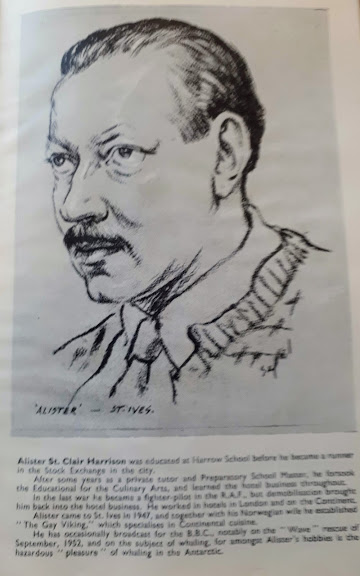
There is also a magnificent sketch of Alistair St Clair Harrison, like Churchill, an old Harovian who had been a fighter pilot during the Second World War. It was Harrison who broadcst for the BBC about the rescue of HMS Wave in September 1952 and also about his interest in Antartic whaling. It was with his Norwegian wife that he established “The Gay Viking”;almost as famous for its colourful clientele as its innovative continental cuisine. ( Gay Viking was incidentally one of eight vessels that were ordered by the Turkish Navy, but were requisitioned by the Royal Navy to serve with Coastal Forces during the Second World War)

Alistair St Clair Harrison by Hyman Segal

Frank Edward Endell Mitchell, appropriately portrayed with bow-tie, fashionable in the 1950s, was known as “Micheal” and was the tenant of the Castle Inn. His friendship with Dylan Thomas must have been firmly established in the bohemian atmosphere of the bar there, then opposite Lanham’s and the Scala Cinema (presently Boots). Mitchell who was the brother, I believe of the eminent sculptor, Denis Mitchell, offered the Castle lounge for the display of art works and in his spare time, he himself did pastels and was occupied in breeding Boxer dogs.

The donation of this little pamphlet to the Morrab Archive offers members the opportunity to recreate for themselves the ambience of the Fifties through “The Familiar Faces of  St Ives”.


Categories
Penwith St Ives West Cornwall (and local history)

Coming soon- “Growing up in West Cornwall”

Coming soon

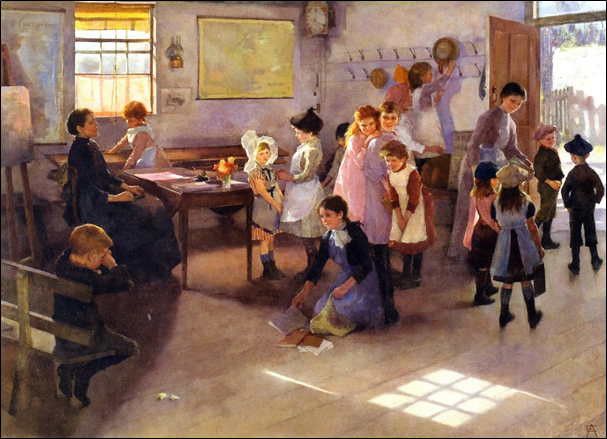
Complementing our previous title, Women of West Cornwall (ed. Pam Lomax, 2016), Growing up in West Cornwall describes the experience of childhood in West Cornwall, from the seventeenth century onwards. It documents childhood memories, mostly from the early years of the Twentieth Century, set in the context of institutions that structured the children’s lives – the village schools and the workhouse. The recollections captured here deal with schooldays, holidays, home life (sometimes when the father has gone mining overseas, or when the parents are busy Newlyn artists);  and starting work, as an undertaker’s apprentice in a spooky situation or a cabin boy preparing meals for the crew. How many of us regret that we did not ask our grandparents more about their childhood? This book helps us to understand how it felt to be a child in West Cornwall in the very different world in earlier centuries. Family historians will welcome the surname index.


The main chapters:

Chapter 1 Clifford Harry’s Recollections of Carnyorth Schooldays 1908 -1916 (Carlene Harry)

Chapter 2 The Decline and Fall of the Village School in Lamorna (Sally Corbet)

Chapter 3 St Erth Wesleyan Day School 1900-1922 (Cedric Appleby)

Chapter 4 Memories of a Mousehole Childhood (Susan Soyinka)

Chapter 5 Young People of Zennor 1600-1750 (Jean Nankervis)

Chapter 6 Children of the State (Sue Nebesnuick)

Chapter 7 The Artists’ Child (Pam Lomax)

Chapter 8 Word of Mouth (Jenny Dearlove)


Shorter articles:

Children’s Books (Dawn Walker)

Pamela Smart remembers (Caroline Baker)

Children’s Toys (Dawn Walker)

Jean Mitchell remembers (Dawn Walker)

May Day Celebrations (Carlene Harry)

George Care remembers (George Care)

Bad Boys up the Rec (Linda Camidge)

The eleventh publication of the Penwith Local History Group

100 pages, A4, illustrated throughout in colour and black and white

Published July 2019

Editor Sally Corbet

ISBN 978-0-9954940-1-5

RRP £10 from local bookshops, Morrab Library, Penzance, or from the Penwith Local History Group

Here is one old tradition that used to take place at Man’s Head the other side of Porthmere from the Island in St Ives


Categories
Art and Photographic History German Matters Literature Penwith West Cornwall (and local history)

Der September-Kästner

“Der September

Das ist ein Abschied mit Standarten
aus Pflaumenblau und Apfelgrün.
Goldlack und Astern flaggt der Garten,
und tausend Königskerzen glühn.

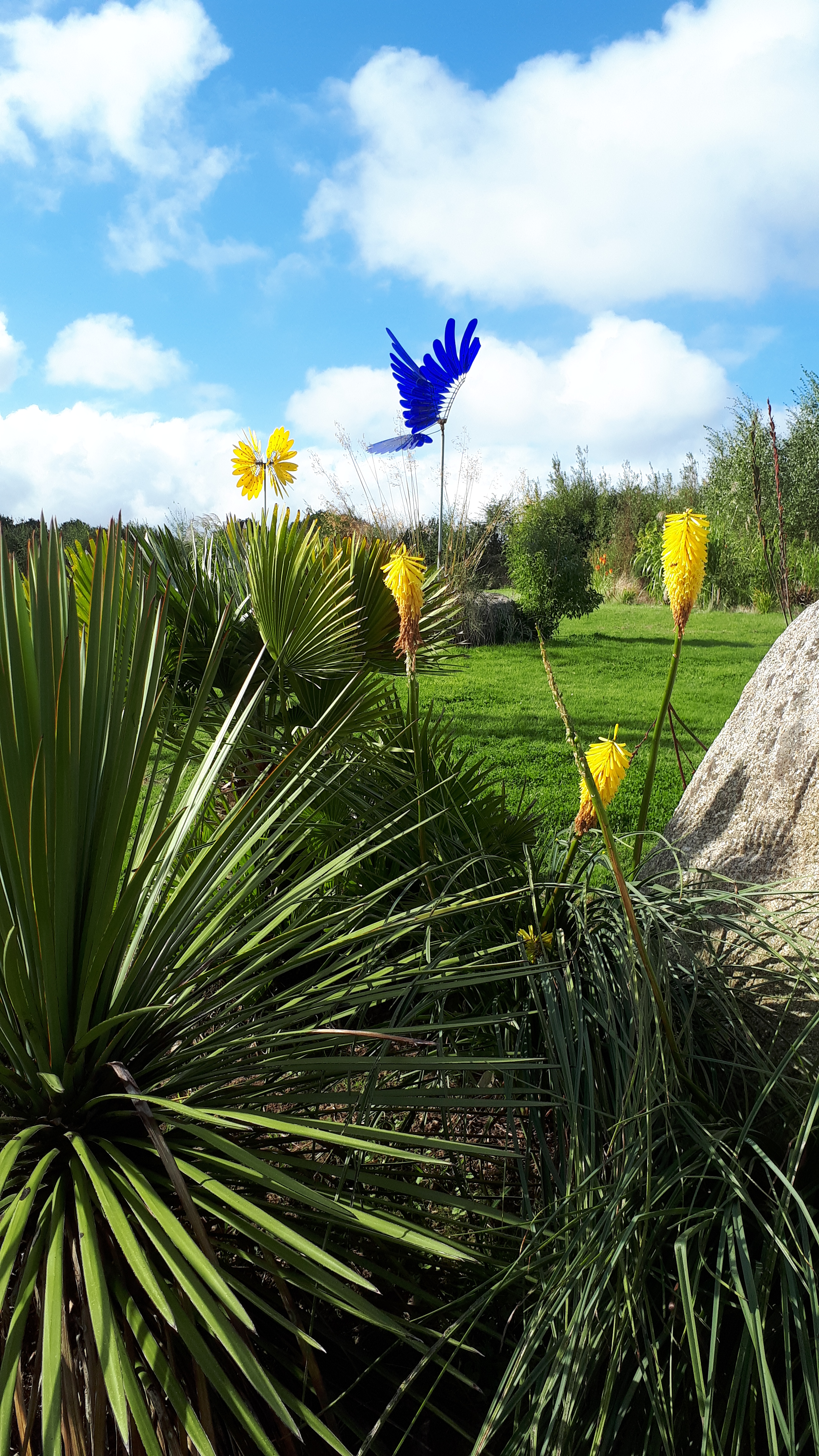
Winsculpture-Tremenheere- September 2018

Das ist ein Abschied mit Posaunen,
mit Erntedank und Bauernball.
Kuhglockenläutend ziehn die braunen
und bunten Herden in den Stall.

Das ist ein Abschied mit Gerüchen
aus einer fast vergessenen Welt.
Mus und Gelee kocht in den Küchen.
Kartoffelfeuer qualmt im Feld.

Das ist ein Abschied mit Getümmel,
mit Huhn am Spieß und Bier im Krug.
Luftschaukeln möchten in den Himmel.
Doch sind sie wohl nicht fromm genug.

Die Stare gehen auf die Reise.
Altweibersommer weht im Wind.
Das ist ein Abschied laut und leise.
Die Karussells drehn sich im Kreise.
Und was vorüber schien, beginnt.”

(Aus: Kästner, DIE DREIZEHN MONATE)

Well here is a rough translation by a good friend.
It´s September

This is a farewell with flags
coloured plum-blue and apple-green.
The garden is flagging wallflowers and asters,
and thousand mulleins glow.

This is a farewell with trombones,
with guldize and farmers´ ball.
Tolling their cowbells the brown
and colourful herds are stable bound.

This is a farewell with scents
of a long forlorn world.
Jams and Jellies simmer in the kitchens.
Potato fire smoulders in the field.

This is a farewell with turmoil,
with chicken on skewer and beer in jug.
Swingboats want to go to heaven
But they might not be piously enough.

The starlings start their journey.
Gossamer waves in the wind.
This is farewell noisy and gentle.
The merry-go-rounds are spinning in circles.
And what seemed past, starts.

Categories
Penwith Poetry St Ives West Cornwall (and local history)

Four Old Photographs from St Ives

Here is my Mother’s Aunt Vera

as though for a test on the screen

like a Hollywood Star, pure smile;

happy, serene, genteel like a heroine-

war survivor, positively engaged

with the future a dream.


Turning the page where a collection

of ladies, mostly hatted with one man

wait on the wharf for Crimson Tours to bring the charabanc.

One lady, in control, in the centre

banters with the photographer, another

has her back turned as the shutter clicks.


The next, a street party, circa 1960

or before, all festive with my mother

looking happy serving a group of pensioners

who look like they are reliving a Sunday School band-tea.

Everyone wears hats and there is a lovely bunch of flowers,

one lady glowers, a man has his customary

goofy smile and there are delivered milk in bottles

unlikely to be stolen on the step behind.


By 1970 the future seems to be arriving more suddenly,

when standing with camera on the end of the quay,

and almost unbelievably four or five

ducks carry a squadron of marines

into the harbour. What have we done

to be thus invaded? History approaches

us on a stormy day and I bury my chin

into my duffel coat.


Categories
Literature Penwith Poetry St Ives

Modryb Marya, or Aunt Mary

We always had a holly tree at Christmas decorated with fairy lights in little copper lanterns made by my Father. These contained rice paper to diffuse the light and the same rice paper was used as a base for the coconut macaroons that my Mother made as part of the preparations for Christmas.

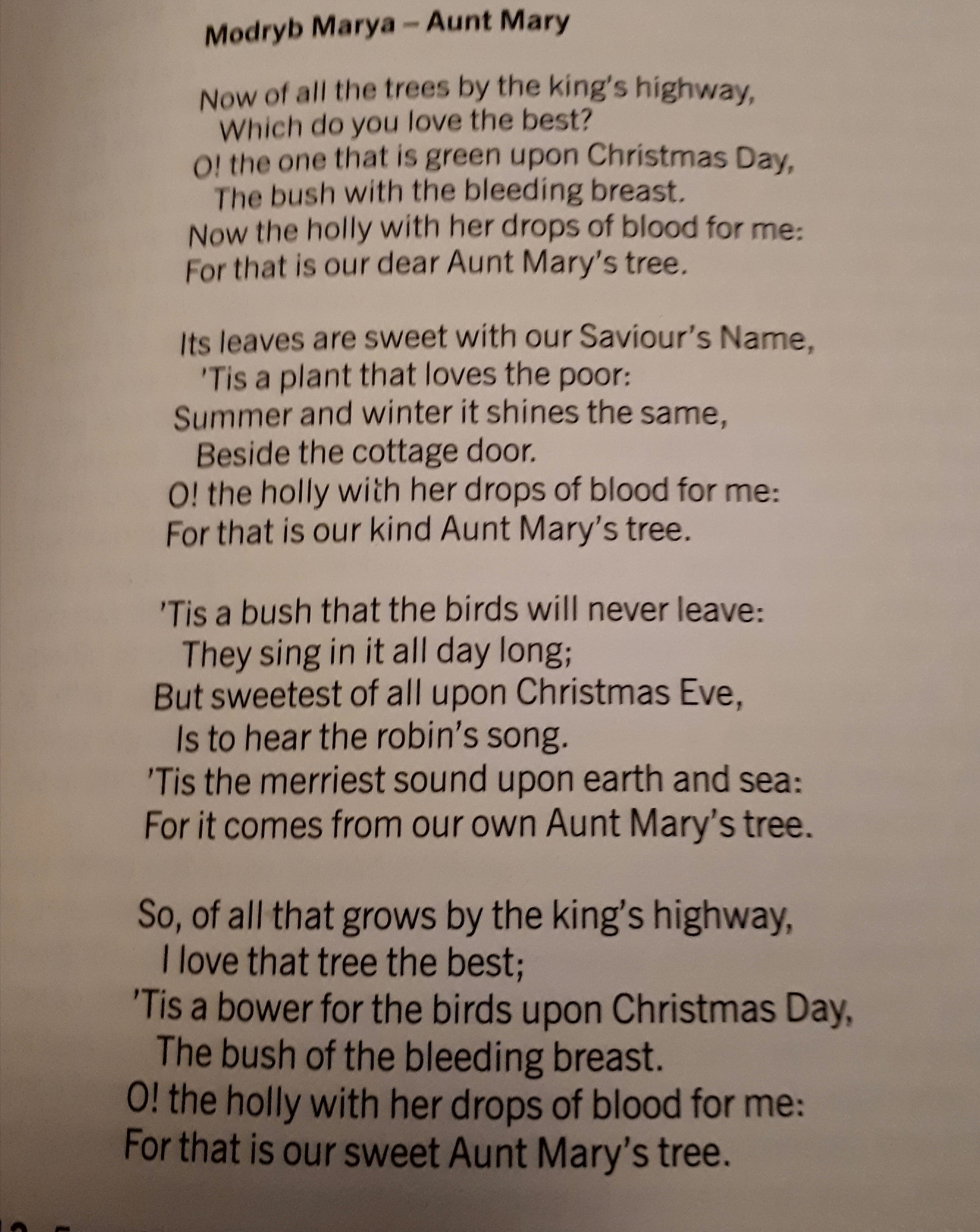
The Holly Tree is referred to in this beautiful poem by R.S.Hawker.

Image result for Holly tree

There is a little more information at https://rpo.library.utoronto.ca/poems/modryb-marya-aunt-mary

Categories
Art and Photographic History Penwith Uncategorized West Cornwall (and local history)

French Folk Music from America

Listening to tracks on You Tube I came across two groups who were entirely new to me but both of which I found appealing:-

First – Reina del Cid

Secondly – The Avalon Jazz Band

From a Jazz Day at Trerife (Near Penzance)

Jazzman August 2006


Categories
Penwith Uncategorized West Cornwall (and local history)

No Sunshine when She’s gone-Bill Withers

Ain’t no sunshine when she’s gone
It’s not warm when she’s away
Ain’t no sunshine when she’s gone
And she’s always gone too long…Wonder this time where she’s gone
Wonder if she’s gone to stay
Ain’t no sunshine when she’s gone
And this house just ain’t no home
Anytime she goes away

Wonder this time where she’s gone
Wonder if she’s gone to stay
Ain’t no sunshine when she’s gone
And this house just ain’t no home
Anytime she goes away

This song has been in the background of the Kaffeehaeuser -and I like that term-as I sometimes, in my Walter Mitty manner, like to imagine Penzance as a sort of Vienna. Sometimes the conversation feels as good as that in the heyday of the Cafe Central! As the darkness of twilight looms with the storm clouds and the sense of life’s losses becomes more a melancholy nostalgia. Outside the colours of the sky are glorious and then the song begins with its evocative repetition of the third verse:-

And I know, I know, I know, I know,
I know, I know, I know, I know, I know
I know, I know,
Hey, I oughtta leave young thing alone
But ain’t no sunshine when she’s gone

The only other song that seems to have a similar effect is, of course, Stormy Weather, which once brought tears to my eyes in -banal  and bathetic note– Pizza Express in Truro! 

Ain’t no sunshine when she’s gone
Only darkness every day
Ain’t no sunshine when she’s gone
And this house just ain’t no home
Anytime she goes away

The song is so popular that there is naturally a detailed note about its origins back in 1971 on https://en.wikipedia.org/wiki/Ain%27t_No_Sunshine

Image result for storms in St Ives