I have been perusing in a somewhat feckless manner an introductory chapter in Blake Morrison’s carefully written “The Movement” subtitled, English Poetry and Fiction of the 1950s. Here he mentions a poem about Plymouth by Philip Larkin which begins-
A box of teak, a box of sandalwood,
A brass-ringed spyglass in a case,
A coin, leaf thin with many polishings,
(Collected poems page 166)
This appears to be an early poem which concludes with a stanza that explains in which Larkin says of his intentions for his poetry……
Let my hands find such symbols, that can be
Unnoticed in the casual light of day,
Lying in wait for half a century
To split chance lives across, that had not dreamed
Such coasts had echoed, or such seabirds had screamed.
Now when today mourning takes place with great pomp and ceremony it is somewhat salutary to turn to Keith Douglas killed fighting in the Second World War, admired by Movement poets, and his splendid and sparse poem-
If I should go away, Beloved, do not say ‘He has forgotten me’. For you abide, A singing rib within my dreaming side; You always stay. And in the mad tormented valley Where blood and hunger rally And Death the wild beast is uncaught, untamed, Our soul withstands the terror And has its quiet honour Among the glittering stars your voices named.
Alun Lewis is a poet whose writing is associated with the Second World War in which he died in Burma in 1944. It is then naturally a poetry of partings, separation and yet shows the tenderness which is expressed in the poem above. See also https://allpoetry.com/Alun-Lewis
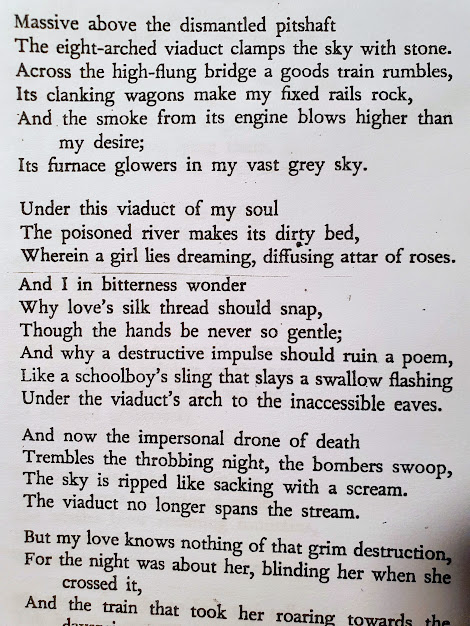
However, it is the following lines which grasped my attention and which are shown here from a poem called Destruction:-
In this intriguing passage, the viaduct arches feels like an image, perhaps from a dream suggesting transportation, crossing a gulf as well as the industrial Welsh scenery which it also evokes. The polluted river contrasts remarkably with the dreaming girl. I discover that attar of roses, also called otto of rose, essence of rose, or rose oil, fragrant, colourless or pale-yellow liquid is an essential oil distilled from fresh petals. This is followed by a striking consideration of the fragility of the poet’s writing and how it can be affected by the sudden hostility of his own feelings- the destructive feelings which he acknowledges. This too is beautifully expressed in a line of tragic s sounds- “Like a schoolboy’s sling that slays a swallow.” A swallow that might be otherwise be free to rise to otherwise unreachable places. Lewis goes on to compare this to the devastation of war with words that must remind a contemporary reader of the current conflict in Ukraine-“the impersonal drone of death Trembles the throbbing night” so that possible connection is broken as the viaduct is destroyed.
This link for what is possibly Alun Lewis’s most famous poem is also worth exploring:-
the new LG TV with its True Voice advanced technology.
The channel didn’t matter, what we cared about was clarity
and pitch, the digital dialling down
of background noise, homing in on the frequency
of the newsreader’s voice: far off famine
wars, a politician sacked, another
celebrity whose phone was hacked. We sat
in the sweet spot, the speakers concentrating
sound
I tend to collect books of poetry and poetry magazines and came across the above poem which I have not copied in full in the Poetry Review Volume 101:2 Summer 2011 This edition was subtitled The New Political Poetry and inside Dautch has written a letter to Emily Dickinson in which she writes about the Talmudic tradition in which contradictory truths are allowed to co-exist. and also about doubt in contradistinction, she says to a Western Tradition that emphasises single truths or epiphanies. This seems apparent too in the first section of the poem -or perhaps prose poem quoted above.
As is widely known Friday evenings in Jewish families constitute the advent of Shabbat and the poem has a certain cosiness, one might say Gemutlich quality about it. Yet also there exists a troubled contrast between the technical sound quality and the dreadful news on the radio which has been arbitrarily chosen. In the remainder of the poem, there is a concern shown about the intensity of the experience becoming overwhelming.
All that evening, as we transformed secular time into Shabbat, everything seemed heightened: the candles, bread, wine, vibrating; each molecule its own distinct, sacred, world.
There are several ways of looking at this feeling. Psychologically Melanie Klein might refer to feelings of envy overwhelming what on a deep level might represent the maternal perfect breast. This state also reminds me of certain lines from the beautiful hymn by W.Chalmers Smith (1824-1908) Immortal, Invisible, God only wise–
Great Father of glory, pure Father of light.
Thine angels adore thee, all veiling their sight;
All laud we would render:O help us to see
Tis only the splendour of light hideth thee.
and in the next verse-
Immortal, invisible, God only wise,
In light inaccesssible hid from our eyes
…..and in this poem, of course, our ears as well although the background sound of snow shuffling down the roof paradoxically helps the evening feel complete. Reading Col Toibin’s book Mad, Bad, Dangerous to Know just yesterday on W.B.Yeat’s artist’s father and the concept of the gaze, I came across the former’s well known poem about the Second Coming-
A shape with lion body and the head of a man,
A gaze blank and pitiless as the sun…
In any event Aviva Dautch is worthy of future consideration and here is a discussion on displacement, migration and exile in which she takes part:-
Through the heat of the day it did nothing but fidget and whine,
Now it snuffles under the dew and the cold star-shine,
And lies across my heart heavy as lead,
Heavy as the dead.
This beautiful poem by STW is another poem about the flight of refugees. It almost certainly relates to the civilian escape from Paris as it fell in 1940, It conveys both the weariness and the worry of a woman escaping with a child who is not her own and unfortunately there must be many such examples of such experiences among refugees from Ukraine at the present time. The next lines reveal that the story is being reported by an observer.
Why did I lift it, she said,
Out of its cradle in the wheel-tracks?
On the dusty road burdens have melted like wax,
Soldiers have thrown down their rifles, misers slipped their packs:
Yes, and the woman who left it there has sped
With a lighter tread.
The poem continues to discuss the rescuers ambivalence towards the child being rescued. there are echoes of the Scriptural verses of Matthew 24:19 –
And woe unto them that are with child and to them that give suck in those days!
and also of Mark 13:17
Townsend-Warner finishes with these poignant lines which might also be those of a similar refugee from the Ukraine, Syria, Afghanistan or elsewhere:-
But since I’ve carried it, she said,
So far I might as well carry it still.
If we ever should come to kindness someone will
Pity me perhaps as the mother of a child so ill,
Grant me even to lie down on a bed;
Give me at least bread.
Here is another moving poem by Townsend Warner from You Tube where you can also find her own reading of this second poem.
has to fight its way through every scattered grain.
I had not heard of Herbert, born 1961 in Dundee until I recently came across this poem in Ruth Padel’s instructive collection; The Poem and the Journey -60 Poems for the Journey of Life. It appeals to me very much and I am asking myself just why.
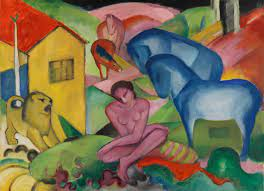
These first eleven lines interweave the process of getting up for breakfast with the contrasts in the outside landscape. Being cold and having no clothes on and breakfast itself – perhaps “Frosties” (crunch sucrose flake) and perhaps a suggestion of tiredness or exhaustion. The gradual awakening takes place with engaging contrasts as Padel makes clear in her own interpretation. There is cold sharpness against and before the sunlight. There are contrasting colours orange-yellow with the blue flanks of the horses. An image which might suggest the paintings of Franz Marc.
Then there is the poet’s usage of engaging tropes like “cold was urban” and “sepia…medieval photographs”. These encourage the reader to use his imagination. It is interesting too that the latter photo image reinforces the element of time which is clearly passing along during the course of the poem.
These lines from MacNeice’s poem written in 1938 sadly seem apposite today. The lines refer to the bombing of Barcelona when fascists killed some 1300 people. They also refer to his response which is to seek solace in sleep. https://en.wikipedia.org/wiki/Bombing_of_Barcelona
Now, of course the Spanish Civil War was a totally different situation from the current situation from the Russian invasion of Ukraine. However, the melancholy tone of Autumn Journal resonates with my personal feelings about current events. Firstly, weapons have become vastly more destructive and in a few days the casualties and destruction have become enormous and sadly mch more about to be revealed. In both conflicts, ethnic and religous belief would appear to be active. Although mercenaries and International Brigades are involved the ideological factors such as a belief in Marxism are radically different in form.
The cock which crowed in respect to Barcelona is an Easter image relating to betrayal. Just as with Covid the current response by politicians to the current crisis is totally underwhelming and indicates too how domestic and isolationist narratives have obscured a wider view as to how to resolve or even contain this conflict.
So this melancholia pervades from 80 or more years ago-
Once again I have been reading Christopher Reid and again finding his poetry both lyrical and accessible. I recently found a poem in his collection, “For and After“(2003) which is intriguingly entitled Bermudapest and is dedicated to Clariisa Upchurch and her husband George Szirtes. It begins:-
A place I’ve never been, but which, at back of my mind’s eye, I know I’ve seen:
its stately apartment blocks beginning to melt in the mid-morning blaze, its beach cafés
loud with the laughter of chess-players and philosophers. And there’s the postcard view you’ll know it –
Now although the title has an ambiguity about it perhaps suggesting an imaginary destination, I can only read a few lines and think upon the city of Odesa. A city about which I only know but a few matters but one whose cosmopolitan nature makes it onto my wish list for a visit. Having seen those famous steps in Eisenstein’s “Battleship Potemkin” in the early 70s started my interest. Re- kindled by a minitrek to Istanbul and Princes Island then I bought Neil Acherson’s Black Sea. Then again reading about the trade of the Euphrasi family in de Waal’s Hare with the Amber Eyes stimulated my interest further.
Reid’s lovely poem talks of a lively city with…..
loud with laughter
of chess players and philosophers.
And there’s a postcard view-
you’ll know it
However, the city which has grasped my imagination through reading this poem is awaiting the armed assault of the invader. The sandbags surround the elegant statues. The town where Pushkin was in exile which was always a cosmopolitan treasure awaits another barbarous incursion .A large portion of the dwellers have already left their homes fearing the sort of destruction meted out to Mariupol now some 13hours journey away to the East.
There is a certain irony in the last lines in which a guitar playing poet flavours his words with…
The lines above come from Stephen Romer’s title poem in his 2008 collection Yellow Studio. This poetry book (Oxford Poetry Series ISBN978 1 90303985 4)I purchased having read some of his critical writings in the TLS (or was it the LRB?) Getting to understand a new poet inevitably takes time and I find that I have reached the point where actually I want to reassess my favourites; Auden, MacNeice, Yeats and Mahon). However, my interest in French Poetry remains strong and Romer is perhaps the leading translator. Incidentally, Romer keeps reminding me of the corresponding poetry and translations from German by Michael Hofmann. Here is a clip finding Romer reading at Worcester College, Oxford in 2019 about the warmth of the South,the approach of Spring, Air BnB and other matters.
Perusing the collection my eye was caught by the poems about returning to Paris.:-
Returning here
under the cold blue
the rue des Saules
is absurdly tender
with its pink house
on the corner
and the château des Brouillards
with its ruined vineyard
and secret trees
still a world on its own
(For more information on the misty castle opposite Renoir’s house see
Another section of Yellow Studio deals with the poets relaxation and remembering a friend/lover recently lost ;an elegy conceived in the garden and about the house. It is called Pottering About.
any sign of neglect or decay
weighs on my conscience
when you were always the one
somewhere at work among the birdsong
and the appleboughs, the place marked
by a stupendous oath
as the Allen Scythe choked
or where the odd chainsaw
was hurled into the undergrowth
and I dreaming on
among my books
in the yellow attic room.
Here is Stephen Romer in more sombre mood reading at Trinity College, Cambridge in 2018
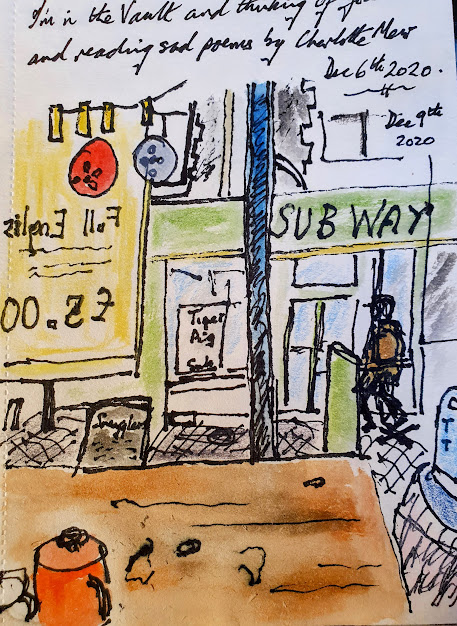
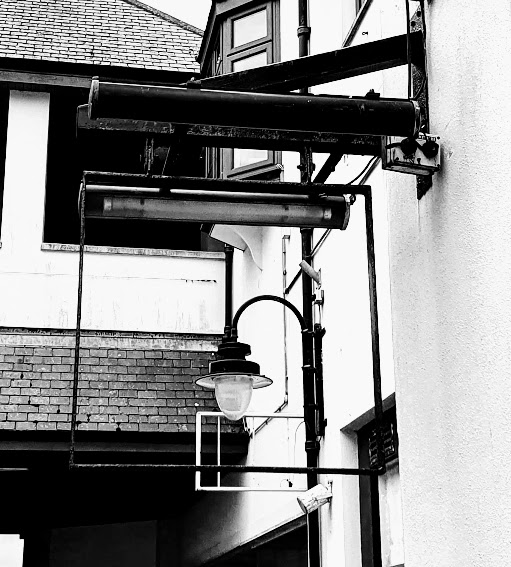
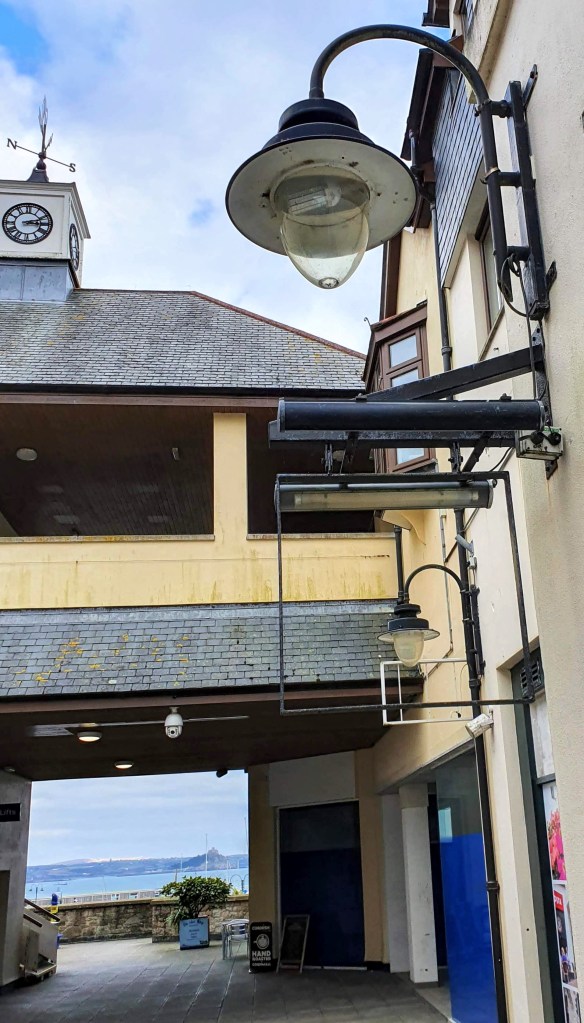
This shopping precinct seems full of empty shops. It feels as though the local economy has not recovered from Covid and this environment has taken on the strangeness of the new normal. This in turn raises questions about the whole construct of “normality” and how normal the old normal really was. The empty frame, one might ask oneself; is it really empty? The frame itself can become a tool to investigate the reality on which attention is focussed.
“Frames are mental structures that shape the way we see the world. As a result, they shape the goals we seek, the plans we make, the way we act, and what counts as a good or bad outcome of our actions. In politics, our frames shape our social policies and the institutions we form to carry out policies. To change our frames is to change all of this. Reframing is social change“
Furthermore from Fairhurst and Sarr-
“Just like a photographer, when we select a frame for a subject, we choose which aspect or portion of the subject we will focus on and which we will exclude. When we choose to highlight some aspect of our subject over others, we make it more noticeable, more meaningful, and more memorable to others. Our framing adds color or accentuates the subject in unique ways. For this reason, frames determine whether people notice problems, how they understand and remember problems, and how they evaluate and act upon them (Entman, 1993).
Frames exert their power not only through what they highlight, but also through what they leave out. In framing, when we create a bias towards one interpretation of our subject, we exclude other aspects, including those that may produce opposite or alternative interpretations.”
The frame might be the area of domestic politics which when focussed upon excessively means that political discourse becomes isolated. This has been the case in the U.K. where foreign affairs has suffered much neglect. Statesmen with detailed understanding of policy seem few. Consequently issues nearby are outside the frame. The events leading up to the invasion of 🇺🇦 Ukraine 🇺🇦 are now the return of the repressed.
The doleful and economically depressed scenario locally has a dreamlike quality at times somewhat reminiscent of paintings by de Chirico or Rene Magritte. Outside the frame there are grander landscapes.





 penwithlit