Categories
Category: politics
Categories
There should be dancing in the streets
When one fled past, a maniac maid,
And her name was Hope, she said :
But she looked more like Despair,
And she cried out in the air :
‘My father Time is weak and gray
With waiting for a better day ;
See how idiot-like he stands,
Fumbling with his palsied hands!
‘He has had child after child,
And the dust of death is piled
Over every one but me—
Misery, oh, Misery!’
Then she lay down in the street,
Right before the horses feet,
Expecting, with a patient eye,
Murder, Fraud, and Anarchy.
When between her and her foes
A mist, a light, an image rose.
Small at first, and weak, and frail
Like the vapour of a vale :
From Shelley….The Mask of Anarchy
Adam Phillips is an intriguing author and psychoanalyst who has clearly stated in an interview his opinions on the crisis following Covid at https://warwick.ac.uk/fac/soc/ces/research/current/mentalhealth/interview/
QUOTE
EW: Do you think the current levels of suffering and unhappiness are the signs of a crisis that is entirely new, or do you think these are problems that have been around in one way or another for some time?
AP: I think that there’s a crisis in the sense of people finding it more and more difficult to live. So there’s a crisis in health, so to speak, and obviously we live in a very polluted environment as well. But the scale of envy and competition in this culture is too much for them to bear.
To put this as crudely as possible: I think that capitalism drives people mad. Once you live in a world in which competition trumps collaboration, it’s as though there’s no shared project; we’re all competing with one another for limited resources. So I think it’s good that it’s become a matter of concern in the public realm that people are really suffering. I think it’s also important that there are many descriptions of what they’re suffering from, because the risk is of thinking that what we need are solutions to mental health problems, whereas actually we need political solutions, and the mental health problems are symptoms of a political catastrophe that is occurring.
END OF QUOTE

Another somewhat similar view is expounded by another Psychoanalyst David Morgan at https://vimeo.com/201127253 and his excellent podcasts that he has chaired can be found at http://thepoliticalmind.co.uk/resources-articles-politics-psychology/6-david-morgan-psychoanalyst-po

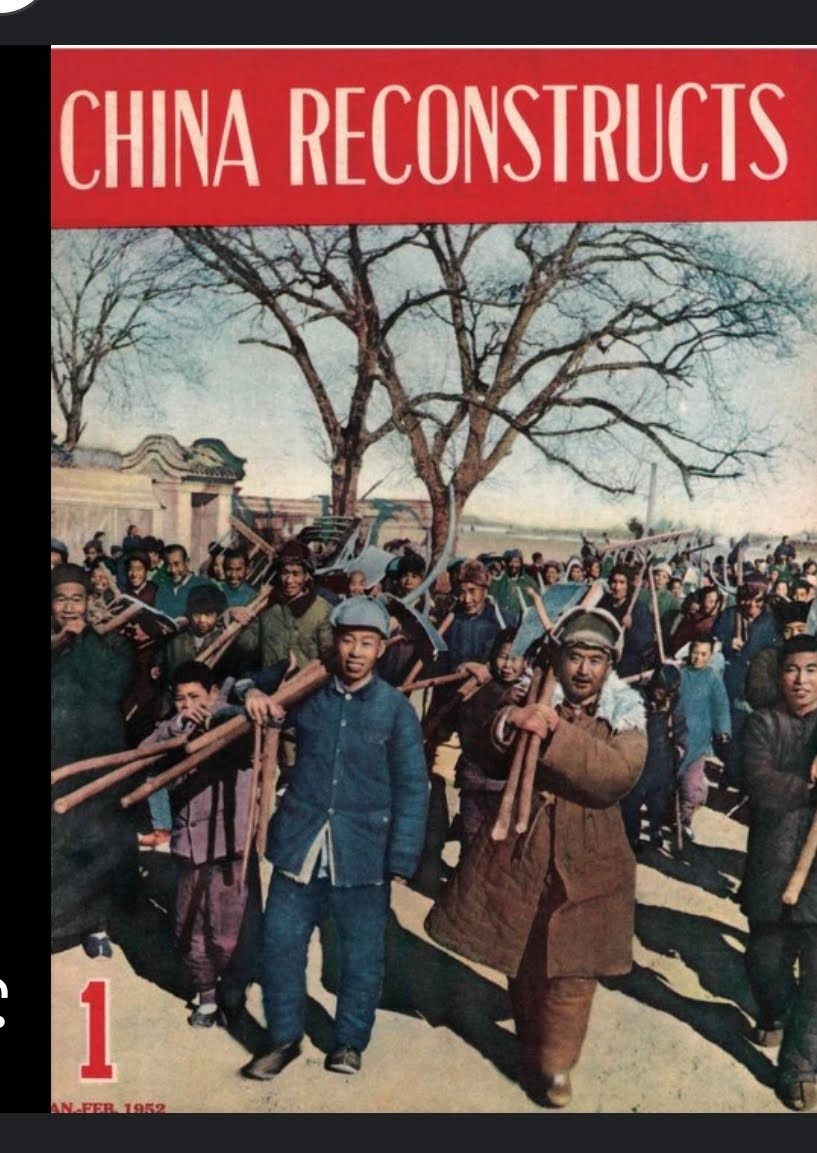
Many years ago my French Master, somewhat radically inclined, offered to teach me Chinese. The condition was that I had first to ensure my French was up to scratch. Unfortunately I was scarcely up to the mark with the language but have in recent years got as far as reading a very easy version of Flaubert with an immense amount of pleasure. I did however have at least one lesson of Chinese and can still recall one or two phrases about writing a character on a blackboard. I also recall seeing on my schoolmasters desk a few copies of a magazine called “China Reconstructs”.
In a very different study overlooking St Ives harbour and bay, I saw a copy of the same journal. This was the study of a friend’s father who had been a brave member of the Chinese Inland Mission. One of the achievements of this famous organisation was to encourage the unbinding of women’s feet. A task interrupted by the Japanese invasion. There was a magnificent cat wandering around the house called “La Fu” and meals at my friends were frequently taken using chop sticks.
Large parts of Cornwall have unfortunately been subject to neglect and decline. A situation which appears to have got still worse under the Tories and due to Brexit. Much reconstruction of public services is urgently needed to avoid further poverty, ill-health and decline. The view below shows another side to Cornwall but unfortunately is all too common.

I am currently reading a book about a doomed society on the brink of Fascism. Where publicity takes the trivial and ephemeral and promotes it as serious journalism. Set in a city where it is important to be seen in the right places. A society where there is a strong underlying current of racism. A place where a spectacle is required every evening to entertain manual workers, secretaries and shopkeepers. A city where greed and cheap, unreliable information dominates the public space. This could be London; this could be today.
In fact this is Berlin in 1930 where a man whose name roughly translates as Cheeseburger sings sickly romantic songs and becomes the equivalent of a Tik Tok celebrity – reports about him soon dominat the front pages of the city’s many newspapers and journals. Such is Käsebier Takes Berlin, a demanding book ably translated from the German by Sophie Duvernoy. (You can improve your knowledge of Berlin Argot at https://www.fluentu.com/blog/german/berlin-slang/)
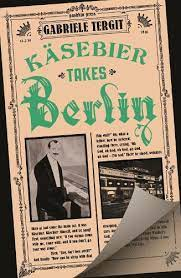
Not the least interesting aspect of this novel (early metrication??) are the cultural references to be found in the notes- from Schiller to Fontane including scenes of the famous, louche “Romanisches” cafe. If you enjoyed the recent series on KaDeWe on BBC you will enjoy this spectacle of the frantic Weimar period.
Then there is the evocative smell of newspapers hot off the press. Journalists who become frustrated by sub-editors who cut their best phrases and compositors who have a scarcely veiled contempt for content as long as it fits elegantly on the front page.
Finally Berlin itself as it was in the pre-war period is touched upon; the Biergartens beside the Spree, the absurd architecture of prosperous flats and yet the strange variations in property prices. This latter caused by insecurities in the currency together with the speculations of dodgy developers. This too gives Tergit’s Weimar novel contemporary relevance.

During this peculiar August weather, I have been reading David Boyd Hancock’s remarkable account of young British Artists and the Great War. Firstly, the account has introduced me to the Slade Artists whose work I was fortunate to see a few year’s ago in the Dulwich Art Gallery. So I have become acquainted with the critical instructor Henry Tonks whose sarcasm of student’s drawing was interlaced with great conviction about fostering the development of fine talents. I have learned much about the deep courage of Stanley Spencer, the lyrical regard of Paul Nash and his brother for the countryside, and of how Nevinson subverted Futurism to convey the mechanical dreadfulness of modern warfare.
Secondly, Boyd Haycock is excellent on the personal relationships affecting the development and interaction between the painters. The upbringing of Mark Gertler and his passion for the wayward and difficult Dora Carrington, I found fascinating as the figures of Bloomsbury enter the scene: Strachey, Fry and of course, Ottoline Morrell. Rupert Brooke and D.H.Lawrence are included too and the various links with art dealers, sponsors and critics completely convey the vivid and sometimes lurid time.

Thirdly, the response of these sensitive souls to the destruction so suddenly released in 1914 is powerfully conveyed. Minds as well as bodies are for ever traumatised and the pictures generated under fire have enormous power. Reading about the stalemate which ensued and the trench warfare, the horrors suffered under artillery bombardment and perhaps especially, the unnatural distortion of countryside inevitably bring contemporary issues to mind.
One interesting exhibition which has displayed the artwork in relation to the Ukrainian conflict has taken place in Brussels and is the subject of an engaging article from The Guardian- Making sense of the senseless: Ukrainian war-art exhibition arrives in Brussels and may be viewed at https://www.theguardian.com/world/2022/jul/31/ukrainian-war-art-exhibition-arrives-brussels-captured-house
Another which well repays viewing and includes outstanding sketches by George Butler may be seen on this BBC website and shows extensive video clips with further artists at
https://www.bbc.com/news/av/entertainment-arts-61347805
Finally, there is this academic discussion relating Ukranian artist’s work with issues of Russian colonialism from Columbia University. It also includes Music and Film.
 penwithlit