Category: Psychoanalysis
Adam Phillips is an intriguing author and psychoanalyst who has clearly stated in an interview his opinions on the crisis following Covid at https://warwick.ac.uk/fac/soc/ces/research/current/mentalhealth/interview/
QUOTE
EW: Do you think the current levels of suffering and unhappiness are the signs of a crisis that is entirely new, or do you think these are problems that have been around in one way or another for some time?
AP: I think that there’s a crisis in the sense of people finding it more and more difficult to live. So there’s a crisis in health, so to speak, and obviously we live in a very polluted environment as well. But the scale of envy and competition in this culture is too much for them to bear.
To put this as crudely as possible: I think that capitalism drives people mad. Once you live in a world in which competition trumps collaboration, it’s as though there’s no shared project; we’re all competing with one another for limited resources. So I think it’s good that it’s become a matter of concern in the public realm that people are really suffering. I think it’s also important that there are many descriptions of what they’re suffering from, because the risk is of thinking that what we need are solutions to mental health problems, whereas actually we need political solutions, and the mental health problems are symptoms of a political catastrophe that is occurring.
END OF QUOTE

Another somewhat similar view is expounded by another Psychoanalyst David Morgan at https://vimeo.com/201127253 and his excellent podcasts that he has chaired can be found at http://thepoliticalmind.co.uk/resources-articles-politics-psychology/6-david-morgan-psychoanalyst-po

I have read but a little Samuel Beckett- one play and a novel but his persona I find intriguing and his clearly having studied Joyce interests as well. I found a tome-like collection of his poetry second hand and have been looking at some of his translations from French. He translated Rimbaud, Breton and the surrealist poet, Paul Eluard. I notice that a collection of the latter’s poetry is soon to be published in both French and English. Beckett also translated a poem called “Delta” from Italian by Eugenio Montale. Beckett too wrote fluently in French and demonstrates his fascination for arcane usage. Here is an example-
Tristesse Janale
C’est toi, o beauté blême des subtiles concierges,
La Chose kantienne, l’icone bilitique;
C’est toi, muette énigme des aphasiques vierges,
Qui centres mes désirs d’un trait antithétique.
O mystique carquois! O flèches de Télèphe!
Correlatif de toi! Abîme et dure sonde!
Sois éternellement le greffé et la greffe,
Ma superfétatoire et frêle furibonde!
Ultime coquillage et palais de la bouche
Mallarméenne et emblème de Michel-Ange,
Consume-toi, o neutre, en extases farouches,
Barbouille-toi, bigène, de crispations de fange,
Et co-ordonne enfin, lacustre conifère,
Tes tensions ambigues de crête et de cratère.
Using Google Translate and adjusting this curious poem reads-
Sadness Janale
It is you, o pallid beauty of the subtle concierges, The Kantian Thing, the bilious icon; It is you, mute enigma of aphasic virgins, Who centers my desires with an antithetical trait.
O mystical quiver! O arrows of Telephus! Correlative of you! Abyss and hard probe! Be eternally the grafted and the graft, My superfluous and frail furious!
Ultimate shell and palate of the Mallarméan mouth and emblem of Michelangelo, Consume yourself, o neutral, in fierce ecstasies, Smear yourself, bigène, with mire contractions,
And finally coordinates, coniferous lacustrine, Your ambiguous tensions of ridge and crater.
Essentially this seems difficult although each stanza has a cluster of meaningful concerns. There are many fascinating words with allusions to place names and classical studies. The imperious voice of the poem marked by imperatives is not without a comic undertone or so it seems to me. It has made me aware of Beckett’s command of the French language and his dreamlike imagery.
Categories
Heddy Lamarr (Misconnected)
Communication only partial
the latching you designed
seems to glitch
So that signals disappear
down some tremendous
existential void.
Wires are somehow more
secure than your bluetooth
despite its representation
as a reliable mechanical
gearwheel safely
locked in a Newtonian Universe.
How can I connect
with you? What message
can reach you up there?
Here I remain
with weakened pulses
and unreliable links
living with Beckett and Bion.
Categories
Discovering Levertov
I was thumbing through a copy of Contemporary American Poetry price six shillings, published 1962 that I borrowed from a friend at University. I couldn’t help noticing that there appeared to be only two woman poets in the collection by Donald Hall and of neither had I heard. At first perusal some of the poems by Denise Levertov seemed to be redolent of new perceptions of American springtime and then I read the blurb in the front-
DENISE LEVERTOV (b. 1923) comes from Ilford in Essex, England, and served as a nurse during the Second World War, when her poems were first published by Wrey Gardiner in London. She married an American and has lived in the United States since 1948. She published her first book, The Double Image, in England in 1946. Her American books are Here and Now (1957), Overland to the Islands (1958), With Eyes at the Back of our Heads (1960), and The Jacob’s Ladder (1961).


This delightful poem about origins and identities is immersed in beautiful place names both suburban and sylvan. Rivers run through it and there is the lovely image of the forlorn white statue standing in the old house garden. It is a reflection of childhood innocence and religious thoughts add to the majesty of the poetic voice. ( ” merciful Phillipa”, “multitudes” and “Simeon quiet evensong”) In the meeting and parting she brings together Belarus and Spain, the United States and Wales. It is about the expansion of the world as in the maps of a child’s imagination; the safety and containment of morning sunlight on garden walls.
The London Review of Books editions that arrive every two weeks seem to vary in their interest value. The most recent edition, however, grabbed my interest in a short article on the life of the German Expressionist, George Grosz. Then I went on to read about the amazing Adolfo Kaminsky, the brave photographer and forger on behalf of radical causes. Two good articles and it puts you in the mood to read the rest before the next explosion of magazines arrive with more information having to be processed. (LRB Volume 45 Number 4 -16th Februrary 2023)
Thomas Meaney has visited the Staatsgalerie in Stuttgart and his review of Grosz is particularly interesting from a psychological viewpoint with informative quotations from Walter Benjamin, Hannah Arendt; the former claiming that Grosz’s caricatures were not satire but reportage. His transition to America in 1933 marked a point at which he seems to have attempted to subdue, what he considered, his former arrogance and nihilistic tendencies. Yet he seemed out of sympathy with American society, its cultural interests and the false persona he felt he had to adopt in his teaching of drawing. By 1954 he appears to be in some sort of deep decline. Meaney quotes the Dadaist and friend Schlicter –
“Rarely have I seen a person with such self-destructive rage…..It is a depressing spectacle to see a man whom one once cherished go to the dogs in this way.”
Returning to Berlin where he died in 1958 seems to have exacerbated matters still keenly aware of past issues unresolved.
Secondly, last week there was a dearth of anything but Tory supporting newspapers at Sainsbury’s so I decided to buy the Morning Star. I came across an interview by Chris Searle with the veteran Bassist Dave Green. He and his friend, Evan Parker have just issued a new CD called Raise Four.
The clip above is almost 20 years old but in this recent interview, Green highlights his favourite artists; Roland Kirk, Coleman Hawkins and among British Jazz musicians, Bruce Turner. Green has been a dedicated anti-racist and an ardent believer in constant experimental freedom to develop his craft.
The third article to engage my attention, in this case by the vivid illustrations, was in Saturday’s Guardian and may be found at https://www.theguardian.com/artanddesign/2023/feb/16/women-abstract-expressionism-whitechapel-gallery-krasner-sobel
This article is a review of the Women’s Abstract Exhibition (1940-1970) to be found at the Whitechapel Gallery until 7th May. I particularly was taken by the dark variegated shades of Li Fang’s work of 1969.
Very likely it is the mood I find myself in at the moment. Arriving in town just a few minutes earlier than expected. The bus driver must be keen or perhaps a manic denial of boredom. Then the bus is blue -quite unusual and reminiscent of a bus service locally that years ago was renowned for unreliable and battered buses. The service now appears to have hired a range of peculiar vehicles – this one has shiny black leather seats somehow suggestive of the aspirations of another era.
Need to top up with a little cash but a scrawled notice- and I mean a scrawled notice says “Out of order” and you almost expect it to add….” this is Penzance boy….carry on waiting for Godot”. Thank goodness for the Co-op.
As I stroll on I think of the latest large Tory leaflet that has been pushed through the door. Green naturally. Telling me “together we are successful” or words to that effect. What at precisely? Schools where there are very few fully qualified teachers and pupils marched before the moronic inducing banks of second rate computers or various mad pods and pads. Successful with 12 hour waiting times in A and E. Bleak visions of rooms that would be like Scutari drawn by Daumier. No Florence- instead the only visible care comes from the worried looking young Security Staff in front of lengthening lines of ambulances. Successful for the Mme Defay who made a fortune out of her Government Grant for pathetic PPE.
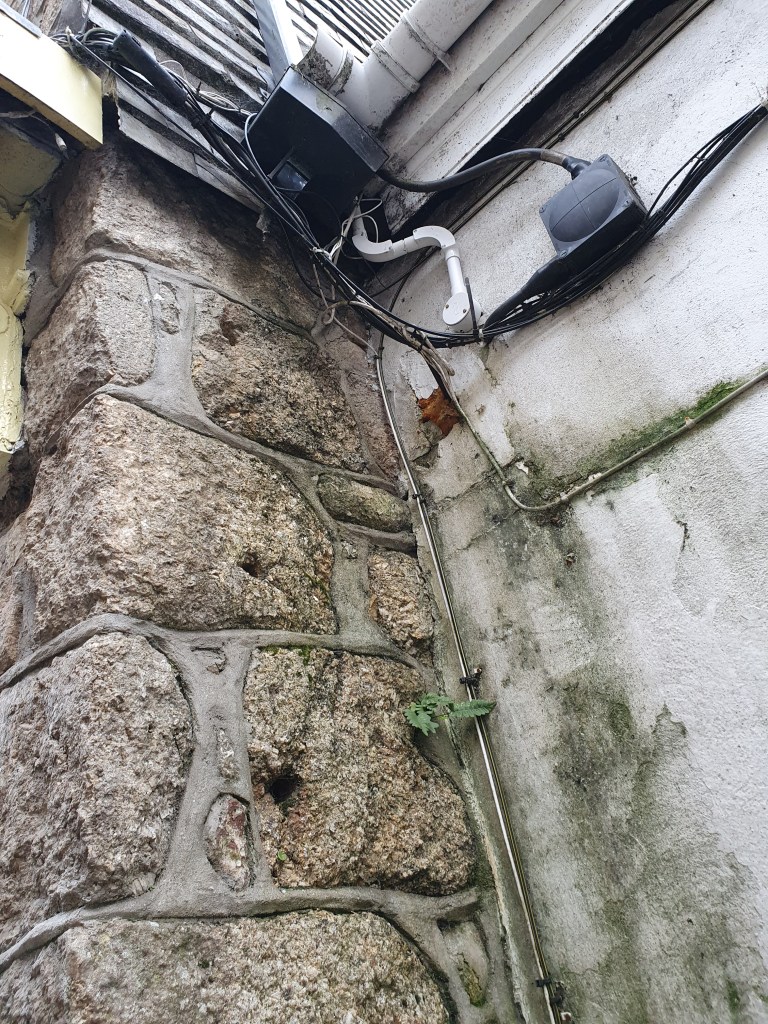
Everywhere recently my eye has been captured by curious clumps of electrical apparatus. These somehow have a certain lyrical attraction even or especially when accompanied by patches of viridian lichen or intriguing pipework, transformers and untidy wiring. In other countries with technological competence they might be safely enclosed.

 penwithlit