Categories
Book Reviews Literature Penwith St Ives West Cornwall (and local history)

Außerhalb Lilly Schönauer und Rosamunde Pilcher (1) Virginia Woolf

Außerhalb Lilly Schönauer und Rosamunde Pilcher (1) Virginia Woolf

The Cornish Review Edited by Denys Val Baker


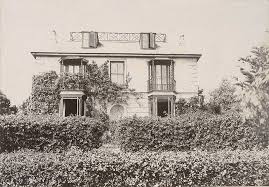
West Cornwall has many literary connections and famous writers have been attracted to its scenery and its people. In an idle moment I was thinking about how useful it might be to give an account of some of the significant figures that are associated with the Penwith peninsula. In her magical notes, “Moments of Being” Virginia Woolf writes of the evocative inspiration which waking in Talland House gave to her. Not only was it a source of inspiration for her great modernist novel,“To the Lighthouse” but to remember that once Henry James took tea on the lawn recalls once again the long Edwardian summer and the echoes of the conversations between him and Virginia’s father, the formidable Leslie Stephen. Links include http://www.woolfonline.com/timepasses/?q=node/271

and

http://fernham.blogspot.co.uk/2009/07/virginia-woolf-on-henry-james.html

Books about Virginia and her sister in St Ives include “Virginia Woolf, Vanessa Bell and Remembering St Ives” by Marion Whybrow (currently unavailable on Amazon) and the novel “Virginia and Vanessa” said to be;”…a chronicle of love and revenge, madness, genius, and the compulsion to create beauty in the face of relentless difficulty and deep grief”. In addition there is Dell, Marion. Peering Through the Escallonia: Virginia Woolf, Talland House and St. Ives. No. 23. 1999. ISBN 1-897967-47-0. Price £7.00VW
There are more websites to peruse and pursue, should you have the time. Namely, http://www.glennhorowitz.com/featured/virginia_woolf_goes_to_the_beach

And

https://bloggingwoolf.wordpress.com/books/

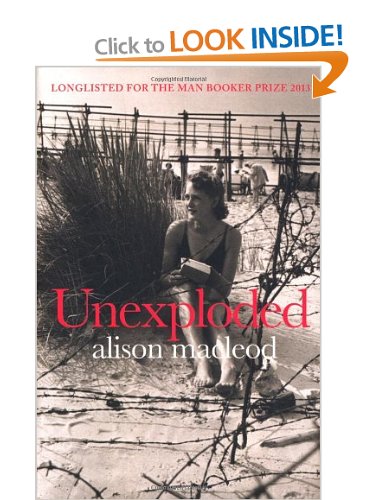
It is interesting, though unsurprising, how Woolf keeps turning up as a factional character in novels. My personal favourite as I have mentioned on here before is “House of Exile” by Evelyn Juers –mostly about Thomas Mann-which contains an interesting and memorable incident where Virginia and Leonard visit a restaurant in the Funkturm in Berlin and loses her elegant scarf which is recovered by another leading character.” Some moments of exhilarating coincidence in these pages are reminiscent of Stoppard’s Travesties.” According to the reviewer, Robert McCrum at http://www.theguardian.com/books/2011/may/22/house-of-exile-juers-review. Although not associated with St Ives, Virginia Woolf turns fictional in the film “The Hours” based on the novel by Michael Cunningham, which came out in 2002 directed by Stephen Daldry (who also filmed The Reader). Her bent-nosed appearance, which some critics found rather hilarious, won Nicole Kidman the best actress award that year. Recently I came across Alison Macleod at this year’s Jewish Book Week, where she was talking about her haunting and remarkable novel, “Unexploded”. She is Professor of Contemporary Fiction at the University of Chichester and a lively and engaging speaker who talked about her research into the background of the novel which is set in Brighton, where she herself lives, during the hazardous summer of 1940. The novel was long-listed for the Man Booker Prize in 2013 and deals with, among other sensitive issues, anti-Semitism in wartime Britain. Virginia Woolf lectured in Brighton during this period and she and her novels turn up as one leitmotiv in this persuasively constructed story. Many of the issues are based on a thoroughgoing examination of the archives. http:/www.telegraph.co.uk/culture/books/bookreviews/10244729/Unexploded-by-Alison-MacLeod-review.htmlVW3
VW1

Returning along the coast in a westerly direction to West Penwith, a glance at A Literary Atlas and Gazeteer reveals that many fascinating littérateurs lived or visited from Truro and to the west.  Here are a list of just ten whose connections may not be very well known. At Zennor at Higher Tregarthen from 1916-1917, D.H.Lawrence, J.Middleton Murray and Katherine Mansfield. In Truro, Samuel Foote (1720-1777 became celebrated as much for his acting as his didactic diatribes)-his story has just been magnificently told by Ian Kelly see- http://www.theguardian.com/books/2012/oct/05/mr-footes-other-leg-review. Sir William Golding lived nearby at Perranaworthal from 1985 until his death in 1993-where he became a great friend of the controversial novelist and translator of Russian Poetry, D.M.Thomas. He has recently published a poetry collection, Light and Smoke.http://www.dmthomasonline.net/

Samuel Foote
Samuel Foote

In St Ives, Mrs Havelock Ellis wrote Cornish Idyll in 1898. Much later, after the War in 1945 Norman Levine found the town conducive to his stories, poetry and travel writing. At Madron, the inspirational poet’s poet, penned his charmed verses:-http://www.scottishpoetrylibrary.org.uk/poetry/poems/listen-put-morning

Listen. Put on morning.
Waken into falling light.
A man's imagining
Suddenly may inherit
The handclapping centuries
Of his one minute on earth.
And hear the virgin juries
Talk with his own breath
To the corner boys of his street.
And hear the Black Maria
Searching the town at night.

]Daphne Du Maurier arrived here in Penwith before her time at Menabilly -for more details see http://www.intocornwall.com/features/literature.asp


Categories
Penwith St Ives Uncategorized West Cornwall (and local history)

Reports from Cornish Newspapers in 1914-The Outbreak of War

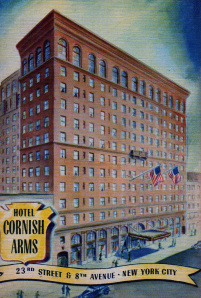
A postcard of The Cornish Arms Hotel in New York-frequently advertised in The Cornishman

20140326_150101

Up until August 1914, The Cornishman and the St Ives Weekly Report contain many detailed reports from abroad. These include the Cornish in America, Canada, South Africa. Many Cornish people travelling to the States will have responded to the large adverts in the Cornishman for the famous hotel in New York https://ephemeralnewyork.wordpress.com/tag/hotel-cornish-arms/

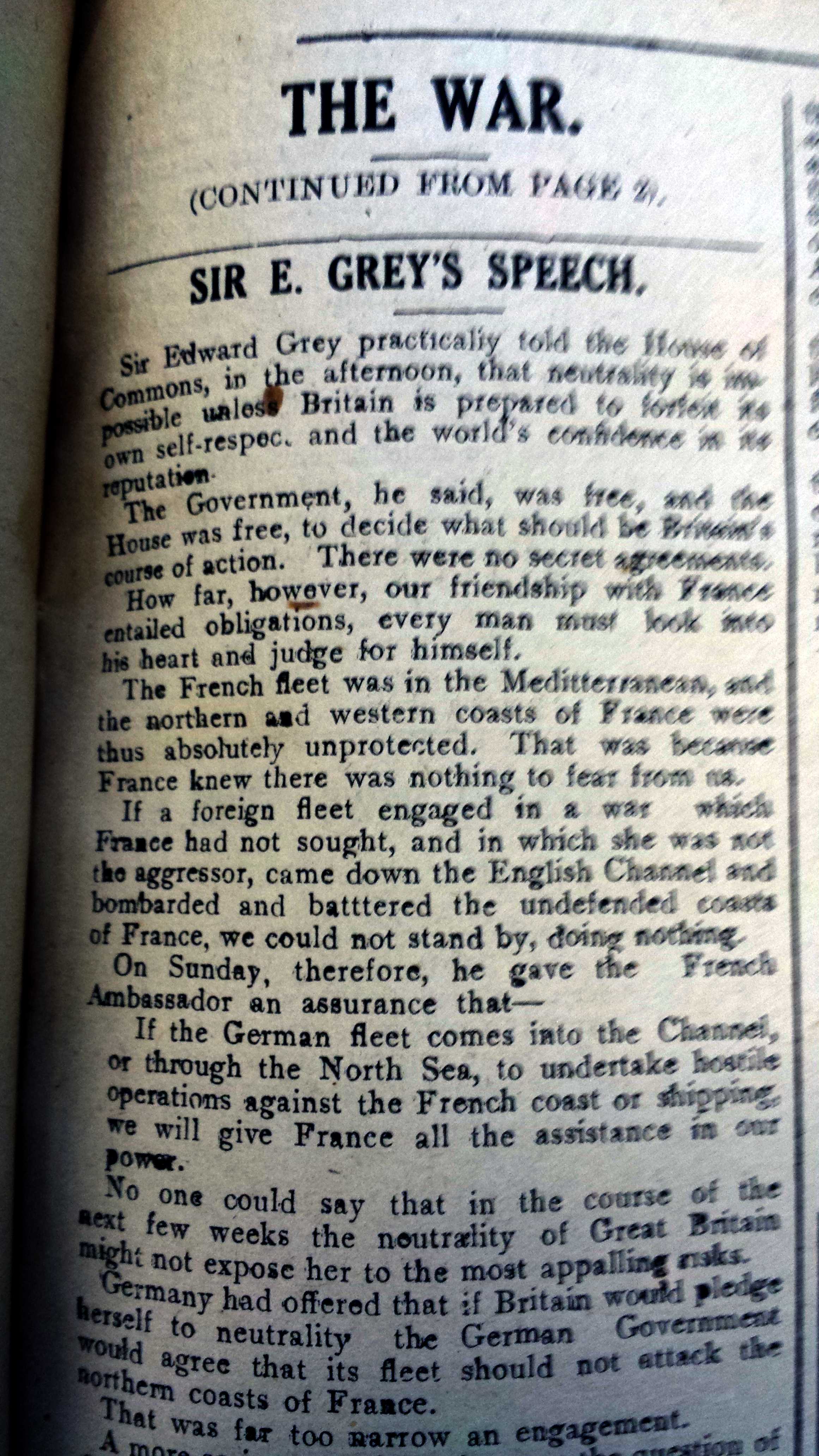
Without doubt, however, the greatest concern appears to be about Nationalist Rebellions in Ireland.http://www.bbc.co.uk/history/british/britain_wwone/ireland_wwone_01.shtml  The only reference to the possibility of  an outbreak of war- reading between the lines- concerns the speeches in support of building more dreadnoughts. Money appeared to be of no real concern  to the advocates of building more battleships.

The effect on the Fishermen and Families

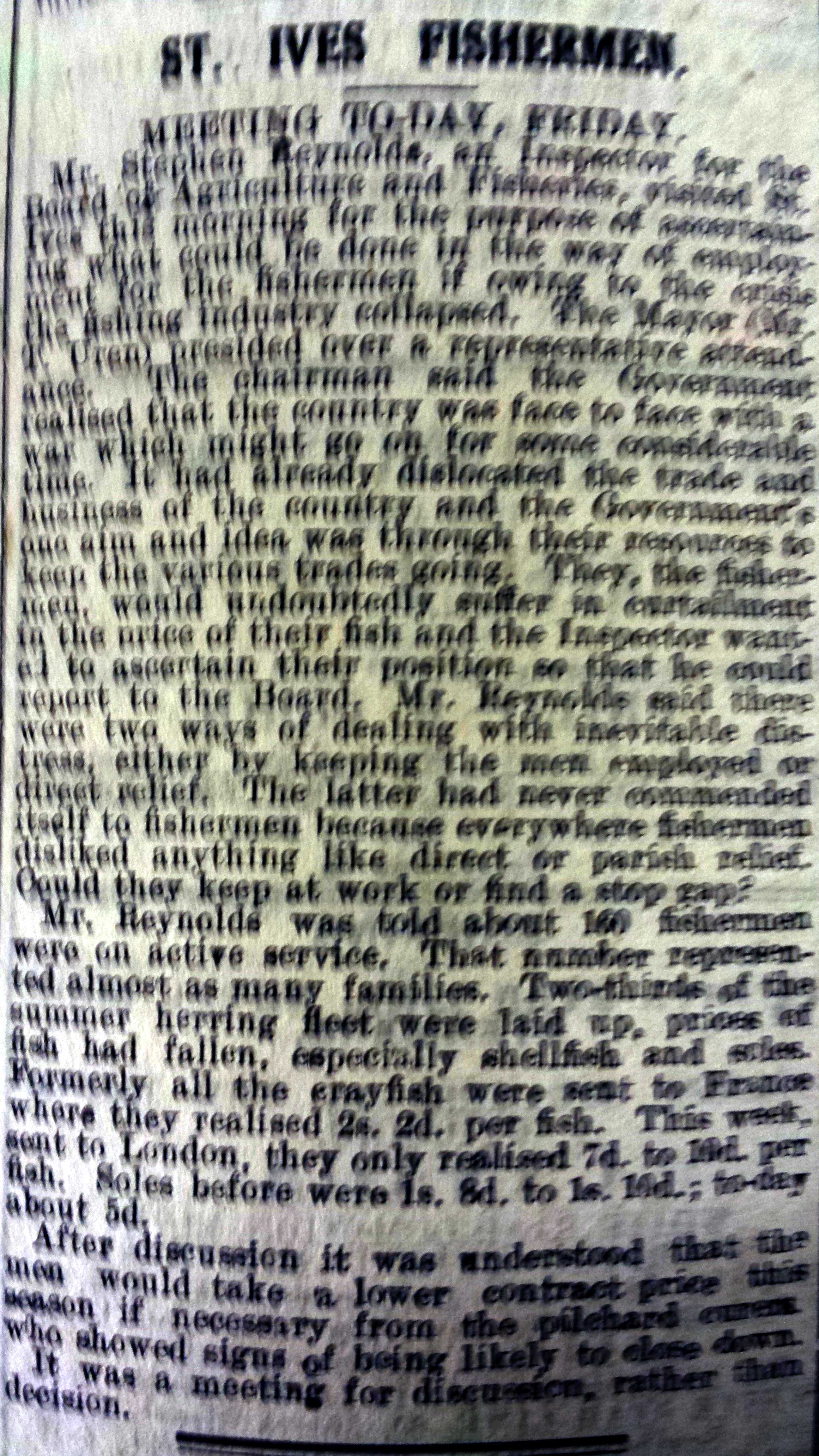
When war broke out many fishermen in St Ives were immediately affected and the effect on many of them, their families and the price of fish was very soon to follow. Many were called up within hours and summoned as members of the Royal Naval Reserve to Davenport and had to leave by train for that destination. A newspaper report states that when addressed by Mr Stephen Reynolds, Inspector for the Board of Agriculture and Fisheries, he was told that some 160 fisherman were on active service with about the same numbers of families affected. Two-thirds of the summer Herring Fleet were laid up and the price of fish and particularly Crayfish that would otherwise have fetched a fine price in Paris were catastrophically affected.


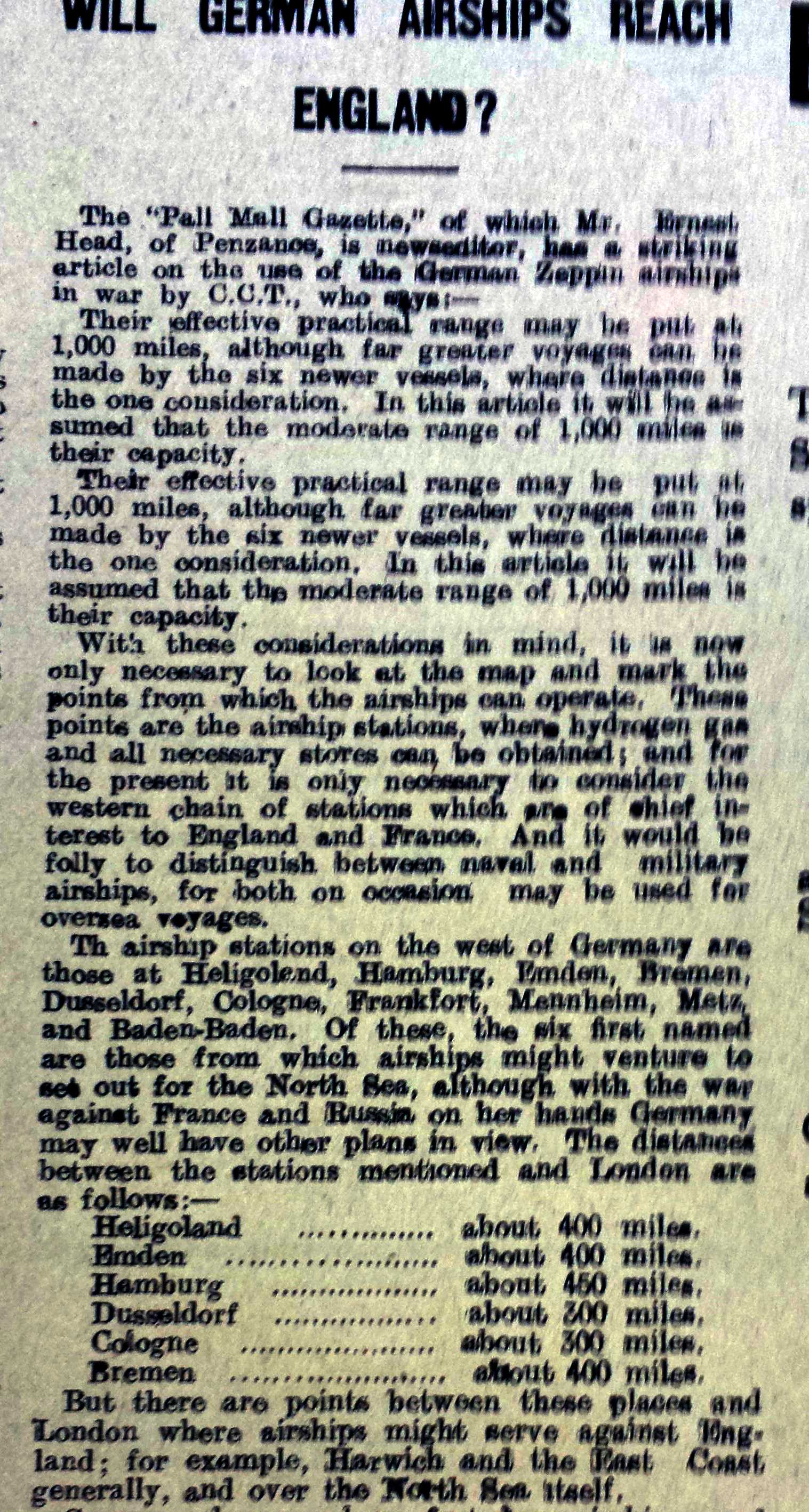
The details of this call=up are very moving since we only have to turn to the next couple of weeks to learn how many will have been aboard ships which sank or been caught in the first defeat later at Mons. The accounts of farewells said above the peaceful beaches and the brass bands playing can still be imagined by anyone walking out of the town. There is a strange mixture of fear and jingoism apparent in the newspapers. There were worries about the supply of wheat which caused fears about  starvation; there were food riots in Camborne. Other articles show a concern about possibilities of aerial attack from Zeppelins and tables showing their limited range were the subject of articles in the press.

Vulnerability to Aerial Bombardment

zeppelin-airship


The Zeppelin Threat
The Zeppelin Threat
Categories
Penwith St Ives West Cornwall (and local history)

A Brief Memoir of Downlong in St Ives some sixty years ago

In the fifties, there were no flowers in hanging baskets or even in window boxes and the main smell downlong was of  fish and tarred nets, On the other hand there were houses built upon greenstone masses where you might well find a profusion of sea pinks in clumps. Heading along Back Road West towards the Digey, there were many village shops, including general grocers like Georgie Wedge’s at the top of Bethesda Hill, where everything from sweets to biscuits were sold out of glass topped tin boxes and placed in small neat paper bags. There was another grocers, Roucefield’s which did a smart trade in St Eia street, where many folk  in downlong had celebrated the Coronation, beneath festoons of flags in red , white and blue. The fare on this occasion consisted of saffron buns and bottles of corona served on long trestle tables. There was also a wool shop, at the end of Island Road where women discussed knitting patterns for winter jerseys or Fair Isle jumpers.Print2

At the top of Fish Street the gentle and well spoken, Mrs Laposta ran a  busy and popular fruit and vegetable stores just opposite Couch’s works which at this time employed more than 50 workers making parts like buoyancy trimmers for amphibious vehicles for the British Army on the Rhine. Two further venues in Back Road West were particularly intriguing. Further along before the Mariner’s Church, the house where pilchards were marinated in fish spice, vinegar and bay leaves which was accessed at the top of a steep staircase. It cost just a few shillings and a suitably large dish for a dozen had to be left, a few days before. Even more interesting for youngsters on a Saturday morning visit was the Laity Museum. This was crammed with models of tea clippers and Chinese junks, scrimshaw, and intricate furniture and dark sea chests inlaid with mother of pearl. Redolent in atmosphere of the clipper trade with the Far East, from jute to silk, spices and calico, there were contemplative jade Buddhas and several examples of fierce black Japanese armour. Further information, histories of the sea and tales of the Orient were liberally supplied by the ancient mariner who was the proud curator at this period of time.

Print1

Categories
Art and Photographic History Art Exhibition Reviews Penwith St Ives

Ida Car (Ида Карамян 8 April 1908 – 24 December 1974) in Truro;

“In 1960 Ida Kar (1908-74) became the first photographer to have a retrospective exhibition at a major London art gallery. Her portraits offer a fascinating insight into post-war cultural life and her subjects included some of the most celebrated figures from the art world of 1950s and 1960s Europe and Russia. A number of the artists Kar photographed also included artists from the St Ives School.” as it says at http://www.royalcornwallmuseum.org.uk/exhibitions/.mpu.ex.Ida

I saw this exhibition on Saturday and was truly moved at this small but fascinating exhibition and the sculptures that came with it which included Hepworth and Epstein. Lovely picture of Ida with Victor Musgrave with whom she lived in the 1940s in Cairo. Delightfully bohemian, her work is taken from the studios and ateliers of Paris and London. Even more exciting I found her photographs of St Ives in the 1950s. Her Braque portrait captures the essence of the artist-his eye sockets look as though they were a Picasso portrait brought to life. The portraits of Leach, Denis Mitchell whose reputation is still growing and Hepworth forming an armature from wire for a sculpture are all lively and moving. The original exhibition at the National Portrait Gallery is reviewed at http://www.theguardian.com/artanddesign/2011/mar/13/ida-kar-bohemian-photographer-review. There is a great review of her photographs at http://www.bbc.co.uk/news/entertainment-arts-11998337. Should you get to Truro Museum at the moment there is an intriguing collection, A Century of St Ives Art 1840-1940.

The Wharf, St Ives
The Wharf, St Ives
Ida with Victor Musgrave