Category: West Cornwall (and local history)
The Davy Notebooks Project is glad to announce that we have fully transcribed all 120 of Humphry Davy’s notebooks and sets of lecture notes, the vast majority of which are held at the Royal Institution in London. In total, including our pilot project that took place in 2019, our volunteers transcribed 13,121 pages. We are so very grateful […]
Davy Notebooks Projects Official Launch: Saturday 19th October
British scientist Sir Humphry Davy, known for his scientific breakthroughs, hid a trove of poetry within his notebooks. See a glimpse into the mind that revolutionized electrochemistry.
3,500 volunteers spent 4 years decoding scientist’s 200-year-old notes
Whilst waiting for the weather to turn fair,
I brush the chalk dust from out my hair,
straighten up this my bedraggled gown,
take the next, if available bus for coffee,
in our overcrowded Cornish town.
Beware the tilted pavements, the granite chicanes,
canine trailing trip wires and sleeping bags
that litter the arcades. Walk carefully along
the pavement edge and avoid the scaffolded barricades.

FOR M.F.H.
I can’t remember being in class with you.
Not socially I mean, but at Grammar School.
If it was Latin you would have been at the top,
As I was usually bottom, lost and
deposed by deponents.
Perhaps on the Rugby field –
we could both have been props.
I couldn’t see without specs and
coming from London, soccer
was really your game.
We might hae rolled down the grass
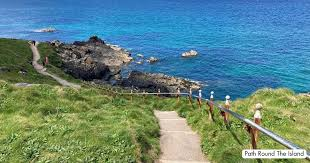
Together on the Island-
years passed before I knew it
to be an ancient coastal fort or castle.
With H.C. we might have climbed
the rock we called “Old Smokey”.
Or did we look and fish together
for mulllies together in rock pools?
We followed the older boys building dens
-of cardboard and canvas and pitched camps
In tents on the grass like Brutus
Before the battle of Phillipi.
Your father was a printer and to
my parents a cockney with fair hai rand
ran the youth club with judo in the schoolhouse
next to the textile factory, close
to the beach and the sea.
We traveled to Penzance daily on the buses
forgetting those cowboy films we watched on your TV,
we spoke little except,
I do recall staying off school your
coming around and telling me I had a detention.
What for I wonder?
Towards summer term in the third year,
I borrowed your exercise book
before the Physics exam, my own a mess,
and swotted up calorimetry. I could never
understand how a copper can could have a temperature.
Was it sick?
To my own surprise, I came top with
an absurd 98 per cent.So went on to
Measuring “g” with a swinging lath, like
a cricket bat with the Wing Commander
You went forward to Caesar’s Wars in
tripartite Gaul then Greek and Homer.
Where are you now I wonder>
With Russell Crowe in the Elysian Fields?
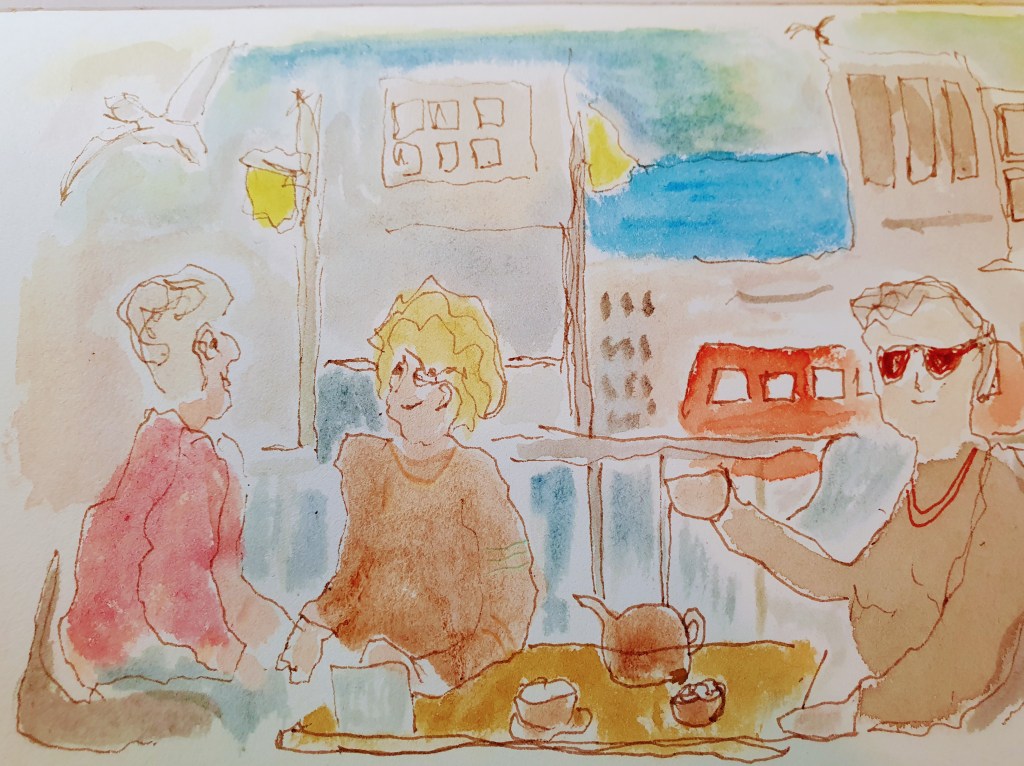
Three ladies settle in front of the Portugese Coffee House
in Market Jew Street.
I'm glad in a way,they are only taking drinks.
A teapot heralds a certain degree of bourgeois comfort, whilst the lady on the left sips her milkshake like a teenager.
They seem oblivious to the marauding prospect of seagulls.
The effect this sunshine spell on older skin doesn't bother them.
Above pound-stretcher a gull stretches his wings.
The black and yellow pennants flutter wildly in the in the incipient breeze.
A single-decker spreads a cascade of pollutants.
The outspread Guardian announces Johnson to be referred to the police by his own lawyers.
To me it feels like a temporary delicate interregnum.
Many years ago my French Master, somewhat radically inclined, offered to teach me Chinese. The condition was that I had first to ensure my French was up to scratch. Unfortunately I was scarcely up to the mark with the language but have in recent years got as far as reading a very easy version of Flaubert with an immense amount of pleasure. I did however have at least one lesson of Chinese and can still recall one or two phrases about writing a character on a blackboard. I also recall seeing on my schoolmasters desk a few copies of a magazine called “China Reconstructs”.
In a very different study overlooking St Ives harbour and bay, I saw a copy of the same journal. This was the study of a friend’s father who had been a brave member of the Chinese Inland Mission. One of the achievements of this famous organisation was to encourage the unbinding of women’s feet. A task interrupted by the Japanese invasion. There was a magnificent cat wandering around the house called “La Fu” and meals at my friends were frequently taken using chop sticks.

Large parts of Cornwall have unfortunately been subject to neglect and decline. A situation which appears to have got still worse under the Tories and due to Brexit. Much reconstruction of public services is urgently needed to avoid further poverty, ill-health and decline. The view below shows another side to Cornwall but unfortunately is all too common.

In both of these collections the sea and its various moods features. It is not just this that endears me in each case but it is that element that prompts me to write about them today. It is raining once again here in Cornwall and it is as the mists mizzle gather over the bay that I find myself in somewhat melancholy mood to respond to these collections.
Derek Mahon
Essentially this is a collection of essays by different writers together with Mahon’s poems. Here is one example- the poem-“The Sea in Winter” which was written for Desmond O’Grady. There are so many lovely passages in this poem which is fast becoming a favourite.-
Portstewart, Portrush, Portballintrae-
Un beau pays mal habité,
policed by rednecks in dark cloth
and roving gangs of tartan youth.
No place for a gentleman like you.
The good, the beautiful and the true
have a tough time of it; and yet
there is that Hebridean sunset,
The coast in winter, something familiar here in West Cornwall evokes feelings as in these engaging couplets:-
The sea in winter, where she walks,
vents its displeasure on the rocks.
The human factor appears too beside these images or pathetic fallacies-
………………………….; the spite
mankind has brought to this infernal
backwater destroys the soul;
it sneaks into the daily life,
sunders the husband from the wife.
Sunder seems a significant word here, perhaps evoking “thunder” and reminiscent of the biblical separation of “asunder”. ( The chariot and horses of fire “parted asunder” Elijah and Elisha (2 Kings 2:11). So we are situated on the bleak edge of the sea. Though not quite in the same mood state as T.S.Eliot-On Margate Sands./I can connect/Nothing with nothing./The broken fingernails of dirty hands./My people humble people who expect/Nothing.
There is an interesting piece on Mahon as the poet of place at https://www.tandfonline.com/doi/abs/10.1080/0895769X.2012.640266?journalCode=vanq20
In his comments on this poem, John Fitzgerald https://gallerypress.com/authors/a-to-f/john-fitzgerald/ says;
“I grew to love the poem’s complicit sense of ennui,bordering on but never quite reaching desolation, ‘living on the edge of space’; the memorable turns of phrase and allusive colour, both classical and contemporary; the sense of redemption just out of reach; the agonizing, trapped uncertainty of the writing life; all balanced against the consolation of confident, impeccable poetry.”

Evelyn Holloway
Evelyn’s book is published in English and German by Edition Sonnberg which is based in Vienna, where Evelyn was born in 1955. Perhaps the most interesting poem, it is for me, is Meeting which tells of Evelyn encountering Samuel Beckett in Oxford where she was a student in October 1973. I find that even with my poor German having the text in both languages somehow broadens the comprehension of the text.
Suddenly I see his face
stepped down from book covers,
a furrowed face, a landscape of thought
I waited for Godot,
saw people stuck in bins,
so many figures of his universe,
Now to return to the sea, a sea of memories- some perhaps repressed…….
ERRINERUNG IST EIN OZEAN OHNE SALZ
Ich kam hier um das Wrack zu sehen,
musste tiefer tauchen, tiefer.
Farben sind dort begraben,
Stimmen von der Zeit verschluckt.
Irgendwo in diesem Chaos,
ich bin irgendwo
verlassen,gefunden, und wieder verlassen
Atmen fällt schwer hier unten
Kunstweke hinter Mauern versteckt
Errinerung ist ein Ozean ohne Salz.
So that the memory can appear like a sea too, but one without salt. Memory and dreams have perhaps links to Vienna but the salty sea is close by in St Ives.
Here are just a few lines from WE ARE DANCING ROCKS (WIR SIND TANZENDE FELSEN)
We will outlast you.
Our salty eternity does not count the years.
We do not mourn the sand swallowed by the sea.
We are dancing rocks.
Her collection Words through Walls is published by Wieser Verlag ISBN 978-3-9504320-8-4
 penwithlit