
With Maupassant’s new version of Bel Ami portraying the belle époque, having recently been released in the UK, Forain is certainly of current interest. The trailer may be found at http://www.imdb.com/title/tt1440732/ Of course the well-known previous version was released by director, Willi Forst inGermany in 1939.
Forain was a French Impressionist painter, lithographer, watercolorist and etcher and has recently been the subject of some interesting and charming exhibitions. About his drawing the Spaightwood gallery, Upton MA ( http://www.spaightwoodgalleries.com/Pages/Forain2.html) says,”A participant in the Impressionist exhibitions of 1879, 1880, 1881, and 1886 and a close friend of Manet and Degas, Forain was considered one of the most important artists of the first few decades of the twentieth century, frequently compared to Rembrandt for his emotional power as an etcher. His drawings were regularly reproduced just as Daumier’s had been in the mid-19th century, but Forain’s not only ridiculed follies but sympathisize with the poor and the unfortunate. He was one of Ambroise Vollard’s stable of artists along with Renoir, Rouault, Chagall, Dufy, and many others.”
Forain was strongly influenced by both Daumier and Degas, the latter was a friend of some fifty years and acknowledged the closeness of their styles when he said, “He paints with his hands in my pockets”. Additionally Forain attended the famous heated debates which took place Édouard Manet and Edgar Degas at the Café de la Nouvelle Athènes. There is a particularly relevant and interesting discussion on the social history of such cafés and the development of the modernist movement at http://etd.lsu.edu/docs/available/etd-0903102-153114/unrestricted/Dees_thesis.pdf
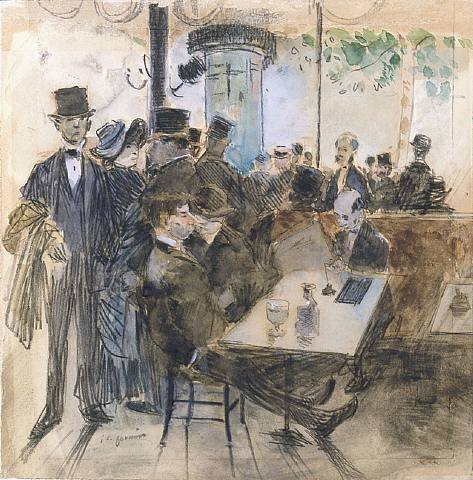
Certainly, Forain was an assiduous painter of the café scene as may be discerned from the early watercolour sketch “Au Café” circa 1872. The engaging atmosphere and general bonhomie of the scene, perhaps in Spring depicts clerks and businessmen taking a breather at lunchtime, lovers meeting and the overarching foliage providing the shelter to bavarder over a glass of wine. The poise indicated by the extended legs of the figure seated at the table completes the mood. The influence of Daumier is certainly present; Forain was about 22 or 23 years old.
As is well known, Jean-Louis Forain had a ready wit and was the associate of Rimbaud, Verlaine and in particular Joris-Karl Huysmans. It was Arthur Rimbaud who wrote in a fragment,” Le haut étang fume continuellement. Quelle sorcière va se dresser sur le couchant blanc? Quelles violettes frondaisons vont descendre ?” Which has been translated as.”The upland pond smokes continuously. What witch will rise against the white west sky? What violet frondescence fall?” This is reminiscent of a lovely painting by Forain entitled Young woman standing on a balcony contemplating the Paris Rooftops, 1890.It was completed in Watercolour with black Conté crayons, red chalk and brush on paper and is to be found in theVancouver Art Gallery. It is appears as an early prototype of the bandes dessinées and the woman’s left profile stance resembles the figure in Seurat’s roughly contemporaneous Sunday Afternoon on the Island of La Grand Jatte,1884–1886.
An idea of the range of Forain’s work may be obtained from a suitable search such as http://www.flickr.com/search/show/?q=Jean+Louis+Forain&z=e


 penwithlit