Wir saßen mal wieder im Café Sunrise, bestellten Espresso und bekamen, wie immer, Mokka. Genüßlich nippte Jojo am heißen Bohnengebräu, lehnte sich zurück in den Polsterstuhl, schloss die Augen und ließ sich die Mittagssonne ins Gesicht scheinen.
„Was stimmt hier mit dem Service nicht, Frankie?“
„Was meinst Du?“
Jojo zeigte mit dem Finger auf den Mokka. „Den Espresso!“
„Achso, es wird wohl am Arbeitsdruck liegen.“
Jojo öffnete kurz die Augen, um sich umzusehen. Die Tische waren spärlich besetzt, von Servicekräften keine Spur. „Ja natürlich, das wird es sein.“
During lockdown I rediscovered my joy of knitting, and recently many of my friends have become grandparents. I haven’t been able to unlock the multi-tasking skill of reading while knitting, but listening to audiobooks with needles in hand is quite achievable, and a great way of finally clearing some chunksters from the TBR. Last month I also indulged in a little supportive role play – everyone has heard about the women who sat knitting by the guillotine during the French Revolution, haven’t they?
These days it’s hard to imagine Hilary Mantel taking 13 years to find a publisher, but that is what happened here. It took her four years to write – from 1975 to 1979 – with the novel finally published in 1992. But in those days Mantel wasn’t the giantess of historical fiction that she is these days, and a novel of 880 pages would be quite a…
In 1886, the former Impressionist artist Paul Signac (1863-1935) made the transition to Divisionism, using the fine dots distinctive of what’s widely known now as Pointillism(e). This change may well have been precipitated by his friend Camille Pissarro, who switched in January, and must have been greatly influenced by Georges Seurat, who moved into a new studio next door to Signac’s in June.
Paul Signac (1863-1935), Les Gazomètres. Clichy (Gasometers at Clichy) (Op 131) (1886), oil on canvas, 65 x 81 cm, National Gallery of Victoria, Melbourne, Australia. Wikimedia Commons.
This painting of Gasometers at Clichy was one of the first of his excursions into this new territory. This is one of a quite large group of views that he painted of the immediate vicinity of his family’s house, several of which show similar industrial motifs. Although they might appear mundane today, at the time these gasometers were novel, and…
Each month Peter Millar, a long-time member of the Iona Community shares a reflection. At Easter it took the form of a poem which Peter asked readers to share with others.
Reference – There is no copyright on this poem. No quotes from others. It would be great if you could share it in these days of Lent and of Easter. Thank you and let us hold God’s amazing world in our hearts. Peter.
Easter2022 Every new day across our planet there is a constant certainty moving in our midst - it is this: violence, disconnection and radical change are our sure companions and disturbers. Sometimes the whole edifice spins too fast as we ponder the human future and the divisions that ensnare us. Yet within these shadows are fragile possibilities of light always inviting us to engage with other visions and truths - ones that spring from our depths:…
Through the heat of the day it did nothing but fidget and whine,
Now it snuffles under the dew and the cold star-shine,
And lies across my heart heavy as lead,
Heavy as the dead.
This beautiful poem by STW is another poem about the flight of refugees. It almost certainly relates to the civilian escape from Paris as it fell in 1940, It conveys both the weariness and the worry of a woman escaping with a child who is not her own and unfortunately there must be many such examples of such experiences among refugees from Ukraine at the present time. The next lines reveal that the story is being reported by an observer.
Why did I lift it, she said,
Out of its cradle in the wheel-tracks?
On the dusty road burdens have melted like wax,
Soldiers have thrown down their rifles, misers slipped their packs:
Yes, and the woman who left it there has sped
With a lighter tread.
The poem continues to discuss the rescuers ambivalence towards the child being rescued. there are echoes of the Scriptural verses of Matthew 24:19 –
And woe unto them that are with child and to them that give suck in those days!
and also of Mark 13:17
Townsend-Warner finishes with these poignant lines which might also be those of a similar refugee from the Ukraine, Syria, Afghanistan or elsewhere:-
But since I’ve carried it, she said,
So far I might as well carry it still.
If we ever should come to kindness someone will
Pity me perhaps as the mother of a child so ill,
Grant me even to lie down on a bed;
Give me at least bread.
Here is another moving poem by Townsend Warner from You Tube where you can also find her own reading of this second poem.
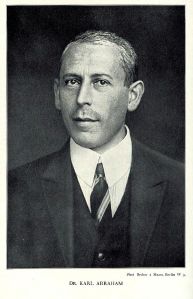
Karl Abraham (03 May 1877 to 25 December 1925) was an influential German psychoanalyst, and a collaborator of Sigmund Freud, who called him his ‘best pupil’.
Life
Abraham was born in Bremen, Germany. His parents were Nathan Abraham, a Jewish religion teacher (1842-1915), and his wife (and cousin) Ida (1847-1929). His studies in medicine enabled him to take a position at the Burghölzli Swiss Mental Hospital, where Eugen Bleuler practiced. The setting of this hospital initially introduced him to the psychoanalysis of Carl Gustav Jung.
Collaborations
In 1907, he had his first contact with Sigmund Freud, with whom he developed a lifetime relationship. Returning to Germany, he founded the Berliner Society of Psychoanalysis in 1910. He was the president of the International Psychoanalytical Association from 1914 to 1918 and again in 1925.
Karl Abraham, Psychoanalyst.
Karl Abraham collaborated with Freud on the understanding of manic-depressive illness, leading…
This must have been a brilliant adventure! My parents were in Oban during the war where my father was an aircraft fitter making modifications to Bristol Beaufighters and Blenheims. Fortunately, your trip was much more peaceful!
Every year the Lady of Avenel needs a refit to prepare her for her working season. The Lady of Avenel is an 102ft square rigged brigantine, currently based near Oban, on the west coast of Scotland. This year I went up there to join the working party for the refit.
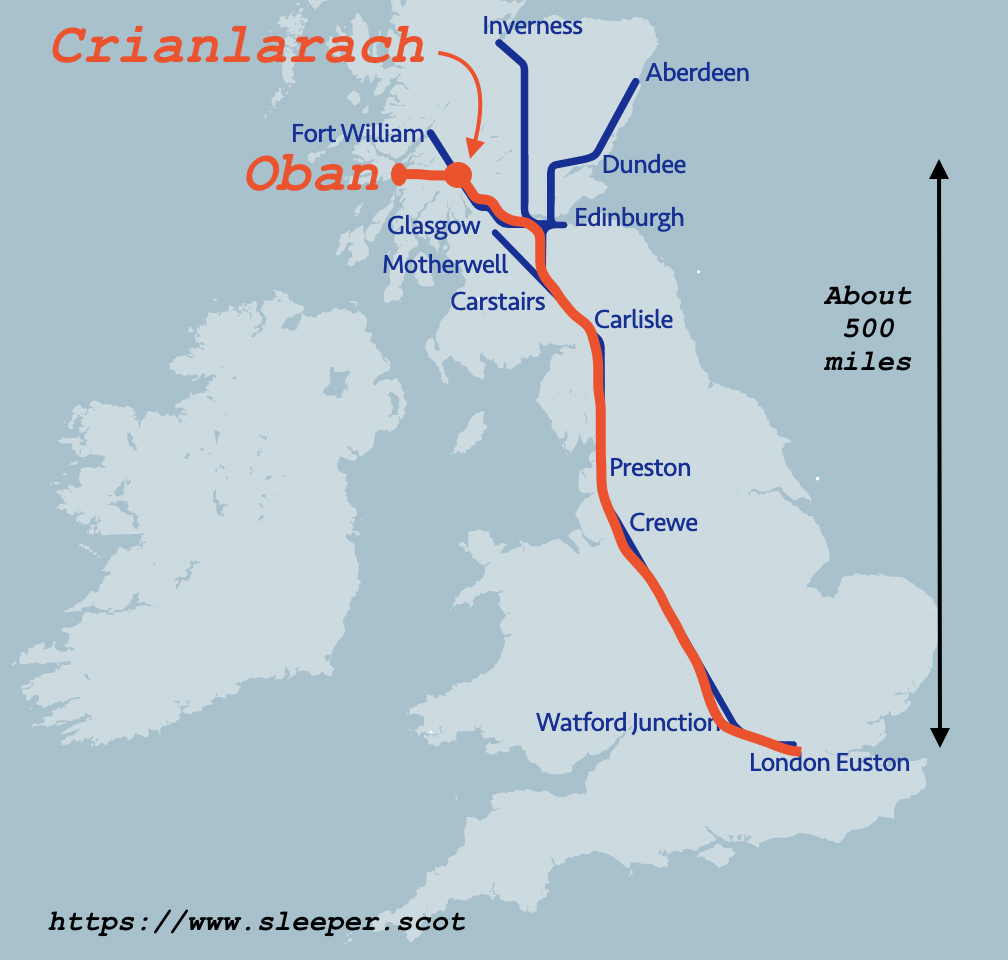
I travelled by overnight train from Euston to Crianlarach.
Journey via the Caledonian Sleeper from London to Oban. Map from the Caledonian Sleeper webpage. The overnight journey takes about 10 hours Euston-Crianlarach. Then I caught a local train Crianlarach to Oban.
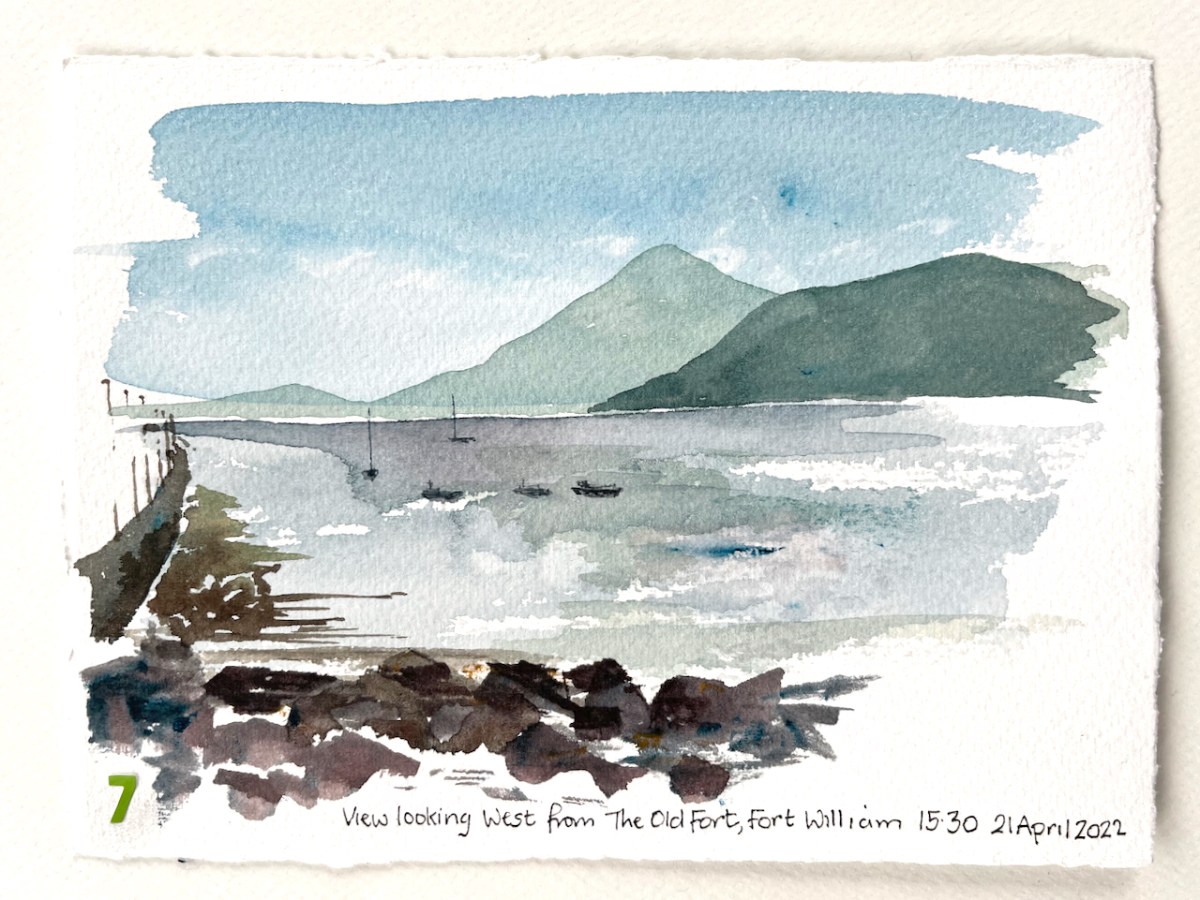
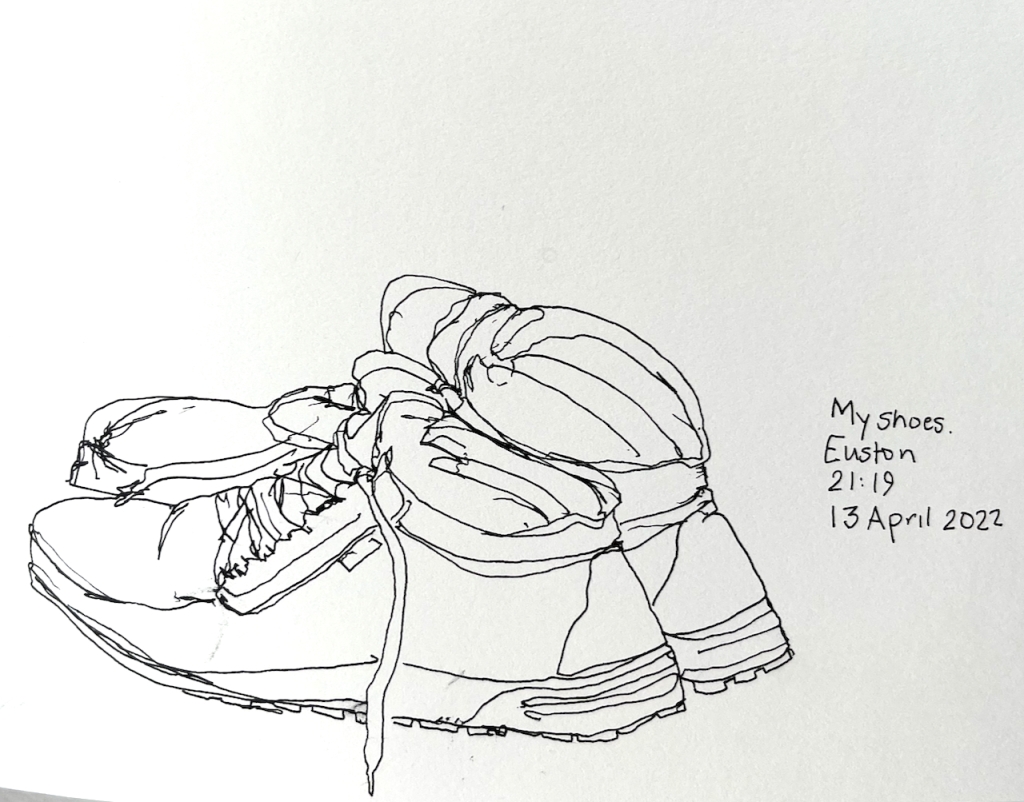
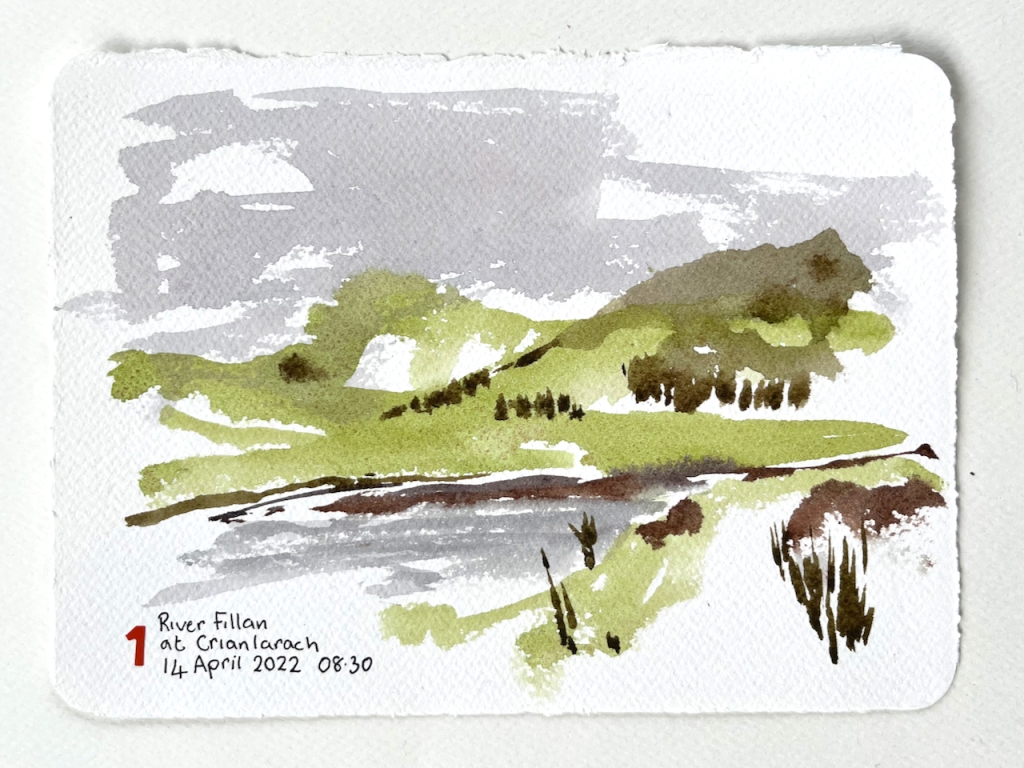
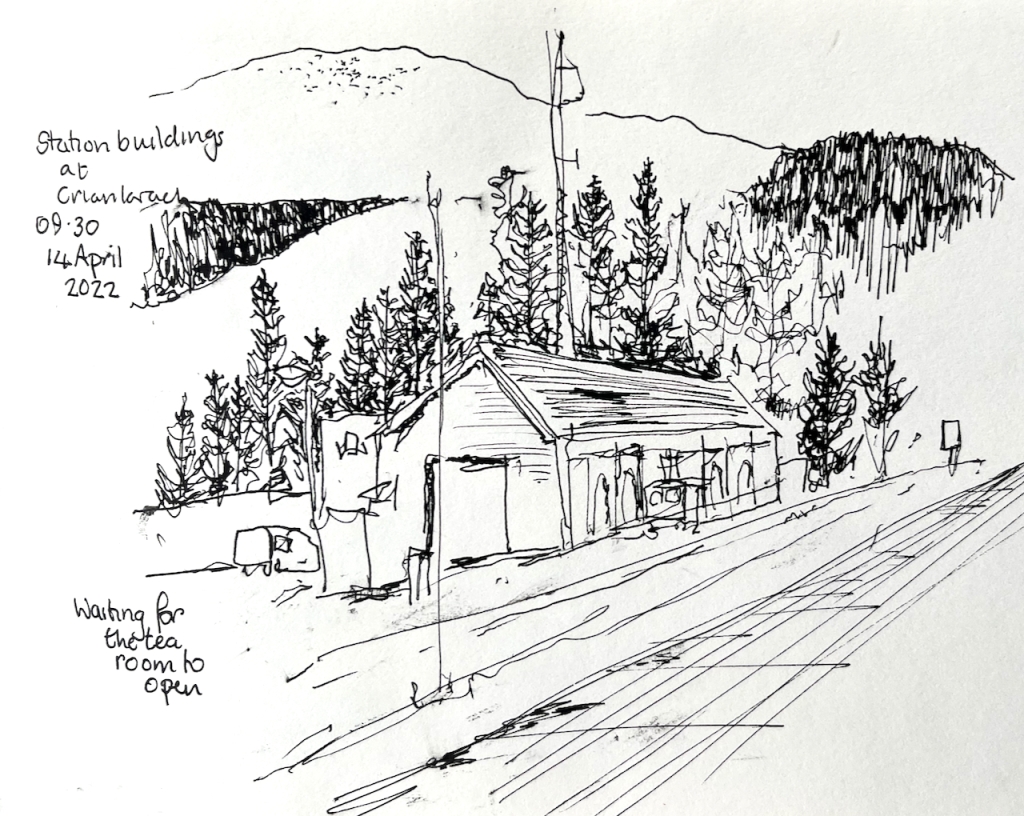
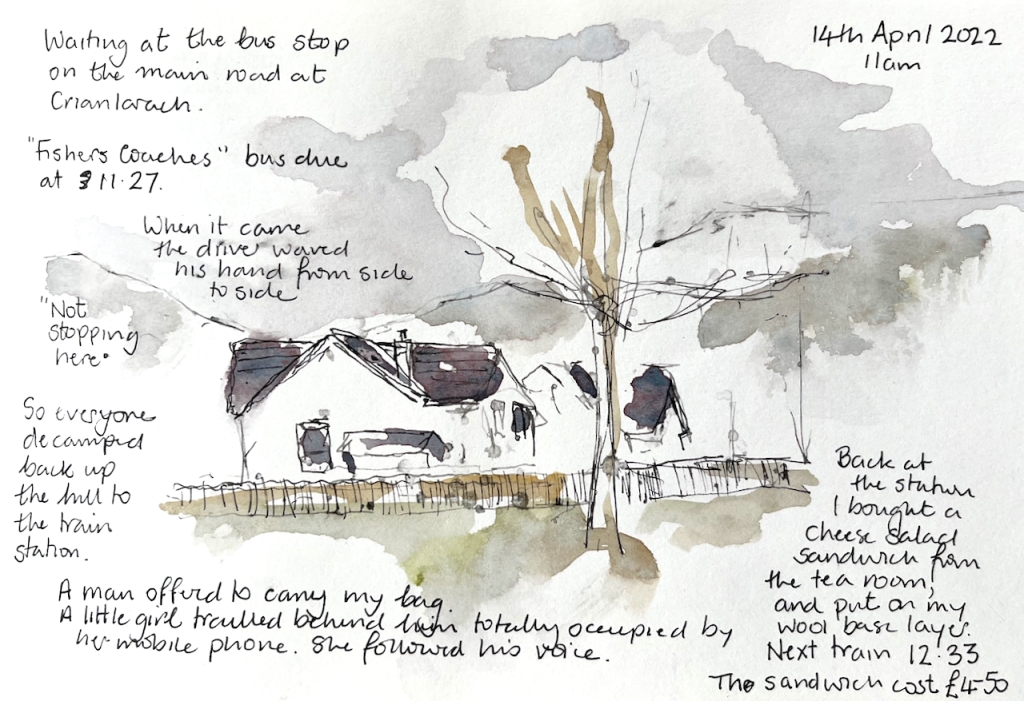
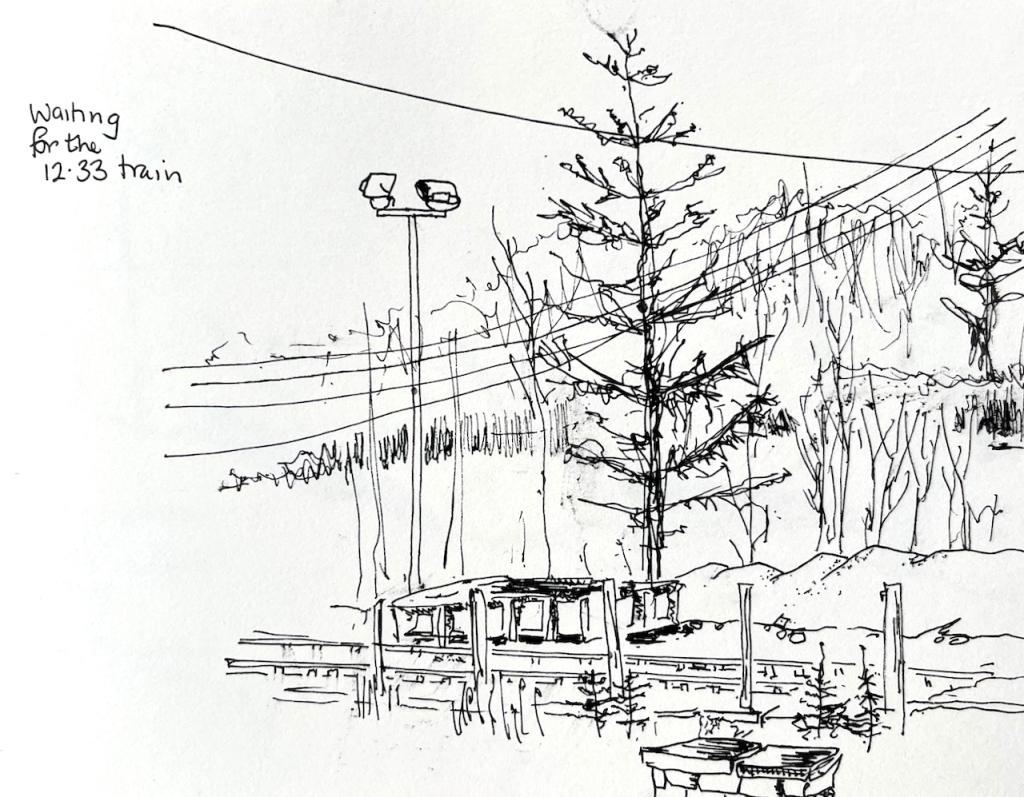
I drew some sketches on the journey.
I sketch my shoes before going to sleep on the train.Arrival at Crianlarach: a walk to the nearby River FillanWaiting for the train to ObanThe train is cancelled. Waiting for a bus on the main road. The bus doesn’t stop. Probably it is full. Back at the station, waiting…
has to fight its way through every scattered grain.
I had not heard of Herbert, born 1961 in Dundee until I recently came across this poem in Ruth Padel’s instructive collection; The Poem and the Journey -60 Poems for the Journey of Life. It appeals to me very much and I am asking myself just why.
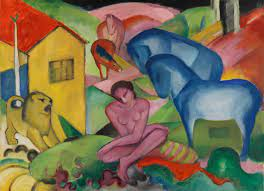
These first eleven lines interweave the process of getting up for breakfast with the contrasts in the outside landscape. Being cold and having no clothes on and breakfast itself – perhaps “Frosties” (crunch sucrose flake) and perhaps a suggestion of tiredness or exhaustion. The gradual awakening takes place with engaging contrasts as Padel makes clear in her own interpretation. There is cold sharpness against and before the sunlight. There are contrasting colours orange-yellow with the blue flanks of the horses. An image which might suggest the paintings of Franz Marc.
Then there is the poet’s usage of engaging tropes like “cold was urban” and “sepia…medieval photographs”. These encourage the reader to use his imagination. It is interesting too that the latter photo image reinforces the element of time which is clearly passing along during the course of the poem.








 penwithlit