Here is the Bristol Community Dance Centre on the Jacobs Wells Road.
Bristol Community Dance Centre, Jacobs Wells Road. 12:15, 23rd March 2022 in Sketchbook 11
This is building is special for me. Here I learned how to stand up straight, and I learned where my feet were. Or rather, I learned how to learn those physical things, or I learned that they could be learned. My teacher was a dancer, Helen Roberts.
Earlier on, many years previously, in another town, in a different life, I had been to a performance by London Contemporary Dance Theatre. There I saw, for the first time, movement as language. The way I described it to myself was: “First they teach you a language, then they talk to you in it.” That, for me, was Contemporary Dance. Once I’d seen it, I wanted to do it.
Once again I have been reading Christopher Reid and again finding his poetry both lyrical and accessible. I recently found a poem in his collection, “For and After“(2003) which is intriguingly entitled Bermudapest and is dedicated to Clariisa Upchurch and her husband George Szirtes. It begins:-
A place I’ve never been, but which, at back of my mind’s eye, I know I’ve seen:
its stately apartment blocks beginning to melt in the mid-morning blaze, its beach cafés
loud with the laughter of chess-players and philosophers. And there’s the postcard view you’ll know it –
Now although the title has an ambiguity about it perhaps suggesting an imaginary destination, I can only read a few lines and think upon the city of Odesa. A city about which I only know but a few matters but one whose cosmopolitan nature makes it onto my wish list for a visit. Having seen those famous steps in Eisenstein’s “Battleship Potemkin” in the early 70s started my interest. Re- kindled by a minitrek to Istanbul and Princes Island then I bought Neil Acherson’s Black Sea. Then again reading about the trade of the Euphrasi family in de Waal’s Hare with the Amber Eyes stimulated my interest further.
Reid’s lovely poem talks of a lively city with…..
loud with laughter
of chess players and philosophers.
And there’s a postcard view-
you’ll know it
However, the city which has grasped my imagination through reading this poem is awaiting the armed assault of the invader. The sandbags surround the elegant statues. The town where Pushkin was in exile which was always a cosmopolitan treasure awaits another barbarous incursion .A large portion of the dwellers have already left their homes fearing the sort of destruction meted out to Mariupol now some 13hours journey away to the East.
There is a certain irony in the last lines in which a guitar playing poet flavours his words with…
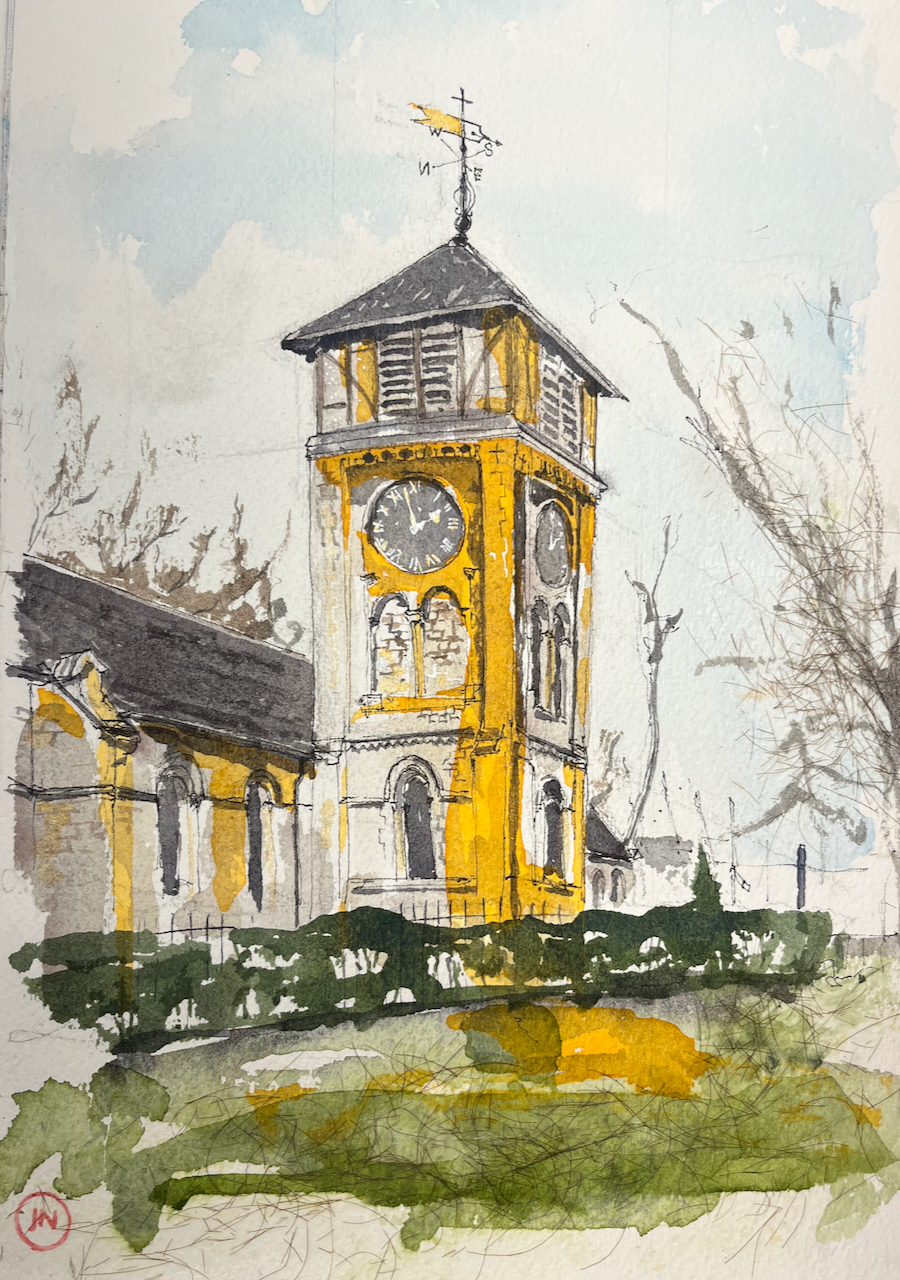
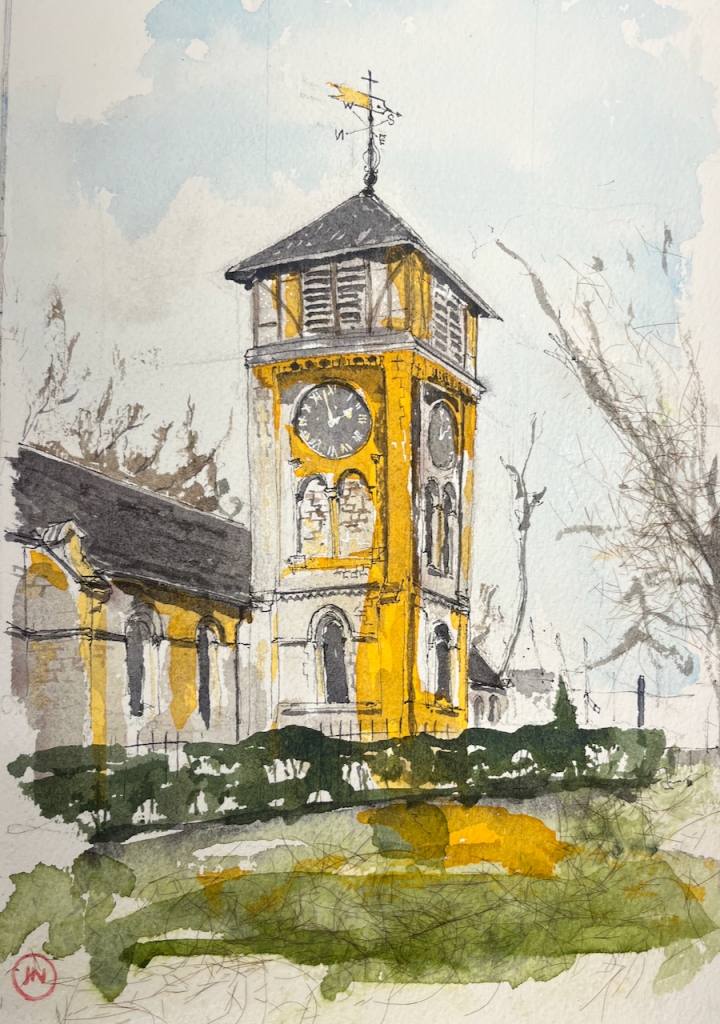
On a sunny day I went to draw a church tower in a country churchyard. The churchyard is near Kings Cross and the church tower is that of St Pancras Old Church.
St Pancras Old Church, tower. 20th March 2022 10″ x 7″ in Sketchbook 11
I sketched sitting on the grass beside the River Fleet, while the river flowed behind me, in my imagination.
It’s a real river though. These days it’s under St Pancras Way. But it used to flow by the church.
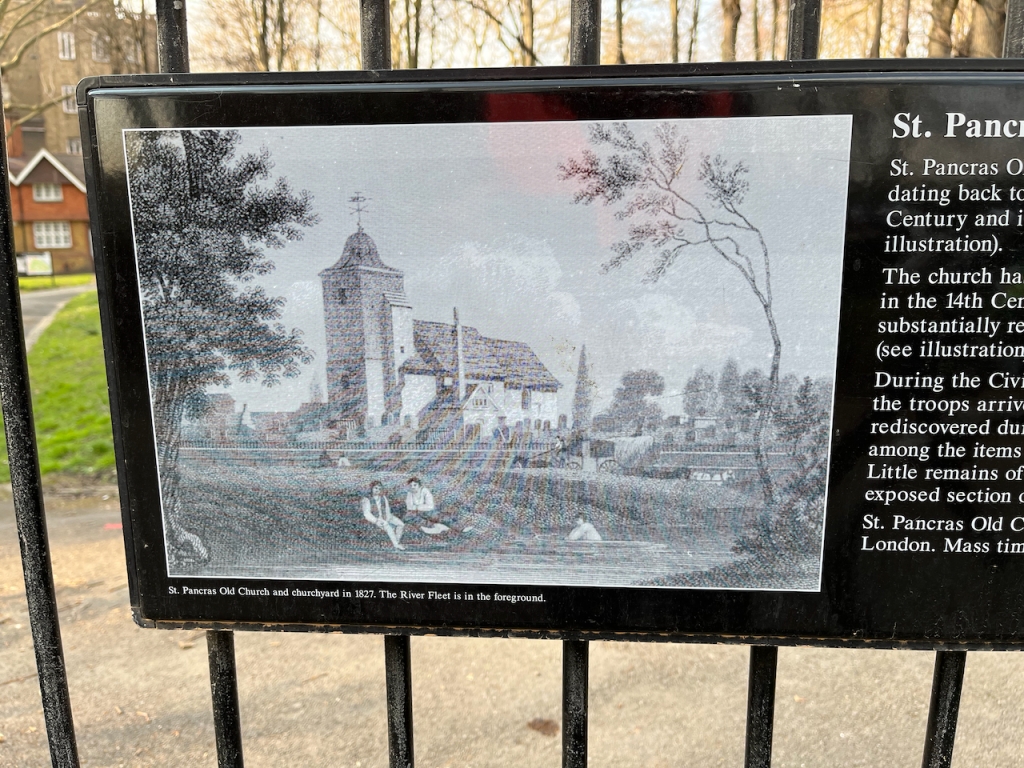
“St Pancras Old Church and churchyard in 1827. The River Fleet is in the foreground.” notice on the railings of the churchyard.
As you see from that picture, in 1827 the church looked very different. The south tower which I sketched is not as ancient as it looks. It was constructed in 1847 to the designs of A.D. Gough.
The European Bank for Reconstruction and Development (“EBRD”) Literature Prize was created in 2017 and is awarded to the year’s “best work of literary fiction”, translated into English, from the Bank’s countries of operations, and published by a UK publisher.
There is a €20,000 prize which is split equally between the author and translator. The two runners-up and their translators receive a prize of €4,000 each.
Past winners:
2018 – ‘Istanbul, Istanbul’ by the Turkish author Burhan Sönmez and his translator Ümit Hussein.
2019 – ‘The Devils’ Dance’ by Hamid Ismailov and translated from Uzbek by Donald Rayfield (with John Farndon)
2020 – ‘Devilspel’ by Grigory Kanovich and translated from Russian by Yisrael Elliot Cohen
2021 – ‘The King of Warsaw’ by writer Szczepan Twardoch and translated from Polish by Sean Gasper Bye
The judges for the 2022 Prize are Toby Lichtig (Chair), the Fiction and Politics Editor of the…
“I never asked myself about the meaning of freedom until the day I hugged Stalin. From close up, he was much taller than I expected. Our teacher, Nora, had told us that imperialists and revisionists liked to emphasize how Stalin was a short man. He was, in fact, not as short as Louis XIV, whose height, she said, they – strangely – never brought up. In any case, she added gravely, focusing on appearances rather than what really mattered was a typical imperialist mistake. Stalin was a giant, and his deeds were far more relevant than his physique.” (p. 3)
You might imagine that Free would be the driest of books. Lea Ypi is around my age, but the parallels stop there, as she is also an intimidatingly successful Professor of Political Theory at the LSE, who speaks about seven languages fluently. Her other books have titles like The Architectonic…






 penwithlit