Categories
Art Exhibition Reviews Penwith

The 2013 International Art Fair followed by Nancy Pickard and Simon Turner at the Cornwall Contemporary

Having just returned from the International Art Fair http://www.20-21intartfair.com/ in Kensington Gore, where I was particularly taken, indeed entranced by the Artists of Russia  stand, it was great to see the quality exhibition of Nancy Pickard’s work together with that of Simon Turner at the Cornwall Contemporary here in Penzance. The Art Fair in London was great fun where I not only saw for the first time work of the German Expressionist, Käthe Kollwitz (July 8, 1867 – April 22, 1945) but also discovered the lovely paintings of  Olga Oreshnikov. (http://www.artistsofrussia.com/olga-oreshnikov)

Whispered Aside by Olga Oreshnikov
Kathy KollwitzB rother_Love/ Verbrüderung
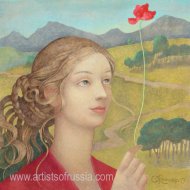
Country Girl Olga Oreshnikov
Country Girl
Olga Oreshnikov

olga-oreshnikov-14263As Julian Ravest has written, “In 1990, Olga immigrated to Israel. She works in oil, tempera, watercolour, and gouache in a unique style. Her paintings are humorous, symbolic, and yet serious in content, meticulously executed and with a fresh and dreamlike quality. Her assured drawing, elaborate composition and rich use of colour are in the tradition of European painting. Her images and landscapes seem to be from a different timeless world, telling stories that are tender, dreamy, overpowering and seductive.” I was particularly taken by a work, an acrylic, called “Whispered Aside” which has a theatrical and magical quality about it. The expression on the face of the aging sailor and the slightly astonished young actress transported me to some imaginary dramatic venue in St Petersburg. The quality of execution in this painting too was quite extraordinary and delightful.

In “Garden Light”, Orishnikov has depicted an ingenue, endearingly innocent amongst a cavern of leaves, peering into the distance under her straw bonnet and surrounded by blossoming  mauve flowerheads. She clasps her hands in a gesture that reinforces her distance as an observer and suggests her naivety. Tragicomedy, flora and contemplation combine in her work to embody an elegant exuberance. This is repeated in “Country Girl” where the girl cherishes a crimson sweet pea  and beholds the blossom on the spindling stem.
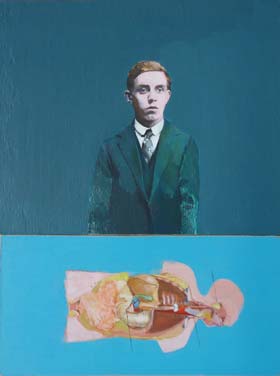
The Anatomist by Simon Turner

Arriving this sunny morning at Sarah Brittain’s delightful gallery in Parade Street Penzance, my attention was drawn to Simon Turner’s bearded “Landlady” painted on found panel. Many of these pictures seem to have a Victorian or Edwardian quality, perhaps a little reminiscent of Monty Python. These reminded me a little of Adam Birtwistle’s portraits which I had recently seen displayed at King’s Place, http://whosjack.wpengine.com/wp-content/uploads/2010/01/adam.png especially in relation to the horizontal structuring of the composition. Simon’s surreal playfulness shown in several zany mosaics are a nostalgic  investigation into time, dream and reminiscence. I particularly liked  “Man sending an e-mail”.stmansending

Nancy Pickard, Black Tulips oil on canvas 50 x 50cm
Nancy Pickard, Black Tulips
oil on canvas 50 x 50cm

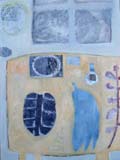
The exuberant compositions of Nancy Pickard, however, made the visit. Nancy, who has been in Cornwall for over ten years now is clearly influenced by the landscape and the sea. It is the blue luminescence of  her inspiring canvases that drew my attention. It is the domestic peace of these compositions which attract the eye, which is echoed in her ceramics. Her delightful work may be viewed at http://www.nancypickard.co.uk/gallery.html
npblue

Cantaloupe Nancy Pickard,  oil on canvas 50 x 50cm
Cantaloupe
Nancy Pickard,
oil on canvas 50 x 50cm
Categories
Uncategorized

Character Development Worksheet

For potential novelists…..

Categories
Uncategorized

Porthminster Cook Book – The Launch!

For those who visit St Ives……

lucycornes's avatarPorthminster Beach Café

Our brand new cook book was finally unveiled at a party at the restaurant on Friday 17th May. Regular diners celebrated alongside journalists and leading figures from the Cornish hospitality industry, hosted by Executive Chef Michael Smith and the team.

As well as a Foreword written by Nathan Outlaw, whose restaurant in Rock holds two Michelin Stars, the book has been further endorsed by Heston Blumenthal. Heston, whose restaurant The Fat Duck consistently receives the highest accolades in the whole of the UK, was pleased to recommend Porthminster as a “favourite holiday eating spot of mine,” going on to praise “inventive cooking and a gorgeous location.”

We would like to thank Champagne Louis Roederer, Polgoon and Matthew Stevens & Son Fish for their sponsorship on the night.

The book is now available to buy from the restaurant and online.

Guests were served a taste of various recipes from the book, as well…

View original post 34 more words

Categories
Uncategorized

Cornish Sea glass

This looks attractive..

lucynewman2013's avatarCornish Seaglass

Since moving to Cornwall collecting seaglass has been a passion of mine and a hobby that can be enjoyed by the whole family. For those of you that don’t know, seaglass is otherwise known as beach glass or ‘mermaids tears’. It is old pieces of glass that have been discarded into the sea and have been broken and moulded by the sea tossing and turning them over the years turning the shards into frosted gems of glass. Cornwall has some of the best beaches in the world for searching for these hidden gems and can reveal a surprising array of different colours, shapes, sizes and types, many well over 100 years old. These can range from the rarest colours , orange , yellow and turquoise generally from tableware of the early 1900’s, to the more common greens and brown of the early wine and beer bottles and a huge range…

View original post 202 more words

Categories
Literature Poetry Uncategorized

The Walk; A collection of short stories by Robert Walser

Newly published collection

The publication of this collection of around forty short stories from Serpent’s Tail books affords the English speaking public a unique opportunity; that of reading Walser, possibly the leading modernist writer of Swiss German in the last century. He has received high praise in A Place in the Country, W.G.Sebald’s recently published posthumous collection and he is well-known as being a significant influence on Franz Kafka. His work here dates from 1907 to 1929 and along with his poetry won him recognition with Berlin’s avant garde. He combines lyrical delicacy with detailed observation; reflective melancholy with criticism of brash commercialism. The fine writing in this volume strives to achieve a hard won integrity together with an experimental capacity for reflection. It challenges the reader and provokes him to new insights.

Referring to Walser’s ten page account, Kleist in Thun, written in 1913 Susan Sontag in her introduction states, “Wasler often writes from the point of view of a casualty of the romantic visionary imagination”. Walser describes how Kleist, an intense poet of High German Romanticism arrives in a villa in the beautiful Bernese Oberland. Kleist is overwhelmed and disturbed by his own response to what appears to him as the artificiality of his surroundings, as though it were all a sketch by a clever scene painter in an album with green covers. “Which is appropriate. The foothills at the lake’s edge are so half-and-half green, so high, so fragrant”. The changes in the weather and the seasons are portrayed as Kleist struggles with his own historical writings which he is forced to destroy over and over. This piece portrays with sensitivity Kleist’s struggle for the peaceful moments when he can feel again the outright happiness of a child. All that now remains is a plaque on the wall to commemorate the poet’s visit.

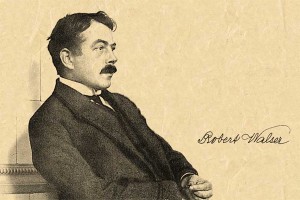
Robert Walser, Swiss poet and writer

Written over an extensive period these tales vary in tone from the surreal “Trousers” to the strange voyage of a captain, a gentleman and a young girl over the luminous course of the Elbe in “Balloon Journey”. In the more psychologically interesting “Helbling’s Story”, a bank clerk finds that he is feckless in time keeping and prefers the self-forgetfulness of dancing. His pursuit of his lively fiancée reveals that her sweetness tempered by her faithlessness. He seems caught between how he is perceived by his colleagues at the bank and his deep yearnings for isolation to the point of oblivion. There is a degree of Weltschmerz in some of these tales but worth the effort. Gradually, they repay the reader with their strange charm.

The longest story of sixty pages, “The Walk”, is an account of the writer venturing forth in his English yellow suit and recording his strongly felt impressions of the people, countryside and architecture that he encounters on a fine morning. As he gets into his stride, he remarks,” Spirits with enchanting shapes and garments emerged vast and soft, and the country road shone sky-blue, and white and precious gold”. Written in 1917, it also reveals his impressions of noisy cars passing by and of intrusive advertising in all its brashness contrasting with this rural idyll. He visits the post office, his tailor and goes to pay his taxes. Nothing escapes his eye, wild strawberry bushes, rivulets, the innocent play of children, honest black-jet dogs and he is almost hypersensitively given to reflect too upon the impression he makes upon others. Into this prose poem enter curious character like the odd lanky beanpole of a fellow called, Tomzack, who travels restlessly and devoid of human connection. Then with Swiss punctuality he dines with a cordial gracious lady that had previously been an actress. His self-justification and need for recognition attain huge and angry proportions when he negotiates his tax payments and it is at this point that his writing brings Kafka to mind. Out of this dense writing emerge passages with a sense of monumental grandeur and an awareness of transcending grace.

sriimg20030414_1763336_1

In addition to his value as a great writer, Robert Walser also affords the delights of entering a past world, that of Switzerland, a land isolated by the partial protection of its neutrality. The elegance of this past together with his sensitive impressions, including the already crowding and wearying pressures of commercialism, adds an extra level of piquancy. Joseph Roth, a well-known contemporary who also had a developed taste for irony, on arrival in Berlin, wrote in 1921, “The diminutive of the parts is more impressive than the monumentality of the whole”. In Walser’s writing we continually encounter this same fascination with the fine entrancing detail of small and beautiful things.

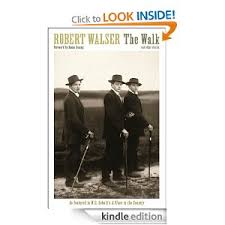
The cover image by August Sander shows three smartly dressed young farmers in Westerwald, although not entirely appropriate, makes an elegant jacket to these varied stories of imagination and vision.

A You Tube programme for German speakers is at http://www.youtube.com/watch?v=twMopurvK8g  Portrait und Erinnerungen

Berlin Stories Another available selection
Berlin Stories
Another available selection
Categories
Uncategorized

The Shapes of Stories by Kurt Vonnegut

Interesting and intriguing,

Categories
Uncategorized

Austerliz ~ W. G. Sebald

Anyone into the magnificent Sebald?

Categories
Book Reviews German Matters

The Aftermath by Rhidian Brook -Filmed with Keira Knightley and Alexander Skarsgård

Ruine der Volksoper, Hamburg


The Aftermath is set amongst the devastated ruins in the fire-bombed city of Hamburg in 1946. The British have occupied the ruined city and Colonel Lewis Morgan, an officer and a gentleman, is charged with overseeing the restoration of order. However, Colonel Morgan must first deal with the human cost of the bombing including remnants of fanatic Nazis, the trummerkind – children of the rubble, and the starving civil populace. He also, in 1943, lost a child due to a Luftwaffe bomb and he must support his deeply grieving wife, Rachel, when she arrives after months of separation with their surviving twelve year old boy, the impressionable Edmund.

The drama is intensified when Colonel Lewis has to requisition a splendid villa for his own use and allows the owner, Herr Lubert, a German architect and significantly, a widower, to remain in the house with his own surly, indoctrinated daughter, Freda. There is also a retinue of domestic staff somewhat resentfully having to deal with a new English lady directing their activities. Morgan’s decisions look somewhat naïve but he feels he must set his men a positive example in forging the peace. Has he taken on the personal equivalent of ‘A Bridge Too Far’?

The novel begins with a German youth wearing a British helmet as he claws his way through the pulverised city heaps. He is dressed in an assortment of clothes pilfered and purloined from both the invading and defeated forces. The boy weaves his way with his wild gang of friends, the ferals, through the fractured cityscape. His face is dirty, his limbs are numb with the cold and he is hungry to the point of collapse. He represents the incipient future of Germany and is seeking to destroy the beast of the Nazi past.

In more comfortable surroundings, Colonel Lewes is allocated a house towards the ancient fishing suburb of Blankenese in sight of the winding, partially frozen expanse of the lower Elbe, situated in the grand and historic avenue of the Elbchaussee. His junior aide describes it as, A bloody great palace by the river. Originally, this belonged to the family of the deceased wife of the current owner; they were prosperous people who ran a number of flour mills. Lubert, the Hamburg citizen to whom the villa now belongs, is mourning intensely for his lost wife and appears a civilised man, an architect of considerable imagination. However, he has not yet received his certificate of clearance. This is the so-called Persilschein, which must show him to be free of Nazi connections. Lubert has yet to supply his answers to the 133 questions of the Fragebogen before he can obtain clearance from the Control Commissions Intelligence Branch. Will he be categorised as Black, Grey or White? What about his unhappy daughter, indoctrinated as a Hitler Madel and exploring her developing sexuality by bitterly taunting the English boy, Edmund, when he arrives with his own distraught and emotionally unavailable mother.

The Rhidian

The novel which Rhidian Brooks has written has three qualities to recommend it. Firstly it has a narrative with a cinematic pace to it, giving an irresistibly engaging insight into the troubled times immediately after the war. It is informative about events as various as the firestorm raids, the details of how officer’s wives socialised and did their shopping which is compared with the shortages and rationing under the Attlee Government back in Britain. It is compelling too on the process of démontage by which German war industries and other factories were destroyed partly in accordance with agreements negotiated with Soviet forces. This was not to prevent the building of the Berlin Wall and the division of Germany which, as is pointed out, takes place shortly afterwards.

Secondly, beyond this engaging portrayal on the military and political level, Brook has written a novel which is emotionally intriguing, sometimes uncomfortably so as it deals with the betrayals and unforeseen effects of individuals trying to struggle with painful feelings of love and loss in a period of mistrust and change. This is an honest attempt to show sympathy for individuals caught up in a whirl of actions with unintended consequences. A world into which Brook, the author, has a personal insight; his own Grandfather had been involved in a very similar situation to that of Colonel Lewis and family.

Ausgabe der Schulspeisung

Finally this well-constructed novel is interesting for the manner in which it reflects upon contemporary concerns. Some of these relate to the honourable Army officer. There is, for instance, some measure of Christopher Tiejens about Colonel Lewis Morgan from Maddox Ford’s great novel recently adapted for television, Parade’s End. There is also a renewed interest in the culpability of the enemy and also some of the rough justice meted out in the initial phase of the occupation – subject too of the currently intriguing film, Lore adapted fromThe Dark Room by Rachel Seiffert. This novel raises the question of how a defeated country might be re-established and the deeper personal meaning of loyalty, forgiveness and restitution. As we continue to ask ourselves if we have maintained and protected that fair society on which security might be built since 1945, this thoughtful book makes a sincere contribution to an ongoing debate.

Categories
Uncategorized

Reading Translated Fiction/ Uebersetzte Literatur lesen #iffp

Spot my own spelling mistake!!!

Categories
Literature Uncategorized

NIGHTHAWKS nach Edward Hopper’s Bild – Wolf Wondratschek

Nighthawks by Edward Hopper

Es ist Nacht

Und die Stadt ist Leer.

Die Glücklichen sind zu Hause

oder noch wahrscheinlicher,

es gibt keine mehr.

Auf Hoppers Bild sind vier Menschen übriggebleiben,

sozusagen die Standardbesetzsung:

der Mann hintererm Tresen zwei Männer und eine Frau.

Kunstfreunde, Ihr könnt mich steinigen

aber diese Situation kenne ziemlich genau.

Zwei Männer und eine Frau,

als ob das ein Zufall wäre-

Ihr bewundert den Bildaufbau,

mich packt das Lustgefühl einer

volkommenen Leere

Geredet wird nichts, was auch?

Beide rauchen sie aber nirgendwo Rauch.

Ich wette, sie hat ihm einen Brief geschreiben.

Was auch immer drin stand, er ist nicht Mehr der Mann,

ihre Briefe zweimal zu lesen.

Das Radio ist Kaputt,

Die Air-condition dröhnt,

Ich höre das Heulen einer Polizeisirene.

Zwei Ecken weiter steht im Hauseingang ein Fixer,

stöht und sticht eine Nadel in die Vene.

So sieht das aus, was man nicht sieht.

Der andere Mann ist allein

und erinnert sich an eine Frau,

auch eine in einem roten Kleid.

Es ist eine Ewigkeiter.

Es gefällt ihm, daß es solche Frauen noch gibt,

aber es interessiert ihn nicht mehr.

Wie könnte es damals

zwischen ihnen gewesen sein?

Ich wette,er wollte sie haben.

Sie sagte, ich wette: “Nein“.

Keinwunder Kunstfreunde,

daß dieser Mann Euch den Rücken zudreht.

More information at http://mapyourinfo.com/wiki/en.wikipedia.org/Nighthawks/ a Mind/Concept Map

Soir Bleu   http://mapyourinfo.com/wiki/en.wikipedia.org/Nighthawks/
Soir Bleu
http://mapyourinfo.com/wiki/en.wikipedia.org/Nighthawks/
Hopper.self-portrait