

See More
Tag: Claude Monet At Sunnyside
Claude Monet at Musée Marmottan Monet, Paris
List of Paintings by Claude Monet at wikiwand
Works by Claude Monet at Museum Barberini
Read More
Thanks for Visiting 🙂
~Sunnyside
Freelance writer and radio presenter

Tag: Claude Monet At Sunnyside
Claude Monet at Musée Marmottan Monet, Paris
List of Paintings by Claude Monet at wikiwand
Works by Claude Monet at Museum Barberini
~Sunnyside

Self-portrait, 1927 / Pastel on paper / Private collection

Parts of this reminded me of Gilbert and Sullivan’s magnificent Iolanthe.https://www.youtube.com/watch?v=-mSrbe0ycVw
People tend to believe that, at some point, they have to settle. To them, love is either fire and fury, or immature, or safe and stable, or mature. But there is another option, which may appear different to different people.
Willing yourself to attempt to regain something, as opposed to taking the risk of fighting for something new, isn’t as challenging as you may initially believe; we fear loss much more than we fear rejection. Consider how many times you’ve forsaken dating, trying again but with someone new, Didn’t you long for the comforts of some prior partner, to bask in the warmth of predictability? Did you ever settle for the “nice guy” because it was better than nothing, or rather, better than risking rejection? Settling, in this respect, is common and obvious. The individual knowingly does so, convinced that better options don’t exist, at least not for them.
But…
View original post 598 more words
Sounds well translated too. Some themes perhaps comparable to Georgio Bassini’s wonderful “The Garden of the Finzi-Continis” superbly filmed by Visconti.
I have written before about my love of Natalia Ginzburg’s fiction – most recently, All Our Yesterdays, a rich, multilayered novel of family life spanning the duration of WW2. The Little Virtues is a volume of Ginzburg’s essays, and what a marvellous collection it is – erudite, intelligent and full of the wisdom of life. Ginzburg wrote these pieces individually between 1944 and 1962, and many were published in Italian journals before being collected here. In her characteristically lucid prose, Ginzburg writes of families and friendships, of virtues and parenthood, and of writing and relationships. I adored this beautiful, luminous collection of essays, a certainty for my end-of-year highlights even though we’re only in January – it really is that good.
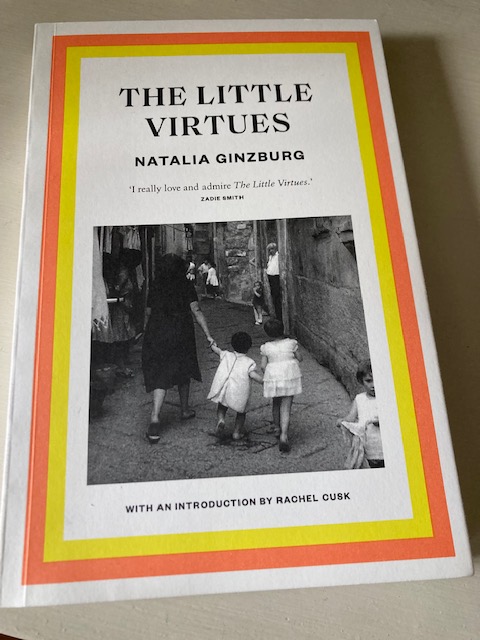
In the opening essay, ‘Winter in the Abruzzi’ (1944), Ginzburg describes the time she and her family spent living in exile in a village in Abruzzo during…
View original post 1,262 more words
A rather touching poem with that tolerant and generous ending. Beats were very much part of the St Ives scene in the 60s.
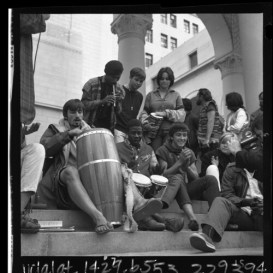
Beatniks from Venice West at LA City Hall
In a recent rambling conversation with Micaela Brinsley, who has a rare gift for drawing people out, I went on — and on, and on — about a poem from My Hollywood in which I imagine Sarah Bernhardt on the amusement pier at Venice Beach. I’ve written about my Venice diptych before, describing the area in which it’s set as “a fanciful corner of LA developed by the fanciful Abbot Kinney in 1905.” In my interview with Micaela, I add a bit to the picture, explaining that Venice is “a place that goes up and down in status rapidly. One decade it’s the worst part of Los Angeles, the next decade it’s the priciest.”
One of its low points, in terms of economic status, happened to coincide with its cultural renaissance. In the 1950s, Venice West became the hub of LA’s beatnik…
View original post 497 more words





 penwithlit