There’s a simplicity and fluidity to Linda Grant’s fourth novel that imbues a slightly odd voyeurism – that as the reader, we are sitting watching events unfold rather reading about them, such is the power of her imagery and storytelling. But there’s nothing simple about her themes, that of identity and sense of belonging as Vivien Kovacs, daughter of post-war Hungarian Jewish refugees, tries to find her way in 1970s London.
Viven’s parents fled Budapest immediately before the war: so grateful to be taken in they barely disturb the air they breathe. They avoid contact with the outside world wherever possible and refuse to look back on their history – even with their only daughter, who is not made aware of the family religion until her teenage years.
It’s a lonely life for Vivien and much of the young girl’s discovery of the real world outside the Marylebone apartment is…
London: Barrie & Jenkins, 1978, Hardback in dust wrapper.
Includes: Further reading list; Black & white plates; List of sources; Appendix;
From the cover: Emile Zola was one of the giants of 19th century literature. Of his vast output, sometimes described as a river of ink, a cycle of twenty novels, written with stark realism, remains as his outstanding literary monument the Rougon-Macquart.
Although he was a realist and the leading theorist of the Naturalist movement in literature, Zola was a lyrical and poetic writer. The subjects of his novels demanded an immense breadth of first-hand experience and observation of life that he did not always possess, forcing him to draw from his astonishingly fertile imagination. Thus the novelist, who had never…
The orchards half the way From home to Ludlow fair Flowered on the first of May In Mays when I was there; And seen from stile or turning The plume of smoke would show Where fires were burning That went out long ago.
The plum broke forth in green, The pear stood high and snowed, My friends and I between Would take the Ludlow road; Dressed to the nines and drinking And light in heart and limb, And each chap thinking The fair was held for him.
Between the trees in flower New friends at fairtime tread The way where Ludlow tower Stands planted on the dead. Our thoughts, a long while after, They think, our words they say; Theirs now’s the laughter, The fair, the first of May.
Ay, yonder lads are yet The fools that we were then; For oh, the sons we get Are still the sons of men. The sumless tale of sorrow Is all unrolled in vain: May comes to-morrow And Ludlow fair again.
I had recently been perusing Cavafy – particularly reading the essay on him written by that doyen of Dons, Maurice Bowra in his book, The Creative Experiment. Bowra, of whom it has been said, ” …..either the most distinguished or the most notorious Oxford don of the early twentieth century. Classicist, poet, wit, raconteur extraordinary, and Warden of Wadham College for over thirty years, he met nearly everyone of consequence in the worlds of literature and politics” He remarks of Cavafy’s abilility to find pathos in quite simple situations and quotes, The Melancholy of Jason poet in Kommagini, a.D. 595–
The aging of my body and my beauty is a wound from a merciless knife. I’m not resigned to it at all. I turn to you, Art of Poetry,
n these all-white courtyards where the south wind blows Whistling through vaulted arcades, tell me, is it the mad pomegranate tree That leaps in the light, scattering its fruitful laughter With windy wilfulness and whispering, tell me, is it the mad pomegranate tree That quivers with foliage newly born at dawn Raising high its colors in a shiver of triumph?
On plains where the naked girls awake, When they harvest clover with their light brown arms Roaming round the borders of their dreams — tell me, is it the mad pomegranate tree, Unsuspecting, that puts the lights in their verdant baskets That floods their names with the singing of birds — tell me Is it the mad pomegranate tree that combats the cloudy skies of the world?
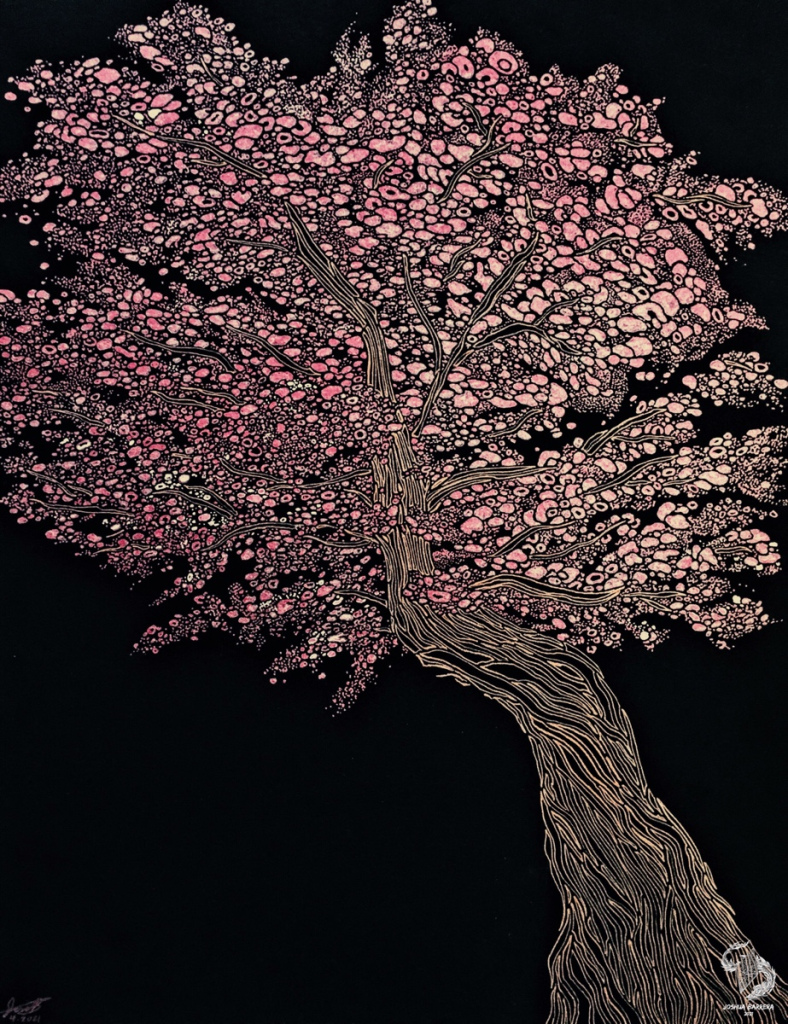
A lovely spring night…, by Joshua Barrera, metallic ink on paper, 8.5 x 11”, 2021.
I felt like drawing something simple yet magical – the cherry blossoms as a spectacle of fleeting beauty and memory. It’s all about cherishing those little precious moments in life. This piece is inspired by Basho’s haiku, and hanami (flower viewing).
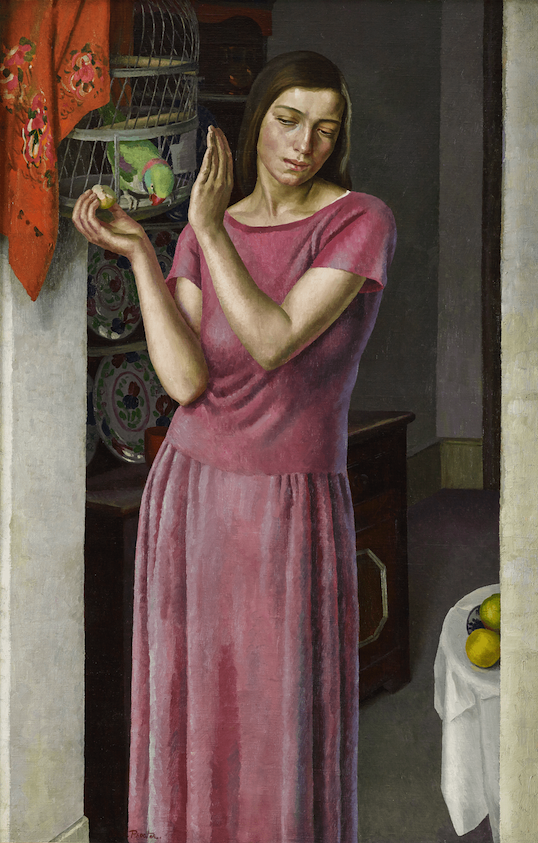
Dod Procter (April 21, 1890-July 31, 1972) was an English painter. Procter and her husband, also an artist, met while attending art school. Biography on Wikipedia:https://en.wikipedia.org/wiki/Dod_Procter
Girl with a Parrot by Dod Procter c.1925 / Oil on canvas / 52-3/4″x34-1/4″ / Private collection
The most accessible introduction to great philosophers, for me anyway, are the You-Tube programmes made by Bryan Magee maybe some 30 years ago. Particularly interesting was Iris Murdoch talking about Philosophy and Literature. Then there was the lucid conversation with Anthony Quinton on Spinoza and Leibnitz. The clearest philosophy book I managed to grasp however, was Language, Truth and Logic by A.J.Ayer. Freddie Ayer used to appear on the Brains Trust on Sunday afternoons -such excellent stimulating elevating television as we seem to see but rarely nowadays. True conversation seemingly in short supply.
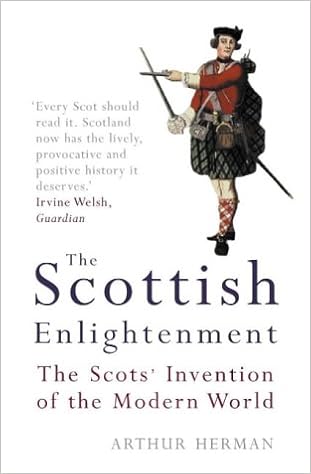
However, skimming through Herman’s delightful book on The Scottish Enlightenment, I came across the intriguing philosopher, Francis Hutcheson (1694-1746). Here is how Herman concludes upon him…”He challenged other forms of oppression, which Locke and even Shaftesbury had ignored…….One was the legal subjection of women. Hutcheson defined rights as universal, and did not recognise any distinction based on gender. The other, even more important was slavery. ‘Nothing’, he said, ‘can change a rational creature into a piece of goods void of all rights.’ In fact Hutcheson’s lectures, published after his death under the title A System of Moral Philosophy, were ‘an attack on all forms of slavery as well as denial of any right to govern solely on superior abilities or riches.’ They would inspire anti-slavery abolitionists, not only in Scotland but from London to Philadelphia.
His thoughts on what he terms variolation are certainly pertinent to our contemporary discussions on vaccination. However, his interest in an early study of the philosophy interface with psychology also makes for a certain claim to fame on behalf of this doctor from Yorkshire. According to the Stanford Encyclopaedia of Philosophy, Hartley wrote a significant treatise. “The Observations gained dedicated advocates in Britain, America, and Continental Europe, who appreciated it both for its science and its spirituality. As science, the work grounds consciousness in neuro-physiology, mind in brain. On this basis, the central concept of “association,” much discussed by other British philosophers and psychologists, receives distinctive treatment: the term first names the physiological process that generates “ideas,” and then the psychological processes by which perceptions, thoughts, and emotions either link and fuse or break apart. In keeping with this physiological approach, Hartley offers a conceptually novel account of how we learn and perform skilled actions, a dimension of human nature often left unexplored in works of philosophy. Such actions include those involved in speech—and, by extension, the conduct of scientific inquiry.”
Although difficult perhaps to penetrate his writings in detail it seems to me that in relation to certain aspects of volition, memory, sensation and associations are a significant forerunner of Freud and psychoanalysis. It is often stated that Nietzsche’s thought have such an influence but Hartley should be recognised for his insights at much earlier period.
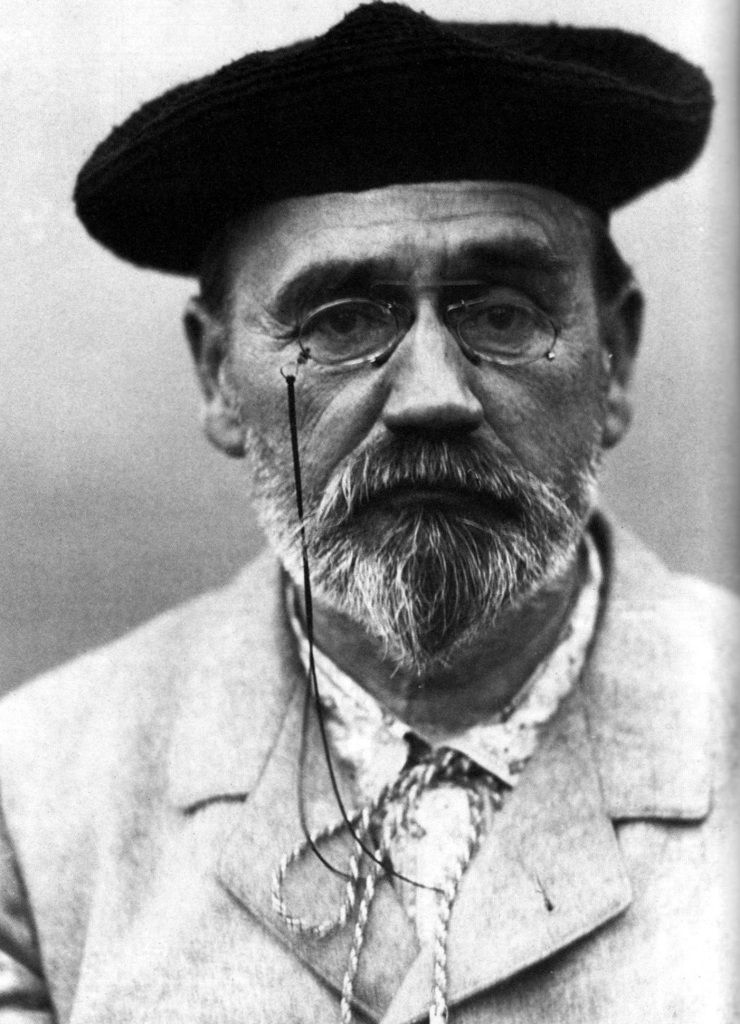
How to tell the story of Anti-Semitism and Intellectuals who Challenge it: Reflecting on reading Michael Rosen’s (2017) The Disappearance of Émile Zola: Love, Literature and the Dreyfus Case London, Faber & Faber.
Émile Zola
This is a book with far larger themes than can be imagined before we not only read it but reflect on it. I have always admired Michael Rosen as before him I admired his father Harold Rosen. This is a family embedded in the cultural and intellectual life not only of Great Britain but of socialism conceived as a European tradition.
During the 2019 election, Michael Rosen was highly prominent on social media, challenging anti-Semitism but also challenging large unspecified claims against some on the left who were being called anti-Semitic with very little evidence. He challenged in particular the Anti-semitism Tsar, Lord John Mann, who had appeared, to many of us on the left…

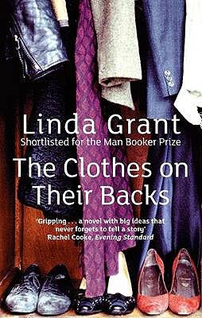 There’s a simplicity and fluidity to Linda Grant’s fourth novel that imbues a slightly odd voyeurism – that as the reader, we are sitting watching events unfold rather reading about them, such is the power of her imagery and storytelling. But there’s nothing simple about her themes, that of identity and sense of belonging as Vivien Kovacs, daughter of post-war Hungarian Jewish refugees, tries to find her way in 1970s London.






 penwithlit