Lovely sketches- particularly like the architecture-very pleasing
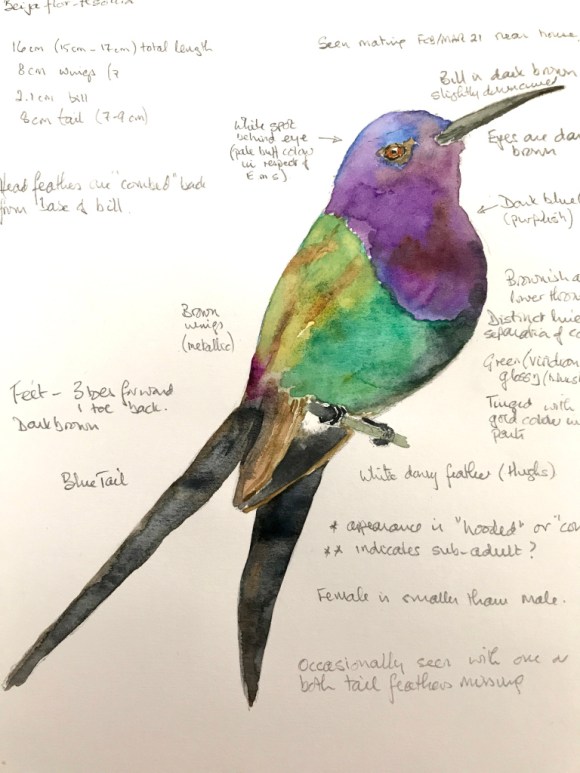
Detail from my Hummingbird project journal.
No painting this week! OK, so I don’t have paper on which to paint but that is no excuse! In fact I have been involved in other admin stuff so didn’t even do any acrylic painting, but that also is not an excuse. It’s probably the pandemic getting me demotivated.
That said, I have started a couple of projects in my journals. One is to paint some marine life to put into a book, no rush but I now have a deadline set for August completion. The other is a personal project which involves documenting details (eg eye, feet, feathers etc) of Hummingbirds and Tanagers to create a reference for when I paint these beautiful birds. Whenever I can get hold of large sheets of watercolour paper I intend to do large-scale portraits of a couple of species and to see how these develop.
First published in 2007, Tahmima Anam’s intimate civil war tale A Golden Age won the Commonwealth Writers’ Prize for the Best First Book and was shortlisted for the Costa First Novel Award. The edition I read was published in 2012 as part of the Canongate ‘the Canons‘ list, which is a slightly strange mixture of ‘boundary-breaking’ books that Canongate decided either were already classics in their own right, or deserved to be. I’m not convinced the collection has aged that well, but it’s an audacious idea.
Anam was born in Dhaka, Bangladesh (and now lives in the UK). This, her debut novel, is set in 1971 in East Pakistan, where Rehana Haque, a young widow, is throwing a party. Anam is great on description of food, Rehana is an excellent cook and the feast is described in loving detail. But civil conflict…
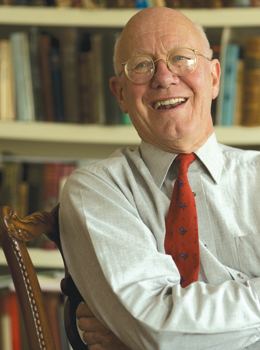
Well, perhaps I have had too much time on my hands and a surfeit of Government adverts on Classic F.M. The latter causing my blood pressure to rise despite the compensating soothing by a combination of the symphonies and the smooth and slightly manic A.A. (Alexander Armstrong). Despite the irritations of the lockdown the discovery of the variety of poetry of Christopher Reid. It is the gift that keeps on giving without the unpleasant associations of that phrase. Here is the great man talking about Ted Hughes and Seamus Heaney.
At the University of Huddersfield
Prose
Prose pays a call on poetry.
A seafaring tower block,
palatial, proud pristinely white
as if fresh from the drawing board
of some high minded architect,
has arrived to inspect
the tired old city.

From Reid's latest collection The Late Sun
There is something subtle and gentle about this poet that reminds me of the best headmaster that I taught under. He can be amusing, eloquent and engaging even with quite short poems like the following from his Selected Poems published in 2011.
“If he/she wanted to he/she would” is the most overused and misguided phrase in consolation. By saying it, the person on the other end attempts to provide his friend with tough-love, to say without saying: You need to move on. It’s akin to the saying: She’s just not that into you. Yet, most of the time, she’s just not that into anyone. But the tough-love crowd doesn’t seem to get it.
Romance has a multitude of barriers: income, self-image, fear of criticism from the prospective partner or one’s circle, fear of abandonment, fear of guilt, lack of sexual chemistry (which may be more internal than external), and so on. Yet, we’re keen on reducing rejection to the last barrier on that list and not only that, but to the version of sexual chemistry which implies that you just aren’t doing it for her/him. As you can imagine, this version of…
Well indeed, the weather has picked up and the magnolia is in blossom in the gardens. I have just been reading the new collection of poems by Christopher Reid entitled “The Late Sun“ and finding it simply excellent. My favourite poem in his collection at the moment is a collaborative translation with Renata Senktas from the Polish of Konstanty Ildefons Gałczyński. It is called from A Trip to Świder
The poem ends with a literary allusion and is infused with a gentle melancholy-
Children in prams, woodpeckers, a birch growing at a slant, the river, and the blind man who drank beer at the station;
and this house with its pointed roof hidden among raspberry bushes, and this shadow… as in Three Sisters by Anton Chekhov.
An informative Polish Website at https://przekroj.pl/en/literature/a-playful-nostalgia-for-a-lost-world-renata-senktas-and-christop interestingly comments that, “hermetic as it sometimes appears, A Trip to Świder is carried along by its musical brio, its dream-like marriage of fantasy and truth, and its kaleidoscopic blending of dissimilar tones and images, which, to quote Czesław Miłosz, “chase one another with the speed of a hurtling train”.“
The Late Summer is replete with great poetry and well worth the effort to read over and over. As a result of reading its 79 pages and not having presently been otherwise engaged by a novel- too many new webinars-I have found much to ponder over between cafetieres of coffee- the poems open up vistas of travel and return to the delights of London. Which thought reminds me of my first encounter with Reid via the wonderful poem-play “The Song of Lunch” world-wearily but delightfully intoned by Alan Rickman with Emma Thompson.
Broncia Koller-Pinell (February 23, 1863-April 26, 1934) was an Austrian Expressionist painter said to be the first to bring attributes of French Impressionism into Austrian painting. Biography on Jewish Women’s Archive: https://jwa.org/encyclopedia/article/koller-pinell-broncia
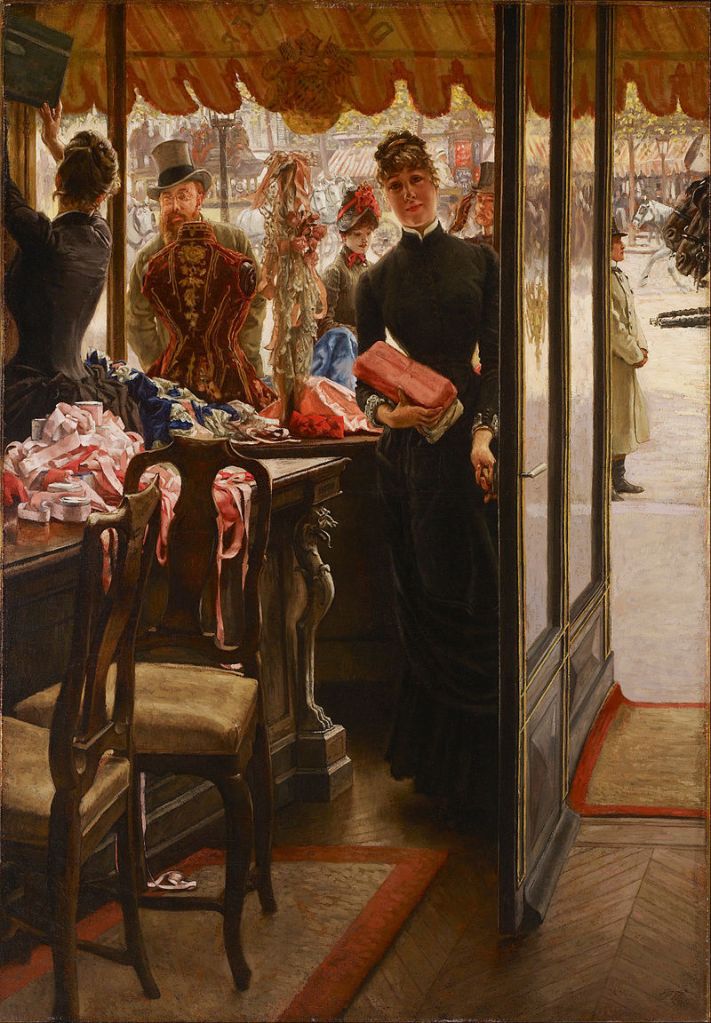
This clip may give some idea of the range of Tissot’s oeuvre.
My personal response to Tissot
There are two factors which have drawn my attention to Tissot recently. Firstly, reading various books and articles by Julian Barnes, who is well versed in French Artists of the Nineteenth Century. Secondly there are particular paintings of his that are especially intriguing. Especially those that seem to show early relationships between the French and English in London. However, more importantly, I seem to remember small illustrated texts from Sunday School back in the 1950s whose subject matter were similar in style and content to those religious paintings that seem to have taken up much of Tissot’s time. Finally, there is of course the insight into the times that these Tissot paintings give.
He doesn’t look too happy does he? But at least, although somewhat contorted in posture and attracting the attention of others, he has his coffee strong and black. He invokes a strong feeling of nostalgia for a seemingly lost world. In this case the mittel europa of the 1920s. He may even have a croissant at his elbow. I particularly like the evocation of the blue-violet-brown of the enclosing satin draping. This work is by the little known Croatian artist -Young Man in a Cafe, c.1923 by Marijan Trepše (1897 – l964). Born into the latter days of the Austro-Hungarian Empire, you may read more about this artist and how he travelled to Prague via Paris at https://en.wikipedia.org/wiki/Marijan_Trep%C5%A1e
It is unsurprising, looking at this painting, to read that this expressionist later became a significant set designer.
Using the magical utility of a reverse image search. There is a very useful such device a TinEye. I happened upon the following:-
Much as I miss the congenial and convivial ambience of just sitting around and chatting away with friends, these characters do not exactly look very warm types. Their faces are mask like and reminiscent of harlequins. We certainly have had enough of face-masks. It is interesting how the hands link across the table but touch perhaps slightly. There seems something of considerable interest off-frame to the right. Nevertheless, something of considerable artistic import is being discussed. The juxtaposition of the feet seems a little more cosy and relaxed. It is the combination of tones such as the contrast between the brown of one gent and the blue of the artist which I find attractive.
It is interesting to compare and contrast these two painters who might well have met up over un petit café noir in Montmartre in the 1920s. They would certainly have much to talk about if they could converse easily.
Rose glow of ambience, turned faces recognise, smiles and greetings made. Hands reach out, cheek to cheek kisses, “Bonjour” and “Ça va” spoken. “Un petit café noir, si’l vous plait”. “A small black coffee please”.
A chair is offered, news exchanged, dialogue and dispute, advice and acrimony. Journal passed in turn, maybe a game of Belotte (cards). Another round of coffees, morning ritual slowly ends. “A demain matin”, “See you tomorrow morning”.







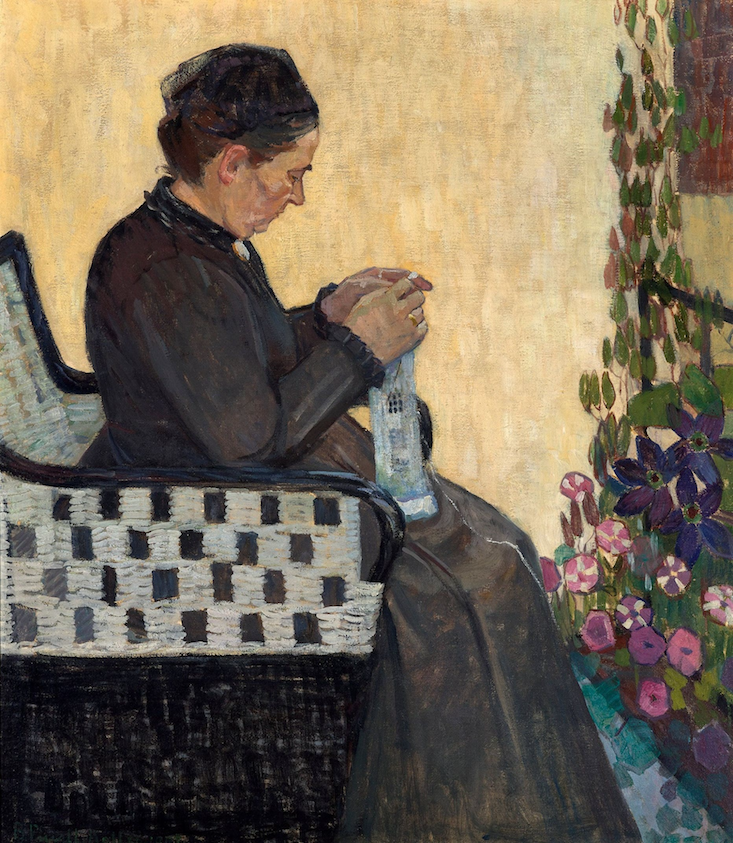 The Mother of the Artist by Broncia Koller-Pinell


 penwithlit