Categories
Poetry

South of the Border-

Image result for diego rivera paintings

South of the border down Mexico way lies

Venezuela and revolution or possibly invasion

South of the narrow isthmus

across which the Chinese  and Nicaraguans are digging a new wider,

deeper canal…..for oil.

Down further in Brazil,

the latest fascist dictator

repeats his pedantic boring chants

in favour of free markets requiring

rain forests be despoiled.

Over the border lies trouble

….but build a wall?

Will not do any good at all.

The drugs will still pour in, Mr Trump-

your so called secure society a sorry business

with its own ecological dumps.

Anyway, anyhow that wall would be porous;

the gringos, aid and arms flowing south.

You might build a wall on the border

to keep the Mexicans out

but what do you do to your people

and yourself?

Let in the bright coloured flowers,

Diego’s art, let it grow…

before your population, sing once again

“Sag mir, wo die Blumen sind?”

Gone to soldiers every one?

When will we ever learn?

Image result for Nicaraguan Canal


Categories
Uncategorized

Eigentlich wollte ich viel lieber italienisch lernen – Susanne Haun

Ich auch! Kurtzlich lese ich Italienische Gedichte Z.B. Mentale, Leopardi u.s.w. Ich wundere mich als Deutsch Perfekt eine Schwesterzeitschrift die auf Italienische-Deutsch publiziert ist.

Susanne Haun's avatarSusanne Haun

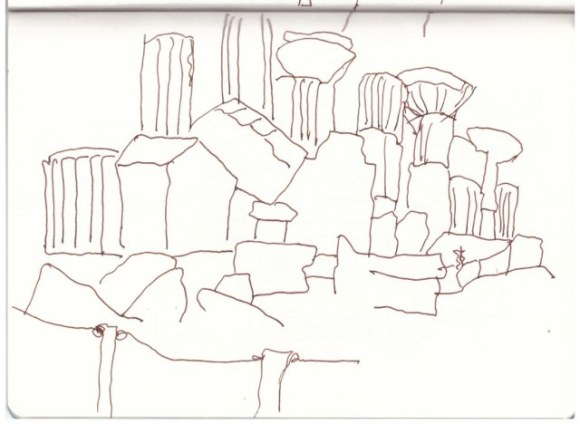
Sizilien (c) Zeichnung von Susanne HaunSizilien, Aggricento (c) Zeichnung von Susanne Haun
Eigentlich wollte ich viel lieber italienisch lernen, um auf meinen Reisen durch Italien einen besseren Kontakt zur Bevölkerung zu erhalten.

Aufgrund meines Willens zu promovieren, benötige ich jedoch Lateinkenntinisse. Ich bin sehr froh, dass ich eine Sprachschule um die Ecke hier in Berlin Wedding gefunden habe. Dort werde ich im März beginnen, Latein zu lernen. Vorweg habe schon einmal einen Beitrag im Weddingweiser zur Sprachschule geschrieben:

Mit Puntolingua im Wedding italienisch lernen

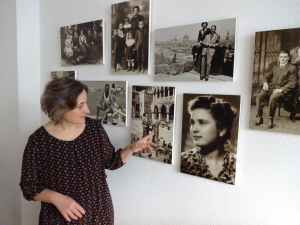
Fotos geben der Sprachschule Puntolingua italienisches Flair, Foto von Susanne HaunFotos geben der Sprachschule Puntolingua italienisches Flair, Foto von Susanne Haun

In der Lüderitzstraße 11 ist schon seit 2012 die kleine aber feine Sprachschule Puntolingua zu finden. Wer qualifiziert italienisch lernen möchte, ist hier genau richtig. Beim Betreten der Schule ist das italienische Flair spürbar, als anerkannter Prüfungsort können hier CELI.Sprachzertifikate erworben werden. Das Zertifikat gilt derzeit als renommierteste italienische Sprachzertifikat und dient als Eintrittskarte für ein Hochschulstudium in Italien. Potenziellen…

View original post 11 more words

Categories
Uncategorized

John Ruskin, Godfather to the Pre-Raphaelites, was born 200 years ago today

I like his Italian sketches, his work in promoting at in Oxford with the Ashmolean and his early socialist beliefs. Thanks for another interesting post.

hoakley's avatarThe Eclectic Light Company

Two hundred years ago today, the major British art critic and writer John Ruskin was born in London. Although Ruskin appears to have painted only in watercolour, and for his own ends, this article takes a look at some of his paintings and his role as a major influence on British painting.

Ruskin was born into an affluent family, and travelled widely in the UK and Europe when still a child. In 1836, he started studies in Classics (‘Greats’) at Christ Church College in Oxford University, but his health was poor and academic achievements limited; he won the Newdigate Prize for poetry in 1839, at his third attempt. In 1842, he was awarded a rare “honorary double fourth-class” degree.

He published his first substantial writing on painting the following year, which was to become the first volume of his highly influential series Modern Painters. This appeared anonymously as the work…

View original post 1,566 more words

Categories
Uncategorized

Painting Reality: 9 Summary and Index

Very interesting and I am thinking of English painters to compare- perhaps the Newlyn School. Maybe the Camden Group. Is there a related naturalism in English Literature, I wonder. It seems Naturalism is often very dark toned. Thanks for this!

hoakley's avatarThe Eclectic Light Company

Over the last year, I have been gradually amassing articles here as I have been studying Naturalist painting in the late nineteenth century. This is the final article in a series of nine which brings together a summary, indexed against the previous eight articles in the series, links to each of the articles about themes in Naturalist painting, an alphabetical list of artists covered in separate articles, and a list of recommended books.

I will try to keep this article updated, so that you can use it as a reference.

Naturalist painting is the visual art sibling of literary Naturalism, typified by the Rougon-Macquart novels of Émile Zola.

1 Emergence (1883)

It emerged gradually from ‘social realist’ painting, particularly that of rural deprivation, notably the work of Jean-François Millet, during the 1860s and 70s.

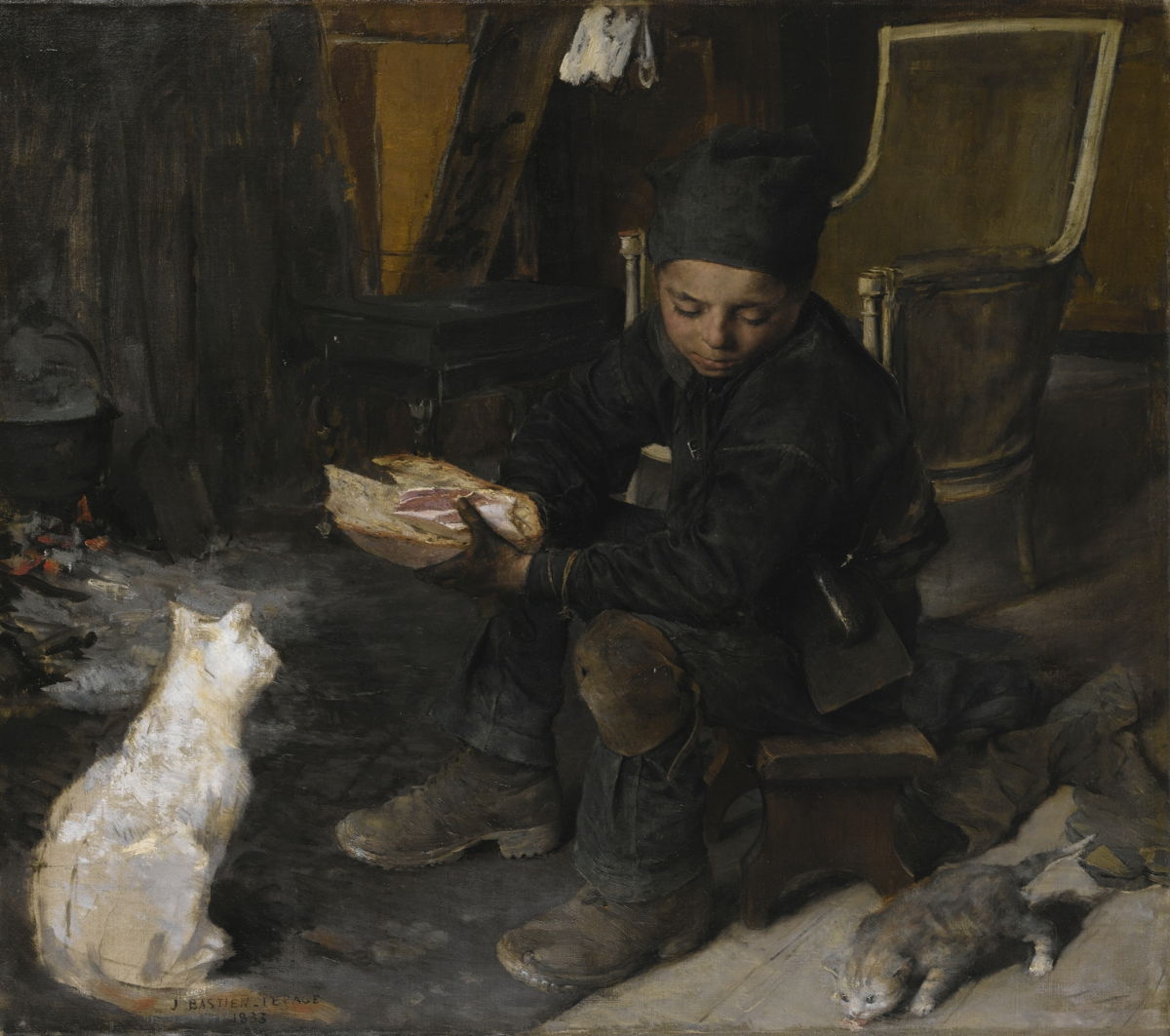
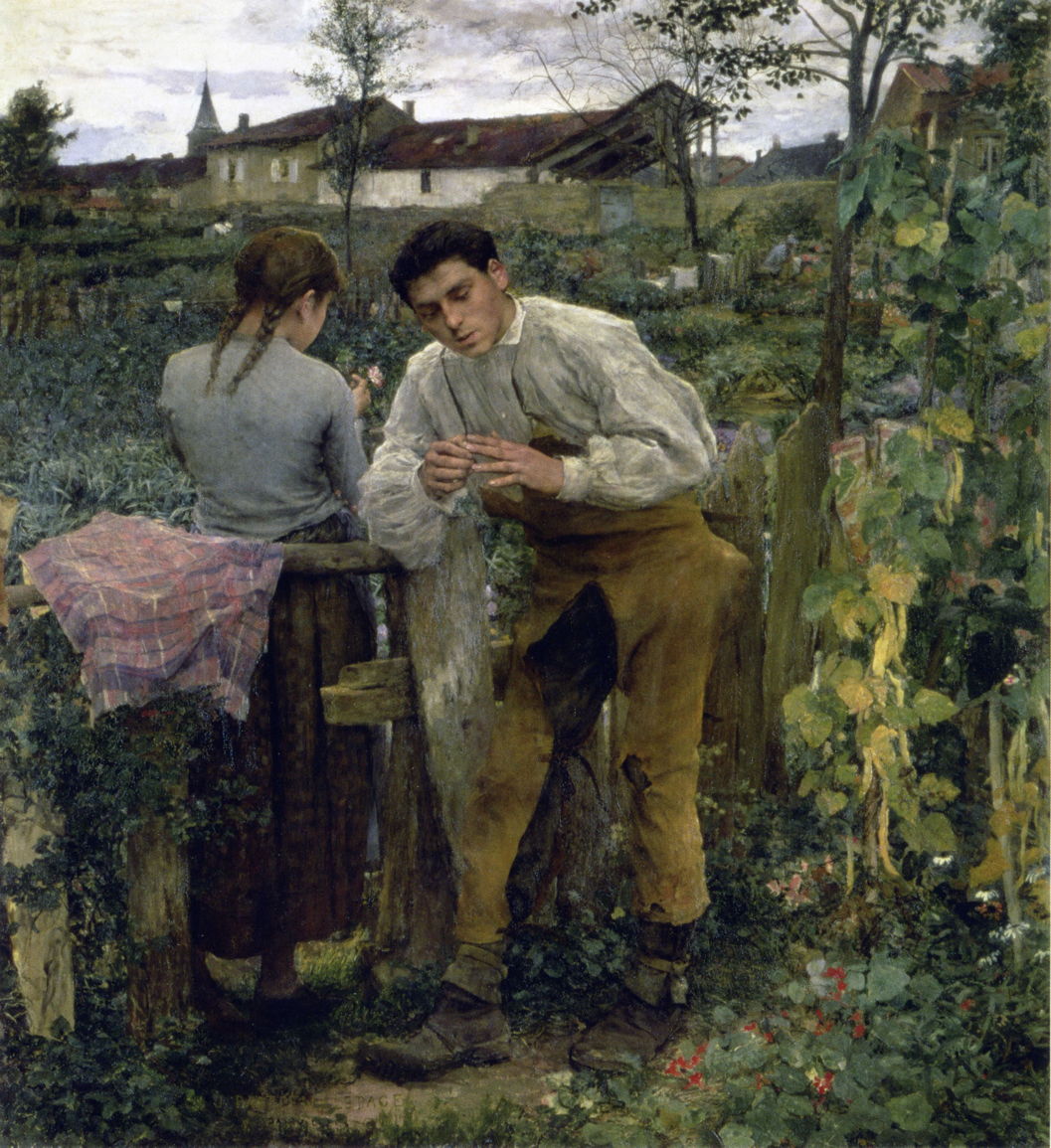
bastienlepagelovevillage Jules Bastien-Lepage (1848–1884), Love in the Village (1882), oil on canvas, 194 × 180 cm, Pushkin…

View original post 1,465 more words

Categories
Classics Poetry

The Jasmine at Night by the Italian Poet, Giovanni Pascoli

  E s’aprono i fiori notturni
nell’ora che penso a’ miei cari.
Sono apparse in mezzo ai viburni
le farfalle crepuscolari.
Da un pezzo si tacquero i gridi:
là sola una casa bisbiglia.
Sotto l’ali dormono i nidi,
come gli occhi sotto le ciglia.
Dai calici aperti si esala
l’odore di fragole rosse.
Splende un lume là nella sala.
Nasce l’erba sopra le fosse.
Un’ape tardiva sussurra
trovando già prese le celle.
La Chioccetta per l’aia azzurra
va col suo pigolio di stelle.
Per tutta la notte s’esala
l’odore che passa col vento.
Passa il lume su per la scala;
brilla al primo piano: s’è spento…
È l’alba: si chiudono i petali
un poco gualciti; si cova,
dentro l’urna molle e segreta,
non so che felicità nuova.

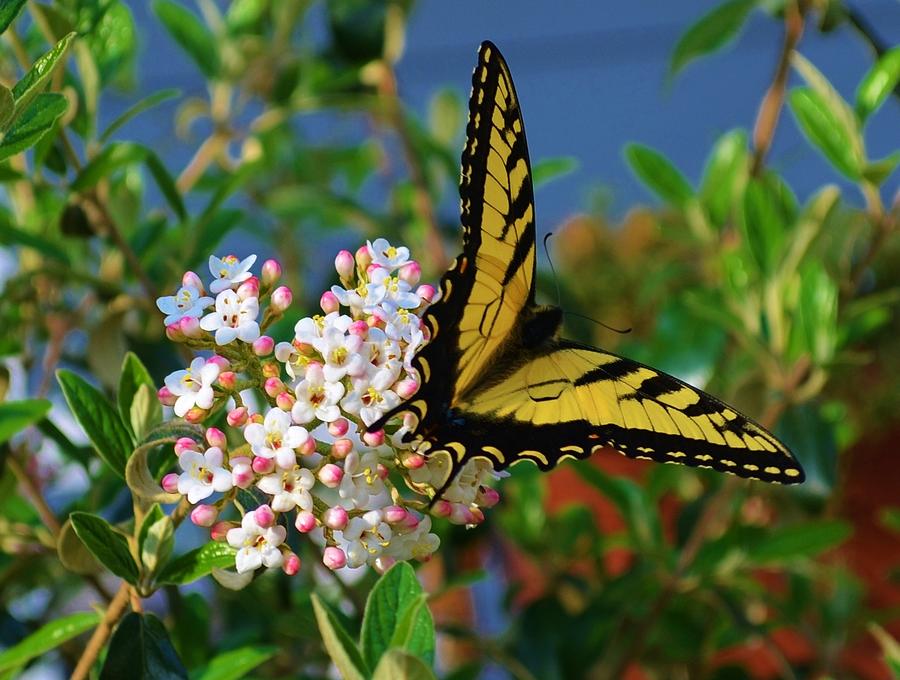
Image result for butterflies in Viburnum

The nocturnal jasmine is a poem by Giovanni Pascoli dedicated to the wedding of a friend of his, and published in 1903 in the Cantos of Castelvecchio .

Giovanni Pascoli ( San Mauro di Romagna , 31 December 1855 – Bologna , 6 April 1912 ) was a poet , academic and literary critic of Italy , an emblematic figure of Italian literature of the late nineteenth century . Despite his eminently positivistic training , he is together with Gabriele D’Annunzio, the greatest Italian decadent poet .

Here is a possible literal translation:-

And the night jasmines open their corolla
in the time of day when I think of my dear departed. Twilight butterflies
have appeared
among the viburnum.
For some time now the cries of the birds have ceased:
only there, in a house, can they hear the whispering of human voices.
The little birds are sleeping under the protective wings,
as the eyes rest under the lashes.
From the open corolla of jasmine comes
a scent like red strawberries.
In the living room you can still see a light on,
the grass rises above the tombs of the dead.
A late bee wanders around buzzing
because all the cells are already occupied.
The constellation of the Pleiades is wandering
through the threshing floor, rendered blue by the night sky, with a chirp of stars.
For the duration of the night
the scent of the nocturnal jasmine fills the air, carried by the wind.
The light in the house moves up the stairs,
then goes into the nuptial chamber on the first floor, then goes off …
The dawn arrives: the petals of the flower close
a little withered, but inside the ovary soft and hidden
in depth, grows a feeling of happiness
never felt before.

Image result for giovanni pascoli

Categories
Uncategorized

Wenn die Sonne sinkt

Wolfregen & Constanze's avatarDas poetische Zimmer

Adolf Kaufmann: Sonnenuntergang in Winterlandschaft (o.J.)

Ubi sol, ibi vita

Am Abend geht sie unter,
Die Sonne, jeden Tag,
Wir sehn’s und bleiben munter,
Dass ich mich wundernd frag:

Ich mag von dir nie scheiden
Und doch wird einer gehn,
Wer wird wohl von uns beiden
Am Grab des andern stehn?

Nur noch den Namen lesen
An einem kalten Stein,
Hinfort das liebe Wesen
Und in der Welt allein!

O dann erst sinkt die Sonne
Und zieht das Dunkel nach –
Verlorn des Lebens Wonne
Und alle Hoffnung brach…

©Wolfregen

View original post

Categories
Uncategorized

Maurice Utrillo: La rue du Mont-Cenis sous la neige (1935)

Truly magnificent – fascinated that he was painted by Valladon.

At Sunnyside - Where Truth and Beauty Meet's avatarAt Sunnyside - Where Truth and Beauty Meet

maurice_utrillo_la_rue_du_mont-cenis_sous_la_neige) jpg (jpeg image, 3200 × 2[...]Maurice Utrillo (1883-1955), La rue du Mont-Cenis sous la neige, signé ‘Maurice, Utrillo, V,’ (en bas à droite) et situé ‘- Montmartre -(en bas à gauche), huile sur toile, 97 x 146 cm.
Peint vers 1935, Source: Christie’s

La rue du Mont-Cenis sous la neige

As World War 1 began, Maurice Utrillo moved into a small studio overlooking the rue du Mont-Cenis in Montmartre –  the street which became one his favorite subjects.

“He would depict it in countless variations over the course of his career, under different weather conditions and lighting. With its high viewpoint overlooking the roofs of Paris and its winding concrete walls with their regular arrangement of windows, the street offered the true painter of Montmartre the ideal subject with which to express his interest in urban landscape.” (Christie’s)

Invitation to Montmartre

According to Christie’s, Maurice Utrillo’s 1935 painting La rue du Mont-Cenis sous la…

View original post 962 more words

Categories
Uncategorized

Truth and bio-pics

I strongly agree- spate of inaccurate Churchill biopics and other films substituting for detailed historical knowledge.

cathyc's avatarThis and That

Dear makers of movies. The truth does matter and it isn’t what you think it is.

Quoting from an article about whether movies about the truth have to be factually correct: “Yet a Google search of each of these titles will produce a long list of factual inaccuracies. And that’s OK — because these films are not about facts, they are about something much more elusive and important: truth.”

I’m a historian and my problem is that this sounds like something Donald Trump says every morning looking in the mirror.

Is there some special reason why Trump would be pilloried the internet over for saying that, whereas movie makers have a dispensation?

Not to mention, it may be an easy way to get your history, from novels, bio-pics, histo-pics etc. But after you stop reading or stop watching you have no idea which bits were true and which bits weren’t…

View original post 86 more words

Categories
Uncategorized

Roger

apolla13's avatarNames Throughout the Ages

Roger is an English given name meaning “famous spear” made up from Germanic elements hrod (famous, fame) and ger (spear). It’s also a surname originating from the given name. As an Irish surname it’s also been used as an anglicized form of Gaelic Mac Ruaidhrí meaning “son of Ruaidhrí”, the latter the Irish form of Rory meaning “red king” made up from Old Irish rúad (red) and  (king).

Origin: Proto-Indo-European

ea2907fc685b7e51598d766cdfabcdfaPinterest

Variants:

  • Rodger (English)
  • Rogier (Dutch)
  • Rutger (Dutch)
  • Rüdiger (German)
  • Ruggiero (Italian)
  • Ruggero (Italian)
  • Rogério (Portuguese)
  • Hrodger (Ancient Germanic)
  • Hroðgar (Anglo-Saxon)
  • Hrothgar (Anglo-Saxon)
  • Hróarr (Ancient Scandinavian)
  • Hróðgeirr (Ancient Scandinavian)
  • Roar (modern Norwegian form of Hróarr)
  • Ruth (Limburgish short form of Rutger)

View original post

Categories
Uncategorized

Folk Songs: ‘When You and I Were Young, Maggie’

Very sweet and moving.

At Sunnyside - Where Truth and Beauty Meet's avatarAt Sunnyside - Where Truth and Beauty Meet

I first saw a recording by the group Mignarda (http://www.Mignarda.com) at Cap’s Blog in his post Se sei con me.  By their own words,

“As Mignarda (http://www.Mignarda.com), we typically perform music from the 16th century, but while taking a break from recording the music of John Dowland, we did an impromptu rendition of this lovely old song.”

This “impromptu rendition” of When You and I Were Young, Maggie is below. ❤️

The poem was written for Maggie Clark of Glanford, Ontario by poet George Washington Johnson. George and Maggie became engaged, married, and moved to Cleveland, but Maggie died less than a year later in May 1865 and was buried near her old home. Washington returned to Canada where he taught at the University of Toronto.

The poem was published in 1864 in a collection entitled ‘Maple Leaves’ and, after Maggie’s death, Johnson arranged for…

View original post 425 more words