A really enjoyable film and an interesting review.

A really enjoyable film and an interesting review.
Having spent a good hour looking at the Expressionist paintings in the Emil Nolde exhibition at the National Gallery, I decided to go and have a look at some favourite paintings by the Irish artist Jack Butler Yeats in the Gallery’s permanent collection, who, over his career, developed an Expressionist style.
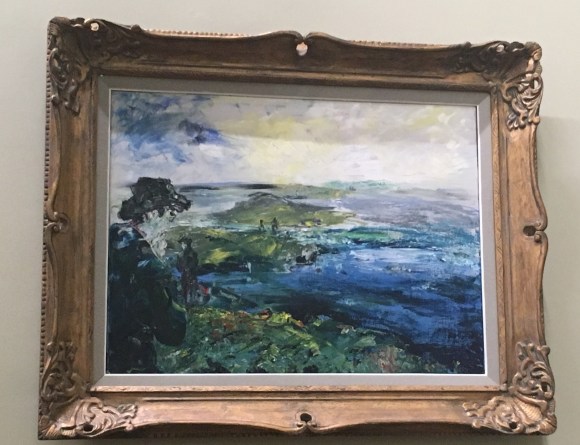 Many Ferries (1948)
Jack Butler Yeats was the brother of the famous poet, William Butler Yeats. He was born in London and spent his childhood between London, Dublin, and Sligo, eventually returning to live permanently in Ireland in 1910.
Jack began his artistic career, in the 1890s, as a black and white journalistic illustrator for various publications before eventually becoming a professional artist. He initially painted in watercolour, but about 1906 he began painting regularly in oil. His early paintings were rather conservative in style and, in my view, most of his paintings, although displaying a clear talent as…
View original post 227 more words
Nolde’s racist views are totally unacceptable. He was a magnificent colourist and flower painter.

A little while ago I developed an interest in German Expressionist art and am quite keen to see and find out more about it. So when I was in Dublin last Sunday afternoon, I decided to call into the National Gallery of Ireland to take a look at their latest temporary exhibition, which is devoted to the work of Emil Nolde.
He was born as Emil Hansen near the village of Nolde in the PrussianDuchy of Schleswig, close to Denmark (and which had been the area disputed by Denmark and Germany in the mid 19th Century resulting in a war between the two countries). He changed his name to that of his home town, for reasons which probably reflect his political views (more of which later).
In 1906, he joined Die Brücke (The Bridge), the group of Expressionist artists based Dresden, but left after a year. He was…
View original post 559 more words

More about the fascinating and influential Hodler.
The first article in my series to commemorate the centenary of the death of the Swiss artist Ferdinand Hodler (1853–1918) showed some of his realist paintings from the early years of his career. During the late 1880s, he started to develop his mature style, a form of Symbolism which he referred to as Parallelism.
It was also a period of great change in his personal life. In 1887, Hodler and his partner Augustine Dupin (1852-1909) had a son. Two years later, Hodler married Bertha Stucki, but they divorced in 1891. He met his future second wife, Berthe Jacques (1868-1957), in 1894. All three of his partners modelled for his paintings, although not, as far as I can tell, simultaneously.
 Ferdinand Hodler (1853–1918), Portrait of Hélène Weiglé (1888), oil on canvas, 88.5 × 69.5 cm, Städelsches Kunstinstitut und Städtische Galerie, Frankfurt, Germany. Wikimedia Commons.
Hodler’s Portrait of Hélène Weiglé (1888) remains…
View original post 971 more words

Interesting that Byron had Cornish antecedents and his daughter was a significant mathematician!
Byron is an English surname derived from a place name meaning “place of the cow sheds”, either a locational name or an occupational name for someone who herded cows. It derives from Old English byrum via PIE root word.
Origin: Proto-Indo-European
Variants:

A fascinating and hugely influential painter. Many thanks for this informative summary:-
Next month, I will be commemorating here the centenary of the death of the great Swiss artist Ferdinand Hodler (1853–1918). He is not a painter that I have known well, and I can’t recall seeing any of his paintings in the flesh. Researching his life and work has been revelatory, though, and in the coming weeks I’d like to share with you what I have found out. I hope that you too will come to appreciate the work of one of the period’s most versatile and innovative painters.
Hodler was born the first child of a poor, working family in Bern, Switzerland. His father, a carpenter, died when Hodler was seven, but the following year his mother married a second time, to a decorative painter who painted stage scenery, etc. Tuberculosis was rife in the poor quarter of the city where they lived, and Hodler saw his brothers and sisters…
View original post 926 more words
I try to read German and French glaringly. Even though not fluent, the foreign modes of expression I find haltingly beautiful.
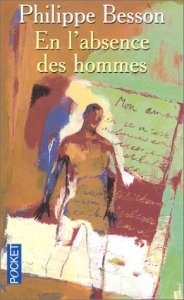 It has taken me ages and ages to read this book because it was a handbag book: I read it in coffee shops, in waiting rooms and on trains. I read it that way because I read the French edition, and I wanted to stop myself from consulting the dictionary every time I was stuck for a word. And even though this means I mainly read it at plot level and probably missed some of its nuances, I still loved reading it because it is a beautiful book.
En l’absence des hommes is a story of doomed love. Doomed because the story is set during WW1 when Vincent is 16, and his first love, Arthur, is destined for the carnage on the battlefront. And even though Vincent’s narrative is imbued with all the insouciance of youth, there is a melancholic tone which tells the reader that this is going to…
View original post 727 more words

Love Caillebot!
Of the painters normally associated with the French Impressionists, two appear to be rather different: Edgar Degas, about whom I wrote at length last autumn, and Gustave Caillebotte (1848–1894).
With the recent ‘rediscovery’ of Naturalism, or social realism, Caillebotte is now being associated with accepted Naturalist artists such as Jules Bastien-Lepage, in many respects more strongly than with the core French Impressionists such as Monet and Pissarro. In this and the next article, I am going to look at a small selection of Caillebotte’s paintings across the breadth of his career, considering how Naturalist they might be, and how that fits in with their appreciation.
 Gustave Caillebotte (1848–1894), Nude Woman Lying on a Couch (1873), pastel on paper, 88.9 x 116.2 cm, Private collection. Wikimedia Commons.
Caillebotte started painting seriously quite late: he had already completed his law degree and obtaining a licence to practice law before the Franco-Prussian War…
View original post 1,143 more words
The Eiffel Tower seen just behind the Ecole Militaire, both being at opposite ends of a beautiful garden – the Champ de Mars.
See for yourself www.eutouring.com/images_eiffel_tower.html


 penwithlit