Quand, les deux yeux fermés, en un soir chaud d’automne,
Je respire l’odeur de ton sein chaleureux,
Je vois se dérouler des rivages heureux
Qu’éblouissent les feux d’un soleil monotone ;
Une île paresseuse où la nature donne
Des arbres singuliers et des fruits savoureux ;
Des hommes dont le corps est mince et vigoureux,
Et des femmes dont l’œil par sa franchise étonne.
Guidé par ton odeur vers de charmants climats,
Je vois un port rempli de voiles et de mâts
Encor tout fatigués par la vague marine,
Pendant que le parfum des verts tamariniers,
Qui circule dans l’air et m’enfle la narine,
Se mêle dans mon âme au chant des mariniers.
Ain’t no sunshine when she’s gone
It’s not warm when she’s away
Ain’t no sunshine when she’s gone
And she’s always gone too long…Wonder this time where she’s gone
Wonder if she’s gone to stay
Ain’t no sunshine when she’s gone
And this house just ain’t no home
Anytime she goes away
Wonder this time where she’s gone
Wonder if she’s gone to stay
Ain’t no sunshine when she’s gone
And this house just ain’t no home
Anytime she goes away
This song has been in the background of the Kaffeehaeuser -and I like that term-as I sometimes, in my Walter Mitty manner, like to imagine Penzance as a sort of Vienna. Sometimes the conversation feels as good as that in the heyday of the Cafe Central! As the darkness of twilight looms with the storm clouds and the sense of life’s losses becomes more a melancholy nostalgia. Outside the colours of the sky are glorious and then the song begins with its evocative repetition of the third verse:-
And I know, I know, I know, I know,
I know, I know, I know, I know, I know
I know, I know, I know, I know, I know
I know, I know, I know, I know, I know
I know, I know, I know, I know, I know
I know, I know,
Hey, I oughtta leave young thing alone
But ain’t no sunshine when she’s gone
The only other song that seems to have a similar effect is, of course, Stormy Weather, which once brought tears to my eyes in -banal and bathetic note– Pizza Express in Truro!
Ain’t no sunshine when she’s gone
Only darkness every day
Ain’t no sunshine when she’s gone
And this house just ain’t no home
Anytime she goes away
Anytime she goes away
Anytime she goes away
Anytime she goes away
Although people seem to be unaware of it today, the development of the faculty of attention forms the real object and almost the sole interest of studies. Most school tasks have a certain intrinsic interest as well, but such an interest is secondary. All tasks that really call upon the power of attention are interesting for the same reason and to an almost equal degree. ( On the right use of School Studies with a view to the Love of God)
My place is on the left and I must go to my seat
I don’t get why they never turn on the heat
Don’t know my neighbor, though it’s now been a year
And we’re sinking, although shallow water is near
And we stare at the ceiling, with a hopeful unease,
On the old trolley-bus that is traveling east
On the old trolley-bus that is traveling east
On the old trolley-bus…
All people are brothers, we’re all six degrees…
And nobody knows why we’re traveling east
My neighbor can’t take it, he wants to break free
But he cannot escape, he doesn’t know where to flee
So we sit and we wonder if we’ll find our peace
On the old trolley-bus that is traveling east
The bus keeps on driving through the driver has fled
And the engine is rusty but we’re moving ahead
And we’re holding our breath, as we stare at the night
Where, for a moment, a star was lit bright
We stay silent, we know that the reason for this
Is the old trolley-bus that is traveling east…
By Victor Tsoi
Translation by Andrey Kneller
In the original Russian:-
Мое место слева, и я должен там сесть,
Не пойму, почему мне так холодно здесь,
Я не знаком с соседом, хоть мы вместе уж год.
И мы тонем, хотя каждый знает, где брод.
И каждый с надеждой глядит в потолок
Троллейбуса, который идет на восток.
Троллейбуса, который идет на восток.
Троллейбуса, который…
Все люди – братья, мы – седьмая вода,
И мы едем, не знаю, зачем и куда.
Мой сосед не может, он хочет уйти,
Но он не может уйти, он не знает пути,
И вот мы гадаем, какой может быть прок
В троллейбусе, который идет на восток.
В кабине нет шофера, но троллейбус идет,
И мотор заржавел, но мы едем вперед,
Мы сидим не дыша, смотрим туда,
Где на долю секунды показалась звезда,
Мы молчим, но мы знаем, нам в этом помог,
Троллейбус, который идет на восток.
Viktor Robertovich Tsoi was a Soviet-Korean singer and songwriter who co-founded Kino, one of the most popular and musically influential bands in the history of Russian music. Born and raised in Leningrad, Tsoi started writing songs as a teenager.
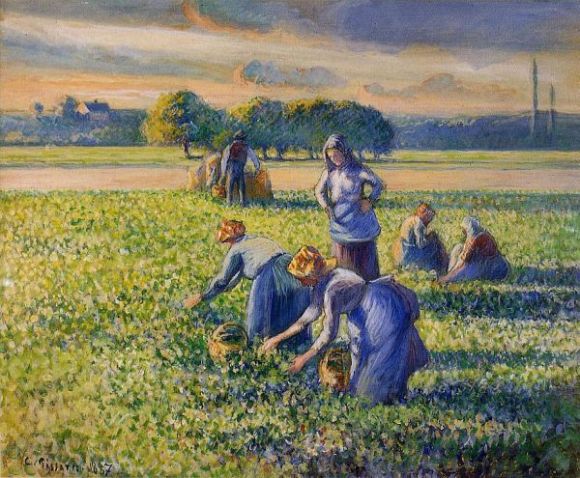
A painting by impressionist master CAMILLE PISSARRO that was seized from its French Jewish owner during World War II is at the center of a court battle beginning Tuesday in Paris after surfacing at an exhibition.
“La Cueillette des Pois” (Picking Peas), a gouache from 1887, emerged earlier this year on display at the French capital’s Marmottan Museum, more than 70 years after being snatched from art collector Simon Bauer in Nazi-occupied France.
A court will on Tuesday begin examining who are the rightful owners — Bauer’s descendants or an American couple who say they had no idea as to its wartime fate when they bought it at auction in 1995.
Bauer, a self-made businessman, was among the thousands of French Jews who were rounded up for deportation in 1944. He narrowly escaped being sent to the Nazi death camps due to a train drivers’ strike.







 penwithlit