I’ve said it once, and I’ll play it again, Sam. The mere sight of the Paris rooftops at l’heure bleue has never failed to give me a thrill. Larger than life, I’m transfixed. I tumble flat.
Reaching for Henry Miller: “In Paris, on the asphalt, I have often walked saying: wild, wild, wild. You just say it, and walk, walk, walk. It makes everything rise, swell, burst. Then I am so happy I cannot bear it any more and I begin to sing. It is cause for bliss. You can get drunk on walking.” Oh, Henry!
Das ist der Herbst; die Blätter fliegen,
Durch nackte Zweige fährt der Wind;
Es schwankt das Schiff, die Segel schwellen –
Leb wohl, du reizend Schifferkind! —
Sie schaute mit den klaren Augen
Vom Bord des Schiffes unverwandt,
Und Grüße einer fremden Sprache
Schickte sie wieder und wieder ans Land.
Am Ufer standen wir und hielten
Den Segler mit den Augen fest –
Das ist der Herbst! wo alles Leben
Und alle Schönheit uns verläßt.
Thinking back to the early 1960s, Bertrand Russell, the subject of another prize winning biography by Ray Monk, was frequently seen on black and white television declaring his concerns over Nuclear Weapons. He stated, Neither a man nor a crowd nor a nation can be trusted to act humanely or to think sanely under the influence of a great fear. For nearly seventy years, mankind has wondered in the words of Sting, How can I save my boy from Oppenheimer’s deadly toy? As concerns about nuclear proliferation in relation to Iraq, Pakistan and North Korea escalate it is salutary to return to a thorough biography of the man, known as the father of the bomb, that felt a deep and urgent need to be at the centre and to belong, J Robert Oppenheimer.
Oppenheimer’s father, Julius, a wealthy cloth merchant came from Hesse and was among the many German Jews to arrive in America in 1888. Oppenheimer visited his Grandfather’s home at the age of four and thought it a medieval village. A strength of Monk’s biography is his facility in evoking locations. In adolescence Oppenheimer was attracted to New Mexico where he had been taken by his English teacher, Herbert Winslow Smith, and fell in love with horse riding and the landscape. At Cambridge, however, he was particularly miserable and suffered a nervous breakdown following his attempt to poison his elegant supervisor, P M S Blackett. His recovery on Corsica was due apparently to a passage from Proust, providing much needed stoic calm before his exciting time at the beautiful university and centre of theoretical physics in Göttingen.
The portrait emerging from letters and documents that Prof Monk has so carefully sifted, is of a highly intelligent man who assumes a debonair persona, motivating others, well-read and proficient in several languages from classical Greek to Sanskrit. His interest in physics covered the chemical bond to astrophysics, from quantum electrodynamics to cosmic rays. In all these fields he made major contributions. He even discovered the possibility of black holes. Here is a man that bullies and inspires his research students and whose lectures are displays of his own facility spiced with a high degree of arrogance and hauteur at the cost of clarity to his audience. Impatient and incompetent with arithmetical calculations, he was ham fisted with experiments. Oppenheimer, a tragic figure with a highly developed knowledge of classical tragedy lacked a real sense of self.
Oppie, Pauli and Rabi on Lake Geneva
Monk’s biography is particularly good at clearly explaining basic physics. Especially the confusions between different formations of quantum mechanics, the difference between the absorption of neutrons in various isotopes of Uranium and the confusion between weak and strong nuclear forces in cosmic ray showers. This was an extremely exciting time in physics and the eloquence of this multi-layered biography lies in painting in both the political background and the personalities of Oppenheimer’s associates, friends, family and lovers.
This variety keeps the reader engaged throughout, iIn particular with the insight which Inside the Centre affords into American values and attitudes. Racism and anti-Semitism was deeply ingrained both in social and academic circles, notably at Harvard where he had been a student. Oppenheimer’s great contribution was the establishment of Berkley in California as a vital international centre for theoretical physics. Becoming a worthy American citizen was always a central concern to him. Seeing a fairer society was important to Oppenheimer who had actively supported a docker’s strike. This would land him in deep trouble with the FBI and later with the McCarthy inquisition and despite his endeavours at Los Alamos, his security clearance was withdrawn.
Inside the Centre by Prof Ray Monk
There is a sense of drama in this book which keeps the reader involved. This is due to the historically momentous events involved but enlivened by the personalities Oppenheimer encountered. His radical brother Frank was an able experimenter. There is the bulky, garrulous and memorable figure of the Swiss, Wolfgang Pauli, depicted among the thirty photographs with Oppenheimer in a boat on Lake Zurich and Ernest Lawrence obsessed with building larger and larger cyclotrons, using ersatz equipment like an 80 ton magnet rusting after WW1 in a junkyard. The contribution of one woman, a pacifist, Lisa Meitner, exiled in Sweden, together with that of Otto Hahn on Christmas Eve 1938 explaining nuclear fission and the devastating amount of energy released clarified the possibility of the construction of a weapon.
In conversation with Einstein at Princeton
Monk’s technique when detailing a particular event or person, allows that the reader may see it differently. The detailed footnotes and comprehensive biography makes it possible to follow up alternative explanations. This is particularly useful in relation to a conflicted individual such as Oppenheimer who felt ambivalent about many issues, some of which he must have kept very close to his chest. There is a certain liberal generosity about Monk’s technique. This is a very fine intellectual biography.
Between October 16, 2013 and February 16, 2014, the State Tretyakov Museum holds an exhibition titled ‘Between the East and the West’, dedicated to the works of Natalia Goncharova (1881-1962).
Natalia Goncharova has been variously called an Amazon of the avant-garde, a great Russian artist, a left-wing painter of the Russian avant-garde. And yet a 100-odd years ago, conservative critics were deprecating her as an blasphemer and an untalented dauber. When you look at the amazing power of her spiritual cycles, her refined theatrical sketches, her decorative still lifes, it is difficult to understand why so much criticism clung to her, and why her works were snatched right off their displays.
Goncharova’s solo exhibition in 1914 (in Nadezhda Dobychina’s ‘Art Bureau’, at the time, the fashionable gallery for modern art in St Petersburg) created a scandal. An anonymous…
Head to Head at Penzance Public Library Nov/Dec 2013
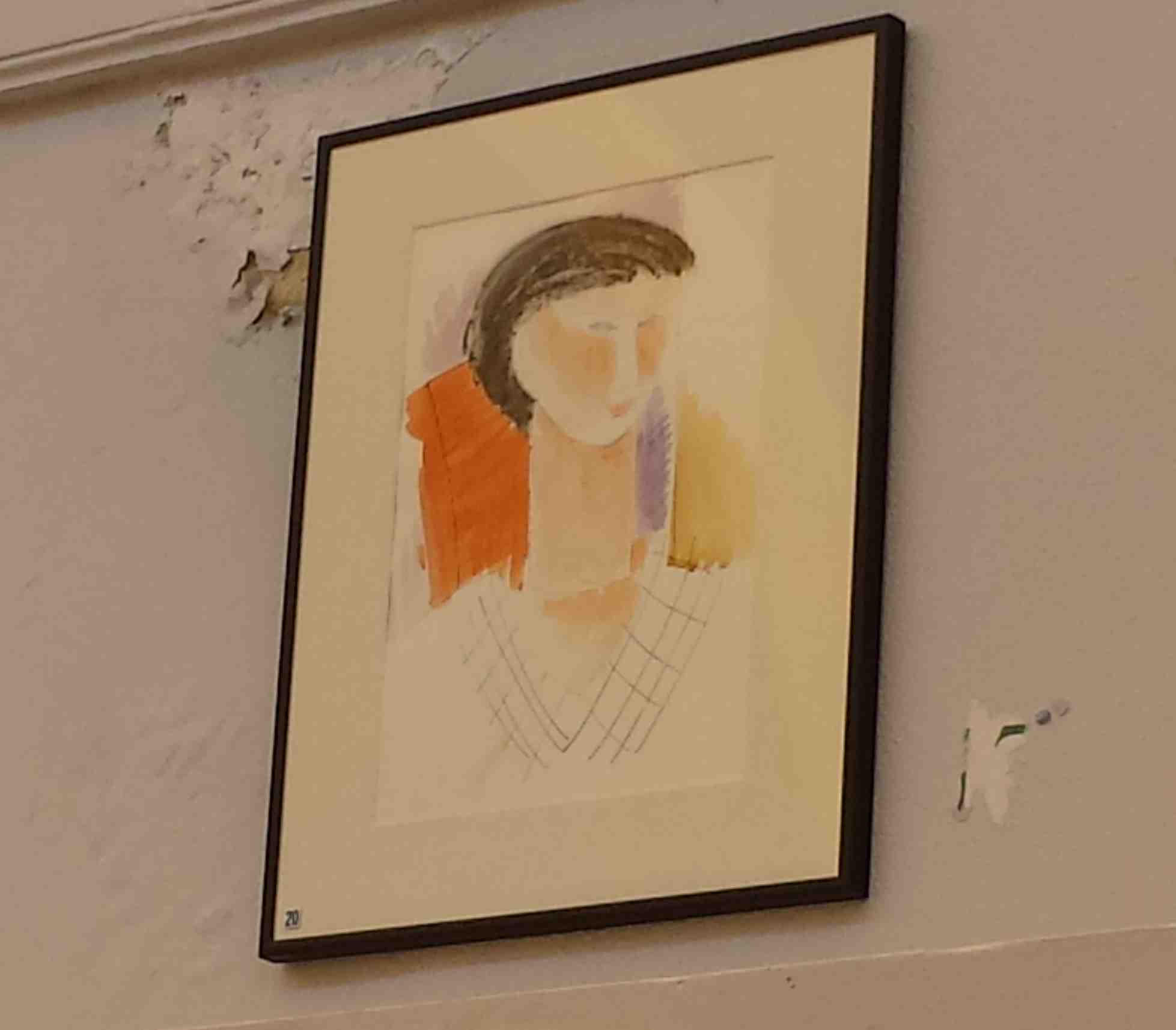
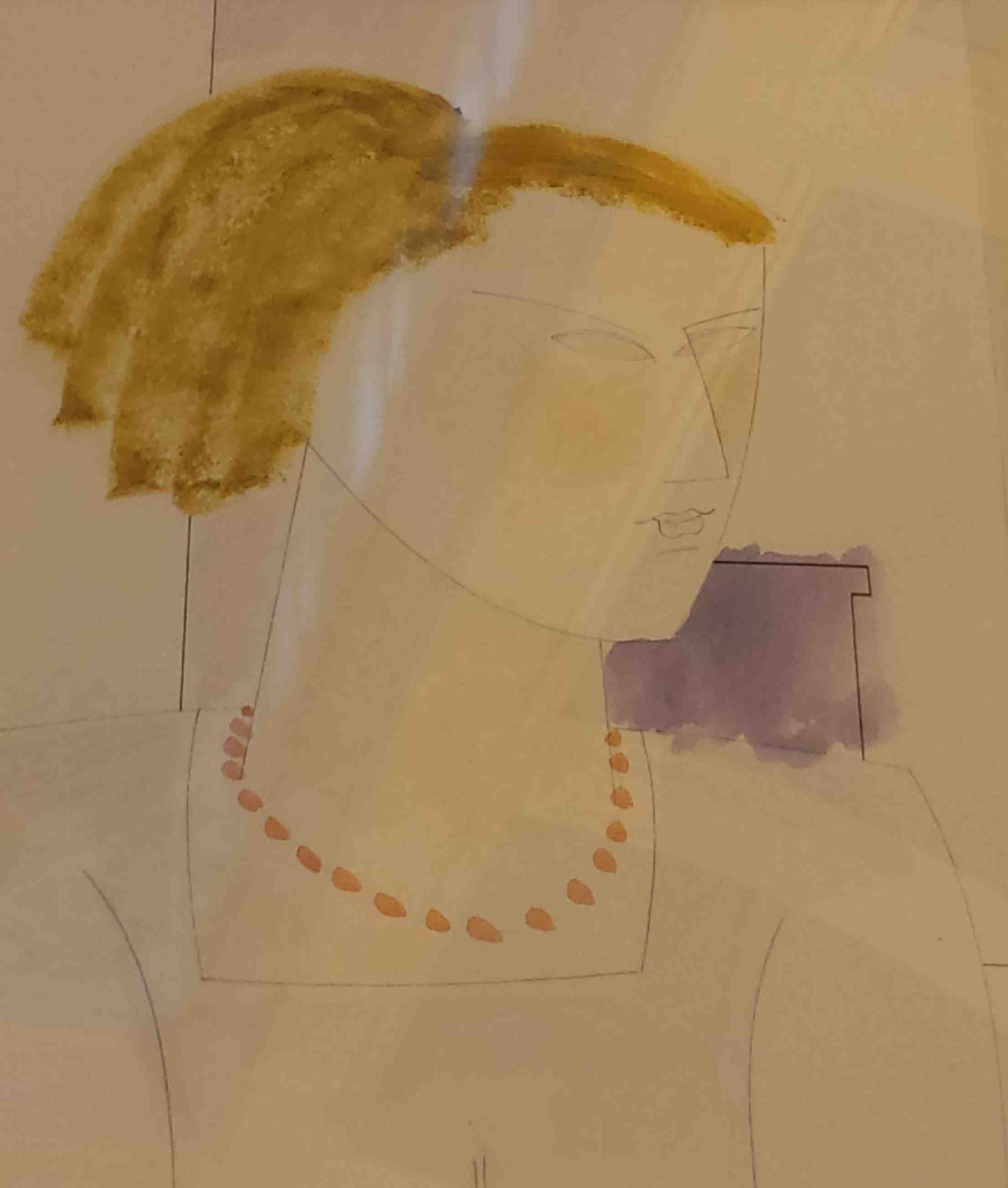
These works were made in the last ten years of John B Anderson’s life. To quote from the notes at the library, “The fine lines adopted from his abstract period remain as precise: less indeed can be more. The work is observational, some of it quite quirky including bad hair days and some serene moments……… John B Anderson pushed his figurative work as far as he could towards abstraction: he then returned to a figurative style with a more restrained and pared back approach resulting in these fine line works.”
At http://www.thisiscornwall.co.uk/Library-pays-tribute-John-B-Anderson/story-13244578-detail/story.html#axzz2leYQH1no there are further details including the remark that, “An artist who was to die in 1997 when in his early 50s, in recent years his paintings have been seen in various local venues, from Trereife Gallery to Penzance Arts Club, and the sequence of his works about to be shown in Penzance Library reveal his admiration for such as Van Gogh, Modigliani and Picasso, and his search for his own style through the figurative and the abstract.”
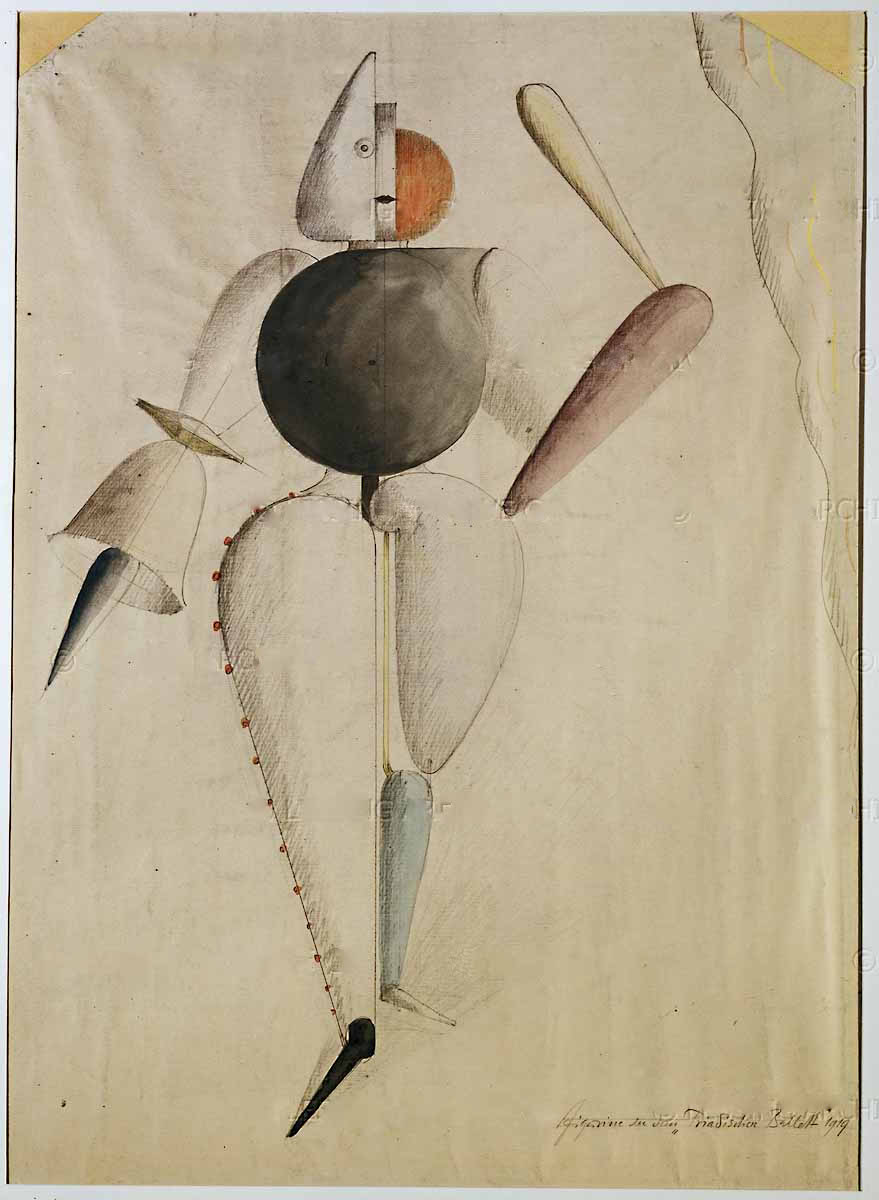
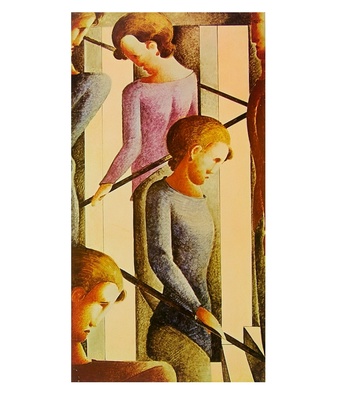
The following images scarcely do these paintings justice taken hurriedly with my mobile. They are hung rather high and difficult to see at their best advantage. However, their geometric style and their delicate colours make them very appealing and remind me in particular of the work of Oskar Schlemmer (4 September 1888 – 13 April 1943) who was a Germanpainter, sculptor, designer and choreographer associated with the Bauhaus school. Some of the images displayed may indicate this similarity as well as with the Bauhaus theatre designer, Lothar Schreyer.
Lothar SchreyerOskar Sclemmer Auf der TreppeOskar Schlemmer Postcard of Young Men
In his introduction Professor Kaiser states that there are three ways in which the west coast hippies have benefited the development of Physics; they opened up deeper speculation into the fundamental philosophy behind quantum theory, they latched on to a crucial theorem of Bell, about what Einstein termed spooky interactions between particles at a distance. This might otherwise have been totally neglected. Thirdly they propounded a key idea which has become known as the no-cloning theorem. Kaiser tells a lucid account as might be expected from the Germeshausen Professor of the History of Science and department chief in the Massachusetts Institute of Technology’s program. Incidentally he also provides an engaging insight into the American industrial-military complex and associated institutions like the University of California at Berkeley.
After a brief survey of the thirties golden age of European physics, including the theories of Born, Bohr, Heisenberg, Schrödinger and of course Einstein, we are introduced to the wacky and hirsute figures of Jack Sarafatti and his good chum, Fred Alan Wolf. This pair were to travel around Europe discussing theories, including the interrelation of consciousness and quantum physics. On the way we are introduced, sometimes with rather scrappy diagrams, to the concepts and key experiments that formed an important new area of Physics, quantum information theory. This has led to technological developments via special encryption that mean that data can be securely sent along optical fibres and is of great importance in finance and to the military. These are contexts where security of transmission is of paramount importance.
The Lawrence Berkeley Laboratory’s Fundamental Fysiks Group founded in May 1975 contained many interesting and eccentric characters. Kaiser’s account of their work is sometimes as bending of the mind as is his description of Geller’s experiments with flexing spoons! Elizabeth A. Rauscher, for instance, emerges as a particularly interesting woman who had to wear tweedy dresses and have her hair cut short to gain serious acceptance in a male-dominated environment. Only 2 per cent of Physics PhDs in the States, were being awarded to women at this time. With a certain feistiness and interest in everything from multidimensional Universe explanations to crucial problems, as well as brain waves and psychic healing, she must have been a wonderful participant guiding the wilder dreams of the so-called Fysiks group. Two other major figures that the Professor reminded this reader about were Thomas Kuhn and David Bohm.
Kuhn’s work testified to a fruitful interaction between the Philosophy of Science and Physics itself. It emphasises that the development in knowledge often requires a huge change, one might even say a quantum leap, to which the prevailing orthodoxy presiding over the subject are resistant. In his account there is no smooth progression involved but a shift, a paradigm shift required to explain new experimental results. Kuhn had to defend his account against charges of relativism but it has the advantage of opening up the teaching of the subject and helping students realise that the study of Physics requires imagination and creativity. David Kaiser draws on these ideas and gives a lively account of the correspondence and vigorous exchange of ideas between the extraordinary Ira Einhorn who was eventually to be convicted of the first degree murder of his own wife and Thomas Kuhn.
Professor David Kaiser- The Author
David Bohm also possessed a brilliantly analytical mind and whilst by no means a hippie he shines forth as a deep, unconventional thinker who pondered the foundations of quantum mechanics. He came to Britain and finally taught at Birkbeck College in London, having been forced out of America by McCarthyism at its height. This was despite having made a huge contribution to the Los Alamos development of the Hiroshima bomb. In 1959 he demonstrated with his student Aharanov that a previously purely theoretical quantity, called magnetic vector potential, could yield a measurable experimental effect. Kaiser shows how he proved an inspiration to younger physicists and how he investigated Geller’s unusual phenomena. In addition to this work he was interested in the philosophy of mind and explaining consciousness. Kaiser deserves praise for weaving such original thinkers as Kuhn and Bohm into his narrative.
Bohm’s Key Text
According to Professor Kaiser another, way out figure that should be thanked for his accidental and unintended contribution in 1967 to developing this new area of Physics was Republican Governor of California, Ronald Reagan. Upon taking office he cut the budget of the University in the state by 30 per cent in a drive to lower taxes. Such policies and later the realignment of Cold War policies in the Pentagon, led to a situation where Physics graduates had more time on their hands to explore the deeper roots of equations that had previously been used as mathematical tools in a pragmatic but unexamined way. Kaiser is as interesting on this although the exact interaction between the military and the hippies remains an undisclosed parameter.
This is an interesting book with copious background notes and some well-written passages. I liked the one about the modern ouija board made by Herbert from a supposedly random radioactive thallium source connected to a metaphase typewriter. Wheeled out in March 1974 on Houdini’s 100th birthday to make contact with him on the other side, it did manage to sputter out ungrammatically, aninfinitime.
Feynman’s Introduction to Quantum Electrodynamics
If you are an armchair hippy interested in aspects of ESPionage and the CIA, or laser beam splitters and paradoxical particle counters then a harmless trip with this book may well be for you!
The days leading up to Christmas are associated in my memory with a series of various festivals and events from Guise Dancing to Fair Mo and then Christmas itself. This too was soon followed by the scarlet coated and spectacular grandeur of the Western Hunt during St Ives Feast. The Guise Dancing was ominous and noisy; it seemed to myself-perhaps a timid child, with masked figures, lanterns and loudly beating drums. It was still commonly performed until the mid fifties but seemed then to have died out with the corresponding popularity of television. However, by Fair Mo, a Church based fair situated in the Guildhall and taking place at the end of November it was by then always clear that the Christmas season would soon be upon us. It is described now on the History of St Ives website, as,”… a less rowdy tradition, celebrated just before Christmas. This ancient ‘pig fair’ reflects the long-standing custom of keeping pigs in virtually every Downlong yard. Today local ladies dress in traditional costumes and hold their fair, or market, in the Guildhall.”
Around Christmas Eve, or a day or two before, everyone in downlong had been serenaded by the agreeable euphony of perambulating choirs from the Primitive and the other MethodistChurches. These were accompanied by a clarinet or two and everyone emerged to the truly blissful sounds of Thomas Merritt’s Carols, before each the verses were briefly intoned and led by the choirmaster. “Hark the glad sound” resonated and reverberated against the cottages and along the cobbled streets with such utterly superb harmony that Christmas, together with its peaceful promise, seemed as imminent as the arrival of “the Saviour promised long.” The effect was utterly magical and glorious; recalling it again makes the hairs on my neck stand up on end. So that neighbours emerging from their doorways were thoroughly receptive to the “Tidings of great joy” that Gabriel brought “to you and all mankind.” After the melodic repetitions of Cornish and other carols people returned to their houses prepared by such benedictions to enjoy Christmas Day itself.
Hepworth
Most pubs and inns similarly resounded with affirmative renditions of the “Old Time Religion.” The Cock Robin choirs provided youngsters with the opportunity for mild horseplay- as evidenced the next day by seeing a punt or skiff hoisted on to the roof of the fisherman’s lodge. Few would have ventured as far afield as Mousehole, for either Tom Bowcock’s Eve or even Starry Gazey Pie. There was absolutely no rowdy celebration on New Year’s Eve but grand and elegant Scottish or Hogmanay dances, attended largely by the professional classes at such grand venues as the Portminster Hotel or Kenegie Manor in Gulval.
Preparations for Christmas in the home were concerned with food, presents and decorations. There was an early ecological arrangement whereby potato skins were placed in a special bin and collected each week by the ‘pig man’. The result at Christmas was that every house received a good sized pork joint. The turkey-some in the family might have had goose -was paid for on a card signed for, again on a weekly basis, at the butchers over the autumn months leading up to Christmas. Pickled onions were prepared over a longer period and stored with peppercorns and tiny red chillies on a shelf above the stairway on the ground floor. Military pickle and piccalilli were purchased to go with the tongue, pulled together with skilvin (quality string from the Fisherman’s Co-op) and pressed in a saucepan, with a weighted lid-usually a smoothing iron. Salt beef was also prepared with other cold meats for suppers over the Christmas period.
Patrick Heron
The house was extra warm from the heat generated from the kitchen and if it was windy in the wrong direction, especially before a cowl was fitted, smoke from the coal fire would fill the sitting room. The resulting “smeech” would deposit smoke particles of varying sizes spoiling some of the coloured paper decorations in the sitting room. After saffron stamens had been floated in a small bowl to extract the lovely liquid yellow concoction, bowls both of dough and cake mixture were placed by the fireside, covered by tea towels and left to rise. Cakes purchased especially at Christmas included batten burg, chocolate log and walnut. Macaroons, coconut pyramids were prepared on rice paper as well as congress tarts. The one cookery book –the one which probably came with the oven- were referred to on an annual basis. Reference was made to on one or other well thumbed pages.
The Christmas tree was always a holly tree and the large fairy light bulbs were checked and replacements inserted into and the holders, some of which were in small copper lanterns my father had made and into which rice paper was inserted to diffuse the light. Embroidery thread was cut into lengths and tied on to the baubles or shiny things. The extra demand meant that the electricity meter ‘went’ more frequently and had to be fed and wound with two shilling pieces that were of course known as florins. This process was often accompanied by the question, “Where was Moses when the lights went out?” There seemed to be much to do in those days leading up to Christmas Day and my father might describe how in the 1920s he and my uncle would mostly just have oranges, some wrapped in silver paper and walnuts and brazil nuts as the main fillers in their Christmas stockings.
After Christmas dinner, the turkey which was taken upstairs afterwards into the preservative cool of the so-called small bedroom, borne on the large appointed Victorian ornate and crazed platter. It was carved for suppers and other dinners over the next few days. Nobody could quite get through all the cakes or biscuits, so my father took it, as a snack, with his thermos flask of tea to the factory where he worked until about the middle of March. Apart from Sherry and usually Port – there might be a bottle of each- there was little in the way of drink until white wine, in the form of Blue Nun became a favourite with my mother in the seventies. On reflection much of the fun in the celebration of Christmas was probably also a recovery from the tough period during the war when my parents had travelled around air stations. From Filton in Bristol, where they both worked and had been bombed, they journeyed to Hull and Girvan in Scotland and other places. Housing shortages, especially in Cornwall had to be endured and the severe economic pressures of the Cripps austerity period had also just ended.
A pirate radio can be described as an illegal or unregulated radio transmission. In particular, UK pirate radio [unlicensed illegal broadcasting] was popular in the 1960s and experienced another surge of interest in the 1980s, as Carole Fleming and Pete Wilby say at their research for the book The radio handbook in 2002. Talking about London, we can say that pirate radio is everywhere. Today’s broadcasts are hidden in plain sight, transmitting from secret tower block studios via homemade rooftop antennas, and we were surprised to see that one of these pirate radios is currently transmiting* from the Maunsell Sea Fort, constructed in 1943 and located in the Thames Estuary area.
Using for the London Pirate Radio the same description used for the Berlin’s one:
“There are places you won’t find in a tourist’s guide. Underground bunkers and mysterious hilltop listening stations, built to intercept radio communications.”
If you are inclined to take your cues from the weekly reviews, as the witty poet Gavin Ewart once expressed the matter, you will doubtless find currently articles as varied as; Russell Brand predicting the imminent decline of the BBC, various interpretations of liberalism and how these struggle for expression in Coalition Government policy. There are concerns too about the legislation governing the internet and references back to the Sixties battles between, on the one hand, the unbridled self-expression of the free market and, on the other, the virtues of self-restraint in such matters as the re-examination of the Lady Chatterley trial, now fifty years ago. An unusual and quite intriguing book, Death of a Pirate, about the development of intellectual property and piracy in radio touches on all these contemporary concerns in a dramatic way. It combines the history of modern broadcasting with a crime story and consequent trial.
This is a book about the conflict between two determined but erratic men that ended in violent death. The victim was Reg Calvert, whose parents were travelling musicians who separated early leaving him to wrestle a living in various parts of the music business as an impresario and dance hall manager. He had acquired an illegal handheld jet blowtorch as an item for his own self-protection and for that of the bouncers and henchmen that he employed –usually on a non-contractual ad-hoc basis. Through ingenuity in a series of not very successful ventures he came to control the pirate radio station at Shivering Sands. This was situated on a shabby, rusty and disused ant-aircraft gun emplacement on sixty foot high steel legs just offshore at Whitstable. Becoming the base for RadioCity, Calvert it bought from screaming Lord Sutch. It effected the training of a generation of DJs. Although the structure was physically stable financially it was anything but.
It also needed an effective transmitter-including an antenna- which was imported from Fort Worth in Texas under the aegis of Oliver Smedley then engaged in the financial revival of the station known as Project Atlanta. Smedley was altogether a different type. He hailed from a military background and had distinguished himself directing artillery fire in the summer of 1944. Smedley was not just a man of action; he was nearly 20 years older than Calvert and an ideologue for Hayek and unbridled private enterprise. Business machinations and the disputed ownership of the dilapidated aerial (which had comically fallen into the sea when first delivered, being hauled up by an unsafe lashed up crane, eventually recovered by a team of divers) led to Smedley launching a Combined Cadet Force type raid on the platform carried out by a motley crew of Kentish seamen. Smedley organised the capture of the platform and the removal of microphones and the home-made silicon crystal whose oscillations drove electrons up and down the rigged aerial and without this, of course the Calvert’s station could no longer transmit.
These actions eventually led to a highly distraught Calvert being driven down through the darkened hedgerows to the Essex home of Wenders Ambo where Smedley cohabited with his much younger secretary. Calvert’s entry was highly provocative, especially his intimidation of the girl, but scarcely excused his being shot at close range by the irascible Smedley, often inclined to rash action and this encounter was indeed quite unexpected. It was an incident that was to have repercussions for the future of the broadcasting industry.
Strange encounters and a cast of intriguing characters, including spooks and criminals, make this factual account read like an engaging novel. The settings vary from Dean Street where many seedy business deals were cut to the untidy front rooms of amateur experimenters, laced with wires and triode valves strewn about the place. There are the grand offices of the BBC and the rusting hulks of the early pirate vessels. Prof Johns captures every aspect of the thrill of the early experimenter and scenes of espionage in conflict with the Nazis for control of the ether. The narrative tells of the thrill of the first listeners to the exciting broadcasts from Radio Luxemburg. It relates the propaganda and transmissions from within the narrow borders of the intriguingly independent and strategically positioned state of Liechtenstein. Sandwiched between Austria and Switzerland and with unstable neutrality, its windy heights became crucial to the battle of the airwaves and the control of populations.
A professor of history at the University at the University of Chicago, Adrian Jones provides a thorough and invigorating account. He has briefly outlined the impact of the technical developments from the early problems of feedback interference to the invention of the transistor. In summarising the ideological battles of the information age, he draws memorable pen-portraits of the austere Reith and the flamboyant technical wizardry of P P Eckersley, not to mention the aptly named Plugge. It was Plugge who created the International Broadcasting Company in 1931 as a commercial rival to the British Broadcasting Corporation by buying airtime from radio stations such as Normandy, Toulouse and Ljubljana.
To conclude Adrian Jones has written a well researched and clearly referenced work that demonstrates the connections between technical developments, listeners, broadcasters, academics and political factions. He shows clearly how the pirates provided the music and relaxation that the population, just after the austerity period, really wanted. He is particularly interesting on an academic called Ronald Coase who advanced arguments about the unfairness of the BBC claiming a cultural monopoly. So in addition to telling a tale with journalistic flair his book is also an introduction to cultural history and social change. It is, in this sense, a demanding book which however thoroughly repays close reading. As might be expected, there is a clear list of references and web material for readers to further their own research.



















 penwithlit