Last week’s post looked at the uncanny, and how it resides within ourselves. Today, I will move on to exploring ways in which we can confront these aspects of our inner world, often termed our ‘monsters,’ or our ‘demons.’
The Struggle To Face Our Inner Demons
Ghost – Mario Sironi. Wikimedia Commons.
“No one who, like me, conjures up the most evil of those half-tamed demons that inhabit the human breast, and seeks to wrestle with them, can expect to come through the struggle unscathed.”
Freud. From Dora: An Analysis of a Case of Hysteria, 1905
Facing our dark side, or our shadow side as Jung termed it, is far from easy. Jung’s shadow is akin to Freud’s ‘unheimlich,’ which describes parts of the personality of which we may be unaware. If we remain in denial about the existence of our own shadow, we will tend to project that darkness onto…
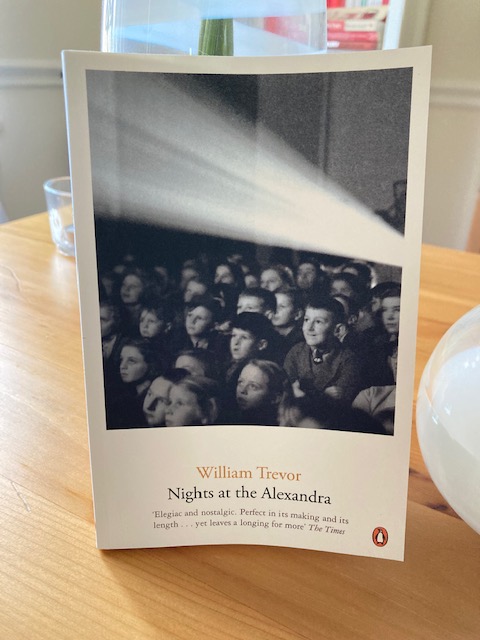
The esteemed Irish writer William Trevor is frequently cited as a master of the short story, and rightly so. His stories are spellbinding – humane, compassionate and beautifully written. He has a way of getting into the hearts and minds of his characters with insight and precision, laying bare their deepest preoccupations for the reader to see. These skills are very much in evidence in Nights at the Alexandra, a slim collection comprising the titular novella and two short stories, The Ballroom of Romance and The Hill Bachelors. I simply adored these achingly melancholy pieces, exquisitely expressed in Trevor’s deceptively simple, understated prose. As in Clare Keegan’s novellas Foster and Small Things Like These, there’s a luminosity or purity to Trevor’s stories, an emotional truthfulness that’s hard to capture in a review.
The collection opens with the titular novella in which fifty-eight-year-old Harry looks back on the days…
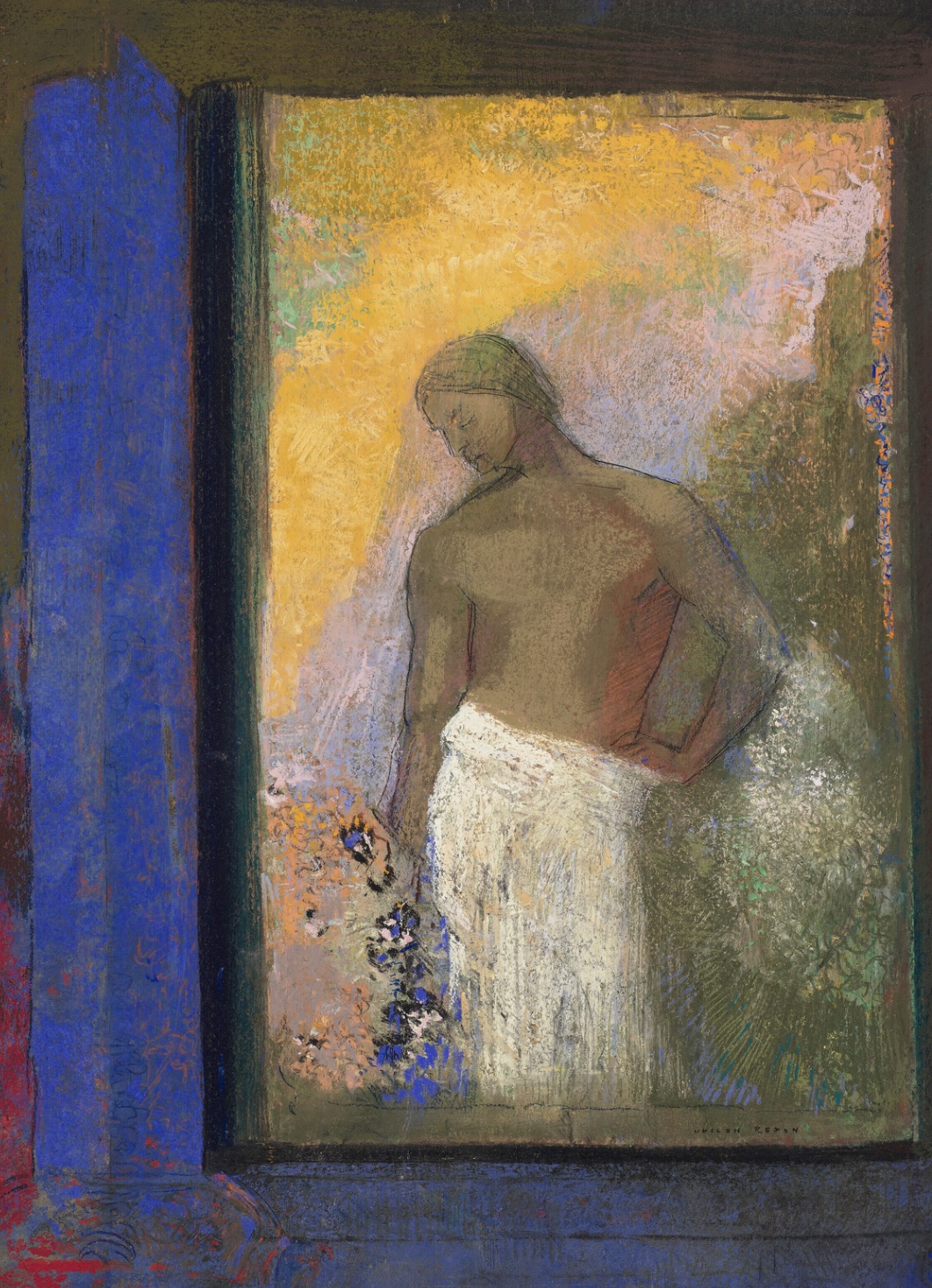
ODILON REDON (1840-1916) Saint Jean signed ‘Odilon Redon’ (lower right), pastel on paper, 17 1/2 x 12 1/8 in. (44.5 x 30.8 cm.), Executed circa 1910, Image Source: Christie’s
Fleur Roos Rosa de Carvalho, ‘Decorative panels’, in Odilon Redon and Andries Bonger: 36 works from the Van Gogh Museum collection, Amsterdam 2022, FREE PDF HERE
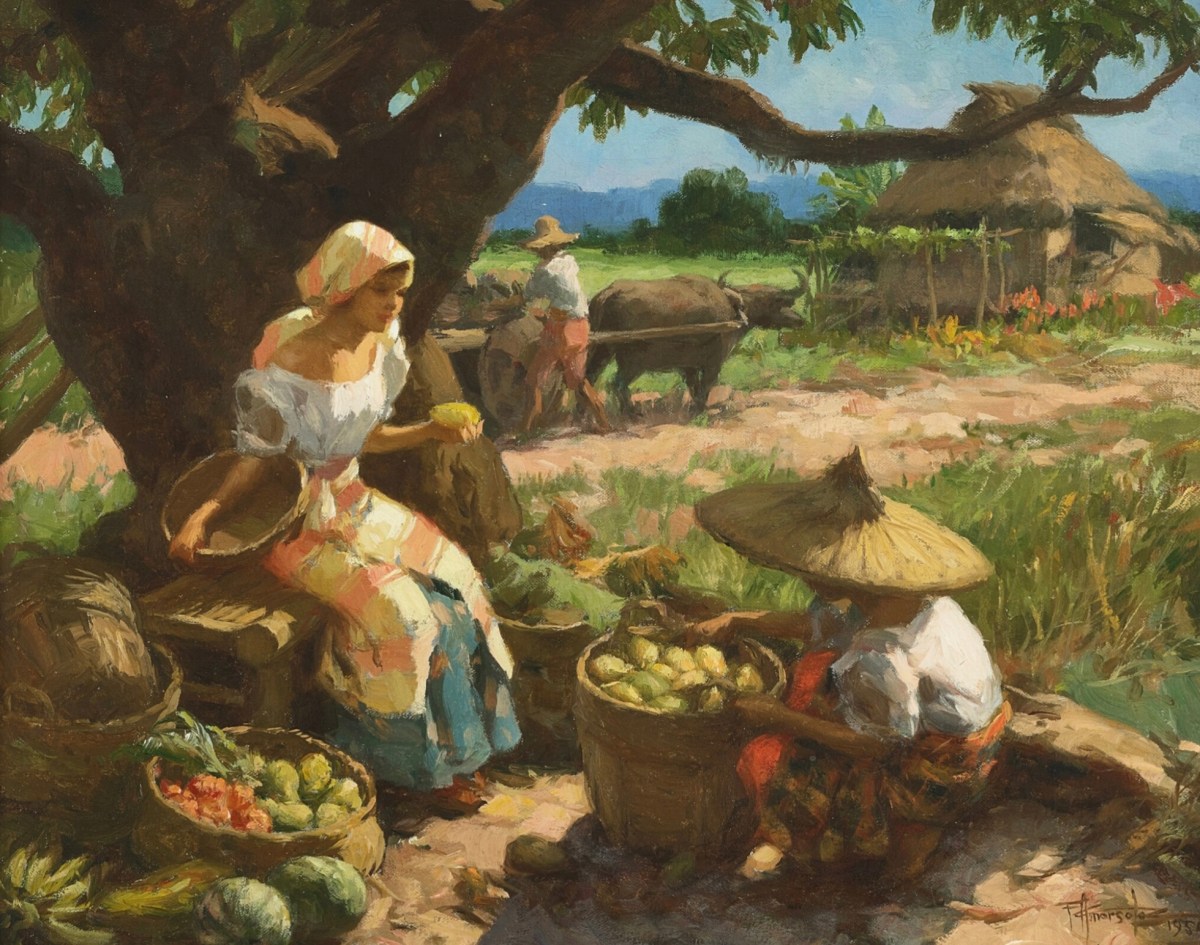
Fernando Cueto Amorsolo (1892 – 1972), Under the mango tree, oil on canvas, signed F. Amorsolo and dated 1950 (lower right), Executed in 1950,Image Source: Sotheby’s
Last week saw the publication of Dana Gioia’s Meet Me at the Lighthouse, a perfect collection of poems. Dana has been a mentor and a friend to me, but had he and I never met, the pages of this book would have lodged themselves just as firmly in my heart. In fact, we came to know each other through one of its masterpieces, “The Ballad of Jesus Ortiz.” It reached me through a mutual friend, the late Scott Timberg, and I leapt at the chance to publish it in the Los Angeles Review of Books. The ballad tells the true story of Dana’s great-grandfather, a Mexican immigrant to the US who was killed in an argument over a bar tab. It is a poem of the West, and others in Dana’s book — including the titular “Meet Me at the Lighthouse” — bring the…
In both of these collections the sea and its various moods features. It is not just this that endears me in each case but it is that element that prompts me to write about them today. It is raining once again here in Cornwall and it is as the mists mizzle gather over the bay that I find myself in somewhat melancholy mood to respond to these collections.
Derek Mahon
Essentially this is a collection of essays by different writers together with Mahon’s poems. Here is one example- the poem-“The Sea in Winter” which was written for Desmond O’Grady. There are so many lovely passages in this poem which is fast becoming a favourite.-
Portstewart, Portrush, Portballintrae-
Un beau pays mal habité,
policed by rednecks in dark cloth
and roving gangs of tartan youth.
No place for a gentleman like you.
The good, the beautiful and the true
have a tough time of it; and yet
there is that Hebridean sunset,
The coast in winter, something familiar here in West Cornwall evokes feelings as in these engaging couplets:-
The sea in winter, where she walks,
vents its displeasure on the rocks.
The human factor appears too beside these images or pathetic fallacies-
………………………….; the spite
mankind has brought to this infernal
backwater destroys the soul;
it sneaks into the daily life,
sunders the husband from the wife.
Sunder seems a significant word here, perhaps evoking “thunder” and reminiscent of the biblical separation of “asunder”. ( The chariot and horses of fire “parted asunder” Elijah and Elisha (2 Kings 2:11). So we are situated on the bleak edge of the sea. Though not quite in the same mood state as T.S.Eliot-On Margate Sands./I can connect/Nothing with nothing./The broken fingernails of dirty hands./My people humble people who expect/Nothing.
“I grew to love the poem’s complicit sense of ennui,bordering on but never quite reaching desolation, ‘living on the edge of space’; the memorable turns of phrase and allusive colour, both classical and contemporary; the sense of redemption just out of reach; the agonizing, trapped uncertainty of the writing life; all balanced against the consolation of confident, impeccable poetry.”
Evelyn Holloway
Evelyn’s book is published in English and German by Edition Sonnberg which is based in Vienna, where Evelyn was born in 1955. Perhaps the most interesting poem, it is for me, is Meeting which tells of Evelyn encountering Samuel Beckett in Oxford where she was a student in October 1973. I find that even with my poor German having the text in both languages somehow broadens the comprehension of the text.
Suddenly I see his face
stepped down from book covers,
a furrowed face, a landscape of thought
I waited for Godot,
saw people stuck in bins,
so many figures of his universe,
Now to return to the sea, a sea of memories- some perhaps repressed…….
ERRINERUNG IST EIN OZEAN OHNE SALZ
Ich kam hier um das Wrack zu sehen,
musste tiefer tauchen, tiefer.
Farben sind dort begraben,
Stimmen von der Zeit verschluckt.
Irgendwo in diesem Chaos,
ich bin irgendwo
verlassen,gefunden, und wieder verlassen
Atmen fällt schwer hier unten
Kunstweke hinter Mauern versteckt
Errinerung ist ein Ozean ohne Salz.
So that the memory can appear like a sea too, but one without salt. Memory and dreams have perhaps links to Vienna but the salty sea is close by in St Ives.
Here are just a few lines from WE ARE DANCING ROCKS (WIR SIND TANZENDE FELSEN)
We will outlast you.
Our salty eternity does not count the years.
We do not mourn the sand swallowed by the sea.
We are dancing rocks.
Her collection Words through Walls is published by Wieser Verlag ISBN 978-3-9504320-8-4
Amazing that such work could be done in the eye of the storm, so to speak. Many of these paintings are from a time which doesn’t feel long ago and how unusual that world appears.
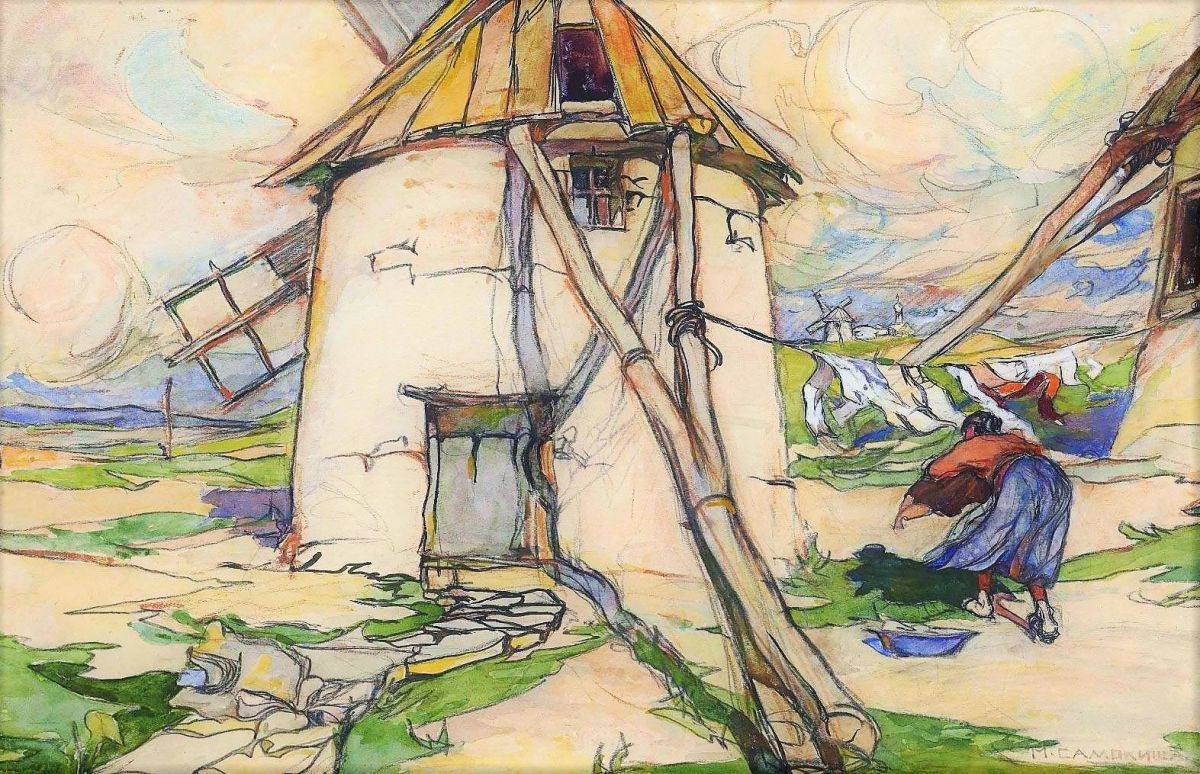
After the early death of Rufin Sudkovsky in 1885, his widow, the former Elena Petrovna Besnard, a prolific Russian illustrator, later married another Ukrainian artist, Mykola Samokish (1860–1944), a selection of whose paintings I show today. Samokish is remarkable for having remained popular and successful in Ukraine and Russia from the 1880s into the Second World War, a period during which so many artists fell foul of one regime or another.
Samokish was born into a Cossack family in Nizhyn, Ukraine, and spent his youth in the town of Nosivka near Chernihiv, in the north-east of the country. He studied at the Imperial Academy of Arts in Saint Petersburg between 1879 and 1885.
Mykola Samokish (1860–1944), Hunters (1885), oil, dimensions not known, National Gallery of Art, Lviv, Ukraine. Wikimedia Commons.
In his early career, he painted several hunting scenes, including the painterly Hunters from 1885.
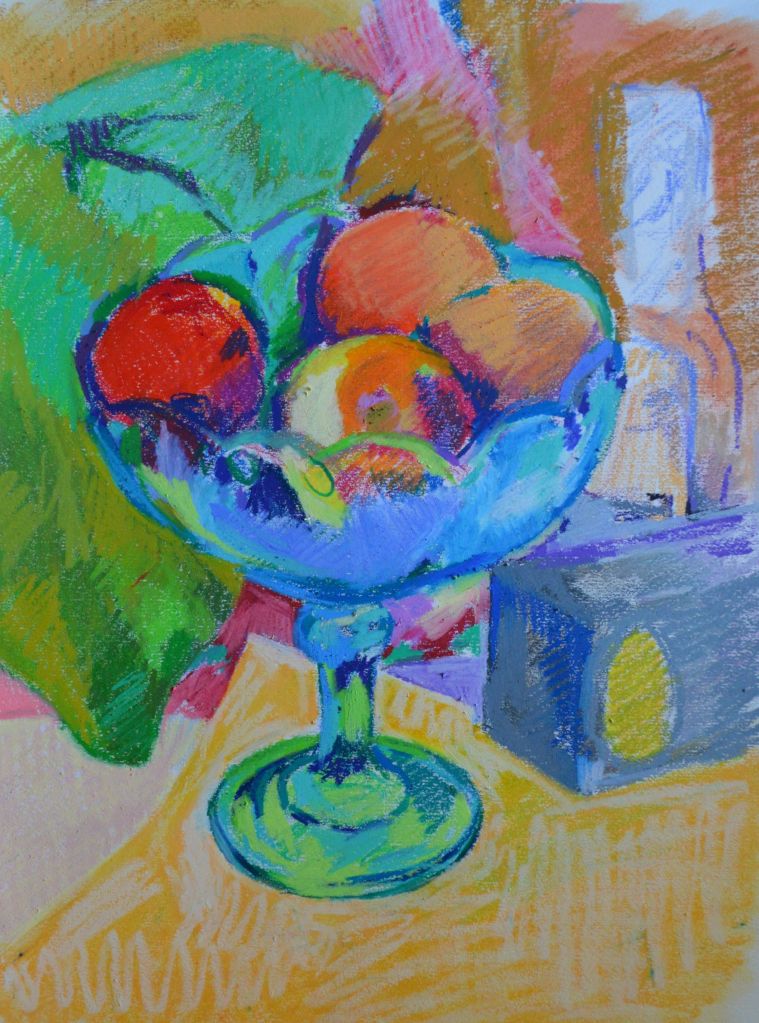
Blue Compotier Still life, neopastel on pastel paper, with additional reworkings begun, work in progress.
I have begun to rework various drawings that I have lately found in storage. Most of the drawings were studies and were never finished for that reason. To finish the drawings now means getting ideas from memory and imagination since the still life set ups are long gone, though in some cases certain still life objects are still in the room with me, available to consult. This drawing is particularly odd in its having a twin. For some reason I made two drawings of the same motif and didn’t finish either one. They appear on same sized sheets and the subjects are very similar. So I have decided to use one to suggest ways of working on the other. Whatever information the one drawing has gets copied to its twin. Then the first reworked drawing…
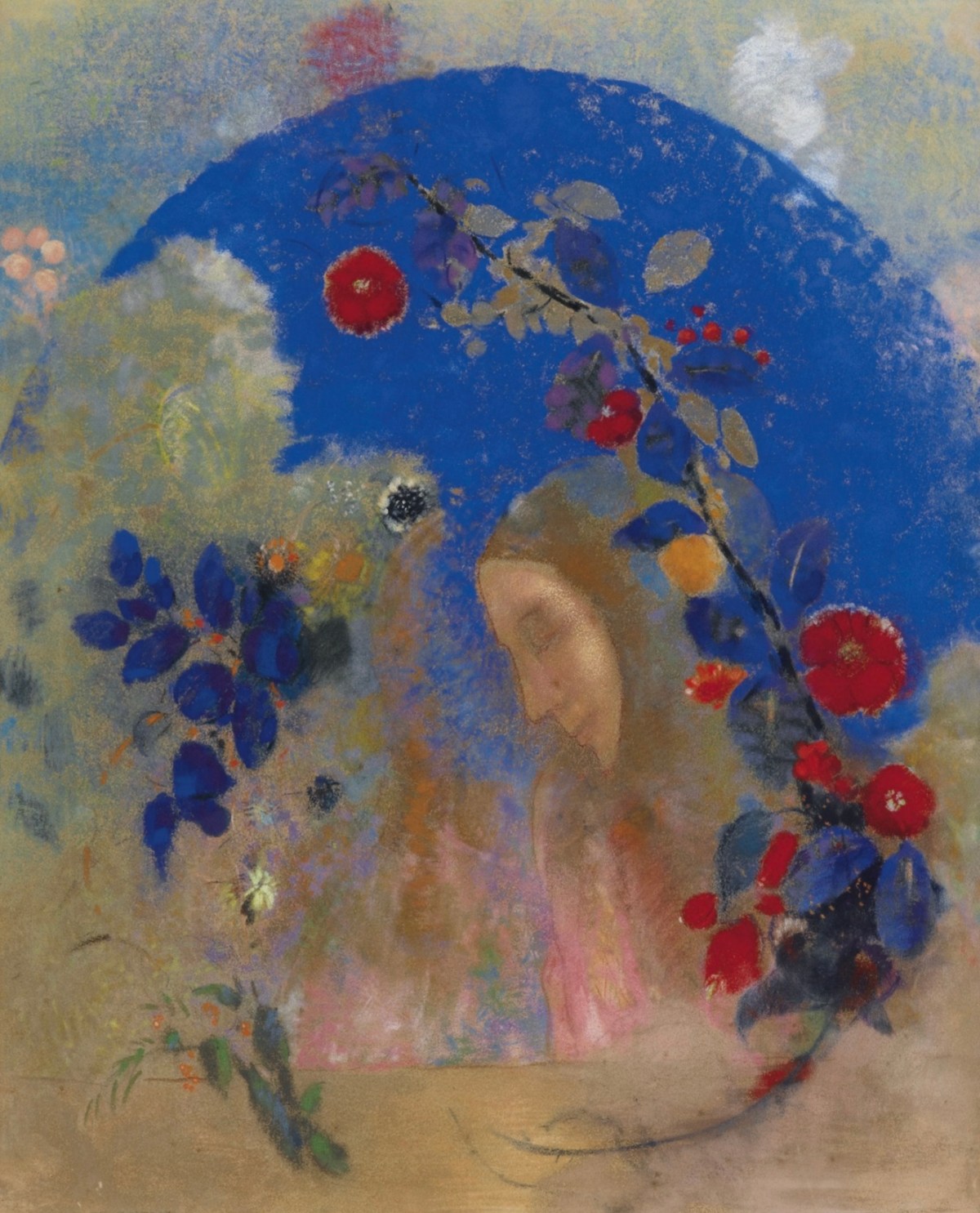
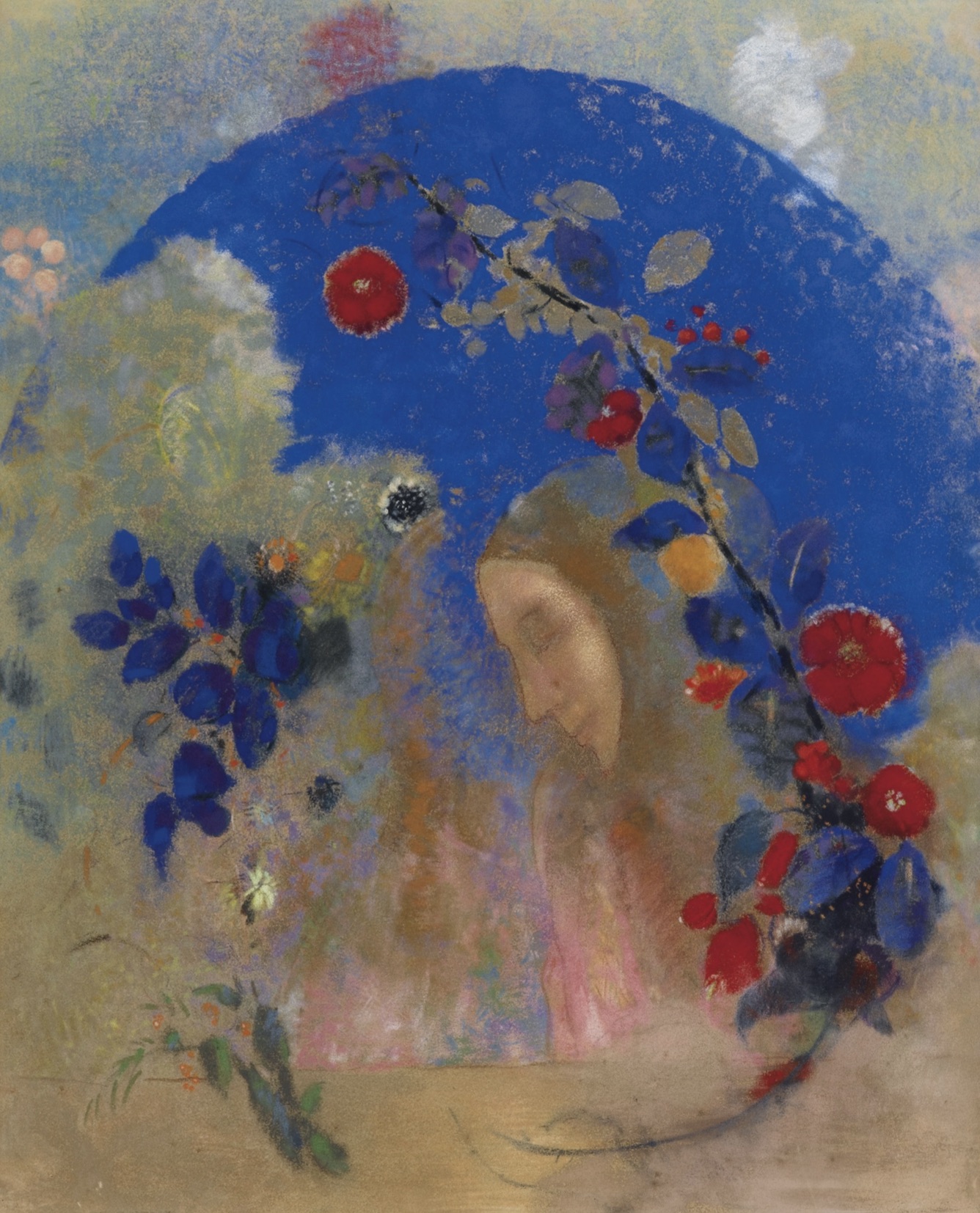
Odilon Redon, Profil sous une arche, signé ODILON REDON (en bas à gauche), pastel sur papier, 67,6 x 53,8 cm ; 26 5/8 x 21 1/8 in., Image Source: Sotheby’s
“Associated with the Symbolist movement, the art of Odilon Redon demonstrates a superb mastery of the pastel technique which draws it source from French 18th century art. The Impressionist painters such as Manet or Degas revived this medium, but Redon then developed a particular style which evoked a world inhabited by a deep sense of spirituality…The use of a arched window-like frame emphasises this space of transition between the physical and the spiritual world. The composition is completed by a majestic invasion of evanescent flowers. Flowers, as Redon described in his diary “…come from the convergence of two shores, that of representation, that of memory”. (A Soi-même. Journal (1867-1915), Paris, 1922, p.115).”








 penwithlit