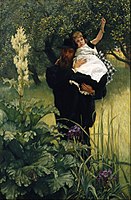
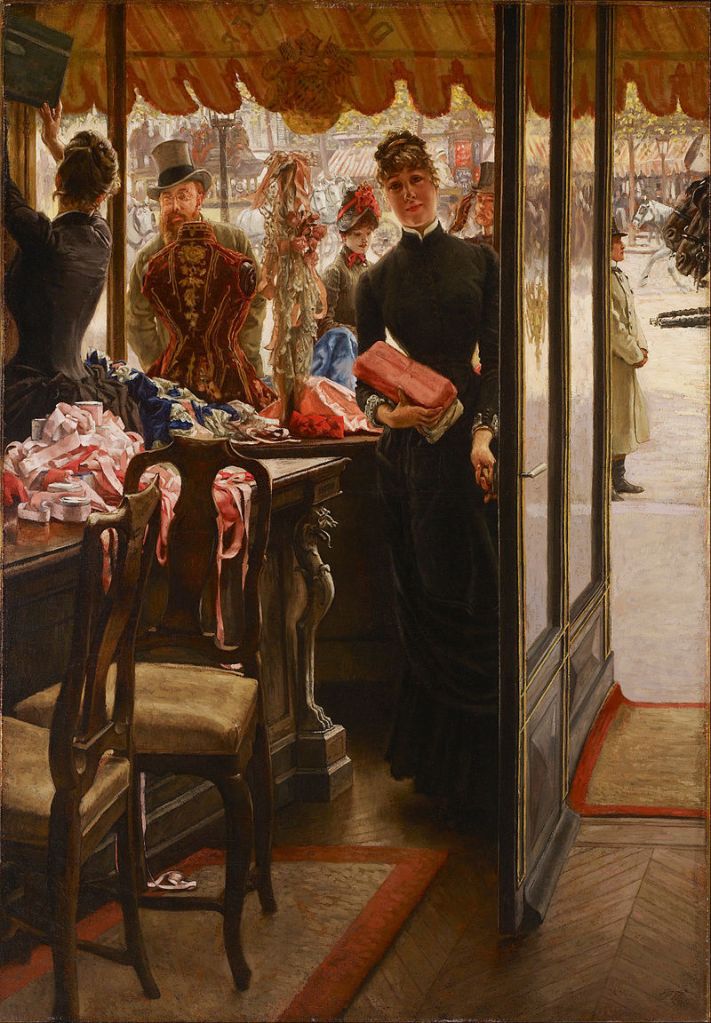
Just discovered this rather relaxing post by this superb anti-Nazi Austrian painter. The accompanying Chopin Nocturne adds to the ambience I find.
Leo Putz (18 June 1869, in Merano – 21 July 1940, in Merano)[1] was a Tyrolean painter. His work encompasses Art Nouveau, Impressionism and the beginnings of Expressionism. Figures, nudes and landscapes are his predominant subjects. https://en.wikipedia.org/wiki/Leo_Putz
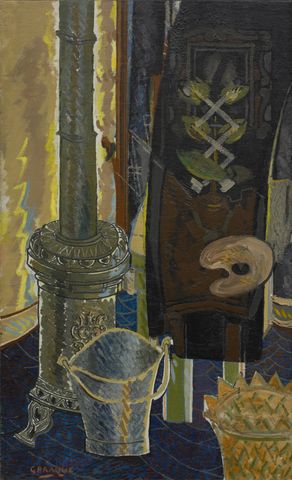
When I think of paintings from interiors of the scene beyond, I tend to think of the South of France,of Dufy or perhaps Matisse. There is something too which reminds me of looking out from a safe place to the activity beyond. It recalls hours in childhood, perhaps when bored watching the summer visitors who looking lost were exploring the cobbled hill outside, often looking somewhat lost themselves.
The above is a view in an Oxford suburb into the garden with trees and a bird-feeder beyond.
This is a view from an upstairs window in Cornwall. The rubber plant has not survived my feckless care unfortunately.
This is a view from the Newlyn Art Gallery cafe which has a splendid large window overlooking the Mount and Bay.
I have previously posted about Red Vienna – the time in the 1930s when an attempt was made to establish a form of social security system in the elegant city and when worker’s flats were built to ease the conditions of poorer citizens. Notoriously, they were shelled by nationalists in the dark period leading up to the Anschluss when the Austria was annexed to Nazi Germany. https://jacobinmag.com/2017/02/red-vienna-austria-housing-urban-planning
Karl Polanyi wrote: “Vienna achieved one of the most spectacular cultural triumphs of Western history … an unexampled moral and intellectual rise in the condition of a highly developed industrial working class which, protected by the Vienna system, withstood the degrading effects of grave economic dislocation and achieved a level never reached before by the masses of the people in any industrial society.”
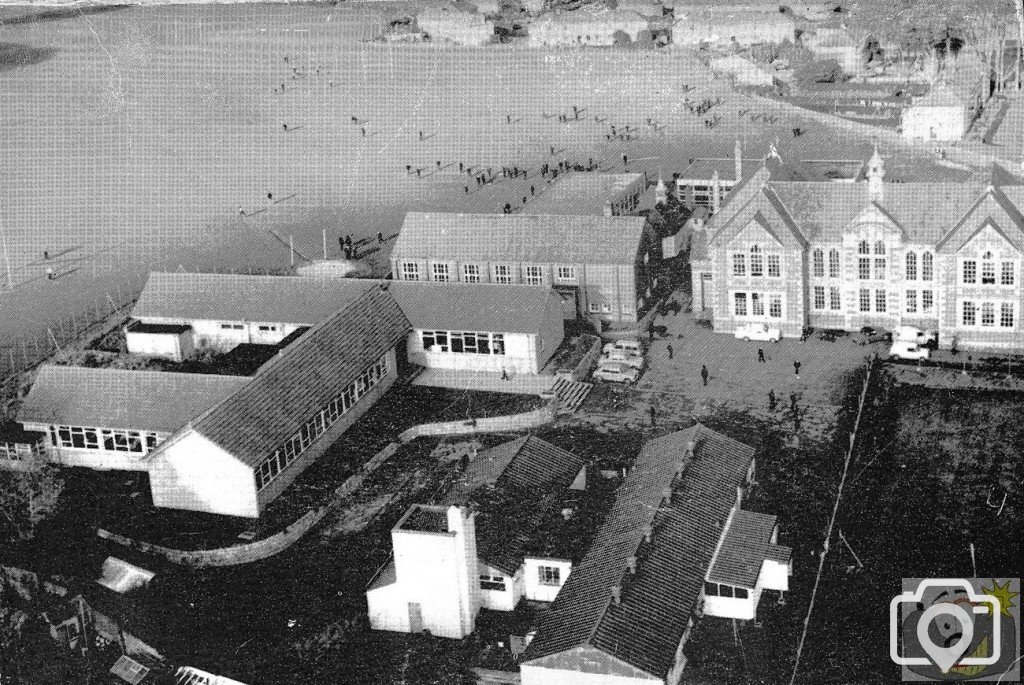
In my personal psychogeography towns and cities remind me of St Ives where I spent many years of my early life. After the gas works was deconstructed and I think, before the Tate arrived many of the fisherman’s lofts and artist studios next to Porthmeor Beach were replaced by the Barnaloft and then the Piazza flats. They seemed to stand out as a statement of the modernism with which the town had been associated. The interior courtyard of the latter had an interesting Hepworth sculpture. They were not by any means worker’s flats but were frequently occupied by what has since been called champagne socialists.
Before the flats were constructed there was the beach cafe occupied by the Val Baker family. This was a homely venue offering a superb view of the sea and marvellous sunsets over it to the West. Little was seen of Denys himself whom I assumed was upstairs with leonine head bent over the typewriter. Denys may be somewhat forgotten but represented the spirit of bohemian values to the locals. He had been active in promoting the celtic culture as a Welshman intrigued by Cornwall and St Ives in particular. He and his wife were committed to pacifism and had been active in the committee of 100. https://www.rainydaygallery.co.uk/denysvalbaker.html
The Foot family has been long associated with St Ives. Issac Foot, bibliophile and liberal politician as well as a staunch Methodist stood in the town for Parliament. That by-election was rather interesting in the troubled atmosphere of 1937 and very narrow indeed. Isaac Foot went on to become Mayor of Plymouth.
Paul Foot his grandson and active contributor to Private Eye was often to be seen around the town. He was an active and intelligent member of the Socialist Worker’s Party as well as a campaigning journalist with a splendid sense of humour. He died rather young and was a notable loss to radical progress in this country. His book on Red Shelley is a moving introduction to that committed poet. https://en.wikipedia.org/wiki/Paul_Foot_(journalist)
Also some years ago spontaneous outdoor performances were given by another group associated with the Foot family-The Footsbarn Theatre Group. These were jolly and musical. Particularly memorable was a performance in St Ives Guildhall of Around the World in Eighty Days with a scence at the Old Bore’s Club which was gloriously funny -a tour de force.
Which leaves us with the intriguing figure of Peter Shore. Any Freudian would not be surprised that given his name he might have been strongly attracted by the glorious beach at Porthmeor. I used to see him taking his morning beverage be-shorted high above the sands at Barnaloft. These buildings were designed by the St Ives Architect, Cyril Gilbert- a shy charming gentleman who later ran the superb Wills Street Gallery near the Police Station. I digress- Shore was a fascinating figure who it seems travelled from the intellectual left of the party to total opposition to what was then called the Common Market. He was for some time an active M.P. for Stepney. Apparently he acted in a sort of Alistair Campbell role in that he advised on media promotion. I well remember how he responded when interviewed later in his career by someone like Robin Day or Brian Walden. He would begin by rephrasing the question and pointing out the precise strength of the case to which he was opposed. It was about then to be devastated by the power of his retort. However, in the questioning this just didn’t happen due to the interviewer’s interruption. You were left with the impression of his honesty and rather sad disappointment. And yet now I feel a little more straight honesty in political matters is crucial- a Balm of Gilead.
Sometimes it is salutary to hear what the opposite case – this clip exudes English chauvinism which is deeply misguided.
I very much admire this painting, “The Fried Fish Shop”, its composition and the limited range of colours which suits this painting which is in the New Walk Museum and Art Gallery in Leicester. Rowe was an important active member of the Artist’s International Association https://en.wikipedia.org/wiki/Artists%27_International_Association
We seem currently to be going through a period of iconoclasm which has an interesting history itself. One of my favourite plays is “Forty Years On” by Alan Bennett. It often seems to me that British, and particularly English, society resembles some sort of minor public school. Hence I can easily hear John Gielgud intoning Ecclesiastes 44-1:-
Let us now praise famous men, and our fathers that begat us.2The Lord hath wrought great glory by them through his great power from the beginning. 3Such as did bear rule in their kingdoms, men renowned for their power, giving counsel by their understanding, and declaring prophecies: 4Leaders of the people by their counsels, and by their knowledge of learning meet for the people, wise and eloquent are their instructions.
Now, when I googled this a moment ago, I discovered that the first six words of the title refers to a book written some 75 years ago by Agee and Evans with photographs of tenant farmers and their dreadful plight in the depression. The verse from Ecclesiastes was obscured and immediately raises the question about how the meaning of the past can be changed or indeed obscured. It also raises the questions about for whom history might be written, recorded or commemorated.
However, before examining the text, consider the last sentence….” meet For the people, WISE and ELOQUENT are their instructions”. Well it would be nice if the present incumbents of the senior management team were wise and concerned for the people and by no means can the repetitive bumbling be described as eloquence.
(Incidentally, I remember hearing that controversial Cornishman D.M. Thomas remarking once that we had moved from reading Isaiah to watching dire television in two generations!)
Now before we start praising famous men, let alone building statues to them, we also need to consider women and children. The statue which really brought pimples to the skin and still does was near the Friedrichstrasse in Berlin which shows those children going to the West in the Kindertransport and those from whom they have been sundered, facing the death camps in the East. Then, also very moving is the statue by Kathe Kollwitz. This sculpture is under an oculus and exposed to the rain, snow and cold symbolising the suffering of civilians during World War II. It is a pieta- a woman with her dead child. She had lost her son, Peter on the battlefield in the First World War.
At this point I should like to recommend a book and close with a couple of quotations which I think are worth pondering. The book is by Rachel Hewitt and is called “A Revolution in Feeling” It deals with the changes of feelings during the 1790s. To quote from the dust jacket;” Every society in every age, feels differently, and from the seismic shifts of the 1790s Britain emerged the contours of our contemporary attitude to need, longing and emotion”.
Now from that complex but original thinker Walter Benjamin, “This is how one pictures the angel of history. His face is turned toward the past. Where we perceive a chain of events, he sees one single catastrophe which keeps piling wreckage upon wreckage and hurls it in front of his feet. The angel would like to stay, awaken the dead, and make whole what has been smashed. But a storm is blowing in from Paradise; it has got caught in his wings with such violence that the angel can no longer close them. This storm irresistibly propels him into the future to which his back is turned, while the pile of debris before him grows skyward. This storm is what we call progress.
WALTER BENJAMIN, Theses on the Philosophy of History
Here we return to eloquence again, a reminder that style in historical writers engage our interest from Hazlitt-
The history of mankind is a romance, a mask, a tragedy, constructed upon the principles of POETICAL JUSTICE; it is a noble or royal hunt, in which what is sport to the few is death to the many, and in which the spectators halloo and encourage the strong to set upon the weak, and cry havoc in the chase, though they do not share in the spoil.
WILLIAM HAZLITT, Characters of Shakespeare’s Plays
Finally
Finally, I listened to a radio programme last night about refugees in camps across the Channel in France desperate to escape persecution and many of them, children in conditions cramped as in a slave ship. What are we going to do to alleviate their situation?
There may be elements of magical thinking in relation to monuments as clearly their destruction does not entail the erasure of the past or the racist structures still in existence. It might be argued that in their removal they can become instrumental towards that aim. Some may also consider that they are works of art which raises further questions about aesthetics – content and form etc.
Baudelaire wrote of the strolling poet in the Paris crowd:-
The poet enjoys the incomparable privilege of being able to be himself of someone else, as he chooses. Like those wandering souls who go looking for a body, he enters as he likes into each man’s personality. For him alone everything is vacant; and if certain places seem closed to him, it is only because in his eyes they are not worth visiting.
The solitary and thoughtful stroller finds a singular intoxication in this universal communion. The man who loves to lose himself in a crowd enjoys feverish delights that the egoist locked up in himself as in a box, and the slothful man like a mollusk in his shell, will be eternally deprived of. He adopts as his own all the occupations, all the joys and all the sorrows that chance offers.
The Paris, a few years after Baudelaire’s passing is shown in these remarkable pictures taken between 1900 and 1917. Baudelaire died in 1867 but his remarks are interesting and pertinent to some of the following photographs, which were shot in direct colour using the Autochrome process developed by the famous Lumière brothers in 1903.
In the original French from Spleen (1869)
Le poète jouit de cet incomparable privilège, qu’il peut à sa guise être lui-même et autrui. Comme ces âmes errantes qui cherchent un corps, il entre, quand il veut, dans le personnage de chacun. Pour lui seul, tout est vacant ; et si de certaines places paraissent lui êtres fermées, c’est qu’à ses yeux elles ne valent pas la peine d’être visitées.
Le promeneur solitaire et pensif tire une singulière ivresse de cette universelle communion. Celui-là qui épouse facilement la foule connaît des jouissances fiévreuses, dont seront éternellement privés l’égoïste, fermé comme un coffre, et le paresseux, interné comme un mollusque. Il adopte comme siennes toutes les professions, toutes les joies et toutes les misères que la circonstance lui présente.
How might we read such a photograph? It has a surreal quality about it that we might associate it with Magritte. The artist, musician and his instrument appear in a classical composition like the three graces. They are starkly outlined against the white Paris sky in front of the descending staircase. The two men seem isolated in their solitude and their is a feeling of expectation and a gentlemanly respect for the instrument whose feminine shape seems implied.
There is a humane quality which suffuses Doisneau’s work- a magical charm. The photograph makes a nice comparison with the famous HMV poster. It is impossible to say weather the subject is more enchanted by the splendid device or the music emerging from the cumbersome, jolly gramophone. Probably he is entranced by both. His posture and beret adds to the general levity of the scene.
Doisneau photographed many great artists and this photograph captures the master, Picasso in his characteristic striped jersey with his penetrating gaze. The photographer makes a marvellous joke with the distorted fingers of bread rolls. It seems likely that this was contrived between them. A morphic distortion and also an interesting game with perspective too.
I did not know when I arrived here that students in the 18th Century used to stand on a nearby hill and recite their poems. Hence the nickname Mount Parnassus. Like many a modern flaneur, however. I associated the quartier with the jazz loving Americans of the 1920s. The habitués of the Café du Dôme rubbed shoulders with the ‘crowd’ as they called themselves; Ernest Hemmingway, Sylvia Beach, John Rodrigo Dos Passos and Ezra Pound. This was the Lost Generation fleeing prohibition living it up in cheap dodgy hotels – later to be followed by Henry Miller. These fading lyrical echoes in the shade contrasted with the undistinguished entrance to the hidden charms of the Musee.
Once into the museum, you enter the creative space of Antoine Bourdelle(1861-1928), the pupil of Rodin and the teacher of both Matisse and Giacometti. It was in 1926 that this typical Parisian atelier was to be turned into a museum. The quiet sanctuary of the front garden gave me the first glimpse of four sculpted figures including La Victoire (Victory) and l’Eloquence (Eloquence) surrounded by a secluded peristyle. At the time of my visit, I was unaware that there were over 500 works of art here. I simply sat and made a few sketches of the first few of these impressive statues.
Passing into the Great Hall, which was built in 1961, for the centenary of the artist’s birth, I encountered an impressive array of magnificent figures some of which towered way above the visitors. Interspersed between these at the further end were brightly colourful dresses by famous contemporary couturiers. This museum has frequently had special exhibitions and this focussed on the fashion of dresses from the back. (Dos à la mode}.However my attention was taken by the famously energetic sculpture of Hercules the Archer.
Bourdieu made some 12 versions of this dynamic sculpture. The model was a certain athletic Commandant Doyen-Parigot who twisted his muscular body into the required difficult posture. He contorted his body in demanding fifteen-minute sessions. Bourdelle also famously used his rather primitive Kodak camera to facilitate his project. A wealthy financier, Gabriel Thomas was deeply impressed by this statue of Hercules in 1910. Thomas together with Gabriel Astruc, the impresario that brought Rubenstein, Caruso, Toscanini and famously Diaghilev to Paris, set up a real estate company to build a new theatre. This became the Theatre des Champs-Elysee, the façade and inner atrium were, under Thomas auspices, to be decorated by Bourdelle. This was to be the debut of Art Deco style, a feature of the new modernism.
Returning through the studios there were many fine sketches by Bourdelle including those he made of the dancer Isadora Duncan. Proceeding through an outlying corridor I came across the Beethoven heads. These imaginative and expressive works began around the time he started his association of 15 years with Rodin. Altogether he made some 40 of such masterpieces.
In the tranquillity of the ivy leafed inner garden I encountered a huge and towering bronze. This was the statue of Centaure Mourant. From just where I stood, I could not see more than the torso of the horse and only by moving gingerly around the piece could I discern the twisted direction in which the head lay. Inspired by classical myth and considering its construction in 1914, Bourdelle was asked why does the centaur die? Bourdelle replied in Nietzschean mode, “He dies like all the gods- because no one believes in him any more.”