Category: Classics
Categories
The Mad Pomegranate Tree
I had recently been perusing Cavafy – particularly reading the essay on him written by that doyen of Dons, Maurice Bowra in his book, The Creative Experiment. Bowra, of whom it has been said, ” …..either the most distinguished or the most notorious Oxford don of the early twentieth century. Classicist, poet, wit, raconteur extraordinary, and Warden of Wadham College for over thirty years, he met nearly everyone of consequence in the worlds of literature and politics” He remarks of Cavafy’s abilility to find pathos in quite simple situations and quotes, The Melancholy of Jason poet in Kommagini, a.D. 595–
The aging of my body and my beauty
is a wound from a merciless knife.
I’m not resigned to it at all.
I turn to you, Art of Poetry,
For the whole poem please see https://www.poetryinternational.org/pi/poem/2516/auto/0/0/Constantine-Cavafy/MELANCHOLY-OF-JASON-KLEANDER-POET-IN-KOMMAGINI-AD-595/en/tile
Then having lost my copy of Four Greek Poets (Penguin Modern European Poets) read a lovely poem by Odesseus Eyletis https://www.poetryfoundation.org/poets/odysseus-elytis

I

THE MAD POMEGRANATE TREE
Inquisitive matinal high spirits
à perdre haleine
n these all-white courtyards where the south wind blows
Whistling through vaulted arcades, tell me, is it the mad pomegranate tree
That leaps in the light, scattering its fruitful laughter
With windy wilfulness and whispering, tell me, is it the mad pomegranate tree
That quivers with foliage newly born at dawn
Raising high its colors in a shiver of triumph?
On plains where the naked girls awake,
When they harvest clover with their light brown arms
Roaming round the borders of their dreams — tell me, is it the mad pomegranate tree,
Unsuspecting, that puts the lights in their verdant baskets
That floods their names with the singing of birds — tell me
Is it the mad pomegranate tree that combats the cloudy skies of the world?
For the whole poem please see http://thestockholmshelf.com/2011/12/the-mad-pomegranate-tree-odysseus-elytis-aegean-surrealist/

The most accessible introduction to great philosophers, for me anyway, are the You-Tube programmes made by Bryan Magee maybe some 30 years ago. Particularly interesting was Iris Murdoch talking about Philosophy and Literature. Then there was the lucid conversation with Anthony Quinton on Spinoza and Leibnitz. The clearest philosophy book I managed to grasp however, was Language, Truth and Logic by A.J.Ayer. Freddie Ayer used to appear on the Brains Trust on Sunday afternoons -such excellent stimulating elevating television as we seem to see but rarely nowadays. True conversation seemingly in short supply.
However, skimming through Herman’s delightful book on The Scottish Enlightenment, I came across the intriguing philosopher, Francis Hutcheson (1694-1746). Here is how Herman concludes upon him…”He challenged other forms of oppression, which Locke and even Shaftesbury had ignored…….One was the legal subjection of women. Hutcheson defined rights as universal, and did not recognise any distinction based on gender. The other, even more important was slavery. ‘Nothing’, he said, ‘can change a rational creature into a piece of goods void of all rights.’ In fact Hutcheson’s lectures, published after his death under the title A System of Moral Philosophy, were ‘an attack on all forms of slavery as well as denial of any right to govern solely on superior abilities or riches.’ They would inspire anti-slavery abolitionists, not only in Scotland but from London to Philadelphia.
The second philosopher who had a more psychological interest and lived a little later and for the same number of years was David Hartley (1705-1757). https://en.wikipedia.org/wiki/David_Hartley_(philosopher)
His thoughts on what he terms variolation are certainly pertinent to our contemporary discussions on vaccination. However, his interest in an early study of the philosophy interface with psychology also makes for a certain claim to fame on behalf of this doctor from Yorkshire. According to the Stanford Encyclopaedia of Philosophy, Hartley wrote a significant treatise. “The Observations gained dedicated advocates in Britain, America, and Continental Europe, who appreciated it both for its science and its spirituality. As science, the work grounds consciousness in neuro-physiology, mind in brain. On this basis, the central concept of “association,” much discussed by other British philosophers and psychologists, receives distinctive treatment: the term first names the physiological process that generates “ideas,” and then the psychological processes by which perceptions, thoughts, and emotions either link and fuse or break apart. In keeping with this physiological approach, Hartley offers a conceptually novel account of how we learn and perform skilled actions, a dimension of human nature often left unexplored in works of philosophy. Such actions include those involved in speech—and, by extension, the conduct of scientific inquiry.”
Although difficult perhaps to penetrate his writings in detail it seems to me that in relation to certain aspects of volition, memory, sensation and associations are a significant forerunner of Freud and psychoanalysis. It is often stated that Nietzsche’s thought have such an influence but Hartley should be recognised for his insights at much earlier period.
From Catullus 64
Peliaco quondam prognatae uertice pinus
dicuntur liquidas Neptuni nasse per undas
Phasidos ad fluctus et fines Aeetaeos,
cum lecti iuuenes, Argiuae robora pubis,
auratam optantes Colchis auertere pellem
ausi sunt uada salsa cita decurrere puppi,
caerula uerrentes abiegnis aequora palmis.
diua quibus retinens in summis urbibus arces,
ipsa leui fecit uolitantem flamine currum,
pinea coniungens inflexae texta carinae.
illa rudem cursu prima imbuit Amphitriten.
quae simul ac rostro uentosum proscidit aequor,
tortaque remigio spumis incanuit unda,
emersere feri candenti e gurgite uultus
aequoreae monstrum Nereides admirantes.
illa, atque haud alia, uiderunt luce marinas
mortales oculi nudato corpore Nymphas
It is said that formerly pines sprung from Pelion’s peak
swam the liquid waves of Neptune
To the waves of Phasis and the lands of Aeetes,
When the chosen youths, the strength of Argive manhood
Choosing to run away with the Golden Fleece from the Colchians,
They dared to traverse with swift ship through the salty waters,
Sweeping the azure sea with fir oars,
For whom the goddess herself occupying the citadels in the highest cities
Made the flying chariot with a light wind,
Fitting the pine timbers to the curved keel.
She first stained inexperienced Amphitrite with sailing;
But which likewise plowed the fickle wave with curved ship’s beak
And the water, twisted by the rowing grew warm with foam,
Aquatic Nereids emerged their faces from the white eddies
Admiring the apparition
On that day, and hardly any other, mortals saw with their own eyes
Marine nymphs, with naked body,
I had just been reading the Stoppard play about Houseman in which this passage is referenced called “The Invention of Love”. https://en.wikipedia.org/wiki/The_Invention_of_Love
In a recent discussion at Jewish Book Week 2021, Hermione Lee mentioned that this was Stoppard’s favourite play. It was first published in 1997 and given it’s themes I wondered if it’s writing had any connection with Stoppard’s feelings about Section 28 of the Local Government Act 1988. This very interesting play can be viewed on You Tube but sadly the quality of the sound is not very good.
I think it is interesting that Stoppard who appears not to have had a University Education appears so interested in the minutaie of recondite and eclectic matters such as logical positivism (Jumpers) or textual analysis as in this play.
Isn’t it interesting how the road not taken, so to speak, may become so interesting one’s later in life. This was seemingly the case about higher education with Tom Stoppard who has become so formidably well read and erudite. I was thinking too of James Callaghan a British politician who served as Prime Minister of the United Kingdom from 1976 to 1979. He became so very interested in Education and seems to have engendered the changes that resulted in the National Curriculum.
https://en.wikipedia.org/wiki/James_Callaghan#Personal_life
The other major figure that springs to mind is George Orwell. However, my most recent encounter with Orwell portrays him rather more as the man of action and not perhaps very interested in University Education as that of describing authoritarian atmosphere of the minor Prep school. I was reading fairly recently an account by Rayner Heppenstall in his engaging account Four Absentees which mentions the time the author spent with Orwell in their Camden flat-https://en.wikipedia.org/wiki/Rayner_Heppenstall
It is difficult to imagine what Orwell might have chosen to read had he gone to University and then again he was young at a time well before the expansion of University Education. Perhaps, he is now studied under the area of Media Studies. There appears to be considerable debate about his writing. Personally I found his diaries which I think appeared in Penguin around 1988 absorbingly interesting.

Orwell and Stoppard are both concerned with language and truth. When looking at this play, there is a debate about the relative merits of poetry and academic scholarship as well as the human relationships. Houseman the classicist obsessed by the scientific and heterosexual Jackson. Obsessed too with such close textual analysis that he seems to missed his first in Greats. How might he be diagnosed or labelled nowadays one wonders.
After recently reading Three Rings by Daniel Mendelsohn (A tale of Exile, Narrative and Fate) I have been tempted to explore diversions and must now return to the text above.
The first two lines above do not appear to make a great deal of sense in English. My Heinemann edition translated by F.W.Cornish (Erstwhile Vice-Provost of Eton) 2nd Edition 1914 gives-
Pine-trees of old, born on top of the Pelion, are said to have swam through the clear waters of Neptune to the waves of Phasis and the realms of Aeetes, when the chosen youths, the flowers of Argive strength, desiring to bear away from the Colchians the golden fleece...
Now the obvious difficulty in getting the poetry here is the number of allusions with which the text is crammed. The sort of associations that in Keats time many were familiar. Looking them up…..
Pelion is simply there as a mountain today and looks gorgeous too.

Phasis appears to be beautiful -The Rioni river, as it is called in classical sources. Ancient Greek Φᾶσις as it says in Wikitionary! Aeetes may be found at https://en.wikipedia.org/wiki/Ae%C3%ABtes, an ancient King of Colchis who has been represented thus:-
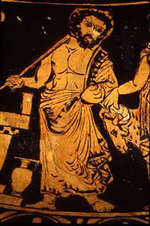
“The flowers of Argive strength” is rather lovely and associated with gladiolus flowers which suggest not only strength but honour and moral integrity. Gladius being Latin for sword. Argive refers to the ancient city of Argos and obviously not the on-line delivery store! Argos (Ancient Argos, located in the Peloponnese in Greece, was a major Mycenaean settlement in the Late Bronze Age (1700-1100 BCE) and remained important throughout the Greek, Hellenistic, and Roman periods until its destruction by the Visigoths in 395 CE)
The full import of Catullus 64 may be found at https://www.ancient-literature.com/catullus-64-translation-2.html
Finally, there is a little possible alternative at line 14 where freti might replace feri above and seems to mean narrow-anyway freti candenti sounds rather nice though I cannot quite make sense of it. It seemsto refer to a white narrow watery space I am told. See https://nodictionaries.com/text-word-note/1731849-remigio-spumis-incanuit-unda-emersere-freti-candenti-e-gurgite-uultus-aequoreae and according to Cornish might instead mean “wild visages” of the emerging Neriads in the spume of the churning oars. Houseman and probably Stoppard would doubtless be intrigued by these codd. (Codices) Referring to the different manuscripts. Cornish in my book -1st Edition 1912 refers to 7 different manuscripts- one of which is in the Bodleian and one of which is no longer extant but 6 of the others are derived from it. Codex Veronensis.
Barbarian Incursions

If such waters had once been yours, Leander,
those straits would not be guilty of your death.
Since the dolphins can’t hurl themselves into the air,
harsh winter holds them back if they try:
and though Boreas roars and thrashes his wings,
there’s no wave on the besieged waters.
The ships stand locked in frozen marble,
and no oar can cut the solid wave.
I’ve seen fish stuck fast held by the ice,
and some of them were alive even then.
Whether the savage power of wild Boreas
freezes the sea-water or the flowing river,
as soon as the Danube’s levelled by dry winds,
the barbarian host attack on swift horses:
strong in horses and strong in far-flung arrows
laying waste the neighbouring lands far and wide.
Some men flee: and, with their fields unguarded,
their undefended wealth is plundered,
the scant wealth of the country, herds
and creaking carts, whatever a poor farmer has.
Some, hands tied, are driven off as captives,
looking back in vain at their farms and homes.
some die wretchedly pierced by barbed arrows,
since there’s a touch of venom on the flying steel.
From https://www.poetryintranslation.com/PITBR/Latin/OvidTristiaBkThree.php#anchor_Toc34217042
To give this book a dedication
The desert sickened,
And lions roared, and dawns of tigers
Took hold of Kipling.
A dried-up well of dreadful longing
Was gaping, yawning.
They swayed and shivered, rubbing shoulders,
Sleek-skinned and tawny.
Since then continuing forever
Their sway in scansion,
They stroll in mist through dewy meadows
Dreamt up by the Ganges.
Creeping at dawn in pits and hollows
Cold sunrays fumble.
Funereal, incense-laden dampness
Pervades the jungle
.Boris Pasternak
Does this poem convey the feeling of nostalgia to you? Geographically widespread there is certainly a sense of some disorientation. From “cold sunrays”, which suggest a Russian winter, to Kipling’s jungle or the Ganges or even the desert. The heat finds it hard to penetrate into the hollows and even the sunrays seem to fumble on their way to the losses of funereal dampness.
The poem shows Pasternak’s knowledge of Kipling and perhaps the first stanza refers also to Blake’s “Tiger, tiger burning bright”. Both, of course are political poets and the possible symbolism here might be imperial. However, it is the voracious hunger for the irretrievable which pervades the beasts-
A dried-up well of dreadful longing
Was gaping, yawning
 penwithlit