Und sagte gähnend: »Steigen Sie ein, wenn es Ihnen beliebt.«
Die Schnecke wehrte: »Danke, mir pressiert es.«
Da gab die Bahn ein Abfahrtssignal und noch eins und
ein drittes und viertes.
Und wirklich begann sie allmählich weiter zu fahren,
Um noch vor Sonntag die nächste Station zu erreichen.
Dort lagen an dreihundert Leichen,
Lauter Leute, die über dem Warten verhungert waren.
Joachim Ringelnatz wurde als jüngstes von drei Geschwistern in einem Wohn- und Geschäftshaus am Crostigall 14 in Wurzen bei Leipzig um „11 ¾ Uhr“ in einem Zimmer über dem Flur geboren, wie der Geburtsschein der Hebamme belegt. Seine Eltern waren beide künstlerisch tätig. Sein Vater Georg Bötticher, der einer thüringischen Gelehrtenfamilie entstammte, war ein Musterzeichner und später hauptberuflicher Verfasser von humoristischen Versen und Kinderbüchern. Er veröffentlichte vierzig Bücher, unter anderem in Reclams Universal-Bibliothek. Die Mutter Rosa Marie, Tochter eines Sägewerksbesitzers, zeichnete ebenfalls, entwarf Muster für Perlstickereien und stellte Puppenbekleidung her. Ringelnatz wuchs in bescheidenem Wohlstand auf: Die Familie beschäftigte zwei Dienstmädchen.
First let us get ourselves into the right mood with some Hungarian Music –from :-Szegedi Szűcs Judit: Három sós perec
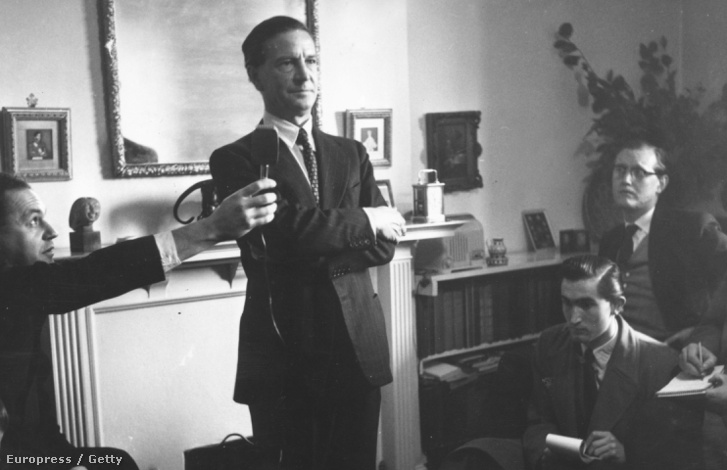
Now translated from the Hungarian version of Index against Censorship by means of the partially garbled Google translate we read of a certain man -István Szegedi Szüts being bound up somehow with the Fourth Man, Kim Philby:-
“Probably never know how mixed up next to each other Szűts Szeged and Philby because Philby one word did not remember the incident, as a later joint útjaikról not, in fact never down either by Szegedi Szűts name, just “Hungarian” referred to as hinted. Nevertheless Szűts Szegedi could play a significant and important role in his life, has recently come of age since the 1930 Easter led Philby’s first trip to Hungary. Motorcycle arrived, but that where you’ve been, shrouded, but much seems certain that Szűts Szegedi’s company reached the Low Countries and Subotica surroundings, where the Black Country is very similar conditions met, but are not industrial workers, but the manual peasants life seen with your own eyes.
Philby same year appeared again in Budapest, this time in the company of Tim Milne, who first hired King Street apartment and a car repair shop encamped, which was for the owner than George Szűts Szeged. Philby and Milne very well felt in the capital: fried meat ate, swam the Danube, which have been removed and used at the time, watched the Blue Angels (was Marlene Dietrich’s first major success in 1930, the German sound film made Heinrich Mann’s novel, first pool by way of ), they walked along the Margaret Island and Milne’s memoir, according to Philby never once gave signs of increasing political beliefs. Szegedi Szűts not name popped up ever again; if there was a secret painter mid-thirties established in England in 1959 when the death took to the grave with him. Philby’s commitment towards the working class and communism found it a few years later confirmed in Vienna, where two Hungarian also participated actively in the consciousness of Philby spy and of becoming.”
Which is very interesting and suggests the possibility that to an unknown extent, Philby was involved with a Hungarian painter who knew the Russian spy and was possibly a contact in his activities. This was not just any painter but an artist who has been compared with Paul Nash, was an excellent woodcut printer and also a talented writer, István Szegedi Szüts. He was born in Budapest and lived for a large portion of his life in the small south Cornwall fishing village of Mullion. István Szegedi Szüts was a member of an Olympic fencing team in 1912 and a brave officer fighting the Russians in the Carpathians during the First World War. It was at this time that he was ordered to shoot any straggelers among his own men to prevent a more horrid death from persuing wolves. His fascinating prints recording his experiences in the K and K forces can be seen at http://www.bhandl.co.uk/articles/2013/03/19/viewer.aspx.
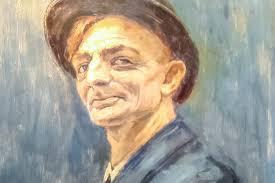
István Szegedi Szüts, a self-portrait at the age of about 32
Images from the First World War may be seen at Barnes, Hampton and Littlewood where they say:”Szuts first visited England in 1929 and held a solo exhibition at the Gieves Gallery, London in the same year. In 1936 he moved to Cornwall with his partner Gwynedd Jones-Parry, whom he married in 1937. The couple lived at Caunce Head near Mullin on The Lizard and remained there for the rest of their lives. Szuts exhibited with The Newlyn Society of Artists and The Penwith Society of Arts.” The link is at http://www.bhandl.co.uk/articles/2013/03/19/viewer.aspx
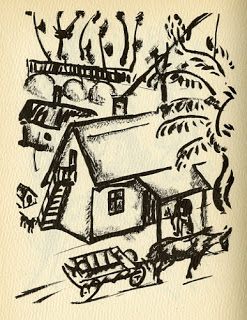
Wordless Book,”My War” showing a village during WW1
The paintings of Jewish refugees from Odessa and Bialystock by Maurycy Minkowski around 1910 are haunting, heartbreaking and evocative. Yet both in their colourful lyricism and moving composition they are a reminder that the refugee crisis is by no means a new phenomena; they are also pointers to some sort of categorical imperative that it requires urgent action still today. These are art works which demand that the fight for peaceful refuge and against racism is taken seriously now and once again.
Translating from the IWO in Buenos Aires, where it states:-
He was born into a wealthy Jewish family in Warsaw in 1881. At five years old he was deaf as a result of an accident. Having shown artistic vocation, he studied art at the Art Academy of Krakow where he graduated with honors. In his early years he painted portraits of local personalities and impressionistic landscapes.
His experience Pogrom of Bialystok (1905) was decisive in the course of his life: he abandoned his specialty as a landscape and portrait painter to devote himself almost exclusively to painting scenes of religious and secular Jewish life in Eastern Europe.
Minkowski rejected the new artistic movements of the early twentieth century to put his painting in the service of a style that could be defined as “ethnographic” and became the portraitist of anonymous Jews, refugees, and the impoverished masses.
His large canvases showing the victims of the pogroms attracted the attention of the European public, and despite the barriers imposed their origin and communication difficulties, his paintings were exhibited in Antwerp, Dusseldorf, Berlin, Paris and other cultural centers in Europe .
in addition to painting many scenes of the suffering of the Jews in Russia and Poland in the early twentieth century, Minkowski devoted much of his work to exalt the role of women in Judaism,
“Soon Minkowski will present to the Argentine public in his simple and beautiful work. Undoubtedly and without prejudice, the heart will appreciate a work that only the heart has dictated, ” Julio E. Payró.wrote from Belgium in the newspaper La Nacion, in June 1926, “No violence, no scene of lethal fire, brutal invasion, but the memory and the threat of pogrom weigh in the atmosphere of the work of Minkowski (…) Thus, in his immense tenderness, the artist’s gesture Leasehold the horizon of Poland and embraces all suffering humanity, “said the Belgian art critic in another part of his article.”
Frances Hodgkins (see these two above images of Belgian Refugee children painted in St Ives in 1916) was a significant New Zealand painter of whom David Tovey has written in his interesting book Sea ChangeFine and Decorative Art in St Ives 1914-1930. During World War I she spent some time in Zennor, Cornwall, where she worked with the Swansea painter, Cedric Morris, who painted her portrait in 1917.She herself began to paint in oils in 1915.
As the website at the New Zealand Museum, http://collections.tepapa.govt.nz/topic/935 states:- “The outbreak of World War One forced Hodgkins to move from Paris to St Ives, a small fishing village in Cornwall, England. Here she found it difficult to travel or earn money and endured considerable hardship. However, it also meant that she had time to paint, and she experimented with larger works, using oil and tempera as an alternative to watercolours. Her works from this time show the influence of Post-Impressionism. “
Tovey points out that under the proactive approach of Gussie Lindner that St Ives took in some 99 refugees from Belgium of whom something like 62 remained in 1915. The large oil which is in the Christchurch,NZ gallery, the upper of these two above was called “Unshatterable” and was exhibited at the International Exhibition in 1916. He quotes from curator Ken Hall at Christchurch who mentions how in this painting the grey swirling area in the top left represents the absent father. Moffat Lindner felt these paintings showed considerable talent and he was to provide for her and encorage her in various ways. More information on Lindner who was a key figure in the St Ives Society of Artists may be found at http://cornwallartists.org/cornwall-artists/moffatt-lindner
In 1915 St Ives was a small town but played its part in taking in those in dire need-surely now we can maintain this enlightened tradition particularly for those who are victims of the devastating weaponry and ferocious assault.
The town is at last fairly free of tourists and today the St Ives Archive Centre-situated presently in Carbis Bay- is presenting an exhibition of St Ives in the 1970s. Actually the photographic display ( of Sam Bennets) goes back a good deal earlier to Doble’s Wall, sailing ships and coaches (which used to be called charabancs)jammed together in narrow streets. The awkward relation between traffic and pedestrians being one constant through the years. The Archive Centre next year is concentrating on the Torrey Canyon and the promenade Fire,{http://www.stivesarchive.co.uk/}
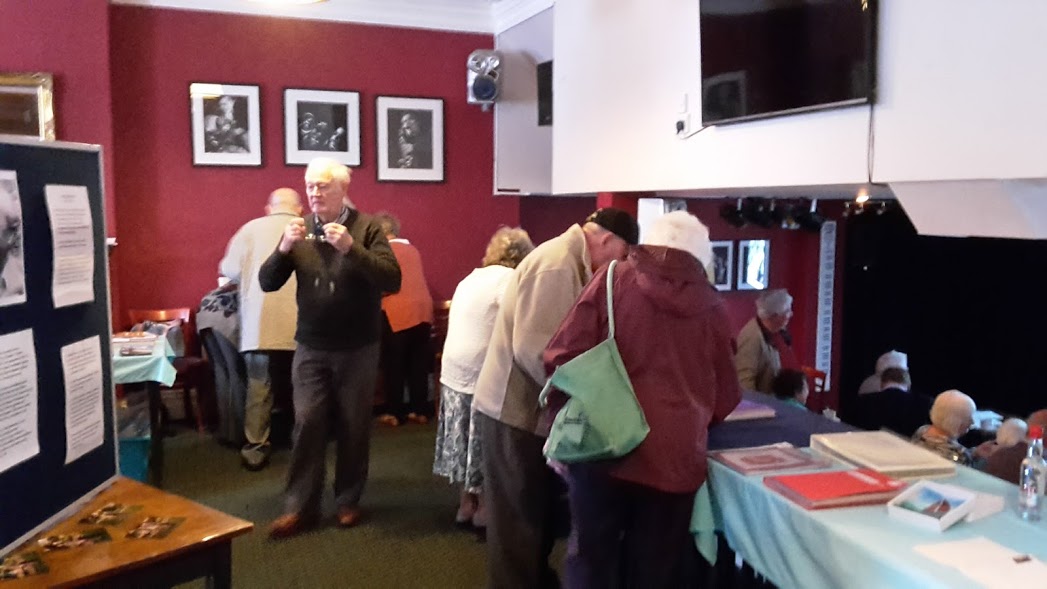
St Ives Archive at the Western Hotel (19/10/16)
.
View from Norway Square
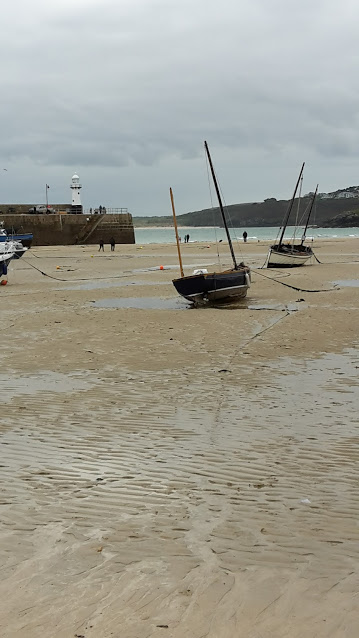
The promenade is still warm enough to eat outside so that Kaffekultur survives despite the horrors of Brexit with a great view of Jumbos and other older craft inside the harbour. Polish, German and other newspapers are available from the tiny newsagents opposite the lodge. The atmosphere is more relaxed and it is much easier to move around the town without the impediment of advertising boards and hawkers. The only guy playing a guitar in Fore Street providing a suitably melancholy, but not too plangent melody.
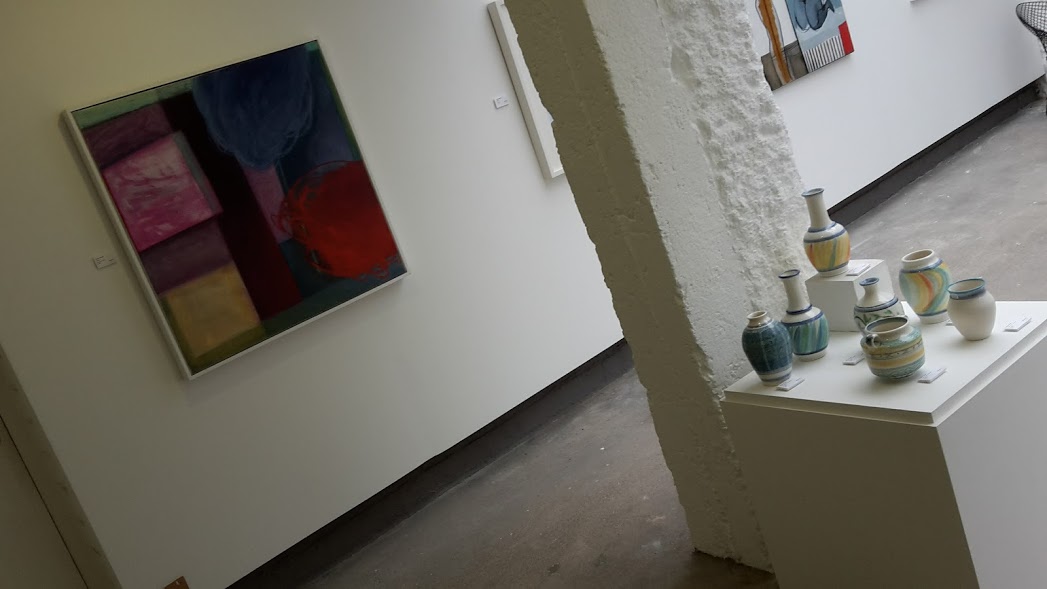
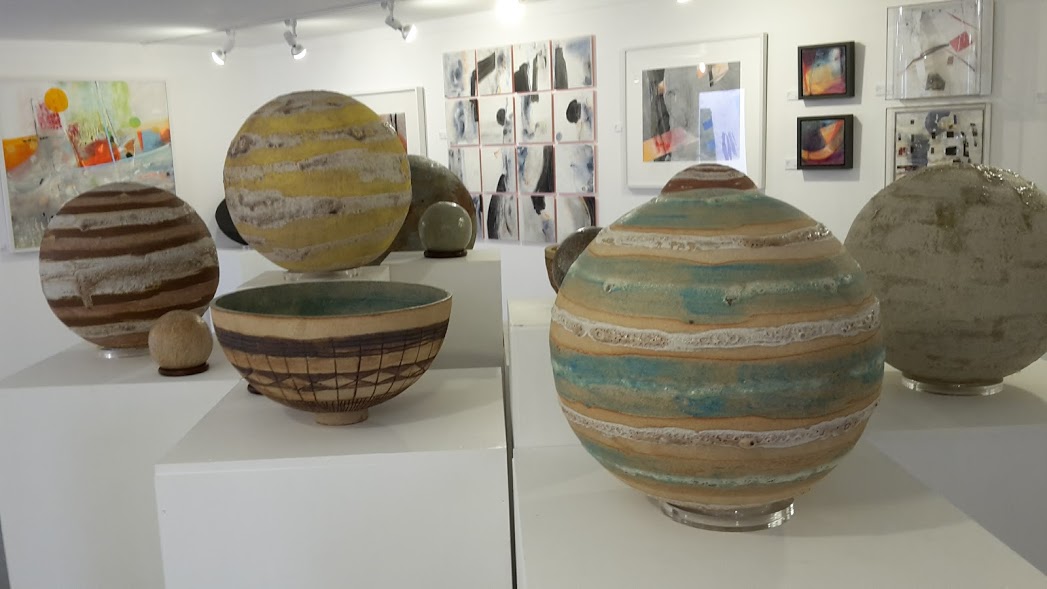
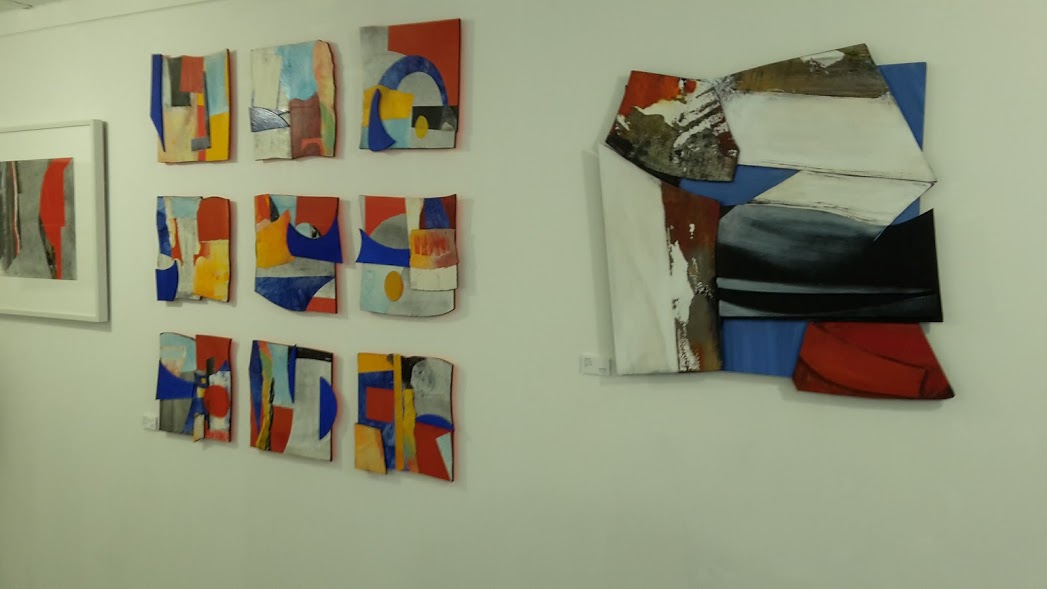
In the Penwith Gallery( http://www.penwithgallery.com/current-exhibition/) the Autumn Exhibition looks more colourful than ever and the sculpture and the ceramics are eye-catching too. This gallery deserves to be better known. In addition there is a section which is entitled Resurgence by Sue Davis and Anthony Fagin which is both inspiring and vivid. The press release states,” The exhibition takes as its central theme the regenerative power of the environment to recover from global despoliation whether from natural processes or human overexploitation. However it also reminds us – although not in any figurative sense – that while we may inhabit a world of ineffable beauty and bounteous resources, there is nevertheless a tipping point beyond which global recovery from continuing abuse will be impossible. Notwithstanding the gravity of their message, the approach of both artists to their work is positive and life affirming” (http://www.anthonyfagin.co.uk/publications/PRESS_RELEASE_resurgence.pdf)
The current exhibition in the Penlee Museum in Penzance lasts until 19th November and is certainly worth seeing for many reasons: its variety of styles, the contrasts between her life in Scotland and St Ives, the photographs, her green transparent glaciers and the more abstract endeavours of her later years. There are paintings which are reminiscent of Christopher Wood, bright touches that are reminiscent of Cezanne and the harmonies of Paul Klee can be glimpsed in the waves and beach scenes.
The view above was painted in 1940 http://www.barns-grahamtrust.org.uk/ -and features the Catholic Church on the left as well as the Church of St Ia almost in the middle. The buildings are vertically elongated which gives them an interesting attenuated quality, The grass of the Island and the roof tiles appear in orange against the predominate blue of the sea. The tide is half way in and the crane on the West Pier is just about visible.
Just a few years before, in early summer 1937, much the same scene was painted by Sir Stanley Spencer. It is interesting to compare the resulting works.
The foreground in Spencer’s painting show palm trees and in general the perspective is given a detailed treatment. There is a large boat alongside the pier. The West Pier is shown in full from this angle and the Island and Downalong shown in considerable detail. The tide level is just a little further inshore. The Mariner’s Church and slipway are both clearly delineated. Spencer became a member of the St Ives Society of Artists. He painted other pictures of the town including this atmospheric painting evidently from the promenade.
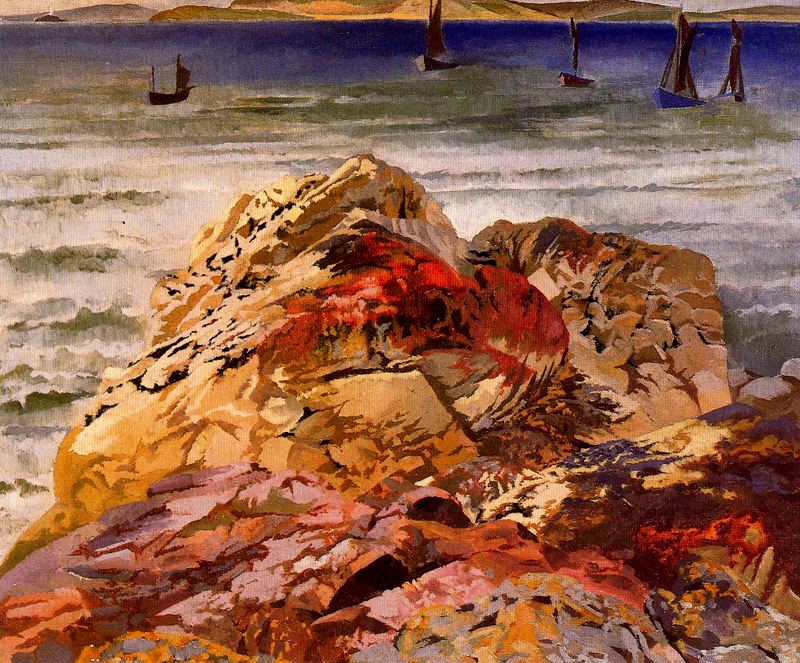
Here too is a painting showing the coluration of the rocks and fishing boats equipped with sails along with the coast beyond Hayle in the background. Perhaps painted from the rocks on the town side of Porthgwidden. The lighthouse at Godrevy as made famous by Virginia Woolf in 1927.
Barns- Graham excels in her sketches which are often interesting in their composition and dabs of spare but effective colour. The palette of yellow against grey below shows this in a view crested by The Island.
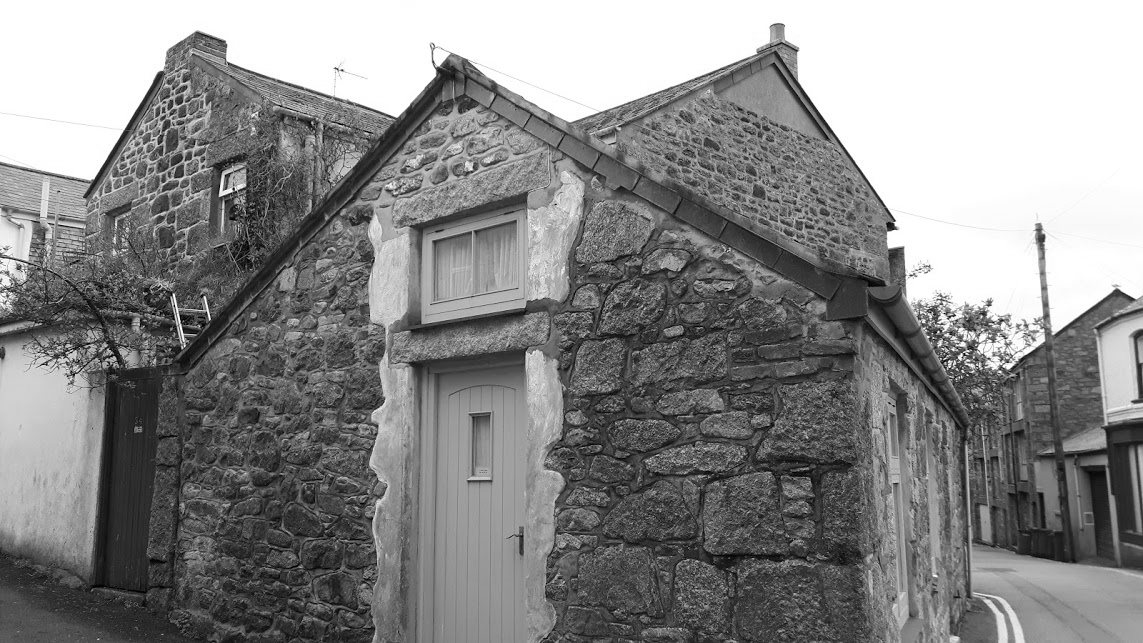
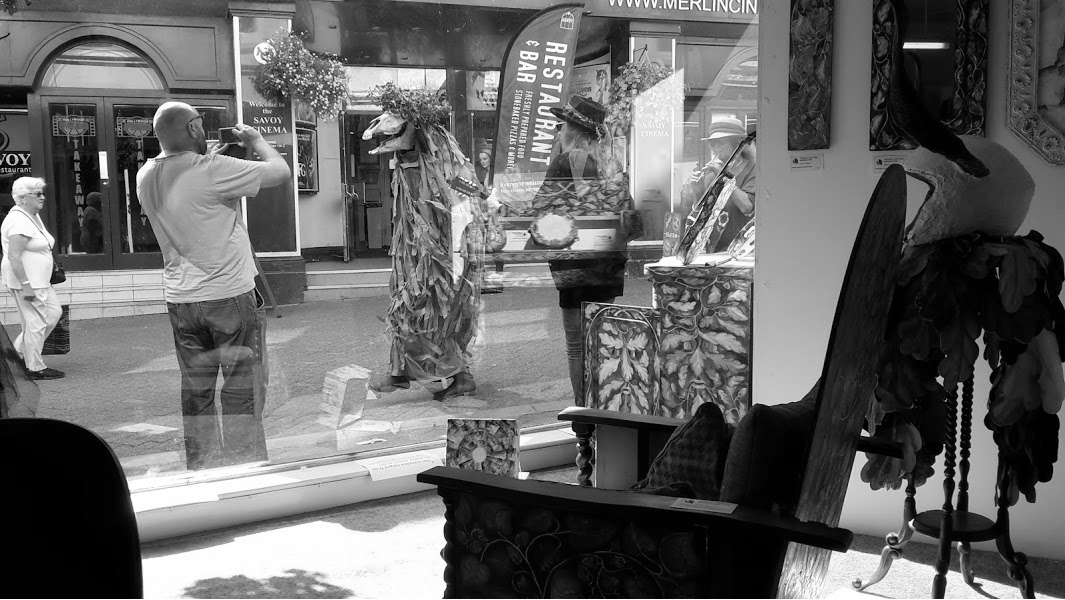
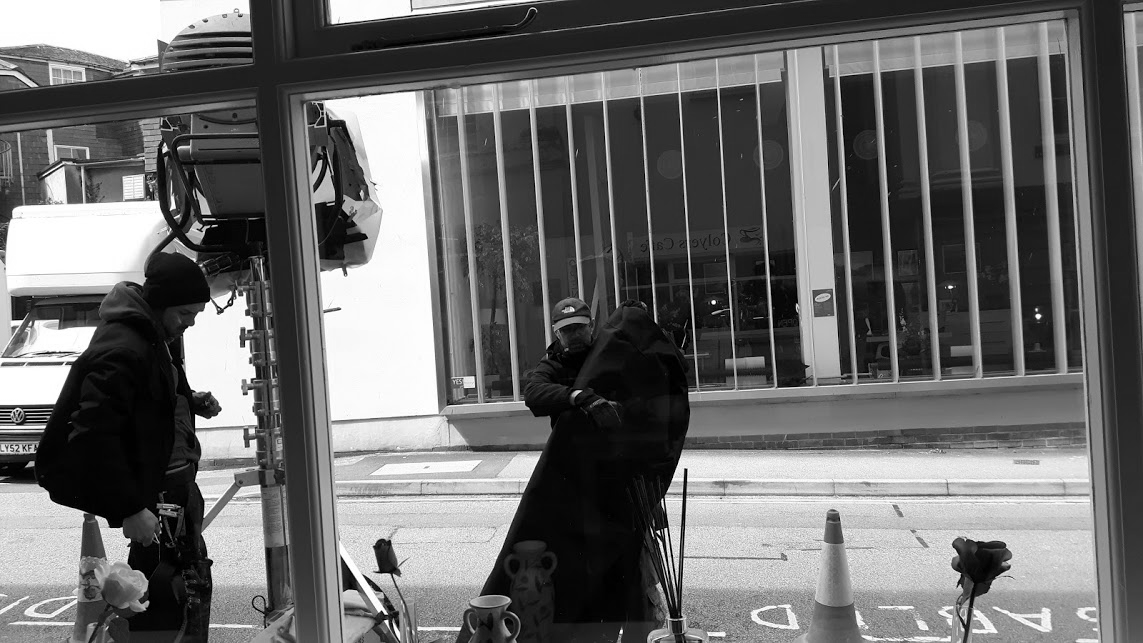
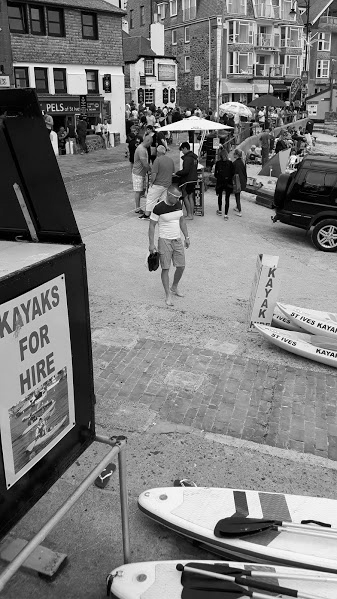
Inspired by this Youtube clip of Berlin taken in 2015 in black and white, I decided to take a look at some, mostly “street” photographs I have taken out and about in Penzance, Newlyn and St Ives this Summer.
There are two analogue photography websites i would like to recommend:-
I have a neat little book called ~” Poems of Cornwall” withdrawn from the County Library Service. The preface is by W.Herbert Thomas and is dated, “Penzance July !892”. A couple of months before the last down train from Paddington on Brunel’s broad gauge had run. It is a collection of some 30 poets of whom photographs of 18 appear inside the front cover. There is a poem by Sir Humphry Davy beneath an engraving of his statue.
St Michael’s Mount
Majestic Michael rises – he whose brow
Is crown’d with castles; and whose rocky sides
Are clad with dusky ivy: he whose base,
Beat by the storm of ages, stands unmov’d
Amidst the wreck of things-the change of time.
That base, encircled by the azure waves,
Was once with verdure clad; the towering oaks
Here waved their branches green: the sacred oaks ,
Whose awful shades among the Druids stay’d
To cut the hallowed mistletoe, and hold
High converse with their gods.
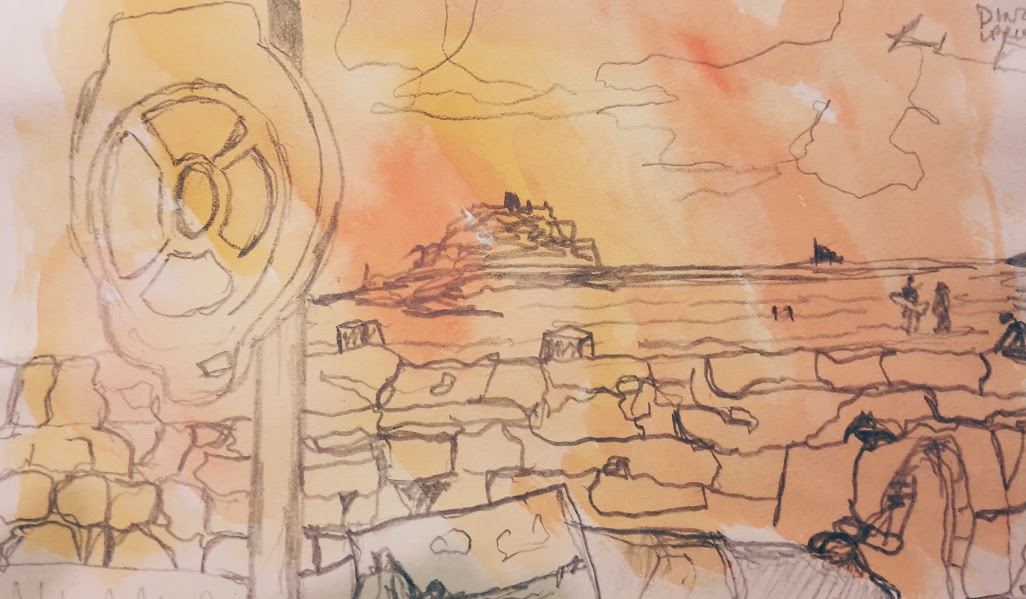
Sketch of the Mount last week and my leg!
Interesting this connection that early scientists felt for poetry and nature. Most obviously found in Goethe perhaps. Davy enjoyed angling and travelled widely across Europe to fish, I believe on the Dalmatian coast-Shakespeare’s Illyria from Twelfth Night. Which information I seem to recall from that fascinating book,”The Age of Wonder” by Richard Holmes. Count Orsino’s castle became the Mount in that great production of Twelfth Night by Trevor Nunn in 1996. Returning to Davy’s poem, I suppose some of the vocabulary now sounds antiquated, although the original “awful” sounds like that recent commonly used word,”awesome”. I rather like the line -“Amidst the wreck of things-the change of time.” which reminds me somehow of that biography of Malcom Muggeridge which he entitled “Chronicles of Wasted Time”. A title which comes from the lovely sonnet 106 of Shakespeare:-
When in the chronicle of wasted time
I see descriptions of the fairest wights,
And beauty making beautiful old rhyme
In praise of ladies dead and lovely knights,
Then, in the blazon of sweet beauty’s best,
Of hand, of foot, of lip, of eye, of brow,
I see their antique pen would have express’d
Even such a beauty as you master now.
So all their praises are but prophecies
Of this our time, all you prefiguring;
And, for they look’d but with divining eyes,
They had not skill enough your worth to sing:
For we, which now behold these present days,
Have eyes to wonder, but lack tongues to praise.
Returning to the main thread -what is otherwise called (aus den „Wahlverwandtschaften“ von Johann Wolfgang von Goethe:) the roter Faden -“Poems in Cornwall”, the editor W.Herbert Thomas was in fact a journalist who is described as “the son of a mine-smith of St Day. For seven years a mining clark, he was afterwards a reporter for two years on the San Francisco “Examiner” and is now on the staff of the” Cornishman” -however I would like to draw attention to a short poem by W,F.Woodfield. It is rather poignant and all that is said of him is that he lived in Penzance, he wrote a collection called “Serpentine Worker” and ,”is now in Australia”.
The Emigrant’s Farewell to Mount’s Bay
Farewell Mount’s Bay! A long farewell
I bid thy rock-bound shore;
My heart nigh breaks with grief to think
I ne’er may see thee more.
From infancy I have watched thy waves,
And roamed thy rocks and sands;
But I must leave thee beauteous bay,
To toil in other lands.
My heart grows faint-tears blind me so,
Words fail my love to tell;
My very soul so yearns for thee
I scarce can say -farewell.
But Manhood bids me dry my tears,
And brace me for the fight;
Adieu, adieu belove’d bay!
Farewell my heart’s delight.
Sincerely felt lines at any rate. It gives us a feeling of the process of uprooting that is involved in emigration and ought, I think, make us consider the plight of refugees with sympathy and support.
Monday was washday. For many Cornish women, the busiest day of the week. The first day of the week one of strenuous activity after a long, quiet and for many a Methodist Sunday. The thought of washday recalls images of raw, red hands, buckets of “blue” whitener and the dangerous possibility of fingers getting crushed in the mangle. In this book from the Penwith Local History Group, “Women of West Cornwall”, all the of the back breaking effort of domestic routine, to which women were tied, is vividly recalled. In earlier days before washing machines and even hot water, it might involve catching and hauling buckets of rainwater. For women in large Victorian families catering for brothers fishing or sons toiling on the land it meant restoring heavily soiled work clothes. It was truly hard labour.
This fascinating 100 page book gives the impression that many women’s lives were run along pre-determined tracks. Who you married decided rigidly the pattern of your future life. Also according to medieval laws, up until the late 19th century your property and dowry became your husband’s. It recalls the lines of Joan Baez’s “Waggoner’s Lad” – a folk song that was much heard around Penwith in the sixties:-
“Oh, hard is the fortune of all womankind
She’s always controlled, she’s always confined
Controlled by her parents until she’s a wife
A slave to her husband the rest of her life”
Yet, in spite of destiny, which sometimes included injury or loss of a husband, perhaps in war, womenfolk were determined not just to survive. “Women in West Cornwall” shows how they were intent upon improving their lot and also that of their sisters, real and metaphorical. Even in small villages like Ludgvan there were successful attempts to create a Friendly Society by means of which women might alleviate difficult times or dire emergencies. In a similar manner, women who managed large families, adapted their skills to run businesses in larger towns like Penzance. Despite educational discrimination and rigid stereotyping, these ladies showed an enterprising spirit, determination and courage. They pursued their rights to preserve their privacy, dignity and reputation through the complexities of Church Court system.
In this splendid little volume, it is truly encouraging to read of the maternal care that one Mousehole women showed in wartime to a number of Jewish children entrusted to her care, showering them with love and understanding. Bearing in mind the current refugee crisis, this story moves the reader to meditate upon the nature of human progress and the transformative power of kindness.
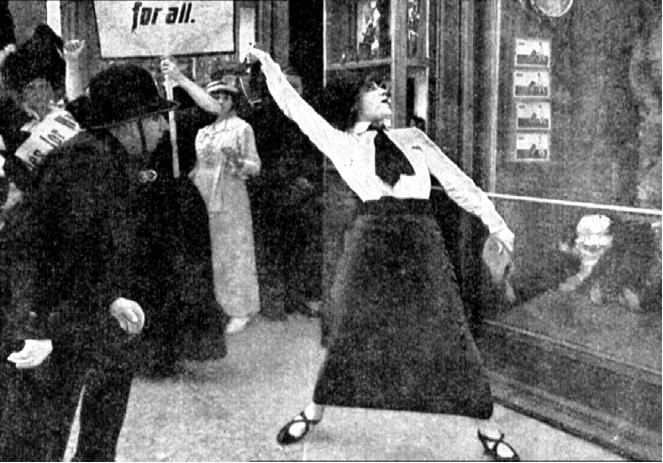
Aste Nielsen- Die Suffragette (1913)
In a short review it is difficult to mention all the useful studies in this fascinating and moderately priced book. It is delightfully illustrated with informative diagrams and background material. It is worth mentioning that it contains passages of humour, like the surreal yet socially revealing clash between Penzance carnival queens in the 1930s. There is an informative chapter on the vicissitudes of being the model of a famous artist and her later experiences. These ten chapters all written by women show, in a variety of styles, empathy and imagination, much systematic and painstaking research into primary sources. Such materials, wills and deeds, being hand written are challenging to decipher. There is in addition a productive use of personal recollection and family memories. This is a great contribution both to Cornish and Women’s Studies. Equality, sadly, is still a work in progress but this neat volume marks, in a touching manner, the distance travelled towards that goal.
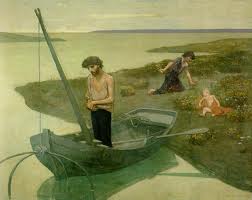
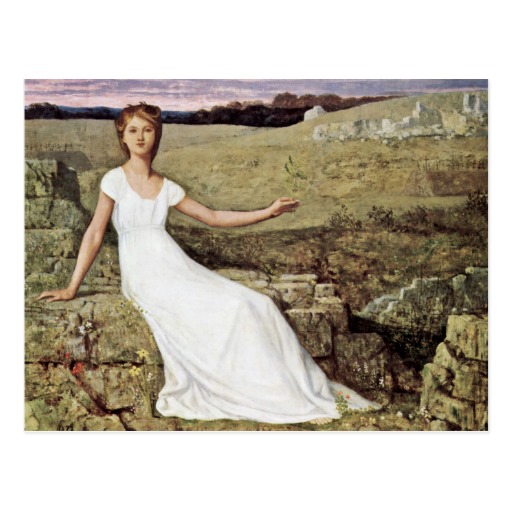
According to the Web Museum in Paris,”He had only modest success early in his career (when a private income enabled him to work for little payment), but he went on to achieve an enormous reputation, and he was universally respected even by artists of very different aims and outlook from his own. Gauguin, Seurat, and Toulouse-Lautrec were among his professed admirers. His reputation has since declined, his idealized depictions of antiquity or allegorical representations of abstract themes now often seeming rather anaemic. He remains important, however, because of his influence on younger artists. He influenced, for instance, the German artist Ludvig von Hoffman https://en.wikipedia.org/wiki/Ludwig_von_Hofmann and perhaps the Cornish based artist Thomas Cooper Gotch.
Ludvig Von Hoffman
His simplified forms, respect for the flatness of the picture surface, rhythmic line, and use of non-naturalistic color to evoke the mood of the painting appealed to both the Post-Impressionists and the Symbolists.”
Hope by Puvis de ChavannesWoodburytype after a negative by Étienne Carjat (1808-1906)
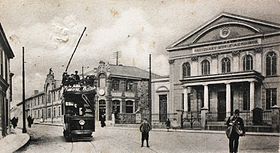
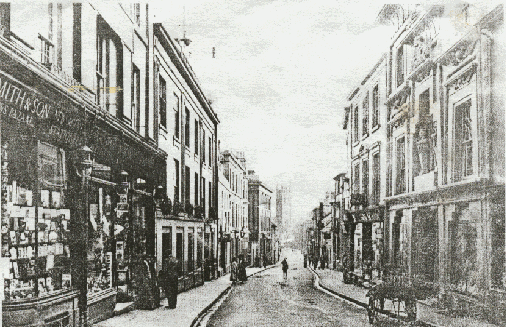
I like rooting around in secondhand shops, in fleamarkets and car boot sales-see my posting on Rosudgeon market. The Arcade building at the top of Chapel Street is often missed by visitors in search of other delights such as the Exchange Gallery. A long time ago-I will need to consult the Penwith Local History Group to discover when-certainly before the Srcond World War this building was W>H.Smith as the photograph shows.Chapel Street. Chapel Street Further details of the intriguing history of this street may be found at http://www.chapelstreet.co.uk/accommodation.html In any event the upstairs and downstairs regions are well worth a visit-these photographs show some sketches that I was able to purchase for a very modest price.
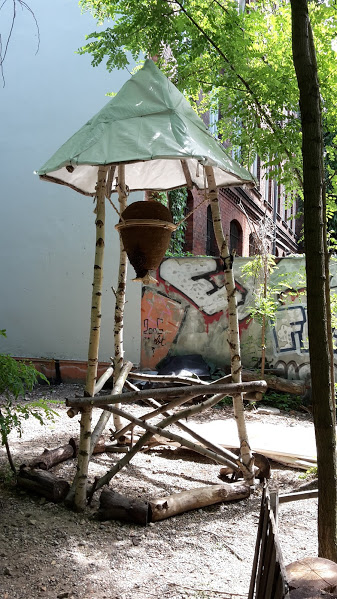
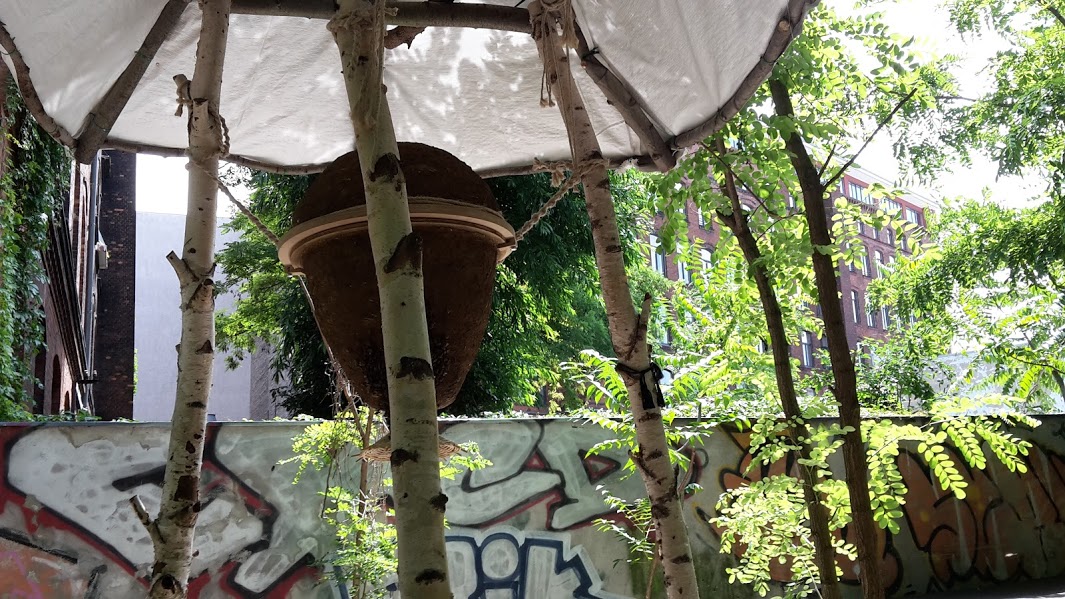
On the hunt for books rather than pictures, much fun is to be had in the Fleamarket in Prinzessinnengarten-close to Moritzplatz on the U-bahn. It always seems to be very hot weather when I have visited and a good reason to have a cool Weissebier at the trestle tables under the trees and to read the Sunday newspapers. There is always an interesting range of literature in at least three languages. There are a good range of other items including records, CDs, dresses and jeans. There is often a music group on hand and the atmosphere reminds me of St Ives in the Sixties or the summer exhibition at Falmouth Art School. There is a big emphasis on green issues, multiculturalism and the folk all seem jolly and entspannend. Further details may be found at http://prinzessinnengarten.net/de/was-passiert-im-garten/projekte/regelmaessige-veranstaltungen-in-der-gartensaison/




















 penwithlit