Footfalls echo in the memory
Down the passage which we did not take
Towards the door we never opened
Into the rose-garden.
So writes T.S. Eliot in Burnt Norton, the first of the Four Quartets. It makes one wonder what memories can be recalled of this particular Rose Garden. A slightly strange venue to choose surely? Maybe the door ought not to have been opened? Most will recall the unfortunate and strange meeting that heralded the unfortunate Coalition Indeed, it was another Special Adviser, Julia Goldsworthy who was to finally conclude, “Many Liberal Democrat activists would have found the Rose Garden love-in between David Cameron and Nick Clegg “sick-inducing”. Perhaps it was to give a green tinge to distract from 260 miles or more of carbon emissions.
It is not just the receding hairline of Cummings that brings G and S’s Mikado character of Nanki-Poo to mind. This histrionic and grumpy individual needs a trickster or Jungian alter ego. Remember it is Nanki-Poo who sings-
The flowers that bloom in the spring, Tra la, Breathe promise of merry sunshine — As we merrily dance and we sing, Tra la, We welcome the hope that they bring, Tra la, Of a summer of roses and wine, Of a summer of roses and wine. And that’s what we mean when we say that a thing Is welcome as flowers that bloom in the spring. Tra la la la la, Tra la la la la, The flowers that bloom in the spring.
This indeed is the Topsy-Turvy World where the Rose Garden becomes the stage for attic antics. Incidentally, Topsy-Turvy is an excellent film directed by the redoubtable Mike Leigh about the making of the Mikado.
The Mikado is relevant here too in more serious ways- it is about a fiercely autocratic society. There is the haughty nobleman, Pooh-Bah.There is making the punishment fit the crime. In Leigh’s film there is drug addiction- there is social distancing and the overwhelming distance brtween performance and the dark and stark reality. In both there is meiosis, a drastic understatement of the situation. Which brings us back to today’s performance attempting to come up smelling of roses.
This seems to me to be a poem which expresses considerable ambivalence to what at first seem comfortable domestic surroundings. In current circumstances it might seem to have some special appeal. The poet feels herself to be marooned and isolated with domestic noises in the background from perhaps a washing machine or spin-drier. Unlike these machines which may perhaps be seen as having some resemblances to male characteristics she lacks a sense of direction. The element of threat appears in the second verse where the interesting verb “tap” introduces the suggestion of blindness. ‘Tapping’ might be seen as a very quiet noise in contrast with the loud machinery. It carries the possibility of tap dancing too. It also carries meanings of connection.
The tranquil security of something like a Dutch interior becomes still more alien in the third stanza. The jigsaw might well imply cutting up or puzzlement. Although the images of a lunar moonlander and the reflection of a swooping kingfisher are at the same time threatening, bizarre but also carry a strange delight. They seem to suggest the distracted nature of the woman and her longing.
In the final lines a sudden stillness suddenly reigns. All is clean and silent but also overcoming. She at last starts to move but the sheet she irons might almost be a shroud. There seem to be elements of boredom and domestic imprisonment but all recorded with a deceptively light touch. This poem comes from a collection called Night Feed 1982. An Irishwoman and feminist her collection is published by Carcanet Press and very well worth attention.
By day and night this street is not still;
Omnibuses with red tail lamps,
Taxi cabs with shiny eyes,
Rumble, shunning its ugliness.
It is corrugated with wheel ruts,
It is dented and pock-marked with traffic,
It has no time for sleep.
It heaves its old, scarred countenance
Skyward between the buildings
And never says a word
On rainy nights
It dully gleams
Like the cold tarnished scales of a snake:
And over it hang arc-lamps,
Blue-white death-lilies on black stems.
I found this poem in the Penguin Collection of Imagist Poetry. I like the cold, gleaming atmosphere of this poem with its feeling of early 20th Century Modernism. The word omnibus seems of its time but is maybe just an Americanism. There is a feeling of Eliot’s empty lots and the vertical feeling of narrow streets. Restlessness and battered feelings are emphasised with corrugated and rumble and ruts, add onomatopoeiacally, to the wet and cold ambience of the poem. The visual images shine out in various colours.
For reasons I only partially understand, this poem brought to mind the area around South Kensington Tube station where I was once caught in very heavy rain. There used to be a cafe on the corner which I thought, wrongly it seems, there once was a Lyons corner house. Last year I sat instead in the pleasant settings of Muriels (which has an Antony Powell ring about it –https://www.murielskitchen.co.uk/
Notice that the old omnibus has now taken a different form and last August the area was filled with tourists consulting their mobile phones.
Row after row with strict impunity
The headstones yield their names to the element,
The wind whirs without recollection;
In the riven troughs the splayed leaves
Pile up, of nature the casual sacrament
To the seasonal eternity of death;
Then driven by the fierce scrutiny
Of heaven to their election in the vast breath,
They sough the rumour of mortality.
Autumn is desolation in the plot
Of a thousand acres where these memories grow
From the inexhaustible bodies that are not
Dead, but feed the grass row after rich row.
Think of the autumns that have come and gone!—
Ambitious November with the humors of the year,
With a particular zeal for every slab,
Staining the uncomfortable angels that rot
On the slabs, a wing chipped here, an arm there:
The brute curiosity of an angel’s stare
Turns you, like them, to stone,
Transforms the heaving air
Till plunged to a heavier world below
You shift your sea-space blindly
Heaving, turning like the blind crab.
Dazed by the wind, only the wind
The leaves flying, plunge
You know who have waited by the wall
The twilight certainty of an animal,
Those midnight restitutions of the blood
You know—the immitigable pines, the smoky frieze
Of the sky, the sudden call: you know the rage,
The cold pool left by the mounting flood,
Of muted Zeno and Parmenides.
You who have waited for the angry resolution
Of those desires that should be yours tomorrow,
You know the unimportant shrift of death
And praise the vision
And praise the arrogant circumstance
Of those who fall
Rank upon rank, hurried beyond decision—
Here by the sagging gate, stopped by the wall.
Seeing, seeing only the leaves
Flying, plunge and expire
Turn your eyes to the immoderate past,
Turn to the inscrutable infantry rising
Demons out of the earth—they will not last.
Stonewall, Stonewall, and the sunken fields of hemp.
Shiloh, Antietam, Malvern Hill, Bull Run.
Lost in that orient of the thick-and-fast
You will curse the setting sun.
Cursing only the leaves crying
Like an old man in a storm
You hear the shout, the crazy hemlocks point
With troubled fingers to the silence which
Smothers you, a mummy, in time.
The hound bitch
Toothless and dying, in a musty cellar
Hears the wind only.
Now that the salt of their blood
Stiffens the saltier oblivion of the sea,
Seals the malignant purity of the flood,
What shall we who count our days and bow
Our heads with a commemorial woe
In the ribboned coats of grim felicity,
What shall we say of the bones, unclean,
Whose verdurous anonymity will grow?
The ragged arms, the ragged heads and eyes
Lost in these acres of the insane green?
The gray lean spiders come, they come and go;
In a tangle of willows without light
The singular screech-owl’s tight
Invisible lyric seeds the mind
With the furious murmur of their chivalry.
We shall say only the leaves
Flying, plunge and expire
We shall say only the leaves whispering
In the improbable mist of nightfall
That flies on multiple wing;
Night is the beginning and the end
And in between the ends of distraction
Waits mute speculation, the patient curse
That stones the eyes, or like the jaguar leaps
For his own image in a jungle pool, his victim.
What shall we say who have knowledge
Carried to the heart? Shall we take the act
To the grave? Shall we, more hopeful, set up the grave
In the house? The ravenous grave?
Leave now
The shut gate and the decomposing wall:
The gentle serpent, green in the mulberry bush,
Riots with his tongue through the hush—
Sentinel of the grave who counts us all!
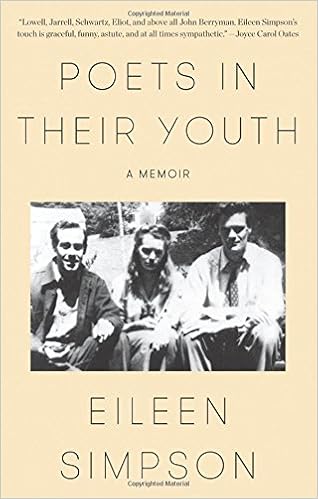
Someone told me once that the English spoken in the Southern States was close to the way in which Shakespeare language was spoken back in the day he wrote his plays. I am unsure of the evidence for that but Tate’s voice adds an extra dimension to the You Tube reading. I first came across reading about him in Eileen Simpson’s fascinating memoir “Poets in their Youth” where he appears as an elegant, imposing and somewhat reactionary figure. There is an interesting account of a recent biography of Tate’s life at https://www.lrb.co.uk/the-paper/v23/n10/ian-hamilton/i-intend-to-support-white-rule.
This poem has been preoccupying me for a day or two. Firstly, because I recall that some long time ago I used to watch a series on television called O Henry’s Playhouse and watching it again recently I came across this clip from 1957, It was not at all bad television and the following episode is tangentially related to the Confederacy.
However, in the present Covid-19 isolation, many of the lines seem to have extra meaning. During constitutional walks, I cannot help noticing that the side gate of the nearby cemetery has been left permanently open. The fact that it is about 250m from the local hospital is a reminder of the crisis and the daily toll which it is exacting. There is also the feeling that we might have done more to protect the NHS politically by a better defence against the reactionary clutches of the current admonistration. Not to mention policies of Brexiteers who have driven nurses and doctors out of the country.
What shall we say who have knowledge Carried to the heart? Shall we take the act To the grave? Shall we, more hopeful, set up the grave In the house? The ravenous grave?
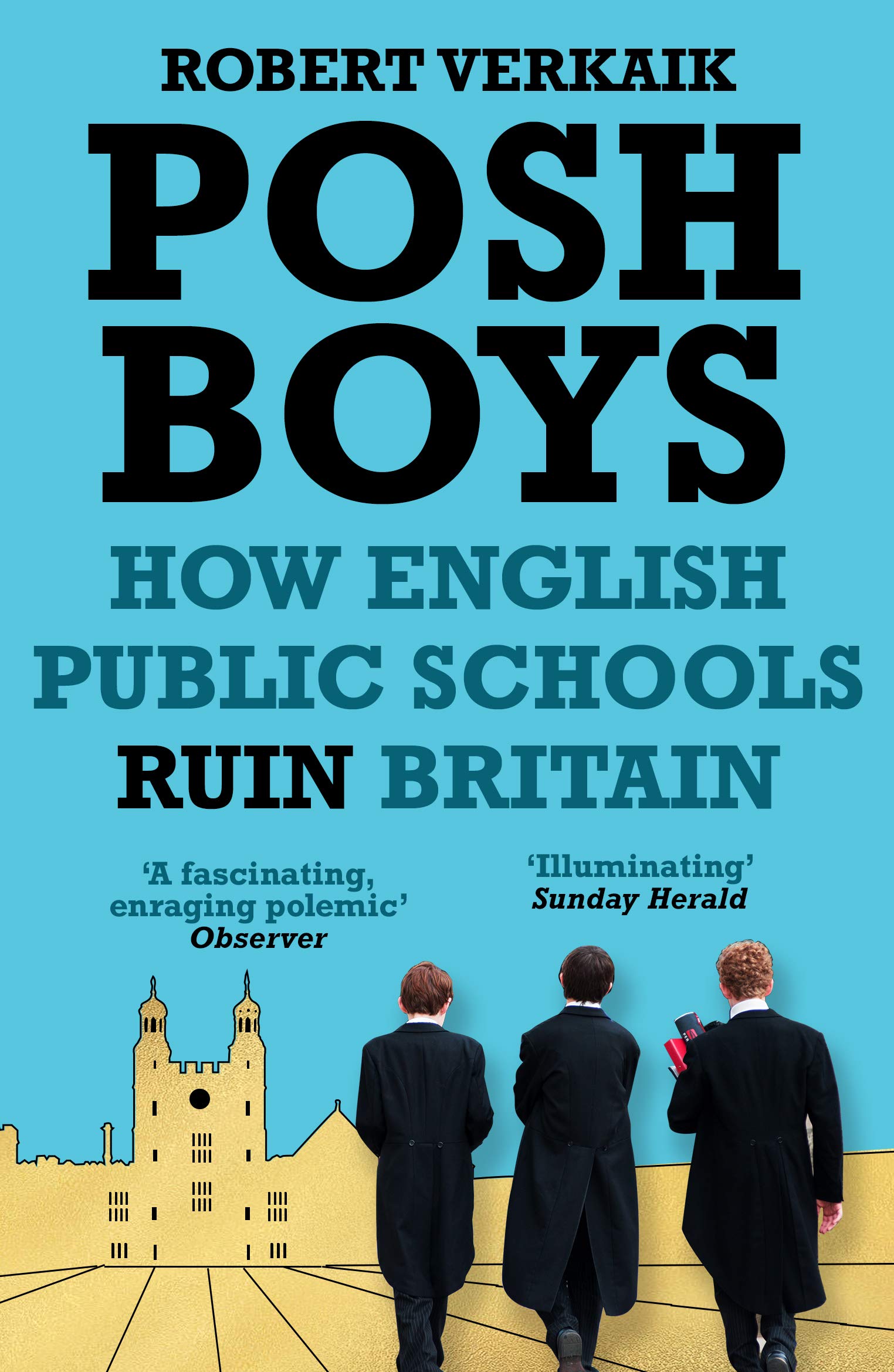
Arte is a brilliant source of great programmes on various topics, many of which are cultural or historical, in French and in German. Here is one in French in which it is possible to hear the absurd inequalities of the English class system spoken in French. This naturally has the effect of being somewhat amusing. The voyeuristic pleasure which the lower orders are supposed to derive from the spectacle is supposed to distract from other concerns- like properly funded public services.
The French and German subtitles are useful too, Here is another view of one aspect of English education by a great teacher, novelist and poet.
The Oxford Voice by D.H. Lawrence
When you hear it languishing
and hooing and cooing, and sidling through the front teeth,
the Oxford voice
or worse still
the would-be Oxford voice
you don’t even laugh any more, you can’t.
For every blooming bird is an Oxford cuckoo nowadays,
you can’t sit on a bus nor in the tube
but it breathes gently and languishingly in the back of
your neck.
And oh, so seductively superior, so seductively
self-effacingly
deprecatingly
superior.
We wouldn’t insist on it for a moment
but we are
we are
you admit we are
superior.
A more gentle and highly amusing perspective on a smaller scale perhaps is the radio series Plum House. It is a Comedy about the eccentric and inept staff at Plum House, former country home of minor 18th-century poet George Pudding. Written by Ben Cottam and Paul Mckenna. It may be found at https://www.bbc.co.uk/programmes/b07hk30x
Baudelaire wrote of the strolling poet in the Paris crowd:-
The poet enjoys the incomparable privilege of being able to be himself of someone else, as he chooses. Like those wandering souls who go looking for a body, he enters as he likes into each man’s personality. For him alone everything is vacant; and if certain places seem closed to him, it is only because in his eyes they are not worth visiting.
The solitary and thoughtful stroller finds a singular intoxication in this universal communion. The man who loves to lose himself in a crowd enjoys feverish delights that the egoist locked up in himself as in a box, and the slothful man like a mollusk in his shell, will be eternally deprived of. He adopts as his own all the occupations, all the joys and all the sorrows that chance offers.
The Paris, a few years after Baudelaire’s passing is shown in these remarkable pictures taken between 1900 and 1917. Baudelaire died in 1867 but his remarks are interesting and pertinent to some of the following photographs, which were shot in direct colour using the Autochrome process developed by the famous Lumière brothers in 1903.
In the original French from Spleen (1869)
Le poète jouit de cet incomparable privilège, qu’il peut à sa guise être lui-même et autrui. Comme ces âmes errantes qui cherchent un corps, il entre, quand il veut, dans le personnage de chacun. Pour lui seul, tout est vacant ; et si de certaines places paraissent lui êtres fermées, c’est qu’à ses yeux elles ne valent pas la peine d’être visitées.
Le promeneur solitaire et pensif tire une singulière ivresse de cette universelle communion. Celui-là qui épouse facilement la foule connaît des jouissances fiévreuses, dont seront éternellement privés l’égoïste, fermé comme un coffre, et le paresseux, interné comme un mollusque. Il adopte comme siennes toutes les professions, toutes les joies et toutes les misères que la circonstance lui présente.
How might we read such a photograph? It has a surreal quality about it that we might associate it with Magritte. The artist, musician and his instrument appear in a classical composition like the three graces. They are starkly outlined against the white Paris sky in front of the descending staircase. The two men seem isolated in their solitude and their is a feeling of expectation and a gentlemanly respect for the instrument whose feminine shape seems implied.
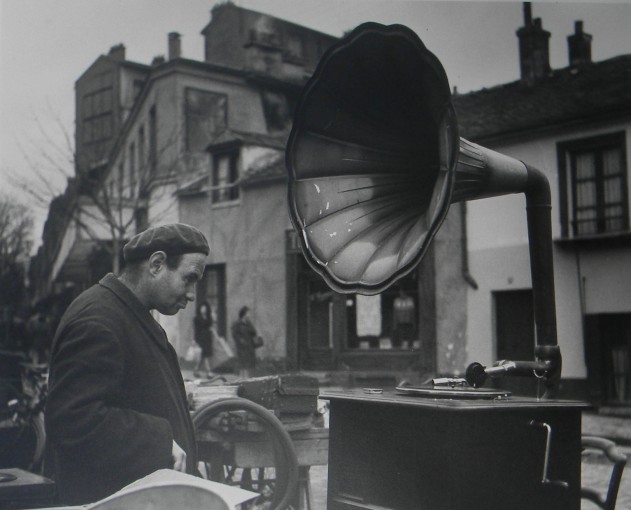
There is a humane quality which suffuses Doisneau’s work- a magical charm. The photograph makes a nice comparison with the famous HMV poster. It is impossible to say weather the subject is more enchanted by the splendid device or the music emerging from the cumbersome, jolly gramophone. Probably he is entranced by both. His posture and beret adds to the general levity of the scene.
Doisneau photographed many great artists and this photograph captures the master, Picasso in his characteristic striped jersey with his penetrating gaze. The photographer makes a marvellous joke with the distorted fingers of bread rolls. It seems likely that this was contrived between them. A morphic distortion and also an interesting game with perspective too.





 penwithlit