Categories
Uncategorized

A Disused Shed in County Wexford by Derek Mahon

They are begging us, you see, in their wordless way,
To do something, to speak on their behalf
Or at least not to close the door again.
Lost people of Treblinka and Pompeii!
‘Save us, save us,’ they seem to say,
‘Let the god not abandon us
Who have come so far in darkness and in pain.
We too had our lives to live.
You with your light meter and relaxed itinerary,
Let not our naive labours have been in vain!’
——————————————————-
This is the final stanza of ten lines. The full poem may be found at https://www.poetryfoundation.org/poems/92154/a-disused-shed-in-co-wexford
The “Web-throated, stalked like triffids” i,e, some type of mushroom remind me of the deep impression that Anthony Gormley’s clay figurines made upon me when I saw them, years ago at the St Ives Tate.
Antony Gormley's Field for the British Isles at Barrington Court
See https://www.ntsouthwest.co.uk/2012/04/antony-gormleys-field-for-the-british-isles-arrives-at-barrington-court/
Categories
Art and Photographic History Uncategorized

Abram Arkhipov (1862-1930) -Russian Realist Painter

Abram Efimovich Arkhipov (RussianАбра́м Ефи́мович Архи́пов; 27 August [O.S. 15 August] 1862 – 25 September 1930) was a Russian realist artist, who was a member of the art collective The Wanderers as well as the Union of Russian Artists.

Russian painter born in Yegorovo, Ryazan Province. He studied at the Moscow School of Painting, Sculpture and Architecture with
Vasily Perov, Aleksey Savrasov, Vladimir Makovsky and Vasily Polenov as teachers. He joined the traveling artists (Peredvizhniki) in 1889 and the Union of Russian Artists in 1903.

Indebted to Perov’s realistic painting, Arkhipov also paid special attention to the effects of light, rhythm and texture, even on his most didactic canvases, such as laundress. Arkhipov found a source of rich and diverse inspiration in the Russian countryside and peasantry; painted peasants at work, the melting of the snow, the local church and the priest, the villages of the far north and the White Sea. Works such as The Lay Brother (1891) and Northern Village (1903, both from Moscow, Tret’yakov Gal.) They are evidence of Arkhipov’s important position in the history of Russian landscape painting of the late 19th century. His concentration in plein-air painting was largely shared by other representatives of the Union of Russian Artists, such as Baksheyev, Leonard Turzhansky (1875–1945) and Sergey Vinogradv (1869–1938).

Categories
Literature Poetry St Ives Uncategorized

The Last of the Fire Kings -an extract from Derek Mahon

Five years I have reigned
During which time
I have lain awake each night

And prowled by day
In the sacred grove
For fear of the usurper,

Perfecting my cold dream
Of a place out of time,
A palace of porcelain

Where the frugivorous
Inheritors recline
In their rich fabrics
Far from the sea.

I find these few lines deeply even profoundly moving.  The whole poem may be found at http://www.troublesarchive.com/artforms/poetry/piece/the-last-of-the-fire-kings 

There it states,”Derek Mahon’s reference to an ancient curse can be construed as referring to the weight of tradition in Northern Ireland and the legacies of division and violence.” However, it is the mythological images that it conjures up and which I do not fully understand which particularly appeals to me. Although it may help a little to know that a frugivore is an animal that thrives mostly on raw fruits, succulent fruit-like vegetables, roots, shoots, nuts and seeds. It can be any type of herbivore or omnivore where fruit is a preferred food type.

For those interested in an analysis or interpretation of the whole poem, there is a PhD thesis from Durham at https://core.ac.uk/download/pdf/108461.pdf

Categories
Literature Poetry Uncategorized

By Severn – Ivor Gurney

  1. If England, her spirit lives anywhere
    It is by Severn, by hawthorns and grand willows.
    Earth heaves up twice a hundred feet in air
    And ruddy clay falls scooped out to the weedy shallows.
    There in the brakes of May Spring has her chambers,
    Robing-rooms of hawthorn, cowslip, cuckoo flower —
    Wonder complete changes for each square joy’s hour,
    Past thought miracles are there and beyond numbers.
    If for the drab atmospheres and managed lighting
    In London town, Oriana’s playwrights had
    Wainlode her theatre and then coppice clad
    Hill for her ground of sauntering and idle waiting.
    Why, then I think, our chiefest glory of pride
    (The Elizabethans of Thames, South and Northern side)
    Would nothing of its needing be denied,
    And her sons praises from England’s mouth again be outcried.

by Ivor Gurney

Categories
Uncategorized

Gegen die Wand 11

wolframette2013's avatarTexte von Wolfram Ette

Die Klimaserie
Folge 11: Das “Überleben des Planeten”

In einer Radiorezension des Manifests Denkt endlich an die Enkel von Wolf Schneider [1] entgegnete der Journalist auf die Frage nach dem appellativen Stil des Manifests: Nein, die vielen Ausrufezeichen würden ihn nicht stören, es ginge ja schließlich um DAS ÜBERLEBEN DES PLANETEN.

Wie viel verbohrte Selbstgefälligkeit, wie viel Verblendung spricht aus dieser gut gemeinten Wendung. Wenn die Erde einige Grade wärmer wird, hat sie keineswegs um ihr “Überleben” zu kämpfen. Das ist schon öfters passiert. Ein evolutionärer Zyklus geht zu Ende. Irgendwann fängt ein neuer an, das Dasein des Planeten bleibt davon vollkommen unberührt. Die Gleichsetzung der Menschheit mit “dem Planeten” ist eine Anmaßung und gehört zum Problem, das zu lösen es vorgibt. Im erdgeschichtlichen Maßstab sind wir nur ein evolutionäres Augenzwinkern, das Vorüberhuschen einer gestörten Hochbegabung. Ob angesichts dessen nicht wir, sondern eigentlich die Viren das Optimum der Evolution darstellen…

View original post 51 more words

Categories
Uncategorized

On the fringes of Dada in Berlin

europeancollections's avatarLanguages across Borders

It seems to be almost a running joke that British people find it difficult to name a famous Belgian. This post highlights a major work of an important and influential 20th century Flemish poet who should definitely be more widely known and who was briefly on the periphery of the Dada movement in Berlin after World War I.

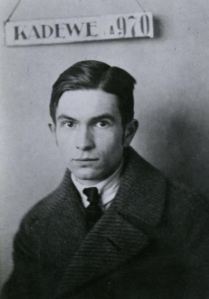
Paul van Ostaijen in Germany, 1920 via Wikimedia Commons

Paul van Ostaijen (1896-1928) was from Antwerp where he gained a reputation as a dandy within bohemian circles. He was a political activist for the Flemish independence movement, and his flight to Berlin at the very end of World War I meant that he escaped a short delayed prison sentence, imposed earlier that year for demonstrating against the pro-French speaking Cardinal Mercier. He was already a published poet and critic, and during the two and a half years that he spent in…

View original post 984 more words

Categories
Uncategorized

Wroclaw – 1

Julian Worker's avatarJulian Worker - Journeys

If you like gnomes, especially statues of gnomes, then Wroclaw is a place you should visit. There are over 300, all in miniature, scattered throughout the city. There’s even a map available at the tourist information for gnome enthusiasts to follow. I wasn’t purposefully following a trail, but I still spotted around a dozen in various places such as the one operating a mechanical digger by the river Oder, an opera gnome singing an aria to a ballerina gnome outside the Opera House , and a rock star gnome holding a guitar skywards in the main square. The most famous are the fireman gnomes near the Hansel and Gretel houses on the main square. Visitors will notice that certain parts of these gnomes, such as the nozzle of their hose, are highly polished as tourists have rubbed them for good luck.

View original post

Categories
Uncategorized

Haarlem Jazz

I’ve recently read Geoff Dyer’s book about Jazz which is called “But Beautiful”. It’s put me in the mood…..so to speak.

ms6282's avatarDown by the Dougie

DSC07084

Our visit to Haarlem coincided with the annual Jazz Festival which started on the Wednesday and ran through until Sunday. We’d hoped to catch some of the music on the Wednesday and Thursday before we headed for home on Friday. On Wednesday evening, however, it poured down more or less continuously so after spending some time watching one of the acts on the opening night, we decided to call it quits and retreated to Tierney’s bar! The next night was much better. It didn’t rain and we were able to sample some of the music and atmosphere.

On the Wednesday there was only one stage, set up in the Grote Markt, but the next night three more stages opened up. 2 other stages around the Grote Kerk – on Oude Groenmarkt and Klokhuisplein – and another venue at the Pletterij , on the outskirts of the town centre.

From what…

View original post 154 more words

Categories
Uncategorized

Gdansk – 15

Interesting to see the detail about this major European city.

Julian Worker's avatarJulian Worker - Journeys

The Old Town was 90% destroyed by these armies and by the Russian forces seeking to wrest Gdansk away from Nazi Germany. My understanding is that the sensitive restoration of the city after 1945 did reduce some of the Prussian influences in the architecture, but that most of the buildings looked exactly as they did before 1939. 

Drawings, paintings, and old plans were used to reconstruct whole neighbourhoods, as was the case with most Polish cities after WWII, and as I walked along each street, strolled through the parks, and admired every church I gave thanks to the restorers for making such great efforts to reproduce their city of the pre-war years. It would have been easier to build Stalinist blocks, but the planners wanted their city back as it was in early 1939. It took over 30 years to complete, but the Old Town is now old again. 

View original post

Categories
Uncategorized

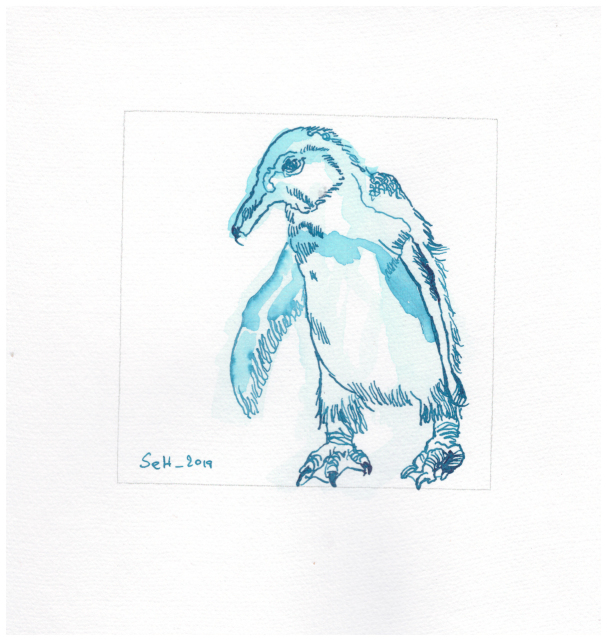
Die Pinguine lassen mich nicht los – Zeichnung von Susanne Haun

Lovely penguins- really sweet!!

Susanne Haun's avatarSusanne Haun

Es hört sich an als ob der nächste Salon am 29. Oktober 2019, 18 Uhr (Klick) in meinem Atelier noch in weiter Ferne scheint, jedoch weiss ich, wie schenll die Zeit vergeht und zeichne weiter an meine Afrika Impressionen.

Die Pinguine lassen mich nicht los. Die Beobachtung der Pinguine gehört zu meinen schönsten Erinnerungen an die Afrika Reise vor nun schon fast zwei Jahren. Hier ist der Link (Klick), der zum Blogbeitrag führt, in dem ich über diesen besonderen Tag berichte.

Afrika, Pinguin, Zeichnung von Susanne Haun (c) VG Bild-Kunst, Bonn 2019Afrika, Pinguin, Zeichnung von Susanne Haun (c) VG Bild-Kunst, Bonn 2019

Ich zeichne für die kleinen Arbeiten immernoch in der Größe 15 x 15 cm. Da ich meine Blätter immer voll ausnutze, muss ich mir tatsächlich einen Bleistiftrahmen dieser Größe zeichnen, damit ich innerhalb meines Passepartoutausschnitts bleibe. Das amüsiert mich etwas, vor dem Rahmen wird der Ausschnitt wieder ausradiert.

View original post