Our brand new cook book was finally unveiled at a party at the restaurant on Friday 17th May. Regular diners celebrated alongside journalists and leading figures from the Cornish hospitality industry, hosted by Executive Chef Michael Smith and the team.
As well as a Foreword written by Nathan Outlaw, whose restaurant in Rock holds two Michelin Stars, the book has been further endorsed by Heston Blumenthal. Heston, whose restaurant The Fat Duck consistently receives the highest accolades in the whole of the UK, was pleased to recommend Porthminster as a “favourite holiday eating spot of mine,” going on to praise “inventive cooking and a gorgeous location.”
We would like to thank Champagne Louis Roederer, Polgoon and Matthew Stevens & Son Fish for their sponsorship on the night.
The book is now available to buy from the restaurant and online.
Guests were served a taste of various recipes from the book, as well…
Since moving to Cornwall collecting seaglass has been a passion of mine and a hobby that can be enjoyed by the whole family. For those of you that don’t know, seaglass is otherwise known as beach glass or ‘mermaids tears’. It is old pieces of glass that have been discarded into the sea and have been broken and moulded by the sea tossing and turning them over the years turning the shards into frosted gems of glass. Cornwall has some of the best beaches in the world for searching for these hidden gems and can reveal a surprising array of different colours, shapes, sizes and types, many well over 100 years old. These can range from the rarest colours , orange , yellow and turquoise generally from tableware of the early 1900’s, to the more common greens and brown of the early wine and beer bottles and a huge range…
The publication of this collection of around forty short stories from Serpent’s Tail books affords the English speaking public a unique opportunity; that of reading Walser, possibly the leading modernist writer of Swiss German in the last century. He has received high praise in A Place in the Country, W.G.Sebald’s recently published posthumous collection and he is well-known as being a significant influence on Franz Kafka. His work here dates from 1907 to 1929 and along with his poetry won him recognition with Berlin’s avant garde. He combines lyrical delicacy with detailed observation; reflective melancholy with criticism of brash commercialism. The fine writing in this volume strives to achieve a hard won integrity together with an experimental capacity for reflection. It challenges the reader and provokes him to new insights.
Referring to Walser’s ten page account, Kleist in Thun, written in 1913 Susan Sontag in her introduction states, “Wasler often writes from the point of view of a casualty of the romantic visionary imagination”. Walser describes how Kleist, an intense poet of High German Romanticism arrives in a villa in the beautiful Bernese Oberland. Kleist is overwhelmed and disturbed by his own response to what appears to him as the artificiality of his surroundings, as though it were all a sketch by a clever scene painter in an album with green covers. “Which is appropriate. The foothills at the lake’s edge are so half-and-half green, so high, so fragrant”. The changes in the weather and the seasons are portrayed as Kleist struggles with his own historical writings which he is forced to destroy over and over. This piece portrays with sensitivity Kleist’s struggle for the peaceful moments when he can feel again the outright happiness of a child. All that now remains is a plaque on the wall to commemorate the poet’s visit.
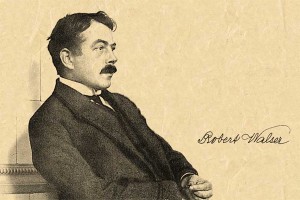
Robert Walser, Swiss poet and writer
Written over an extensive period these tales vary in tone from the surreal “Trousers” to the strange voyage of a captain, a gentleman and a young girl over the luminous course of the Elbe in “Balloon Journey”. In the more psychologically interesting “Helbling’s Story”, a bank clerk finds that he is feckless in time keeping and prefers the self-forgetfulness of dancing. His pursuit of his lively fiancée reveals that her sweetness tempered by her faithlessness. He seems caught between how he is perceived by his colleagues at the bank and his deep yearnings for isolation to the point of oblivion. There is a degree of Weltschmerz in some of these tales but worth the effort. Gradually, they repay the reader with their strange charm.
The longest story of sixty pages, “The Walk”, is an account of the writer venturing forth in his English yellow suit and recording his strongly felt impressions of the people, countryside and architecture that he encounters on a fine morning. As he gets into his stride, he remarks,” Spirits with enchanting shapes and garments emerged vast and soft, and the country road shone sky-blue, and white and precious gold”. Written in 1917, it also reveals his impressions of noisy cars passing by and of intrusive advertising in all its brashness contrasting with this rural idyll. He visits the post office, his tailor and goes to pay his taxes. Nothing escapes his eye, wild strawberry bushes, rivulets, the innocent play of children, honest black-jet dogs and he is almost hypersensitively given to reflect too upon the impression he makes upon others. Into this prose poem enter curious character like the odd lanky beanpole of a fellow called, Tomzack, who travels restlessly and devoid of human connection. Then with Swiss punctuality he dines with a cordial gracious lady that had previously been an actress. His self-justification and need for recognition attain huge and angry proportions when he negotiates his tax payments and it is at this point that his writing brings Kafka to mind. Out of this dense writing emerge passages with a sense of monumental grandeur and an awareness of transcending grace.
In addition to his value as a great writer, Robert Walser also affords the delights of entering a past world, that of Switzerland, a land isolated by the partial protection of its neutrality. The elegance of this past together with his sensitive impressions, including the already crowding and wearying pressures of commercialism, adds an extra level of piquancy. Joseph Roth, a well-known contemporary who also had a developed taste for irony, on arrival in Berlin, wrote in 1921, “The diminutive of the parts is more impressive than the monumentality of the whole”. In Walser’s writing we continually encounter this same fascination with the fine entrancing detail of small and beautiful things.
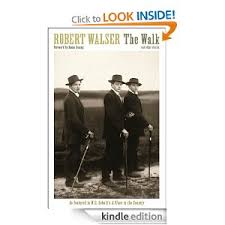
The cover image by August Sander shows three smartly dressed young farmers in Westerwald, although not entirely appropriate, makes an elegant jacket to these varied stories of imagination and vision.
Deine Seele, die die meine liebet,
Ist verwirkt mit ihr im Teppichtibet.Strahl in Strahl, verliebte Farben,
Sterne, die sich himmellang umwarben.Unsere Füße ruhen auf der Kostbarkeit,
Maschentausendabertausendweit.Süßer Lamasohn auf Moschuspflanzenthron,
Wie lange küßt dein Mund den meinen wohl
Und Wang die Wange buntgeknüpfte Zeiten schon?
Nighthawks After Edward Hopper’s Painting – Wolf Wondratschek
It is night and the city is deserted. The lucky ones are at home, or more likely there are none left.
In Hopper’s painting, four people remain the usual cast, so-to-speak: the man behind the counter, two men and a woman. Art lovers, you can stone me but I know this situation pretty well.
Two men and one woman as if this were mere chance. You admire the painting’s composition but what grabs me is the erotic pleasure of complete emptiness.
They don’t say a word, and why should they? Both of them smoking, but there is no smoke. I bet she wrote him a letter. whatever it said, he’s no longer the man who’d read her letters twice.
The radio is broken. The air conditioner hums. I hear a police siren wail.
Picture the crowded atelier of the renowned sculptor, Rodin or perhaps the dimly lit corridor’s of Lord Grimthorpe’s mansion. Perhaps you might prefer to frequent the brightly lit splendour of the balconies of the coastal villa at Cimbrione above the magnificent Gulf of Salerno. The inhabitants of such places led their tangled lives, sometimes enduring painful losses or by contrast, energetically inspired to passionate love affairs. In these stimulating environments we catch glimpses of the famous, like E.M.Forster, Virginia Woolf, sometimes accompanied by her close confidante, Vita Sackville West and then there was that tempestuous iconoclast, D.H.Lawrence. Many such lives were inspired by both landscape and lust, fashioned by each other’s creative energies and endowed with artistic talents of all kinds. Here we learn of talents and beauty that inspires artistic endeavour, like the many charms of Eve Fairfax. She, who after brief affairs was gradually forced into a stoic suspension which she recorded with thoughts from her friends in the pages of annotated diaries which became “A Book of Secrets”.
Michael Holroyd
The Becketts were Yorkshire bankers and MPs who over several generations owned a series of estates and Gothic brickwork mansions. Ernest William, the second Lord Grimthorpe, was sent to Eton and by nature appears to have been, as Holroyd ironically remarks, a schoolboy that in some ways never quite grew up, though he did arrive at TrinityCollege, Cambridge in May 1875. Much about him is surrounded in mystery but his prowess with women soon became almost notorious soon after he reached London, a fact recorded by the writer George Moore describing him as ‘London’s greatest lover’. Ernest was to take the tours customary for young gentlemen around Europe on which he pursued in succession Eve Fairfax who was briefly his fiancée and then met his wife, Luie, a rich American whose story forms an intriguing digression, in Rome. After her most unfortunate death in childbirth, Ernest Beckett was to end up in the arms of Alice Keppel who was to embark upon a dalliance, as is well known, with the Prince of Wales. Besides these, there was a voluptuous Spanish American lady in Rome whom Ernest conveniently installed in Bayswater.
It was the melancholy beauty of the classical features of Eve Fairfax that also sent Auguste Rodin into raptures. Seeing her bronze head in the V&A, actually cast in 1909, first inspired Michael Holroyd to write this book, “The Book of Secrets”, referring to the elaborate memoir which Eve kept throughout her later life whilst attempting to come to terms with her past. In this she recorded her thoughts on mortality, occasional verses whilst frequently pondering the significance of those earlier amorous encounters with Ernest Beckett. Holroyd deploys his fluent elegant prose in describing Eve, her friends and this Edwardian tome, an eclectic and unique personal calendar, and also the letters which she received from various and unsuitable admirers. These appear to have included Rupert, Ernest’s younger brother, hence she concluded ‘All Becketts make bad husbands’.
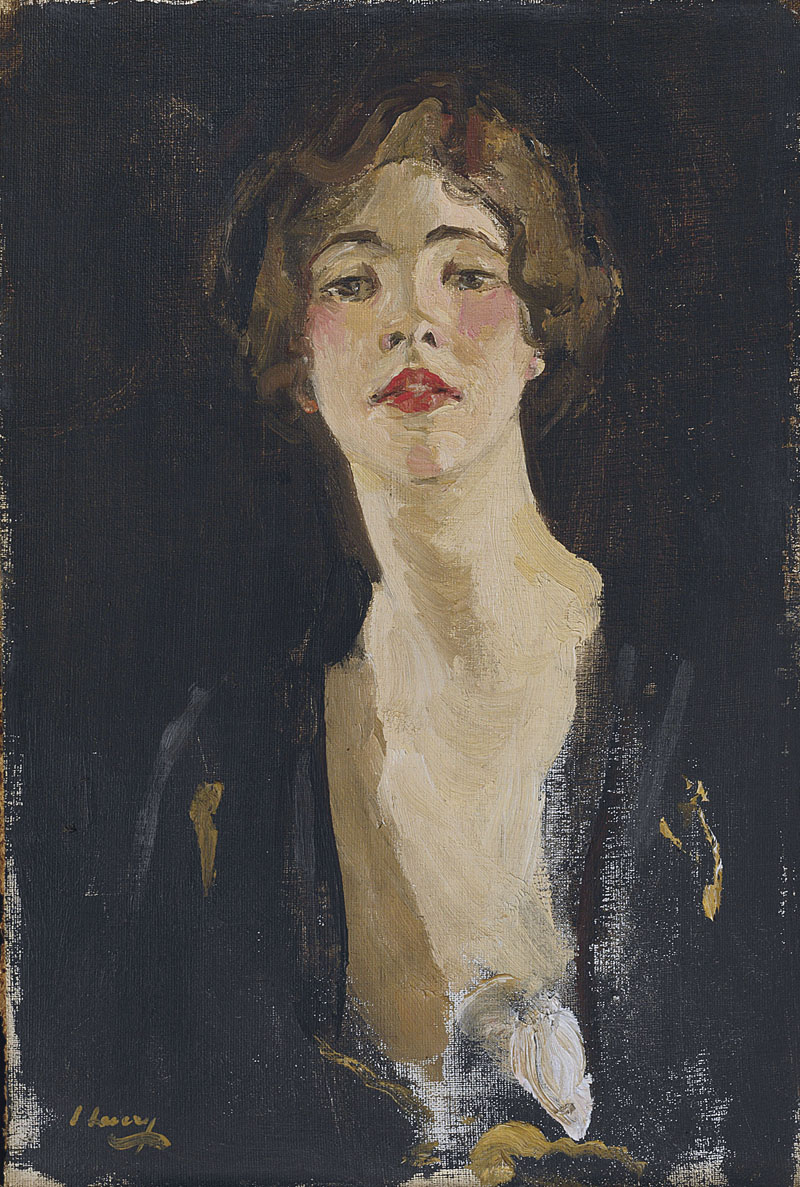
Portrait of Violet Trefussis by Sir John Lavery 1919
Following through complex family trees, helpfully supplied, Michael Holroyd arrives at the passionate love affair between Alice Keppel’s daughter, who later became Violet Trefussis and Harold Nicholson’s wife, Vita Sackville West. Both had severe, imposing mothers and as children chased together around the corridors of Knole. Vita loved this place with its grand towers, high battlements and long gallery surrounded by spacious parks. Vita then came to stay at Violet’s castle at Duntreath in Stirlingshire. Vita was proud, independent, bi-sexual and fascinated by gardening; Violet appears more naïve, wayward and focussed strongly on her ruthless pursuit of Vita, the latter having had several lovers and relationships which were to include Virginia Woolf. These passions inspired Woolf to write of pageant and androgyny in ”Orlando.” From a literary viewpoint, both Vita and Violet were highly productive. Vita wrote ”The Edwardians”, ”All Passion Spent”and ”Challenge”. Violet wrote around a dozen works, several in French; she loved Paris. Holroyd talks about rediscovering these works and he shares this interest with Violet’s young Italian biographer, Tiziana at Cimbrone who charms Michael and so becomes an important figure in this layered narrative. Along with his description of the supportive care of Holroyd’s wife, Margaret Drabble, the author brings the reader into the present. The biography becomes a heart-felt personal memoir.
The Guardian reported recently, “Biography is a genre in crisis, according to perhaps Britain’s best-known biographer, the author of highly acclaimed works on Lytton Strachey, Augustus John and George Bernard Shaw.” In particular literary biography, he feels has been superseded by the myriad forms of the internet and other popular entertainments.
Vita Sackville-West 1924
Holroyd says that this is his last book. However, here he is once again energised by the whole process of searching archives and reconstructs the cultivated, privileged and mostly civilised society back to the early Edwardians. In measured, wry and sympathetic tones he takes the reader into the luxuriant and variegated gardens of the past. He finds time to discuss the role of imagination in the art of biography. In this finely written book he carefully spreads enlightenment as he carefully distinguishes between guesswork, probability and established facts.
There is a related posting at http://nttreasurehunt.wordpress.com/2011/03/07/vita-and-violet/








 penwithlit