Categories
Uncategorized

The #1954Club – some reading recommendations for next week

Is there a particular reason for 1954? If I had to hazard a guess I would have thought that was a great time for post-war German literature. I always confuse Elisabeth Taylor with Elisabeth Jane Howard who wrote the Cazalet novels which have been made into a DVD https://www.goodreads.com/series/73774-cazalet-chronicles

JacquiWine's avatarJacquiWine's Journal

On Monday 18th April, Karen and Simon will be kicking off the #1954Club, a week-long celebration of books first published in 1954. Their ‘Club’ weeks are always great fun, and I’m looking forward to seeing all the various tweets, reviews and recommendations flying around the web during the event.

Perhaps unsurprisingly, given my fondness for fiction from the 1940s and ‘50, I’ve reviewed various 1954 books over the past few years. So if you’re thinking of taking part in the Club, here are some of my faves.

Who Was Changed and Who Was Deadby Barbara Comyns

There is something distinctly English about the world that Barbara Comyns portrays here, a surreal eccentricity that could only be found within the England of old. Set in 1911, three years before the advent of the First World War, Who Was Changed and Who Was Dead has all the hallmarks of…

View original post 1,000 more words

Categories
Uncategorized

Arched Entrance, The Pyrenees, France

Categories
Uncategorized

Norman Davies: God’s Playground – A History of Poland (vol1)

I always confuse Norman Davies with the ebullient Norman Stone- another expert on Eastern Europe with splendid linguistic skills. I would also recommend Adam Zamoyski’s book Warsaw 1920 which was quite fascinating. Davies book on Wroclow (Breslau) is in my mind currently because of the situation in Lviv (Ukraine).

litgaz's avatarLIT.GAZ.

     It’s well over thirty years since I first came across and read this monumental work by Norman Davies, who is the current expert par excellence on Polish history, so much so that all of his works have been translated into Polish and seem to rank alongside native-born historians’ work…

He begins by making it clear that it’s not merely the physical/ geographical location of Poland in the Central European plain sandwiched between Germany and Russia that creates many of that nation’s difficulties, but also Poland’s rule, and lack of it, too. He manages dexterously to pick his way through the minefield of the borderlands, national allegiances and historical changes in a way only recently paralleled by Timothy Snyder; he also demolishes a good number of nationalist myths and sacred cows along the way. It’s worth reminding ourselves that this history was written in the days of…

View original post 434 more words

Categories
Uncategorized

Balconies and Shutters, Nice, France

Lovely warm glow!

Categories
Uncategorized

The Literary Past and Future in C.S. Lewis’ “The Quest of Bleheris”: My Talk Tonight at the New York C.S. Lewis Society (Fri, Apr 8, 2022, 7:30pm Eastern on Zoom)

Brenton Dickieson's avatarA Pilgrim in Narnia

I am very pleased to be speaking tonight at the New York C.S. Lewis Society, the world’s oldest active society for sharing the enjoyment and considering the impact of C.S. Lewis‘ life and works. The New York C.S. Lewis Society was founded in 1969, six years after Lewis passed away. A quick trip to the webpage will give you a sense of their remarkable contribution. Besides monthly meetings, they also produce CSL: The Bulletin of the New York C.S. Lewis Society–a society newsletter that never fails to provide enjoyment and profit for the reader. In each issue, you will find news, reviews, and book notes, but also an academic essay and some occasional features, like Dale Nelson–who has contributed from time to time on A Pilgrim in Narnia–and his “Jack and the Bookshelf” series (now numbering into the 50s in number). Although I have been able to…

View original post 606 more words

Categories
Uncategorized

Painting Everyday London: 13 Camden Town Group

I really love the dark palette being used and the element of social realism. Manson is an interesting and somewhat controversial figure due for a revival, reminiscent in this manner to the poetry of Walter de la Mare but not so romantic.

hoakley's avatarThe Eclectic Light Company

Over the last three months, I have surveyed the paintings of those artists who, in 1911, were elected members of the Camden Town Group. This article draws the series to a close by gathering those works made by the group’s members between 1910 and 1913, when the group merged into the newly formed London Group.

Here I exclude those members who consistently painted themes in styles which were outside Walter Sickert’s repeated intent of depicting everyday London. I also, more reluctantly, exclude the Fauvist works of Spencer Gore when he was living in Letchworth in 1912, on the same basis. My aim here is to form a coherent overview of the group’s themes and style, which has been difficult when examining the work of individuals. Sadly, for copyright reasons, I can’t feature any paintings by Charles Ginner and Duncan Grant, and some others.

Views of Everyday London

By Sickert’s admission…

View original post 855 more words

Categories
Uncategorized

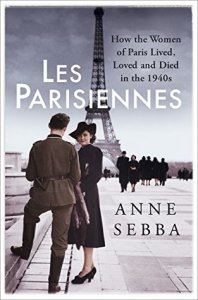
Les Parisiennes, by Anne Sebba (and how Lisa broke the law in Paris in 2005)

I have this on my enormous to- be- read pile. I went to a discussion at Jewish Book Week on the book which as you suggest is an intriguing and informative read.

Lisa Hill's avatarANZ LitLovers LitBlog

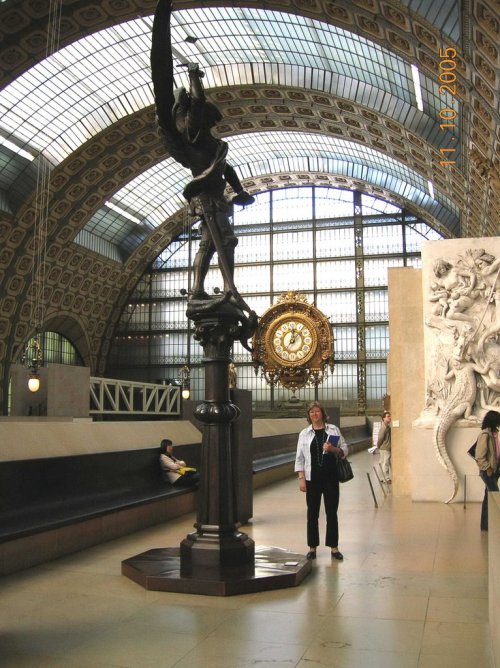
Here I am in Paris in 2005, at the Musee D’Orsay, unwittingly breaking the law…

Let me explain.  Apart from a wedding dress, I haven’t owned or worn a skirt since the late 1980s, and believe it or not, the [French] law against women wearing trousers, never enforceable since its introduction in 1800, was finally rescinded in February 2013, after 213 years. So until that date, every day of every time I visited France, four times from 2001 to 2013, I was breaking the law.  Who knew?  Certainly not me.

I learned about this absurd law from reading Anne Sebba’s comprehensive survey of Parisian life during the Occupation, Les Parisiennes, How the Women of Paris, Lived, Loved and Died in the 1940s.  In the chapter called ‘Paris Divided’ I learned that the Vichy regime had adopted German notions about the role of women, because they believed that moral collapse was…

View original post 992 more words

Categories
Uncategorized

The Old Library, The Hague, The Netherlands

Wow!! Identical red covers too!

Categories
Uncategorized

Separation – Colin Campbell Analysis

Very poignant and atmospheric too.

richinaword's avatarmy word in your ear

Separation

a card arrives 
“happy birthday fondest love”
i stand it on the fridge
whilst half a world away
she has forgotten that she sent it
but recalls the usual things
peeling the vegetables making the bed sweeping dusting
later her head nods over a page and
the once-friendly words turn away and hide

thin rain oozes from the mossy tiles 
and the bare brown trees stare through the afternoon 
and drip she tries to remember what it is 
that she must thaw for tea 
and the kitchen silent as lino will not tell her

dealt from a well-worn pack of tidy habits 
(what ought to be done rather than the needful)
hours are laid out in patterns on the day’s thin fabric
(so much is to do with the turn
of one moment to cover the last)
whilst indifferent greedy thieving Time
gnaws the afternoon

rubbing a hole in…

View original post 528 more words

Categories
Uncategorized

Spring Night (after Wang Wei)

Just thought an empty hillside as I can’t quite conceive of the hill as being empty. Anyway, a nice interpretation.

robert okaji's avatarO at the Edges

file4401311417052

Spring Night (after Wang Wei)

Among falling devilwood blossoms, I lie
on an empty hill this calm spring night.
The moon lunges above the hill, scaring the birds,
but they’re never quiet in this spring canyon.

Another try at an old favorite…

I consider this adaptation rather than translation, but perhaps appropriation or even remaking might be more accurate.

Here’s the transliteration from chinese-poems.com:

Person idle osmanthus flower fall
Night quiet spring hill empty
Moon out startle hill birds
Constant call spring ravine in

So many choices, none of them exactly right, none of them entirely wrong. How does one imply idleness, what words to use for “flower” (blossom? petal?), or for that matter, “fall” (descend, flutter, spiral)? And how to describe a moonrise that scares the constantly calling birds? My first attempt began:

“I lie among the falling petals”

but it seemed vague. The word “osmanthus” fattened my tongue…

View original post 93 more words