Listening to tracks on You Tube I came across two groups who were entirely new to me but both of which I found appealing:-
First – Reina del Cid
Secondly – The Avalon Jazz Band
From a Jazz Day at Trerife (Near Penzance)

Listening to tracks on You Tube I came across two groups who were entirely new to me but both of which I found appealing:-
First – Reina del Cid
Secondly – The Avalon Jazz Band
From a Jazz Day at Trerife (Near Penzance)
Ain’t no sunshine when she’s gone
It’s not warm when she’s away
Ain’t no sunshine when she’s gone
And she’s always gone too long…Wonder this time where she’s gone
Wonder if she’s gone to stay
Ain’t no sunshine when she’s gone
And this house just ain’t no home
Anytime she goes away
Wonder this time where she’s gone
Wonder if she’s gone to stay
Ain’t no sunshine when she’s gone
And this house just ain’t no home
Anytime she goes away
This song has been in the background of the Kaffeehaeuser -and I like that term-as I sometimes, in my Walter Mitty manner, like to imagine Penzance as a sort of Vienna. Sometimes the conversation feels as good as that in the heyday of the Cafe Central! As the darkness of twilight looms with the storm clouds and the sense of life’s losses becomes more a melancholy nostalgia. Outside the colours of the sky are glorious and then the song begins with its evocative repetition of the third verse:-
And I know, I know, I know, I know,
I know, I know, I know, I know, I know
I know, I know, I know, I know, I know
I know, I know, I know, I know, I know
I know, I know, I know, I know, I know
I know, I know,
Hey, I oughtta leave young thing alone
But ain’t no sunshine when she’s gone
The only other song that seems to have a similar effect is, of course, Stormy Weather, which once brought tears to my eyes in -banal and bathetic note– Pizza Express in Truro!
Ain’t no sunshine when she’s gone
Only darkness every day
Ain’t no sunshine when she’s gone
And this house just ain’t no home
Anytime she goes away
Anytime she goes away
Anytime she goes away
Anytime she goes away
The song is so popular that there is naturally a detailed note about its origins back in 1971 on https://en.wikipedia.org/wiki/Ain%27t_No_Sunshine

A historian friend has written me about a Jewish woman who left Berlin, and saved her life, coming to England and starting her training in 1939. She had free board and bed and earned just 36/- per month. That is £3 and 6s. By November 1943 she was fully qualified and working in a General Hospital and her new salary became £5 and 5s-nurses were considered professionals before the NHS was formed and were paid in Guineas (I Guinea= £1 and 1s). In order to fathom what this might have bought I looked up some figures in a couple of hours in a local newspaper archive. The following is what I discovered there.

First let us get ourselves into the right mood with some Hungarian Music –from :-Szegedi Szűcs Judit: Három sós perec
Now translated from the Hungarian version of Index against Censorship by means of the partially garbled Google translate we read of a certain man -István Szegedi Szüts being bound up somehow with the Fourth Man, Kim Philby:-
“Probably never know how mixed up next to each other Szűts Szeged and Philby because Philby one word did not remember the incident, as a later joint útjaikról not, in fact never down either by Szegedi Szűts name, just “Hungarian” referred to as hinted. Nevertheless Szűts Szegedi could play a significant and important role in his life, has recently come of age since the 1930 Easter led Philby’s first trip to Hungary. Motorcycle arrived, but that where you’ve been, shrouded, but much seems certain that Szűts Szegedi’s company reached the Low Countries and Subotica surroundings, where the Black Country is very similar conditions met, but are not industrial workers, but the manual peasants life seen with your own eyes.
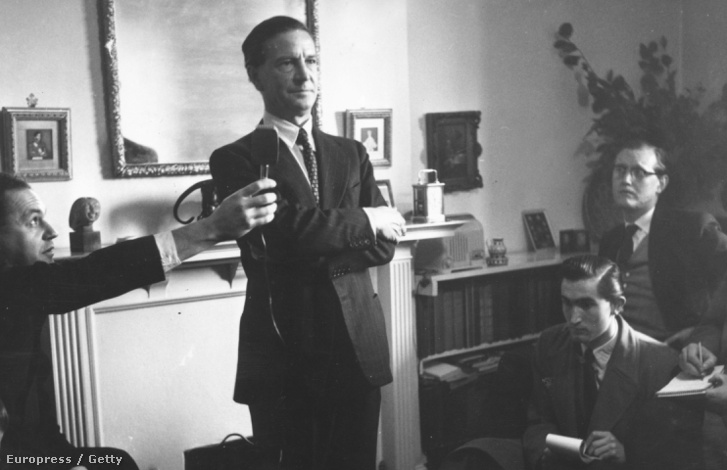
Philby same year appeared again in Budapest, this time in the company of Tim Milne, who first hired King Street apartment and a car repair shop encamped, which was for the owner than George Szűts Szeged. Philby and Milne very well felt in the capital: fried meat ate, swam the Danube, which have been removed and used at the time, watched the Blue Angels (was Marlene Dietrich’s first major success in 1930, the German sound film made Heinrich Mann’s novel, first pool by way of ), they walked along the Margaret Island and Milne’s memoir, according to Philby never once gave signs of increasing political beliefs. Szegedi Szűts not name popped up ever again; if there was a secret painter mid-thirties established in England in 1959 when the death took to the grave with him. Philby’s commitment towards the working class and communism found it a few years later confirmed in Vienna, where two Hungarian also participated actively in the consciousness of Philby spy and of becoming.”
Which is very interesting and suggests the possibility that to an unknown extent, Philby was involved with a Hungarian painter who knew the Russian spy and was possibly a contact in his activities. This was not just any painter but an artist who has been compared with Paul Nash, was an excellent woodcut printer and also a talented writer, István Szegedi Szüts. He was born in Budapest and lived for a large portion of his life in the small south Cornwall fishing village of Mullion. István Szegedi Szüts was a member of an Olympic fencing team in 1912 and a brave officer fighting the Russians in the Carpathians during the First World War. It was at this time that he was ordered to shoot any straggelers among his own men to prevent a more horrid death from persuing wolves. His fascinating prints recording his experiences in the K and K forces can be seen at http://www.bhandl.co.uk/articles/2013/03/19/viewer.aspx.


Images from the First World War may be seen at Barnes, Hampton and Littlewood where they say:”Szuts first visited England in 1929 and held a solo exhibition at the Gieves Gallery, London in the same year. In 1936 he moved to Cornwall with his partner Gwynedd Jones-Parry, whom he married in 1937. The couple lived at Caunce Head near Mullin on The Lizard and remained there for the rest of their lives. Szuts exhibited with The Newlyn Society of Artists and The Penwith Society of Arts.” The link is at http://www.bhandl.co.uk/articles/2013/03/19/viewer.aspx

A teacher and educational philosopher he was also a friend of a friend of the composers Béla Bartók, Zoltán Kodály and György Ránki.

The paintings of Jewish refugees from Odessa and Bialystock by Maurycy Minkowski around 1910 are haunting, heartbreaking and evocative. Yet both in their colourful lyricism and moving composition they are a reminder that the refugee crisis is by no means a new phenomena; they are also pointers to some sort of categorical imperative that it requires urgent action still today. These are art works which demand that the fight for peaceful refuge and against racism is taken seriously now and once again.
Translating from the IWO in Buenos Aires, where it states:-


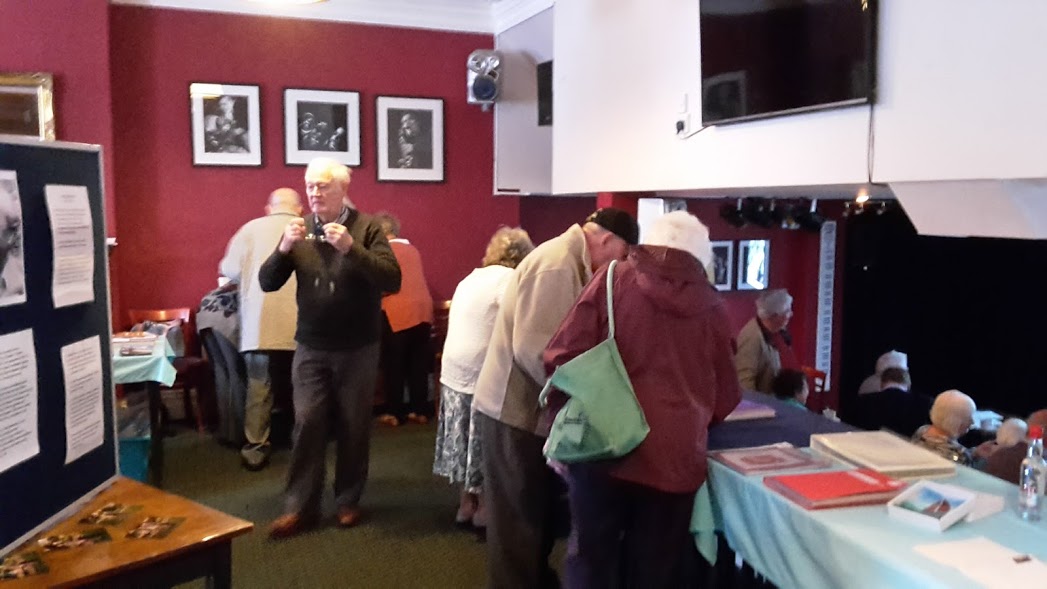
The town is at last fairly free of tourists and today the St Ives Archive Centre-situated presently in Carbis Bay- is presenting an exhibition of St Ives in the 1970s. Actually the photographic display ( of Sam Bennets) goes back a good deal earlier to Doble’s Wall, sailing ships and coaches (which used to be called charabancs)jammed together in narrow streets. The awkward relation between traffic and pedestrians being one constant through the years. The Archive Centre next year is concentrating on the Torrey Canyon and the promenade Fire,{http://www.stivesarchive.co.uk/}
.

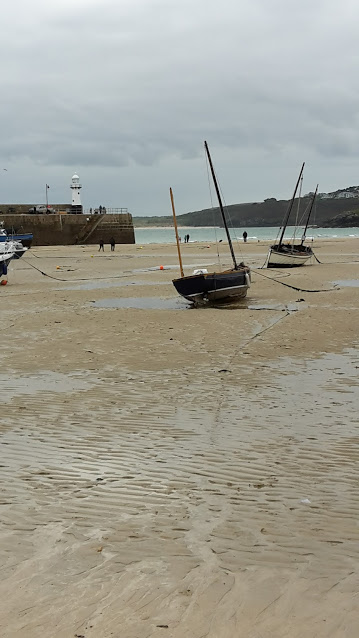
The promenade is still warm enough to eat outside so that Kaffekultur survives despite the horrors of Brexit with a great view of Jumbos and other older craft inside the harbour. Polish, German and other newspapers are available from the tiny newsagents opposite the lodge. The atmosphere is more relaxed and it is much easier to move around the town without the impediment of advertising boards and hawkers. The only guy playing a guitar in Fore Street providing a suitably melancholy, but not too plangent melody.
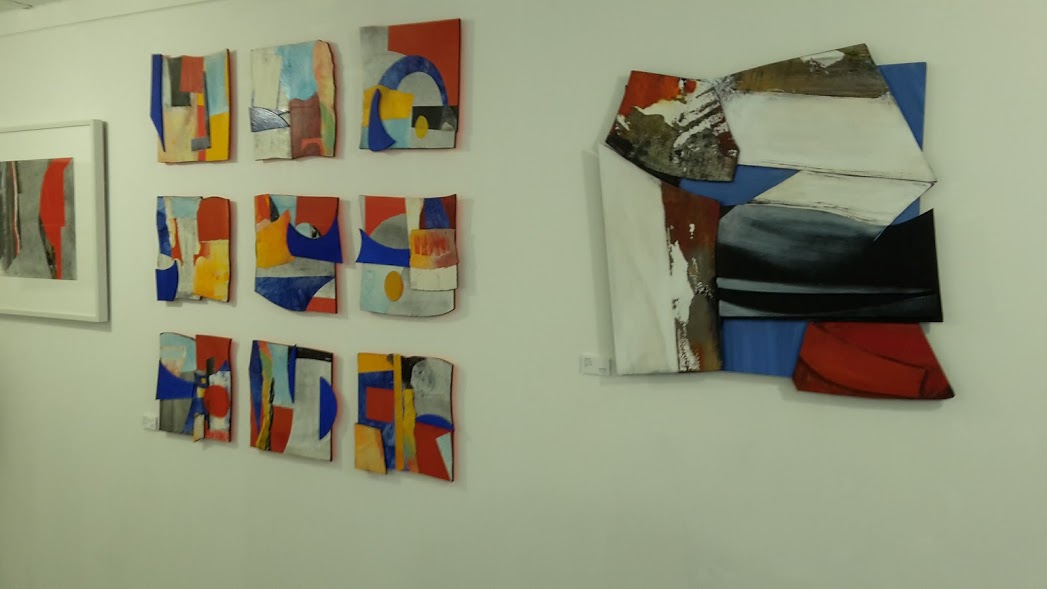
In the Penwith Gallery( http://www.penwithgallery.com/current-exhibition/) the Autumn Exhibition looks more colourful than ever and the sculpture and the ceramics are eye-catching too. This gallery deserves to be better known. In addition there is a section which is entitled Resurgence by Sue Davis and Anthony Fagin which is both inspiring and vivid. The press release states,” The exhibition takes as its central theme the regenerative power of the environment to recover from global despoliation whether from natural processes or human overexploitation. However it also reminds us – although not in any figurative sense – that while we may inhabit a world of ineffable beauty and bounteous resources, there is nevertheless a tipping point beyond which global recovery from continuing abuse will be impossible. Notwithstanding the gravity of their message, the approach of both artists to their work is positive and life affirming” (http://www.anthonyfagin.co.uk/publications/PRESS_RELEASE_resurgence.pdf)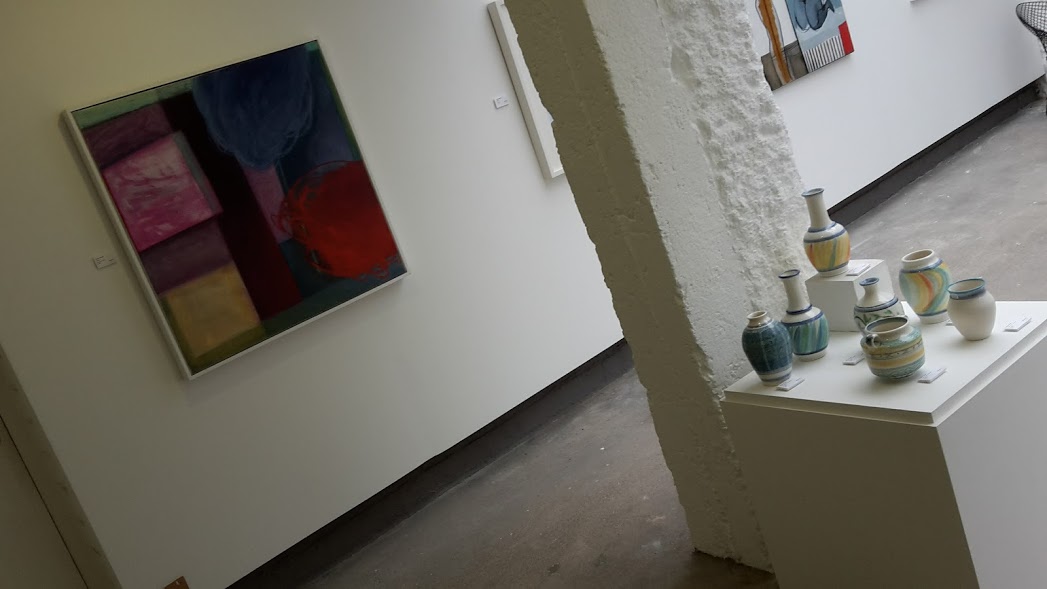


J’écoute en frémissant chaque bûche qui tombe
L’échafaud qu’on bâtit n’a pas d’écho plus sourd.
Mon esprit est pareil à la tour qui succombe
Sous les coups du bélier infatigable et lourd.
II me semble, bercé par ce choc monotone,
Qu’on cloue en grande hâte un cercueil quelque part.
Pour qui ? – C’était hier l’été ; voici l’automne !
Ce bruit mystérieux sonne comme un départ.
II
J’aime de vos longs yeux la lumière verdâtre,
Douce beauté, mais tout aujourd’hui m’est amer,
Et rien, ni votre amour, ni le boudoir, ni l’âtre,
Ne me vaut le soleil rayonnant sur la mer.
Et pourtant aimez-moi, tendre cœur ! soyez mère,
Même pour un ingrat, même pour un méchant ;
Amante ou sœur, soyez la douceur éphémère
D’un glorieux automne ou d’un soleil couchant.
Courte tâche ! La tombe attend – elle est avide !
Ah ! laissez-moi, mon front posé sur vos genoux,
Goûter, en regrettant l’été blanc et torride,
De l’arrière-saison le rayon jaune et doux !
An analysis of the poem is given in French at http://www.bacdefrancais.net/chant-d-automne-baudelaire.php

The current exhibition in the Penlee Museum in Penzance lasts until 19th November and is certainly worth seeing for many reasons: its variety of styles, the contrasts between her life in Scotland and St Ives, the photographs, her green transparent glaciers and the more abstract endeavours of her later years. There are paintings which are reminiscent of Christopher Wood, bright touches that are reminiscent of Cezanne and the harmonies of Paul Klee can be glimpsed in the waves and beach scenes. 
The view above was painted in 1940 http://www.barns-grahamtrust.org.uk/ -and features the Catholic Church on the left as well as the Church of St Ia almost in the middle. The buildings are vertically elongated which gives them an interesting attenuated quality, The grass of the Island and the roof tiles appear in orange against the predominate blue of the sea. The tide is half way in and the crane on the West Pier is just about visible.
Just a few years before, in early summer 1937, much the same scene was painted by Sir Stanley Spencer. It is interesting to compare the resulting works.
The foreground in Spencer’s painting show palm trees and in general the perspective is given a detailed treatment. There is a large boat alongside the pier. The West Pier is shown in full from this angle and the Island and Downalong shown in considerable detail. The tide level is just a little further inshore. The Mariner’s Church and slipway are both clearly delineated. Spencer became a member of the St Ives Society of Artists. He painted other pictures of the town including this atmospheric painting evidently from the promenade.
Here too is a painting showing the coluration of the rocks and fishing boats equipped with sails along with the coast beyond Hayle in the background. Perhaps painted from the rocks on the town side of Porthgwidden. The lighthouse at Godrevy as made famous by Virginia Woolf in 1927.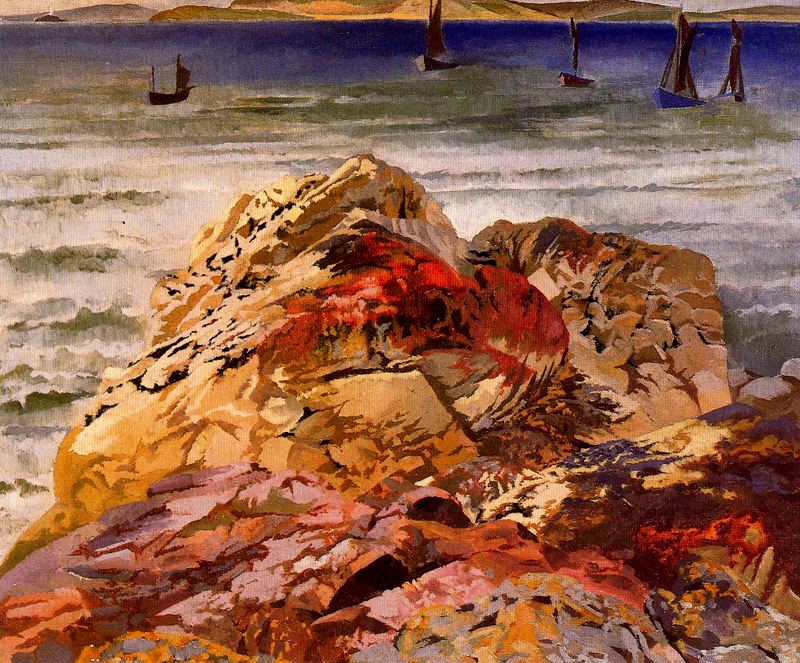
Barns- Graham excels in her sketches which are often interesting in their composition and dabs of spare but effective colour. The palette of yellow against grey below shows this in a view crested by The Island.

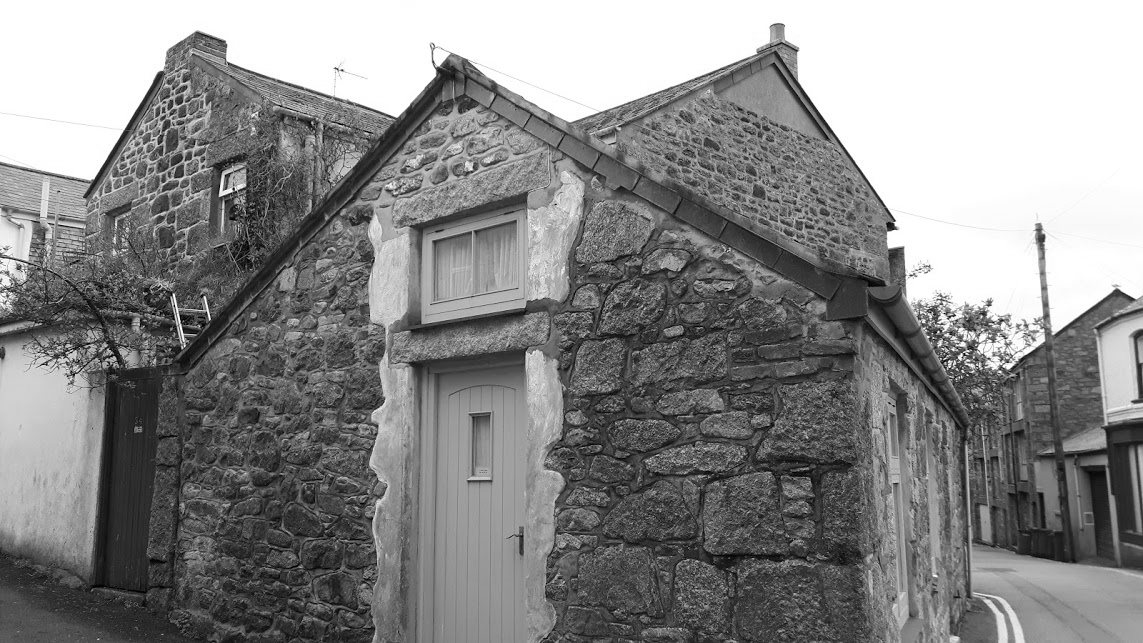
Inspired by this Youtube clip of Berlin taken in 2015 in black and white, I decided to take a look at some, mostly “street” photographs I have taken out and about in Penzance, Newlyn and St Ives this Summer.


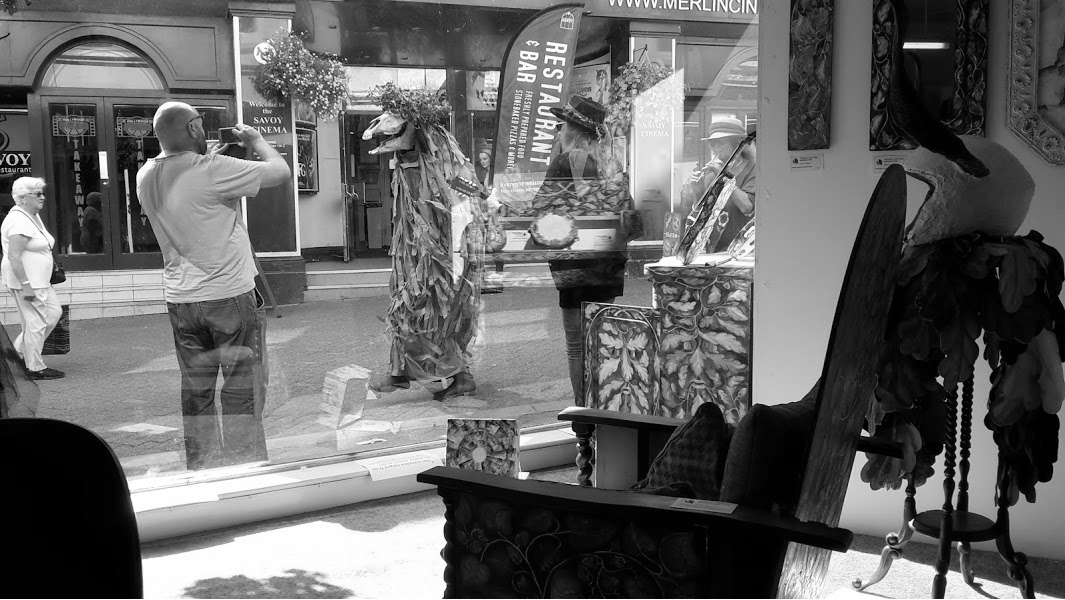
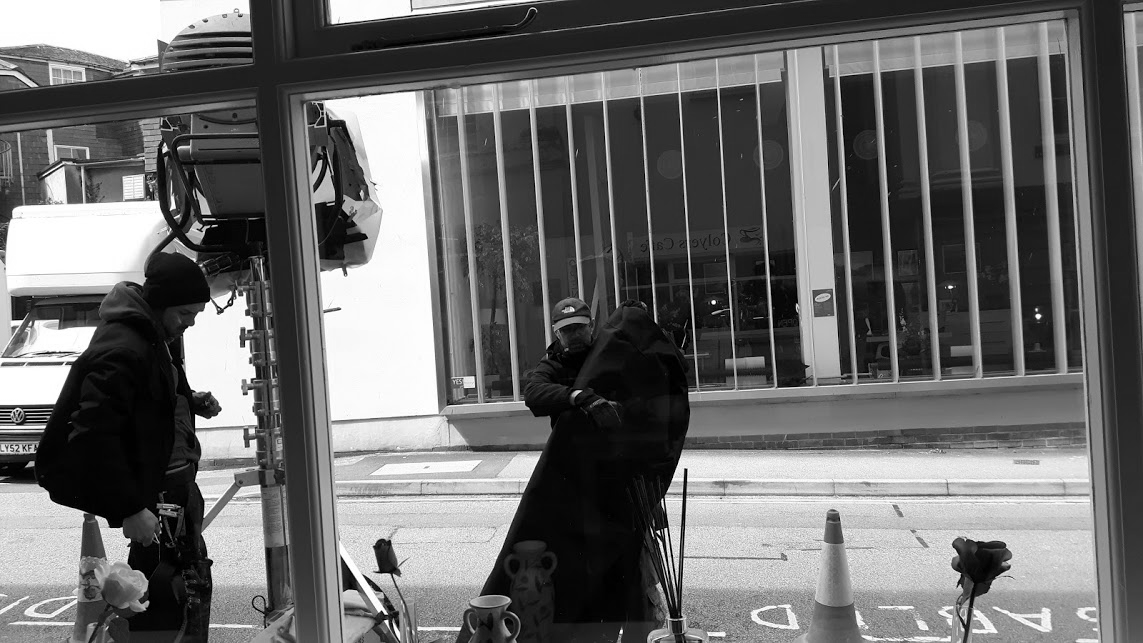


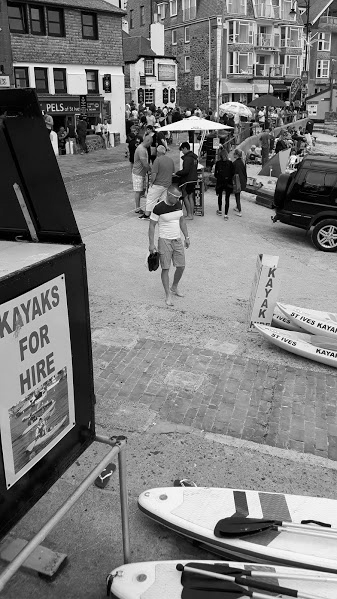

There are two analogue photography websites i would like to recommend:-
and for the forthcoming Newlyn Arts Festival
http://www.homemadeproject.net
the latter will be at the Newlyn Art Gallery
I have a neat little book called ~” Poems of Cornwall” withdrawn from the County Library Service. The preface is by W.Herbert Thomas and is dated, “Penzance July !892”. A couple of months before the last down train from Paddington on Brunel’s broad gauge had run. It is a collection of some 30 poets of whom photographs of 18 appear inside the front cover. There is a poem by Sir Humphry Davy beneath an engraving of his statue.
St Michael’s Mount
Majestic Michael rises – he whose brow
Is crown’d with castles; and whose rocky sides
Are clad with dusky ivy: he whose base,
Beat by the storm of ages, stands unmov’d
Amidst the wreck of things-the change of time.
That base, encircled by the azure waves,
Was once with verdure clad; the towering oaks
Here waved their branches green: the sacred oaks ,
Whose awful shades among the Druids stay’d
To cut the hallowed mistletoe, and hold
High converse with their gods.
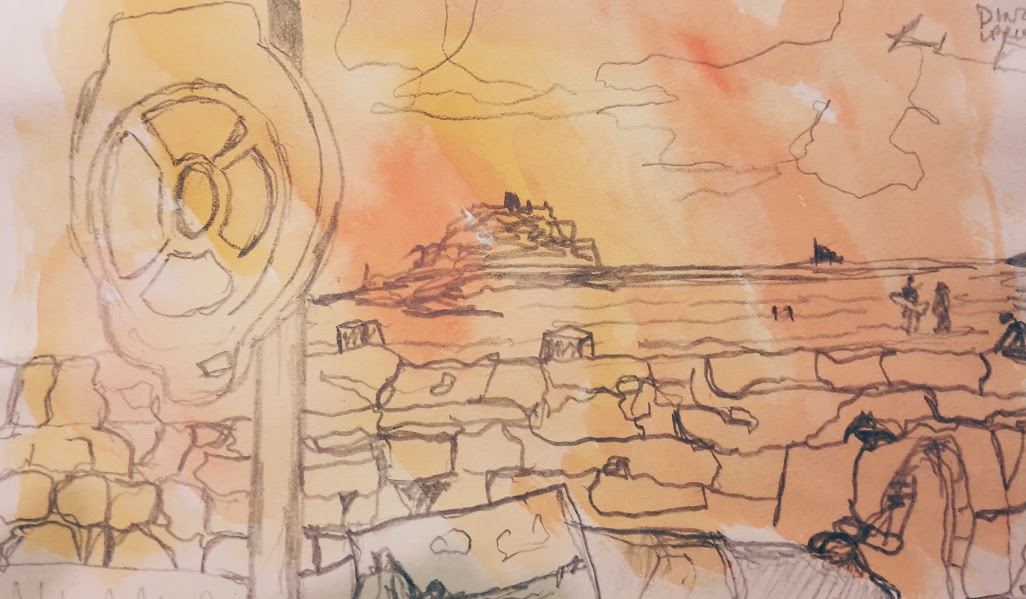

Interesting this connection that early scientists felt for poetry and nature. Most obviously found in Goethe perhaps. Davy enjoyed angling and travelled widely across Europe to fish, I believe on the Dalmatian coast-Shakespeare’s Illyria from Twelfth Night. Which information I seem to recall from that fascinating book,”The Age of Wonder” by Richard Holmes. Count Orsino’s castle became the Mount in that great production of Twelfth Night by Trevor Nunn in 1996. Returning to Davy’s poem, I suppose some of the vocabulary now sounds antiquated, although the original “awful” sounds like that recent commonly used word,”awesome”. I rather like the line -“Amidst the wreck of things-the change of time.” which reminds me somehow of that biography of Malcom Muggeridge which he entitled “Chronicles of Wasted Time”. A title which comes from the lovely sonnet 106 of Shakespeare:-


 penwithlit