As the destruction and slaughter of the Paris Commune subsided in 1871, Henri Fantin-Latour (1836–1904) emerged from his father’s Paris apartment, where he had been hiding since the start of the Franco-Prussian War the previous summer. He then made a start on his next major group painting, which he completed the following year.
Henri Fantin-Latour (1836–1904), By the Table (1872), oil on canvas, 160 x 225 cm, Musée d’Orsay, Paris. Wikimedia Commons.
Another large canvas, By the Table was only just finished in time for the 1872 Salon because one of its figures refused to appear alongside those who he termed “pimps and thieves”. Although outside the Francophone world today you might wonder who these drably-dressed figures are, this was Fantin’s most famous painting, as it shows all the major avant-garde poets of the time.
We were sad to hear of the recent death of Franco Zeffirelli, one of the best known Italian directors and producers of film and opera of the 20th century. Hugely influential and iconic, he stood at the heart of Italian film for decades.
Born Gian Franco Corsi Zeffirelli, he was the illegitimate child of a fashion designer and Florentine wool and silk merchant. After the death of his mother when he was six, he was brought up by the English expatriate community in Florence, who took him under their wing – this part of his story was immortalised in his semi-autobiographical film Tea with Mussolini, set in the pre-war Florence of the “scorpioni” (the English community there, represented by the inspirational Maggie Smith, Judi Dench and Joan Plowright) and in the Tuscany of the war years as war took hold. He enrolled to study art at the University…
I love these lines from this Polish Nobel Prize-winning poet, Wislawa Symborska:-
“We stand in the meadow where it became flesh,
and the meadow is silent as a false witness.
Sunny. Green. Nearby, a forest
with wood for chewing and water under the bark-
every day a full ration of the view
until you go blind. Overhead, a bird-
the shadow of its life-giving wings
brushed their lips. Their jaws opened.
Teeth clacked against teeth.
At night, the sickle moon shone in the sky
and reaped wheat for their bread.
Hands came floating from blackened icons,
empty cups in their fingers.” They come from her poem “Some like poetry” which can be read at http://famouspoetsandpoems.com/poets/wislawa_szymborska/poems/11678
Her poems are also available in German from Suhrkamp
“Laszlo Nemes’ sumptuously photographed drama is set in 1913 in Budapest, where the existential anxieties of the Austro-Hungarian Empire are embodied in the slender form of Irisz Leiter (Juli Jakab), a young woman with a dark past.
She bears the name of the city’s most stylish hat store, Leiter’s: her parents died there in a fire when she was two, and Irisz was raised elsewhere but now returns, looking for work, and answers.
Instead she finds secrets, a wall of silence, and dark rumours about a murderous brother she never knew she had.
Full of dark portents of the continental carnage to come, Sunset is Kafkaesque, melodramatic, enthralling.”
This is not an easy film to understand and it certainly is not in the usual genre of an historical film. Much is about the contrast between the superficial elegance and the arduous and dangerous conflicts beneath this attractive outward view. However, it has to be said that I very much enjoyed the visual presentation of the surface; the milliner’s store with its stupendous colourful hats and the horse drawn carriages. History crept in when a news-vendor announces that the Austro-Hungarian empire is to launch another battleship- jogging the memory that this primarily land locked empire held a port at Trieste. As I have yet to visit Budapest, although I have visited both Vienna and Bratislava, this area intrigues me. This point in time too is the subject to much of the concerns of the novels of Joseph Roth and the magnificent films of that other brilliant Hungarian director, from a previous generation, stván Szabó. Also, for good measure, the Empress Sisi arrives from Vienna in a somewhat grumpy personification. https://en.wikipedia.org/wiki/Archduchess_Elisabeth_Marie_of_Austria
In thinking about this film, I remembered that the famous psychoanalyist, Melanie Klein was living in Budapest at this time. She received her psychoanalytic education with Sándor Ferenczi in Budapest during World War I. She specialized in his advice in child analysis and became one of the first in this field. I mention this because much of the film really deals with states of mind like confusion, exclusion and certain feminist attitudes. It is interesting to see what the film is saying about issues in the contemporary world and in its concentration upon one individual’s perceptions and their attempts to understand relationships with siblings, we seem to be in territory where Klein’s work is uniquely valuable. Here is her photograph wearing an elegant hat.
Watching this film, one is reminded that the film-maker has stated that he has been influenced by Stanley Kubrick and indeed some of the themes do seem rather similar to those Kubrick examines in “91/2 Weeks”. This latter film was an adaptation, of course, of Arthur Schnitzler’s “Traumnovelle” (Dream Story” but without the anti-anti-Semitic aspects of the earlier work which seems based upon Viennese secret societies. https://www.theguardian.com/books/2015/jun/24/alternative-ending-discovered-to-book-behind-eyes-wide-shut

 Henri Fantin-Latour (1836–1904), By the Table (1872), oil on canvas, 160 x 225 cm, Musée d’Orsay, Paris. Wikimedia Commons.
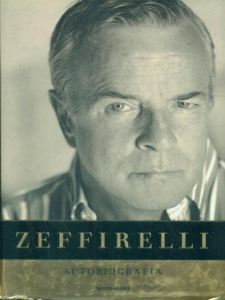

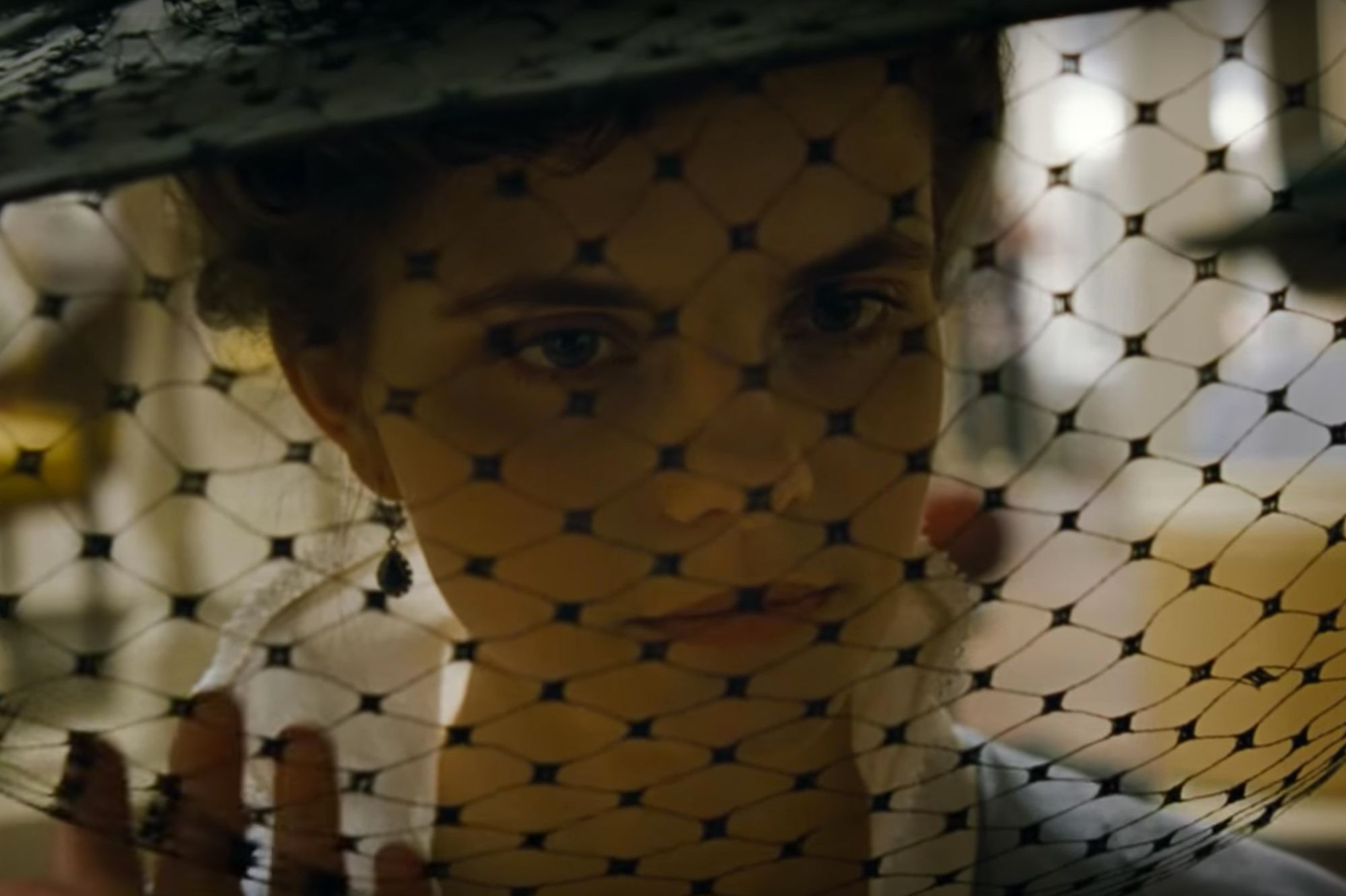


 Foto: ©Wolfregen
  penwithlit