Leaving the Vermeer and the Masters of Genre Painting exhibition at the National Galley of Ireland I spotted that there was an exhibition of works by Käthe Kollwitz in the Print Gallery.
Käthe Schmidt was born in Königsberg, 150 years ago on on 8th July 1867 in what was then in East Prussia (today Kaliningrad, Russia). However she lived most of her life in Berlin where she studied and later married Karl Kollwitz, a doctor living for the half century in Prenzlauer Berg, a working class suburb of North Berlin and one of the city’s poorest neighbourhoods. Her husband worked for a workers’ health insurance fund and often treated the working poor free of charge. Initially trained as a painter, Kollwitz began to focus on the graphic arts – drawing, etching, woodcuts – and sculpture. Influenced by the writings of Emile Zola, her subjects were ordinary people, the downtrodden and the…
Thomas Harding’s The House by the Lake is in some ways similar to Penelope Lively’s A House Unlocked which I read and reviewed back in 2009. Lively’s book tells the stories of objects in her family’s country house that her grandparents bought in 1923, and in doing so creates a social history of her time, covering the period of rapid change in the interwar years as well as WW2. However in one crucial respect, Harding’s memoir of his family’s house and its people is different: whereas the Lively house always stayed in family hands, for the house by the lake in Germany there were five changes of ownership during the tumultuous 20th century.
A hundred years after Otto von Wollank’s estate had run into economic trouble after the First World War; after the collapse of Imperial Germany, the Weimar Republic, the Third Reich, communism and reunification; after five families had fallen in love with the…
In the parched path
I have seen the good lizard
(one drop of crocodile)
meditating.
With his green frock-coat
of an abbot of the devil,
his correct bearing
and his stiff collar,
he has the sad air
of an old professor.
Those faded eyes
of a broken artist,
how they watch the afternoon
in dismay!

Is this, my friend,
your twilight constitutional?
Please use your cane,
you are very old, Mr. Lizard,
and the children of the village
may startle you.
What are you seeking in the path,
my near-sighted philosopher,
if the wavering phantasm
of the parched afternoon
has broken the horizon?

Are you seeking the blue alms
of the moribund heaven?
A penny of a star?
Or perhaps
you’ve been reading a volume
of Lamartine, and you relish
the plateresque trills
of the birds?

(You watch the setting sun,
and your eyes shine,
oh, dragon of the frogs,
with a human radiance.
Ideas, gondolas without oars,
cross the shadowy
waters of your
burnt-out eyes.)

Have you come looking
for that lovely lady lizard,
green as the wheatfields
of May,
as the long locks
of sleeping pools,
who scorned you, and then
left you in your field?
Oh, sweet idyll, broken
among the sweet sedges!
But, live! What the devil!
I like you.
The motto “I oppose
the serpent” triumphs
in that grand double chin
of a Christian archbishop.

Now the sun has dissolved
in the cup of the mountains,
and the flocks
cloud the roadway.
It is the hour to depart:
leave the dry path
and your meditations.
You will have time
to look at the stars
when the worms are eating you
at their leisure.


Go home to your house
by the village, of the crickets!
Good night, my friend
Mr. Lizard!

Now the field is empty,
the mountains dim,
the roadway deserted.
Only, now and again,
a cuckoo sings in the darkness
of the poplar trees.


From the website www.poets.org/poetsorg/poem/old-lizard
Die Blätter fallen, fallen wie von weit,
als welkten in den Himmeln ferne Gärten;
sie fallen mit verneinender Gebärde.
Und in den Nächten fällt die schwere Erde
aus allen Sternen in die Einsamkeit.
Wir alle fallen. Diese Hand da fällt.
Und sieh dir andre an: es ist in allen.
Und doch ist Einer, welcher dieses Fallen
unendlich sanft in seinen Händen hält.
There are several translations of this interesting poem which appear to be copyrighted. In particular mit verneinender Gebärde seems not easy to render into English. Something like with a gesture of decline doesn’t quite measure up. Anyway the poem seems to make a parallel between the seasonal fall and the religious sense of falling into the arms of divine Grace. It put me in mind of the lines from a familiar hymn:-
To all life thou givest — to both great and small;
In all life thou livest, the true life of all;
We blossom and flourish as leaves on the tree,
And wither and perish—but nought changeth thee.
This is from a famous hymn by Walter Chalmers Smith, “Immortal, Invisible, God only Wise”.
Immortal, invisible, God only wise,
In light inaccessible hid from our eyes,
Most blessèd, most glorious, the Ancient of Days,
Almighty, victorious, thy great Name we praise.
Unresting, unhasting, and silent as light,
Nor wanting, nor wasting, thou rulest in might;
Thy justice like mountains high soaring above
Thy clouds which are fountains of goodness and love.
To all life thou givest — to both great and small;
In all life thou livest, the true life of all;
We blossom and flourish as leaves on the tree,
And wither and perish—but nought changeth thee.
Great Father of glory, pure Father of light,
Thine angels adore thee, all veiling their sight;
All laud we would render: O help us to see
’Tis only the splendour of light hideth thee.
or
Und doch ist Einer, welcher dieses Fallen
unendlich sanft in seinen Händen hält.
Albin Egger-Lienz was born in the village of Stribach near Dölsach in the Tyrol. He received his first training from his father, painter and photographer Georg Egger. He then moved to the Munich Academy to continue his training, where he met Franz von Defregger, who strongly influenced his art. Ferdinand Hodler and Jean-François Millet were important models for him to follow. Even as a child, Egger-Lienz was receptive to religious sentiments; The peasant world, with its hard daily life and structured by Catholicism, became a basic theme of his artistic creation. In 1899, Egger-Lienz moved with his wife to Vienna, where he remained up to 1911. In 1911 he received lectures at the Saxon High School of Fine Arts in Weimar. He left the Vienna Academy in 1918. It was also in Vienna that Egger-Lienz had conflicting experiences as an artist. His important work “Totentanz”, which was exhibited in the Künstlerhaus of Vienna, received contradictory reactions, and Egger-Lienz was not given any public contracts. During the First World War he became a painter of the conflict. The four years of war proved to be a defining feature of his future life. In 1918, Egger-Lienz moved his permanent residence to the Tirol. Later work of Egger-Lienz comprised many religious motifs, peasant scenes, stories of the fight of the freedom and the horrors of the war itself. Under the influence of Hodler, Egger-Lienz managed to simplify his imagery with a monumental expressiveness.
Later this month, we will be remembering the life and work of Hilaire Germain Edgar Degas, who died a century ago. Degas is not my favourite artist of the group known as the French Impressionists, but is one of the most fascinating painters, draughtsmen, and print-makers of the nineteenth century.
Over the next three weeks or so, I will look at different areas of and themes in his art; rather than attempt a full biography and chronological account of his paintings, this article gives a concise summary, written around twelve of his key works, as an introduction to more detailed articles later.
Edgar Degas was born in Paris on 19 July 1834, into an affluent family. His father was a banker from Naples, Italy, and his mother’s family were merchants in New Orleans. In the summers of his childhood, the family visited Saint-Valery-sur-Somme, on the northern coast of France. His…
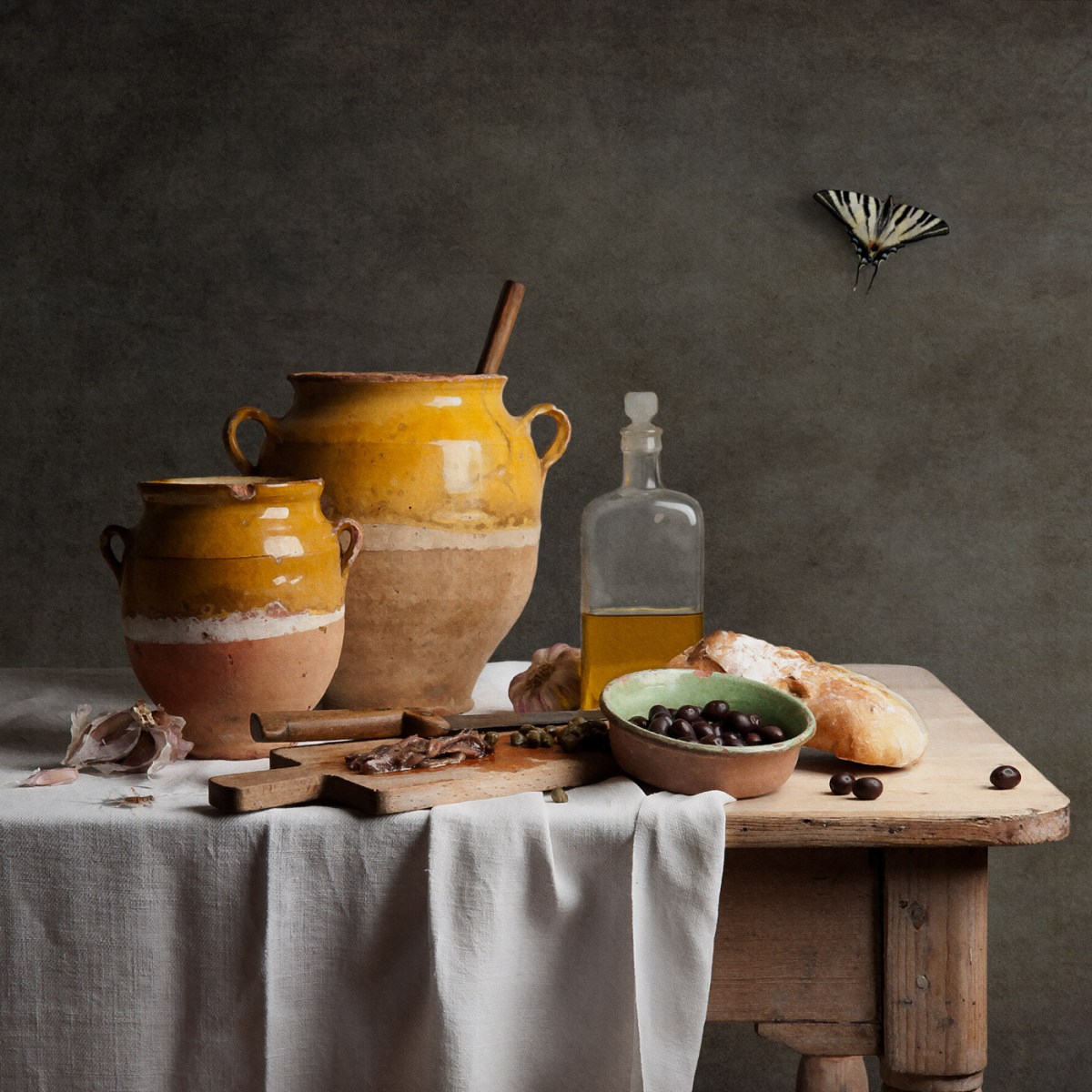
Seeds, petals, loafs of bread, egg shells, orange peels, pots of honey, jars of oil arranged and exhibited carefully in indoor spaces – photographer Tineke Stoffels (born 1957, Den Helder, the Netherlands) captures the beauty of everyday objects in a style that resembles the still life paintings of the Dutch Golden Age. “One often wonders upon seeing my work,” writes the artist, “whether it’s a photograph or a painting. For me it’s both.”
Tineke’s stunning portfolio is divided into series: “Uyt Eenen Tijt”, “Momento Mori”, “Terroir”, “Recettes Provençales”, et cetera. Each project looks at specific themes, which may be a celebration of local cuisine, a reminder of the transience of life, the splendour of imperfection or the importance of temperance.
“Photography for me as a means of expression is the ideal combination of technology and design,” writes Tineke. “Because I think mainly in pictures, the camera helps me…
Louis MacNeice was in London during the Blitz and this poem captures the spirit of that time in masterly fashion as it shifts between the real and the semi-mythic, the defiant and the despairing, its cast of characters moving to the ballad tune in a brilliantly choreographed danse macabre.
Agag was a bibilical king referred in the book of Samuel as coming ‘delicately’ to his execution.
The Streets of Laredo
O early one morning I walked out like Agag,
Early one morning to walk through the fire
Dodging the pythons that leaked on the pavements
With tinkle of glasses and tangle of wire;
When grimed to the eyebrows I met an old fireman
Who looked at me wryly and thus did he say:
‘The streets of Laredo are closed to all traffic,
We won’t never master this joker to-day.
‘O hold the branch tightly and wield the axe brightly, The…


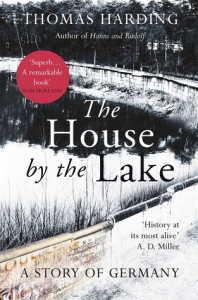 Thomas Harding’s The House by the Lake is in some ways similar to Penelope Lively’s A House Unlocked which I
 From the website www.poets.org/poetsorg/poem/old-lizard



 Tineke Stoffels
 penwithlit