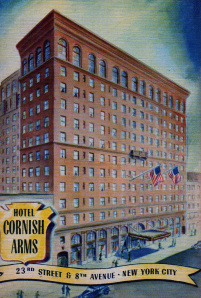
A postcard of The Cornish Arms Hotel in New York-frequently advertised in The Cornishman
Up until August 1914, The Cornishman and the St Ives Weekly Report contain many detailed reports from abroad. These include the Cornish in America, Canada, South Africa. Many Cornish people travelling to the States will have responded to the large adverts in the Cornishman for the famous hotel in New York https://ephemeralnewyork.wordpress.com/tag/hotel-cornish-arms/
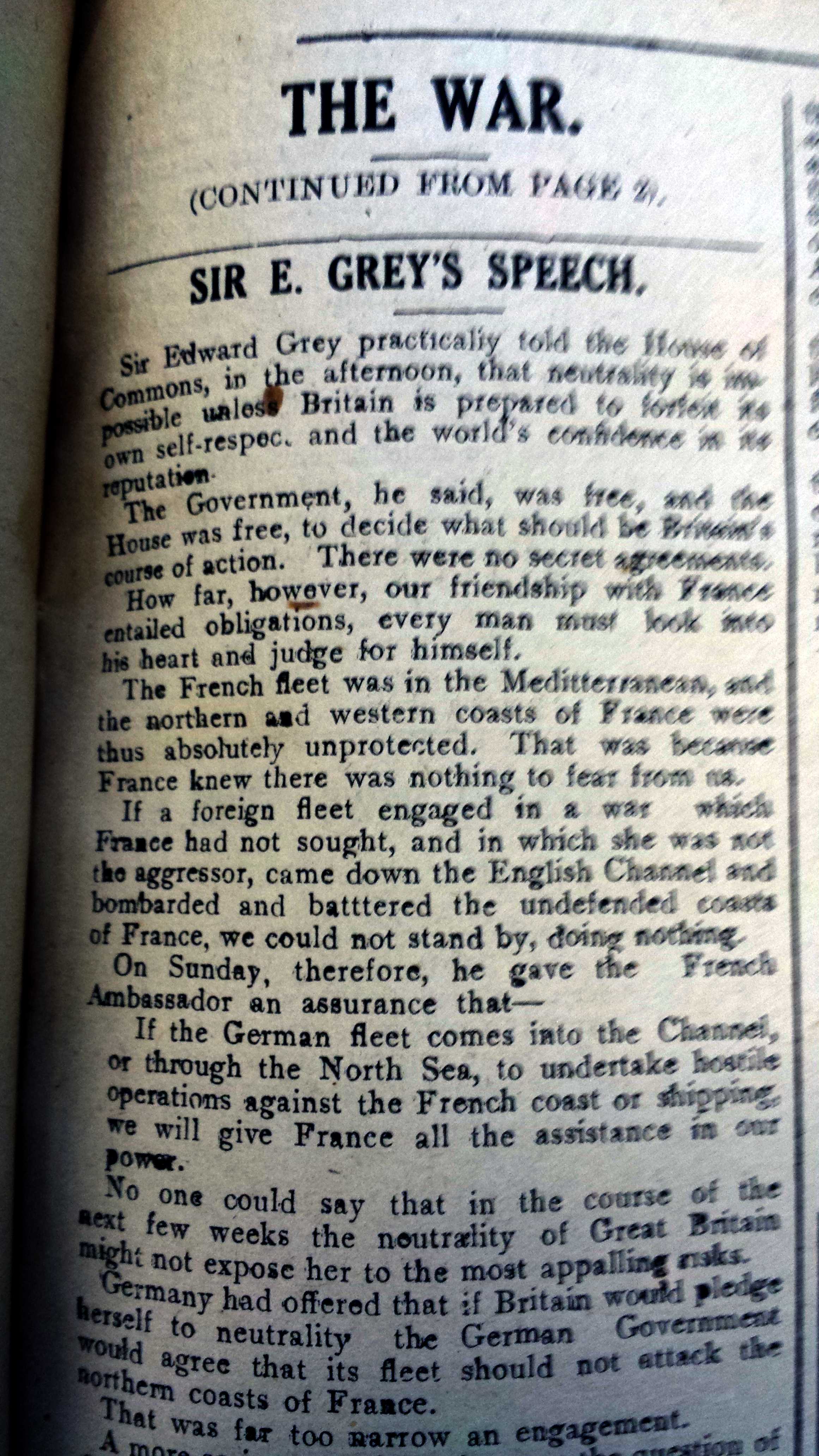
Without doubt, however, the greatest concern appears to be about Nationalist Rebellions in Ireland.http://www.bbc.co.uk/history/british/britain_wwone/ireland_wwone_01.shtml The only reference to the possibility of an outbreak of war- reading between the lines- concerns the speeches in support of building more dreadnoughts. Money appeared to be of no real concern to the advocates of building more battleships.
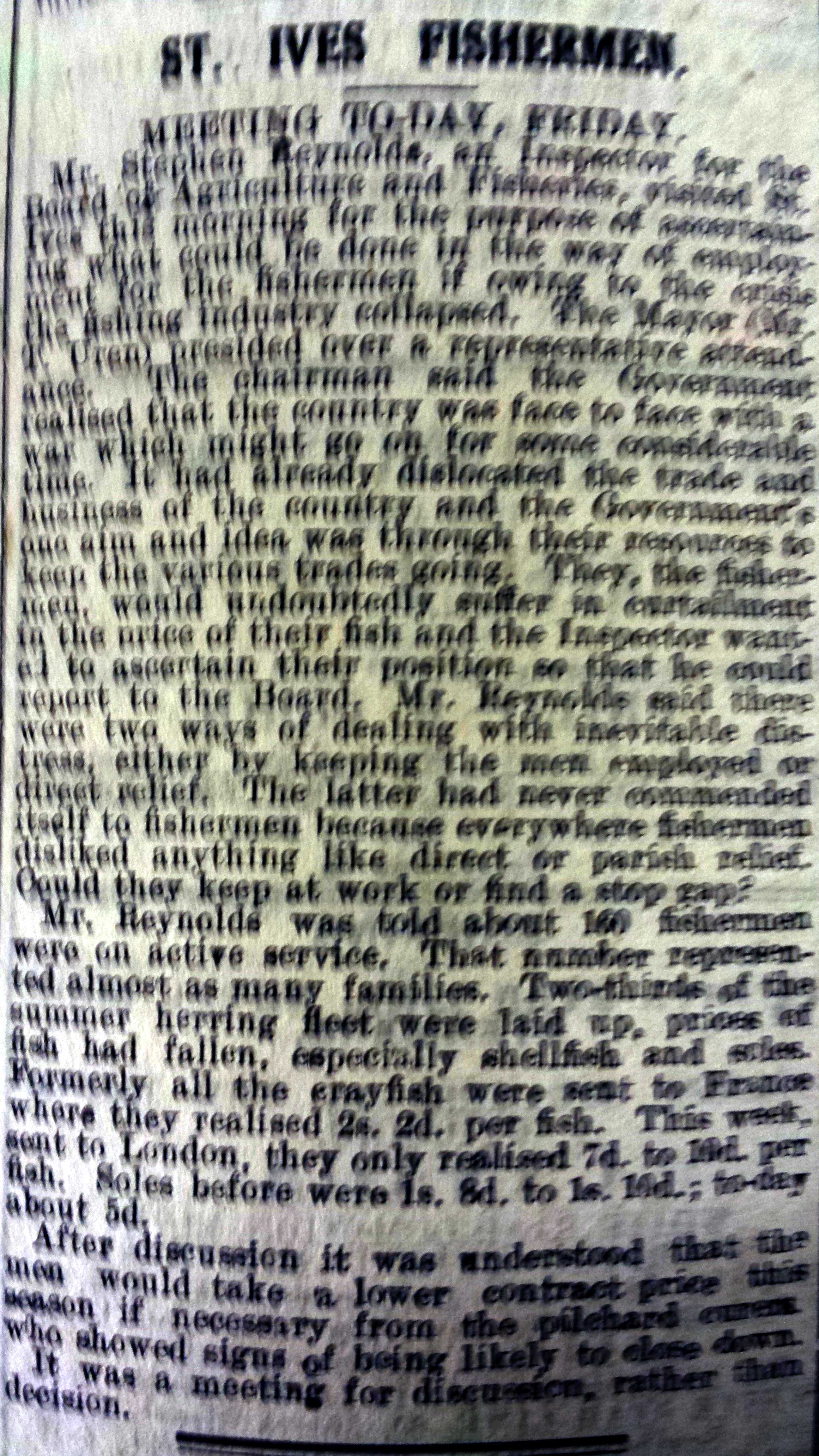
The effect on the Fishermen and Families
When war broke out many fishermen in St Ives were immediately affected and the effect on many of them, their families and the price of fish was very soon to follow. Many were called up within hours and summoned as members of the Royal Naval Reserve to Davenport and had to leave by train for that destination. A newspaper report states that when addressed by Mr Stephen Reynolds, Inspector for the Board of Agriculture and Fisheries, he was told that some 160 fisherman were on active service with about the same numbers of families affected. Two-thirds of the summer Herring Fleet were laid up and the price of fish and particularly Crayfish that would otherwise have fetched a fine price in Paris were catastrophically affected.
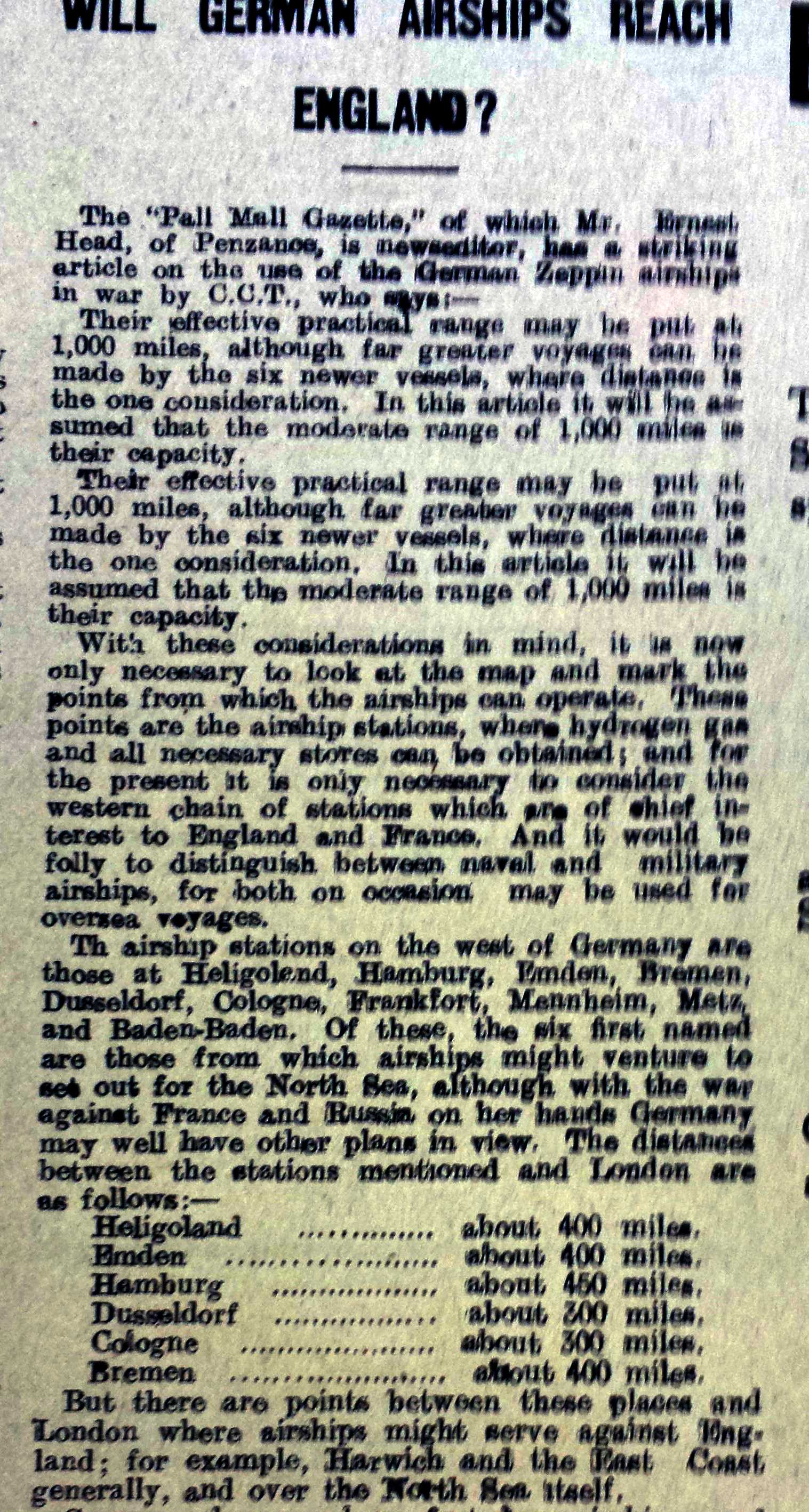
The details of this call=up are very moving since we only have to turn to the next couple of weeks to learn how many will have been aboard ships which sank or been caught in the first defeat later at Mons. The accounts of farewells said above the peaceful beaches and the brass bands playing can still be imagined by anyone walking out of the town. There is a strange mixture of fear and jingoism apparent in the newspapers. There were worries about the supply of wheat which caused fears about starvation; there were food riots in Camborne. Other articles show a concern about possibilities of aerial attack from Zeppelins and tables showing their limited range were the subject of articles in the press.
At the opening of the exhibition Hats: An Anthology by Stephen Jones at the Victoria and Albert Museum, he is said to have commented;”Hats are a great antidote to what’s going on. It’s really their purpose to put a happy face on a sad world.”
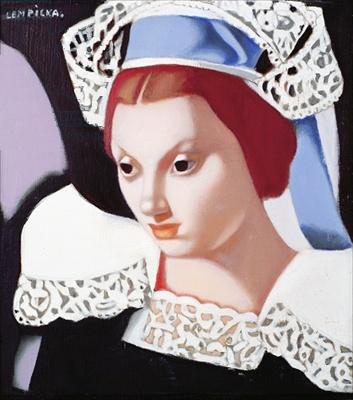
Portrait of a Peasant with a Headdress
The image or drawing which is shown below has some of the intensity of a realist drawing by, say Kathe Kollwitz. Her naturalism shares the integrity which we associate with Van Gogh. Indeed her second cycle of works concerned the German Peasant War which began in 1525. However, this is not by Kollwtz, who seems to have rarely depicted persons with headdress, but by Tamara de Lempicka.
The pellucid definition and monumental stocky quality might also have suggested this in her sketch of a Russian peasant. Headgear was a recurring interest for Lempicka.
La Mexicane by Tamara De Lempicka
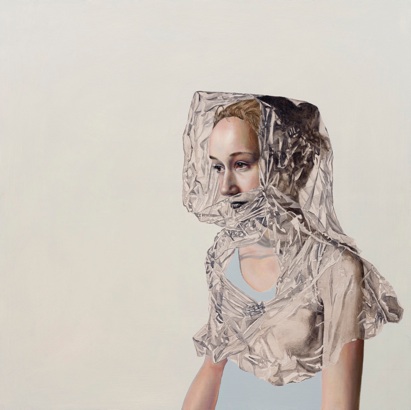
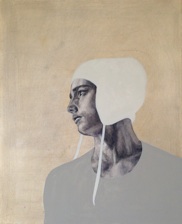
In Pippa Young’s paintings, http://www.pippayoung.co.uk/Art/Welcome.html which she specifically states are not to be considered as portraits, the headwear seems to confer meaning. It renders significance and gives import. Blank spaces and highly modelled backgrounds add to this general effect. She states, “Often the figures are posed to echo art-historical characters: Mantegna’s Saint Sebastian, or one of Vermeer’s subjects. When context is removed the figures become something else, oddly familiar; occupying an empty pictorial space, free from imposed narrative; timeless and unadorned.”
However, many of the male figures appear with antlers or horns and give the impression of dreams and mythology. There is a wide variety of different meanings which can be attached to such headdress or headgear. They may be symbols of earthy virility or alternatively give a suggestion of darker activities. These matters are discussed at http://spellsandmagic.com/Horns.html and further unusual images of horned masks are at http://www.pinterest.com/susantooker/antler-crowns-and-headdresses/ In some of Pippa Young’s paintings the texture of the headwear or clothing looks rather like thin polythene sheeting and seem, possibly, to suggest environmental concerns.
ghost of a departed Pippa YoungSelf Absorbed Pippa Young
Returning to thoughts about horns must remind some of Falstaff in Act 5 of The Merry Wives of Windsor where he is dressed as Herne the Hunter and taunted and humiliated for his bad behaviour. As Shakespeare makes him say earlier in the play,” The Windsor Bell has struck twelve; the minute draws on. Now the hot-blooded gods assist me! Remember, Jove, thou wast a bull for thy Europa, Love set on thy horns- O powerful love that in some respects makes a beast a man, in some others a man a beast!
Pippa Young’s figurative work is finely drawn and the palette which she uses adds to the mysterious and evocative quality in her work. Her present collection can be viewed at the Cornwall Contemporary Gallery at http://cornwallcontemporary.com/HumanNature.html
Her work is in some respects interesting to contrast with that of Cristina Iotti whose work can be seen at http://www.cristinaiotti.it/2013-2012/
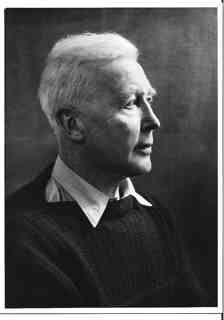
Frank Ernest Halliday was a very enthusiastic walker. Tall with a mane of beautiful white hair and reserved, his elegant stride cut a figure, like a distinguished prophet or poet. He was when, first I became aware of his reputation as a historian and a Shakespearian scholar, hurrying down Back Road West in the general direction of Clodgy where he frequently seemed inclined to walk, frequently at this formidable pace. At about this time, he had already retired from school mastering at Cheltenham College where he had become a friend of Cecil Day-Lewis years before. That was in the early Thirties and the time to which I am referring was somewhere around 1960.
F.E.Halliday
In 1953, Halliday wrote in History Today of the famous Cornish Historian, Richard Carew, a Member of Parliament and a friend of Philip Sydney,” The importance of Richard Carew has never been appreciated. Few, indeed, are even aware of the writer who, while Shakespeare was writing for the London stage, was quietly at work in his Cornish country house. This neglect is the result of his own modesty, the remoteness of his dwelling, and the multitude of his great contemporaries in and about the capital, and not of any lack of merit…..” Much of what Halliday wrote here about Carew is now equally true about himself and the extensive range of his own work. It is time to remember Halliday’s work, much of it written in his house next to the sea, downalong in St Ives. (Those interested in Carew will find a brief entry at http://en.wikipedia.org/wiki/Richard_Carew_(antiquary))
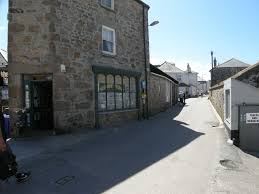
Back Road West, St Ives
When Halliday’s Shakespeare appeared in an American edition in 1961, it was reviewed in the Renaissance News a little later;-
“Mr F.E.Halliday’s life of Shakespeare is the product of a widely read, fully informed, and prolific mind. After twenty years as head of the English Department at Cheltenham College he retired in 1948 to devote himself solely to writing. He is one of the few scholars today who have taken all Shakespearean knowledge as their province. For a period of over fifteen years he has been turning out studies which give an ever broadening view of the great dramatist. In 1946 he published Shakespeare in his Age. Then came Shakespeare and his Critics which although completed in 1947, first appeared in 1949.”
Halliday was educated in North Yorkshire at Giggleswick School where he learnt to cherish Latin poetry, including Horace and his reflections on the seasons, mutability and loss grew up in its unique atmosphere. He was growing up in the dark and difficult days of World War 1 which deeply affected both staff and boys. There is a useful short biography of him included in Cornwall’s People – A Biographical Dictionary by Carolyn Martinand Paul White (Tamar Books). He then went on to King’s College, Cambridge and later entered teaching himself. It was at Cheltenham College that he met and became a supportive friend to Cecil Day-Lewis, the famous thirties poet. Indeed, Halliday, who was an English master and became Head of Department, painted Day-Lewis’s portrait which is in the National Portrait Gallery and may be seen at http://www.npg.org.uk/collections/search/portraitLarge/mw07276/Cecil-Day-Lewis?LinkID=mp01220&search=sas&sText=Day-Lewis&role=sit&rNo=0
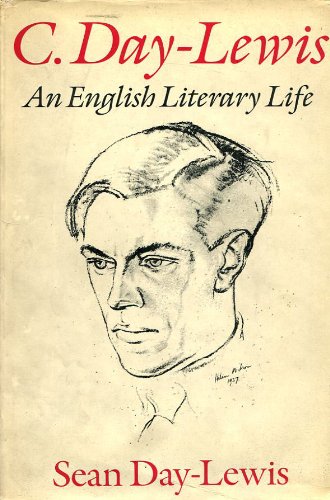
This portrait captures the refined appearance of the poet in a contemplative mood in profile but whether marking an essay or composing a splendid poem is not clear. Day-Lewis’s meeting and friendship in 1931 with Frank Halliday is recorded in some detail in Sean Day-Lewis’s biography of his father C. Day-Lewis, An English Literary Life. It appears that the dress code at Cheltenham was somewhat severe. Also Day-Lewis’s poetry was considered risqué when discovered by the self-appointed proctors of moral rectitude among the other masters. He was accused in a letter from the Headmaster of Bohemian tendencies!
“An Assistant Master at the school had seen him wearing a green shirt, while whitewashing the
walls of his flat, and another observer had reported the poet attending a concert with a stock about his neck under his dinner jacket: this was intolerable conduct, the staff must be properly dressed at all times.
Before replying he took the advice of a college master who, unlike the colleagues who had reported all departures from convention, was a friend. Frank Halliday was a sensitive Yorkshireman who loved literature and eventually became a writer himself. His autobiography tells how he first heard of Cecil as ‘a young married man who liked Beethoven and César Frank’ and was ‘said to write poetry’. He met the newcomers during their second term and registered Mary ‘with ballet dancer’s hair and figure and a dairy maid’s complexion’ and Cecil ‘reserved and almost severe with the trace of an Irish brogue’. Halliday was also a shy man and his mask was an offhand manner, at first discouraging. The discouragement had been overcome and by this March, Cecil and Mary had become friends with Frank and his wife Nancie, and they spent a long time discussing the best response to the headmaster’s outburst.” (Sean Day-Lewis on his father- Halliday’s own biography is called Indifferent Honest, Duckworth 1960)
Halliday’s friendship with Day-Lewis was to last over forty years and much of it conducted by letters from St Ives where he seems to have lived first at Five Fields, Dynas Ia and later when they were completed in Barnaloft Flats, overlooking Porthmeor Beach. Day-Lewis was deeply interested in Marxism and wrote, somewhat ironically to Halliday about the class war and the colourful inhabitants of his local pub at Brinclose, near Axminster, of the News Chronicle, Liberalism and of course in 1938 of Chamberlin and the approach of the Second World War. Day-Lewis moved in an interesting circle of thirties poets and writers and it seems likely that Halliday too might have met such figures as Rex Warner and W.H.Auden. F.E.Halliday seems to have continued as an amateur artist and painted Brinclose in 1939. By 1942 Day-Lewis is working some sixty hours a week at the Ministry of Information and became a close associate of Charles Fenby, journalist and assistant editor of The Picture Post. Day-Lewis records an encounter at this time with another somewhat severe character, Arthur Koestler whom he mentions in his correspondence with Halliday. Day-Lewis’s letters have recently, in 2012, been donated to the Bodleian Library http://www.theguardian.com/books/2012/oct/30/cecil-day-lewis-letters-oxford.
The Wreck of The Firebrand
By the 1960s after the suppression of the Hungarian uprising, which had incidentally also prompted Halliday to sign a letter to the Times, Day-Lewis vigorously renounced his earlier communist views. By 1968, Day-Lewis, who also wrote detective novels as Nicholas Blake, became Poet Laureate. However, in 1971 Day-Lewis mentions to Halliday, a searing review he received from another Cornish poet in the TLS. He correctly identifies the critic as Geoffrey Grigson who having been born in Pelynt was a Cornishman, and held somewhat negative views on Cecil Day-Lewis’s poetry although unlike his earlier Headmaster, regarded him on the single occasion they met at the BBC, as elegantly dressed!
In addition to his Shakespearian Studies, Halliday was active with regard to social and political concerns. In 1963, he signs a letter to the Times along with John Betjeman, A.L.Rowse, Brian Wynter and more than thirty other prominent citizens against the Admiralty’s proposal to take some 355 acres for troop and helicopter training on the lovely Zennor moors. This was a major concern in Penwith at the time. This upset many local people and not least as the land had been placed under a special covenant by the National Trust. In 1975, just over 67% of voters supported the Labour government’s campaign to stay in the EEC, or Common Market and Halliday was writing to the Times again to advocate full political union; not just an economic agreement. Halliday was advocating a Yes vote because he strongly believed in the idealism needed to bring about an effective World government.
There was also a wryly amusing letter written at the end of December 1964(Shakespeare’s quatercentenary) with regard to a production by Lindsey Anderson of Julius Caesar. Anderson was a pupil of Halliday at Cheltenham, where the former also met the future novelist, Gavin Lambert. Halliday gently chides his former pupil for trying to ‘improve Shakespeare’, essentially by excising nine revealing lines of a speech by Brutus. These lines reveal much about the republican’s character. He compares this with how in the Restoration, much was made of Caesar’s ghost who was made to appear at Phillipi. Halliday proceeds to regret the trend towards displaying gratuitous violence in the History plays, whilst making it clear that he is not referring thus to Anderson and expressing his sorrow that Falstaff is being reduced to a sinister figure. He remarks that although he had tickets at Stratford for seven plays he could actually only stomach attending five and a half! The previous year, in another letter to the Times he had taken on the subject of the identity of W.H. of the Dark Lady Sonnets, an unknown William, he surmises, and disagrees somewhat daringly with the inimitable A.L.Rowse.
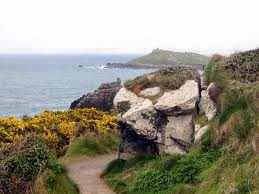
The walk past Man’Head to Clodgy, St Ives
Recently, while reading my own copy of A History of Cornwall, published by Gerald Duckworth in 1959, I became intrigued by a fine chapter on the Eighteenth Century; a generally neglected period but here there was a rich variety of detail. I was particularly interested in the earlier part of the Century, essentially before the mineral wealth of the Duchy had been much exploited. This was an unsettled period of rebellions and Halliday points out, “ Impoverished by the Civil War, the Cornish people took little interest in the events that followed the death of Charles II- the Monmouth Rebellion, the Revolution of 1688, the Jacobite Rebellion of 1715-…” In St Ives, which had had a Parliamentary army garrisoned there, the inhabitants might keenly have felt ravages of occupation. There are also records showing that Monmouth was blown off course there on his way to Weymouth and his future defeat at the Battle of Sedgemoor. The Treaty of Utrecht which interestingly, has recently escaped much notice upon its 300th Anniversary provided a temporary peace to the Wars of the Spanish Succession and its signature was celebrated in St Ives at the time. Travel then was most easily carried out by sea although as the experience of Sir Cloudesley Shovell wrecked on the Scillies suggests, navigation was a hazardous affair particularly in determining longitude. http://en.wikipedia.org/wiki/Scilly_naval_disaster_of_1707
Halliday remarks that this period around 1700 was characterized by a change in land ownership. Lawyers, merchants and businessmen started to invest in land that might be valuable more for the materials beneath the surface than as a source of food that gave it value to the gentry. This is a period where speculation starts to become important and clashes between the older aristocracy and the emerging entrepreneurs. This was particularly true in the western part of the Duchy where the known lodes existed. Halliday points to Celia Fiennes travel diary. He quotes her references to the shortage of timber for mine construction and the shortage of fuel. She writes, “They burn mostly turffs, which is an unpleasant smell; it makes one smell as if smoaked by bacon.” Fiennes, as Halliday points out, had to travel by horse because the roads were in such a poor condition. Copper was mined alongside tin but because of the shortage of fuel it was shipped to Bristol and South Wales for smelting. Little Cornish horses, she tells us were used to carry fish and the corn which was being cut.
The early C18, which Halliday covers in about thirty pages, sees the introduction of the first steam engine in about 1710. It was the very inefficient Newcomen engine, although state of the art at the time, and was used at the Godolphin mine at Wheal Vor. It used vast quantities of fuel. Even by 1740 there were just three steam pumps at work. It was not until the early Nineteenth Century that Cornish engineers greatly improved the efficiency of those engines that had be designed by Watt, Trevithick and others http://en.wikipedia.org/wiki/Cornish_engine. Thus in effect this would henceforth reduce the cost of coal which had to be imported from South Wales, a trade in the hands of merchants and businessmen. Incidentally, it was a German Chemist, a proponent of the celebrated but misguided Phlogiston theory, Johann Joachim Becker (1635-1682) from Speyer near Heidelburg, who visiting Cornwall in the 1680s made an important discovery. At Treloweth, St.Erth, that Becher was said to have built a furnace for the smelting of tin using pit coal as opposed to charcoal. http://de.wikipedia.org/wiki/Johann_Joachim_Becher
The celebrated Tory politician who rose to become Marlborough’s confrere and the First Lord of the Treasury, Sidney Godolphin, 1st Earl of Godolphin, KG, PC (15 June 1645 – 15 September 1712) might well be remembered for the work he did in passing the Act of Union with Scotland which created the united kingdom of Great Britain. He also established sound finances for Queen Anne and made possible the founding of the Bank of England. The Cornish might, however, have other reasons for remembering him as Halliday points out:-
…..”some of the old charcoal-using blowing houses were retained for smelting stream tin, which was of a finer quality than that from the mines. The use of coal probably saved Cornwall from being completely denuded of timber, the demand for which for shoring up the workings was enormous, and one of the last services that Godolphin did for his native county was to cheapen the price of coal by securing a drawback of the duty on that used for smelting. A few years before, in 1703, he had been responsible for the favourable terms of pre-emption granted to the Cornish tinners.” This unfortunately ended when Walpole came to power.
Frank Halliday was not only an author with broad interests, having written books on Chaucer, Dr Johnson, Wordsworth, Hardy and Browning besides Shakespeare; he was also a committed intellectual who was active as a School Governor, interested in social action and helped to set up with Bernard Leach and Barbara Hepworth in 1967, the St Ives Trust http://www.stivestrust.org/ which has been instrumental in developing conservation projects and working in alongside the St Ives Archive Centre. http://www.stivesarchive.co.uk/resource/
F.E.Halliday was an experienced lecturer and I can still recall a historical talk which he gave when I was a young lad in The Labour Party Rooms upstairs behind the back of the Union Hotel at the bottom of Ayr Lane. This is currently a rather chic restaurant but in the Sixties, a quite barely furnished room at the top of a steep winding wooden staircase. The subject concerned the early history of Cornwall and was concerned the Early Bronze Age and I particular recall much mention of the Beaker Folk (Glockenbecherkultur). Halliday’s tall figure loomed over slides showing the migrations of these people over Southern England at a time when Britain’s only significant export material was in fact Cornish tin. http://en.wikipedia.org/wiki/Beaker_culture. He mentions in a chapter on the Bronze Age in “A History of Cornwall” that, “Beakers are rare, but two have been found as far west as Land’s End, both of them in cists, and one, now in St Buryan church, accompanied by a flint knife.” It would be interesting to know if it is still located there.
Spread of the Beaker Culture
Speaking about Cornwall he says,” And I loved it for its character: for its strength, although an outcast among counties; for its appearance of having known and suffered so much, yet without any trace of disillusionment, but having rather an air of expectancy; for its human virtues of patience and endurance; for its mystery…”
Dénoué, l’âpre hiver : printemps, brise, à nouveau,
Bateaux à sec affloués au palan,
Hors l’étable, bétail ! croquant, loin du fourneau !
Les prés ne sont plus niellés de blanc.
Déjà Vénus mène ses chœurs ; lune au zénith,
Unies aux Nymphes, les Grâces jocondes
Alternent leurs brisés ; Vulcain – ce feu ! – visite
Le Cyclope en ses fonderies profondes.
C’est le temps, crâne pur, de te sacrer de feuilles
Ou des fleurs semées parmi le dégel.
C’est le temps d’immoler au Faune dans les breuils –
Suivant ses penchants – chevrette ou agnelle.
La pâle mort d’un même pied détruit manoirs
Et taudis ; bienheureux Sextius, va :
La vie si brève nous dénie tout long espoir.
Déjà la nuit te presse, et l’au-delà ;
Voici où gîte la Faucheuse : à l’arrivée,
Finis banquets, vins bus à l’aveuglette,
Le tendre Lycidan : fini, pour l’heure aimé
Des jouvenceaux – et bientôt des grisettes.
“Farbe für die Republik” is the title of an eagerly awaited exhibition set to take place at one of Germany’s most prestigious museums.
The exhibit – which will be presented at the Deutsches Historisches Museum Berlin between March and August 2014 – features hundreds of colour photographs taken during four decades in the German Democratic Republic (GDR). The concept is extraordinary since most images from the country and are black and white photographs of mediocre quality.
Martin Schmidt and Kurt Schwarzer searched the archive of the museum for the best of their pictures. The photographers, who worked in the GDR, selected images showing women working in factories, youth football teams on the pitch, elderly hikers during an outing on a sunny day, people at the hairdresser’s and many more subjects and themes. The brilliant quality of their photographs – of which all seem to sparkle in the brightest colours –…
IN MEMORY OF ERNST TOLLER
(d. May 1939)
The shining neutral summer has no voice
To judge America, or ask how a man dies;
And the friends who are sad and the enemies who rejoice
Are chased by their shadows lightly away from the grave
Of one who was egotistical and brave,
Lest they should learn without suffering how to forgive.
What was it, Ernst, that your shadow unwittingly said?
O did the child see something horrid in the woodshed
Long ago? Or had the Europe which took refuge in your head
Already been too injured to get well?
O for how long,like the swallows in that other cell,
Had the bright little longings been flying in to tell
About the big friendly death outside,
Where people do not occupy or hide;
No towns like Munich; no need to write?
Dear Ernst, lie shadowless at last among The other…
‘A Concise History of Britain’ by F. E. Halliday is a useful, summarizing overview of the British Isles history. By using comprehensible and deeply argued explanations, the study of Halliday encompasses interesting topics such as ‘Early Invaders,’‘Three Centuries of Peace –43 to 410–,’ ‘The Rise and Fall of Wessex –410 to 1066–,’ ‘From Despotism to Anarchy –1066 to 1154–,’ and ‘The Making of the Nation –1154 to 1307.’ Additionally, charts, photographs, maps, and paintings make the reader feel he or she is closer to the subject matter. The book is indeed an astonishing touch on British history for civilisation investigators.
The first chapter, ‘Early Invaders,’ describes how England is, how it is gradually peopled by humans, and how the then invasions take place. After general features of the English territory –flat land, lower ground with uplands and valleys–, the story begins with Stone Age hunters arriving…
Empieza el llanto
de la guitarra.
Se rompen las copas
de la madrugada.
Empieza el llanto
de la guitarra.
Es inútil callarla.
Es imposible
callarla.
Llora monótona
como llora el agua,
como llora el viento
sobre la nevada.
Es imposible
callarla.
Llora por cosas
lejanas.
Arena del Sur caliente
que pide camelias blancas.
Llora flecha sin blanco,
la tarde sin mañana,
y el primer pájaro muerto
sobre la rama.
¡Oh, guitarra!
Corazón malherido
por cinco espadas.
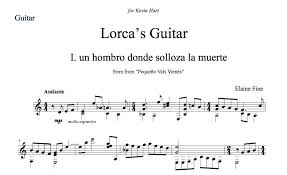
An introductory video may be found at http://www.youtube.com/watch?v=eCwqZjku16A
The weeping of the guitar
begins.
The goblets of dawn
are smashed.
The weeping of the guitar
begins.
Useless
to silence it.
Impossible
to silence it.
It weeps monotonously
as water weeps
as the wind weeps
over snowfields.
Impossible
to silence it.
It weeps for distant
things.
Hot southern sands
yearning for white camellias.
Weeps arrow without target
evening without morning
and the first dead bird
on the branch.
Oh, guitar!
Heart mortally wounded
by five swords.
I keep telling you about all these people, like Kahlo and Picasso, Hemingway and Graves, plus my bits about Gandhi, and Elvis, and I do not even know whether you are interested in the slightest.
Oh well, never mind. I wouldn’t tell you, if I wasn’t interested. I suppose that has to be my guideline.
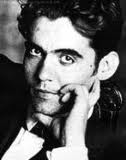
Today I’ll offer you an entry about Federico García Lorca. He was born in Fuente Vaqueros, Granada, Spain, 5th June,1898; he died near Granada, 19th August,1936. Killed. Executed. Murdered. That is 71 years ago, today.
One does not know who killed him, or why. Perhaps it was a political murder, because García Lorca was considered left-leaning. Or it was a Fascist murder, because Lorca stood for the arts and the intellect and for freedom of the mind. Or it was, because Lorca was said to be more interested in men than in the opposite…
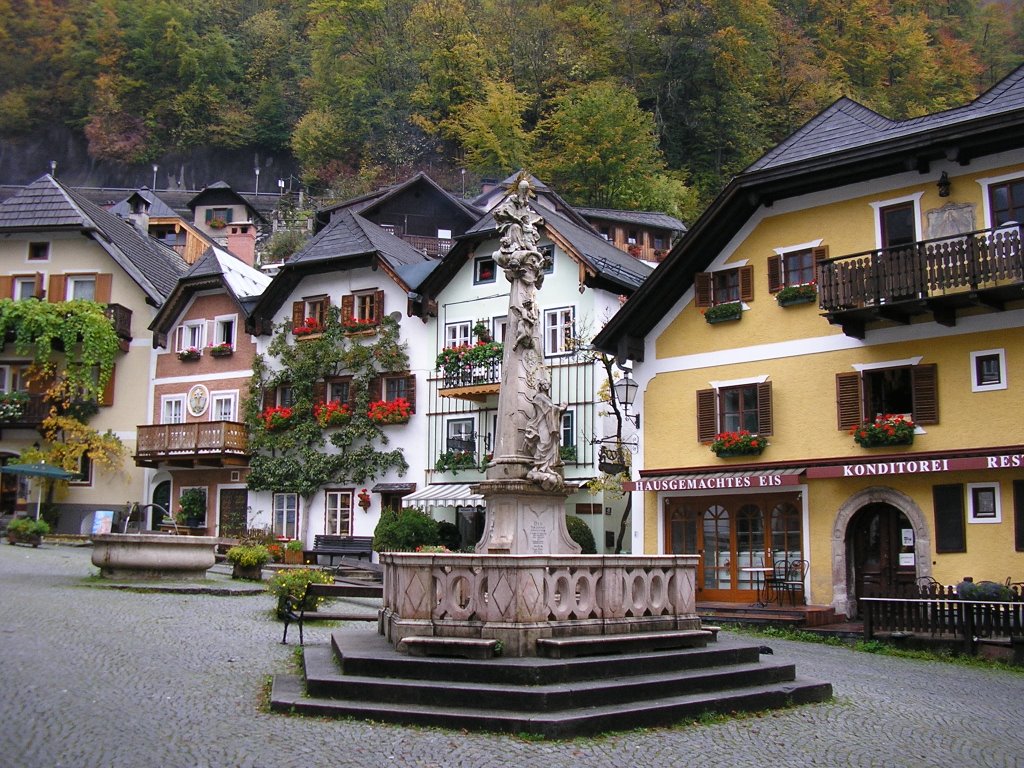
Alte Plätze sonnig schweigen.
Tief in Blau und Gold versponnen
Traumhaft hasten sanfte Nonnen
Unter schwüler Buchen Schweigen.
Aus den braun erhellten Kirchen
Schaun des Todes reine Bilder,
Großer Fürsten schöne Schilder.
Kronen schimmern in den Kirchen.
Rösser tauchen aus dem Brunnen.
Blütenkrallen drohn aus Bäumen.
Knaben spielen wirr von Träumen
Abends leise dort am Brunnen.
Mädchen stehen an den Toren,
Schauen scheu ins farbige Leben.
Ihre feuchten Lippen beben
Und sie warten an den Toren.
Zitternd flattern Glockenklänge,
Marschtakt hallt und Wacherufen.
Fremde lauschen auf den Stufen.
Hoch im Blau sind Orgelklänge.
Helle Instrumente singen.
Durch der Garten Blätterrahmen
Schwirrt das Lachen schöner Damen.
Leise junge Mütter singen.
Heimlich haucht an blumigen Fenstern
Duft von Weihrauch, Teer und Flieder.
Silbern flimmern müde Lider
Durch die Blumen an den Fenstern.
Georg Trakl Aus der Sammlung Gedichte 1913
Here is my translation:-
The Old Square
The ancient square sleeps in sunlight
making deep blue and golden threads
like a spiderweb.
Nuns come and go, gliding gently,
under the sultry silent beech trees.
From inside the illuminated church glimpses
show pure images of Death,
grand princes and magnificent shields.
Crowns gleam down above the aisles.
Horses heads appear from the ancient spring,
Sharp thorns threaten and bristle beneath the trees.
Young men confused with crazy dreams
in the evening gently approach the fountain.
Girls stand in doorways,
appearing shyly into the colourful square.
Their moist lips tremble
as they wait in their doorways.
Resounding, trembling bells
beat out the march with waking calls.
Strangers eavesdrop to their stirring calls.
High into the blue air the organ sounds.
Musical instruments sing high and clear
through the gardens and their leafed surrounds
The laughter of beautiful women sounds
and softly a young mother sings.
Breathe in the fragrance at the flowered sills,
Scents and incense, tar and lilac.
Silver glints through tired eyelids
through the flowers on the window ledges.
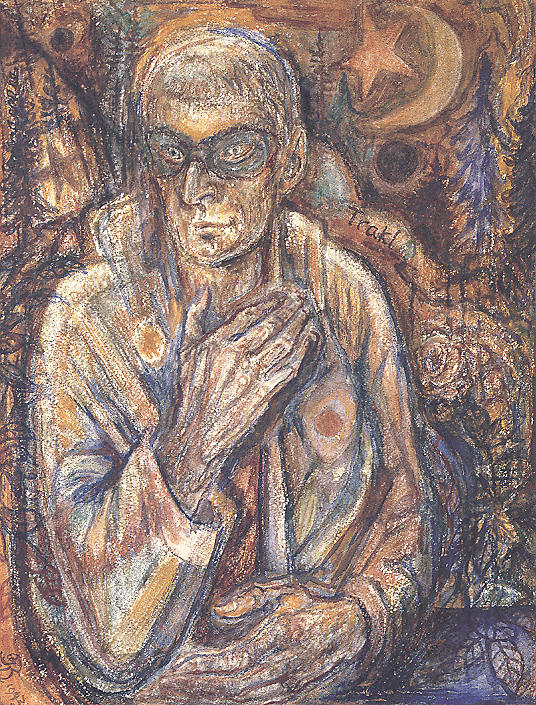
Trakl’s poetry is haunting, symbolist and expressionist. His story is to be found at http://www.kulturvereinigung.com/en/georg-trakl/brief-biography/ and many clips may be found at http://www.youtube.com/results?search_query=Georg%20Trakl&sm=3













 Aus der Sammlung Gedichte 1913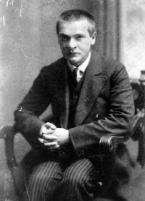
 penwithlit