Categories
This sounds a significant book set in the distant past. I was thinking that the three favourite historical novels I’ve read were Golding’s The Spire, Eco’s The Name of the Rose and Zola’s Germinal- all great writing as literature.

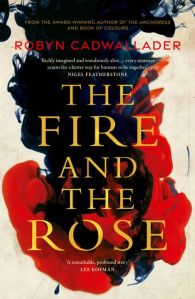 Readers want different things from historical fiction, but I’m quite clear about what I want.
Pontificating recently at Whispering Gums, I stated that I have grown out of what are…
…basically relationship novels dressed up in historical finery and these days I want more from HistFic than *yawn* power, gender and class. We are awash with novels about power, gender and class and very rarely, it seems to me, is there anything different about them except their settings. So many of them are starring *amazing*, *feisty* women determined to rise above their oppression that it’s a cliché.
Continuing on my soap box, I went on to clarify why HistFic can be great reading. (Links are to my reviews).
HistFic can be a brilliant story of character, as in Wolf Hall. It can shine a light on as aspect of life that we rarely consider, as in A Terrible…
View original post 991 more words
Categories
Glowing daffodil


You write ” I didn’t get that being abandoned by a caregiver was only sort of about me” and yet it wasn’t and there is a not surely missing here. To me this illustrates how very difficult it is to accept how vulnerable we all are and our need to perhaps become somehow active in blaming….even ourselves. Thanks for posting.

If trauma can become a gift, first understanding it is imperative.
Left on her own, with no one to look after her, Annie wonders what she’s done wrong. Why don’t her parents care enough about her to check in? She stares at the empty floors lined with barren walls, symbolizing the vast space inside of her tiny heart. Trying to make sense of her predicament, Annie reasons that she must have been a bad girl. For if she were different, she’d be loved. In her book, The Unexpected Gift of Trauma, Dr. Edith Shiro argues, “The trauma itself comes not from the event, but from how we interpret the event, the resources we have to deal with it, and the way we process it. Our response is connected to the meaning we make of the experience we have, but it’s not necessarily proportional to the intensity of that experience.”
View original post 743 more words

A little reminiscent of Thomas Cooper Gotch who painted in nearby Newlyn.


“In this poignant work entitled Young Mother, Gari Melchers portrays a mother and child, a favorite theme throughout the artist’s career, in a form suggestive of religious imagery. Evoking past images of the Madonna and Child and introducing the compositional device of a porcelain plate as a halo. Melchers creates a radiant image of a parent’s eternal love. “Melchers’s large religious genre paintings were major achievements for the young artist and still retain their original depth of meaning and expressive power. The artist’s forthright and realistic style strongly conveys the implicit moral content that underlies the subject matter. The peasants are depicted with an uncompromising honesty that is the stylistic equivalent of their personal sincerity…The carefully orchestrated compositions suggest the ordered structure…
View original post 67 more words
Categories
The start of the lilac season

Categories
Magnolia flower unusual color


See More
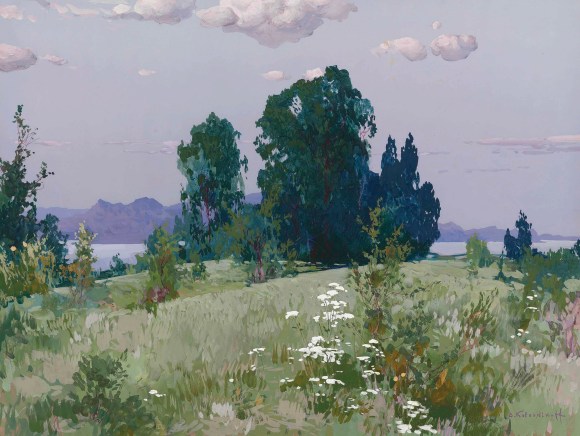
Tag: Stepan Kolesnikov At Sunnyside
Stepan Kolesnikov at Christie’s
Stepan Fedorovich Kolesnikov at MutualArt
Stepan Feodorovich Kolesnikov | Artnet
Read More
Stepan Kolesnikov at Lines and Colors
Thanks for Visiting 🙂
~Sunnyside
I have read but a little Samuel Beckett- one play and a novel but his persona I find intriguing and his clearly having studied Joyce interests as well. I found a tome-like collection of his poetry second hand and have been looking at some of his translations from French. He translated Rimbaud, Breton and the surrealist poet, Paul Eluard. I notice that a collection of the latter’s poetry is soon to be published in both French and English. Beckett also translated a poem called “Delta” from Italian by Eugenio Montale. Beckett too wrote fluently in French and demonstrates his fascination for arcane usage. Here is an example-
Tristesse Janale
C’est toi, o beauté blême des subtiles concierges,
La Chose kantienne, l’icone bilitique;
C’est toi, muette énigme des aphasiques vierges,
Qui centres mes désirs d’un trait antithétique.
O mystique carquois! O flèches de Télèphe!
Correlatif de toi! Abîme et dure sonde!
Sois éternellement le greffé et la greffe,
Ma superfétatoire et frêle furibonde!
Ultime coquillage et palais de la bouche
Mallarméenne et emblème de Michel-Ange,
Consume-toi, o neutre, en extases farouches,
Barbouille-toi, bigène, de crispations de fange,
Et co-ordonne enfin, lacustre conifère,
Tes tensions ambigues de crête et de cratère.
Using Google Translate and adjusting this curious poem reads-
Sadness Janale
It is you, o pallid beauty of the subtle concierges, The Kantian Thing, the bilious icon; It is you, mute enigma of aphasic virgins, Who centers my desires with an antithetical trait.
O mystical quiver! O arrows of Telephus! Correlative of you! Abyss and hard probe! Be eternally the grafted and the graft, My superfluous and frail furious!
Ultimate shell and palate of the Mallarméan mouth and emblem of Michelangelo, Consume yourself, o neutral, in fierce ecstasies, Smear yourself, bigène, with mire contractions,
And finally coordinates, coniferous lacustrine, Your ambiguous tensions of ridge and crater.
Essentially this seems difficult although each stanza has a cluster of meaningful concerns. There are many fascinating words with allusions to place names and classical studies. The imperious voice of the poem marked by imperatives is not without a comic undertone or so it seems to me. It has made me aware of Beckett’s command of the French language and his dreamlike imagery.
A considerable amount to ponder here. Some of these comments are in agreement with the considerable work of Betty Joseph.

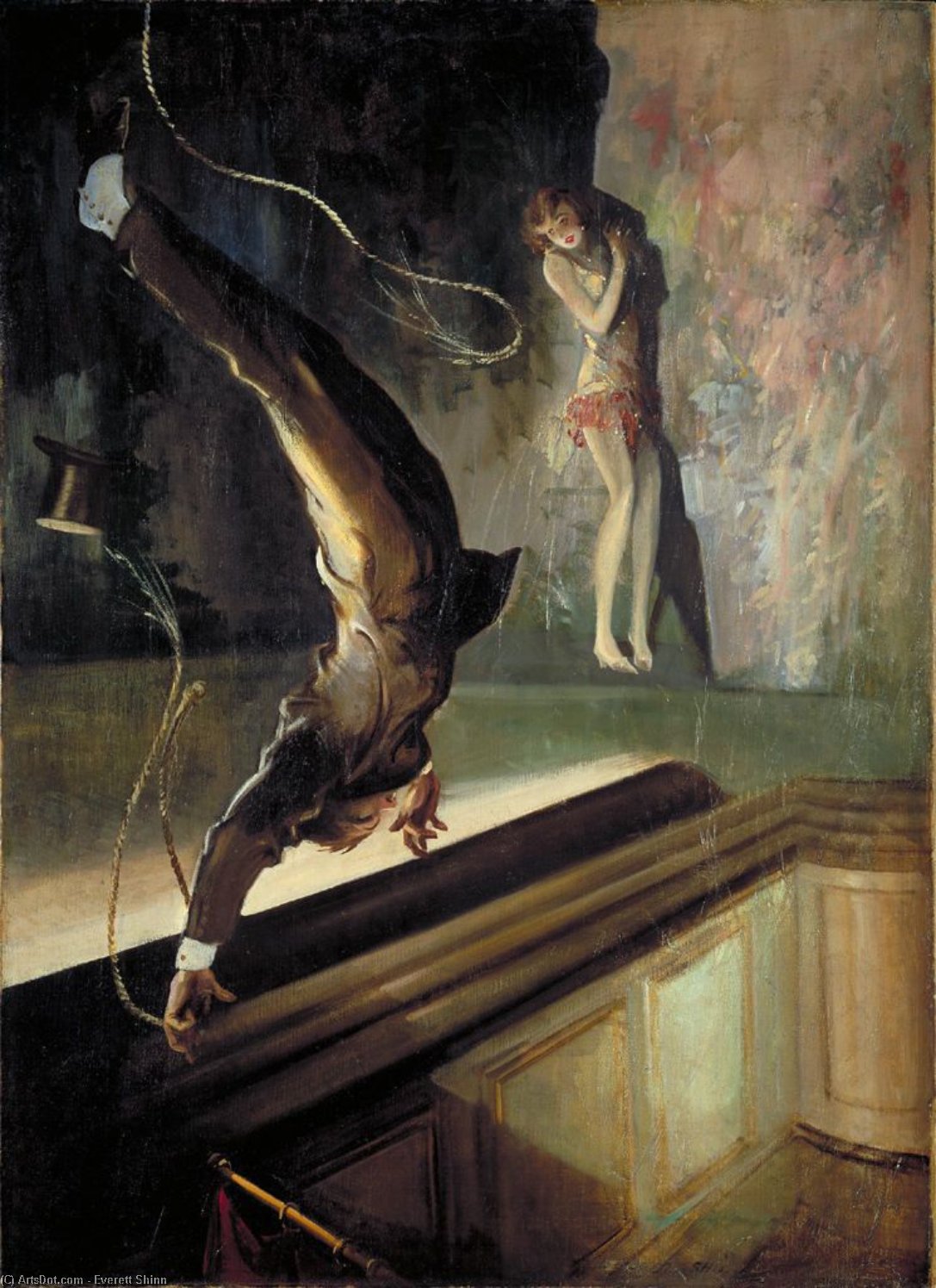 Acrobat Falling. Everett Shinn. Wikioo.
“Our greatest glory is not in never falling, but in rising every time we fall.”
Confucius
We all make mistakes, and therapists are no different in this regard. Learning from these mistakes is a crucial way of developing and refining our skills, no matter how experienced we may be. We can find examples of this learning from error through perusing the writings of many celebrated therapists throughout history.
Whatever our mistake, it is important to have awareness of what it might be about, and how it can reflect both the patient and the therapist. This can lead to more self-understanding for the therapist and, perhaps, further knowledge about the patient, or both.
For example, if we, as therapists, are talking more than usual, are we reacting to some internal pressure from the patient, to find answers, get it all right? If so, we will have…
View original post 1,084 more words
 penwithlit