Next to my laptop propped against the now never used printer is a postcard which I bought at the remarkable Musée Jacquemart–André. This lovely gallery is grandly situated in the Boulevard Haussman in the 8th Arrondissment (huitieme). The postcard shows what a Scotsman might have called a fair bonny lassie.
This Italian Baroque painter was born in Verona and died in St Petersburg. His paintings are remarkable for both their astonishing beauty but also for their realism as can be judged from the following clip.
Looking at these lovely paintings gives me the same feeling as reading this-
The orchards half the way From home to Ludlow fair Flowered on the first of May In Mays when I was there; And seen from stile or turning The plume of smoke would show Where fires were burning That went out long ago.
The plum broke forth in green, The pear stood high and snowed, My friends and I between Would take the Ludlow road; Dressed to the nines and drinking And light in heart and limb, And each chap thinking The fair was held for him.
Between the trees in flower New friends at fairtime tread The way where Ludlow tower Stands planted on the dead. Our thoughts, a long while after, They think, our words they say; Theirs now’s the laughter, The fair, the first of May.
Ay, yonder lads are yet The fools that we were then; For oh, the sons we get Are still the sons of men. The sumless tale of sorrow Is all unrolled in vain: May comes to-morrow And Ludlow fair again.
I had recently been perusing Cavafy – particularly reading the essay on him written by that doyen of Dons, Maurice Bowra in his book, The Creative Experiment. Bowra, of whom it has been said, ” …..either the most distinguished or the most notorious Oxford don of the early twentieth century. Classicist, poet, wit, raconteur extraordinary, and Warden of Wadham College for over thirty years, he met nearly everyone of consequence in the worlds of literature and politics” He remarks of Cavafy’s abilility to find pathos in quite simple situations and quotes, The Melancholy of Jason poet in Kommagini, a.D. 595–
The aging of my body and my beauty is a wound from a merciless knife. I’m not resigned to it at all. I turn to you, Art of Poetry,
n these all-white courtyards where the south wind blows Whistling through vaulted arcades, tell me, is it the mad pomegranate tree That leaps in the light, scattering its fruitful laughter With windy wilfulness and whispering, tell me, is it the mad pomegranate tree That quivers with foliage newly born at dawn Raising high its colors in a shiver of triumph?
On plains where the naked girls awake, When they harvest clover with their light brown arms Roaming round the borders of their dreams — tell me, is it the mad pomegranate tree, Unsuspecting, that puts the lights in their verdant baskets That floods their names with the singing of birds — tell me Is it the mad pomegranate tree that combats the cloudy skies of the world?
Many people will have seen the excellent portrayal of Larry Durrell by Josh O’Connor in the TV Series “Meet the Durrells“. However, my personal encounter with this fellow was at least 50 years ago when I read “The Alexandria Quartet“. I probably was not sufficiently well read at the time to make much sense of these books but much enjoyed their exotic atmosphere. A few years later I saw the film of the first volume, “Justine” (1969 with
Recently searching for a Penguin Poetry book on Cavafy and three other Greek Poets I came across Volume 1 of the Penguin Modern Poets first published in 1962 -price 2/6 (12 and a half New Pence!!) and at an initial glance enjoyed reading a poem by Lawrence Durrell called “Green Coconuts”– then I looked more closely. The first stanza commences:-
At insular café tables under awnings
Bemused benighted half-castes pause
To stretch upon a table jawning
Ten yellow claws and
Order green coconuts to drink with straws.
I gather from perusal of the net that this poem was inspired by his own visit to Rio with his wife, Eve who tasted the coconuts. Here however, it is the “be-mused benighted half-castes” which sounds more than a little racist to me. Peter Porter has written of Durrell’s poetry “Always beautiful as sound and syntax. Its innovation lies in its refusal to be more high-minded than the things it records, together with its handling of the whole lexicon of language.”
Picante and picturesque perhaps but bypassing the infantile fantasy of a “great tree of breasts” we arrive at the third verse-
Lips that are curved to taste this albumen,
To taste with some blue spoon among the curds
Which drying on tongue or moustache are tasteless
As droppings of bats or birds.
Now this general tastelessness suggests in association with beastmilk might suggest all kinds of projections going on here. Does one generally taste with the lips or moustache? Perhaps I am being pedantic but the final verse that returns to yellow mandibles and suggests, it seems to me, that the half-castes have become via reference to Darwin and ends with the lines-
Green coconuts, green
Coconuts, patrimony of the ape.
Well, at least in this poem, Durrell has exceeded Kipling in a sort of distasteful and racist bombast.
Peliaco quondam prognatae uertice pinus dicuntur liquidas Neptuni nasse per undas Phasidos ad fluctus et fines Aeetaeos, cum lecti iuuenes, Argiuae robora pubis, auratam optantes Colchis auertere pellem ausi sunt uada salsa cita decurrere puppi, caerula uerrentes abiegnis aequora palmis. diua quibus retinens in summis urbibus arces, ipsa leui fecit uolitantem flamine currum, pinea coniungens inflexae texta carinae. illa rudem cursu prima imbuit Amphitriten. quae simul ac rostro uentosum proscidit aequor, tortaque remigio spumis incanuit unda, emersere feri candenti e gurgite uultus aequoreae monstrum Nereides admirantes. illa, atque haud alia, uiderunt luce marinas mortales oculi nudato corpore Nymphas
It is said that formerly pines sprung from Pelion’s peak swam the liquid waves of Neptune To the waves of Phasis and the lands of Aeetes, When the chosen youths, the strength of Argive manhood Choosing to run away with the Golden Fleece from the Colchians, They dared to traverse with swift ship through the salty waters, Sweeping the azure sea with fir oars, For whom the goddess herself occupying the citadels in the highest cities Made the flying chariot with a light wind, Fitting the pine timbers to the curved keel. She first stained inexperienced Amphitrite with sailing; But which likewise plowed the fickle wave with curved ship’s beak And the water, twisted by the rowing grew warm with foam, Aquatic Nereids emerged their faces from the white eddies Admiring the apparition On that day, and hardly any other, mortals saw with their own eyes Marine nymphs, with naked body,
In a recent discussion at Jewish Book Week 2021, Hermione Lee mentioned that this was Stoppard’s favourite play. It was first published in 1997 and given it’s themes I wondered if it’s writing had any connection with Stoppard’s feelings about Section 28 of the Local Government Act 1988. This very interesting play can be viewed on You Tube but sadly the quality of the sound is not very good.
I think it is interesting that Stoppard who appears not to have had a University Education appears so interested in the minutaie of recondite and eclectic matters such as logical positivism (Jumpers) or textual analysis as in this play.
Isn’t it interesting how the road not taken, so to speak, may become so interesting one’s later in life. This was seemingly the case about higher education with Tom Stoppard who has become so formidably well read and erudite. I was thinking too of James Callaghan a British politician who served as Prime Minister of the United Kingdom from 1976 to 1979. He became so very interested in Education and seems to have engendered the changes that resulted in the National Curriculum.
The other major figure that springs to mind is George Orwell. However, my most recent encounter with Orwell portrays him rather more as the man of action and not perhaps very interested in University Education as that of describing authoritarian atmosphere of the minor Prep school. I was reading fairly recently an account by Rayner Heppenstall in his engaging account Four Absentees which mentions the time the author spent with Orwell in their Camden flat-https://en.wikipedia.org/wiki/Rayner_Heppenstall
It is difficult to imagine what Orwell might have chosen to read had he gone to University and then again he was young at a time well before the expansion of University Education. Perhaps, he is now studied under the area of Media Studies. There appears to be considerable debate about his writing. Personally I found his diaries which I think appeared in Penguin around 1988 absorbingly interesting.
Orwell and Stoppard are both concerned with language and truth. When looking at this play, there is a debate about the relative merits of poetry and academic scholarship as well as the human relationships. Houseman the classicist obsessed by the scientific and heterosexual Jackson. Obsessed too with such close textual analysis that he seems to missed his first in Greats. How might he be diagnosed or labelled nowadays one wonders.
After recently reading Three Rings by Daniel Mendelsohn (A tale of Exile, Narrative and Fate) I have been tempted to explore diversions and must now return to the text above.
The first two lines above do not appear to make a great deal of sense in English. My Heinemann edition translated by F.W.Cornish (Erstwhile Vice-Provost of Eton) 2nd Edition 1914 gives-
Pine-trees of old, born on top of the Pelion, are said to have swam through the clear waters of Neptune to the waves of Phasis and the realms of Aeetes, when the chosen youths, the flowers of Argive strength, desiring to bear away from the Colchians the golden fleece...
Now the obvious difficulty in getting the poetry here is the number of allusions with which the text is crammed. The sort of associations that in Keats time many were familiar. Looking them up…..
Pelion is simply there as a mountain today and looks gorgeous too.
“The flowers of Argive strength” is rather lovely and associated with gladiolus flowers which suggest not only strength but honour and moral integrity. Gladius being Latin for sword. Argive refers to the ancient city of Argos and obviously not the on-line delivery store! Argos (Ancient Argos, located in the Peloponnese in Greece, was a major Mycenaean settlement in the Late Bronze Age (1700-1100 BCE) and remained important throughout the Greek, Hellenistic, and Roman periods until its destruction by the Visigoths in 395 CE)
Finally, there is a little possible alternative at line 14 where freti might replace feri above and seems to mean narrow-anyway freti candenti sounds rather nice though I cannot quite make sense of it. It seemsto refer to a white narrow watery space I am told. See https://nodictionaries.com/text-word-note/1731849-remigio-spumis-incanuit-unda-emersere-freti-candenti-e-gurgite-uultus-aequoreae and according to Cornish might instead mean “wild visages” of the emerging Neriads in the spume of the churning oars. Houseman and probably Stoppard would doubtless be intrigued by these codd. (Codices) Referring to the different manuscripts. Cornish in my book -1st Edition 1912 refers to 7 different manuscripts- one of which is in the Bodleian and one of which is no longer extant but 6 of the others are derived from it. Codex Veronensis.
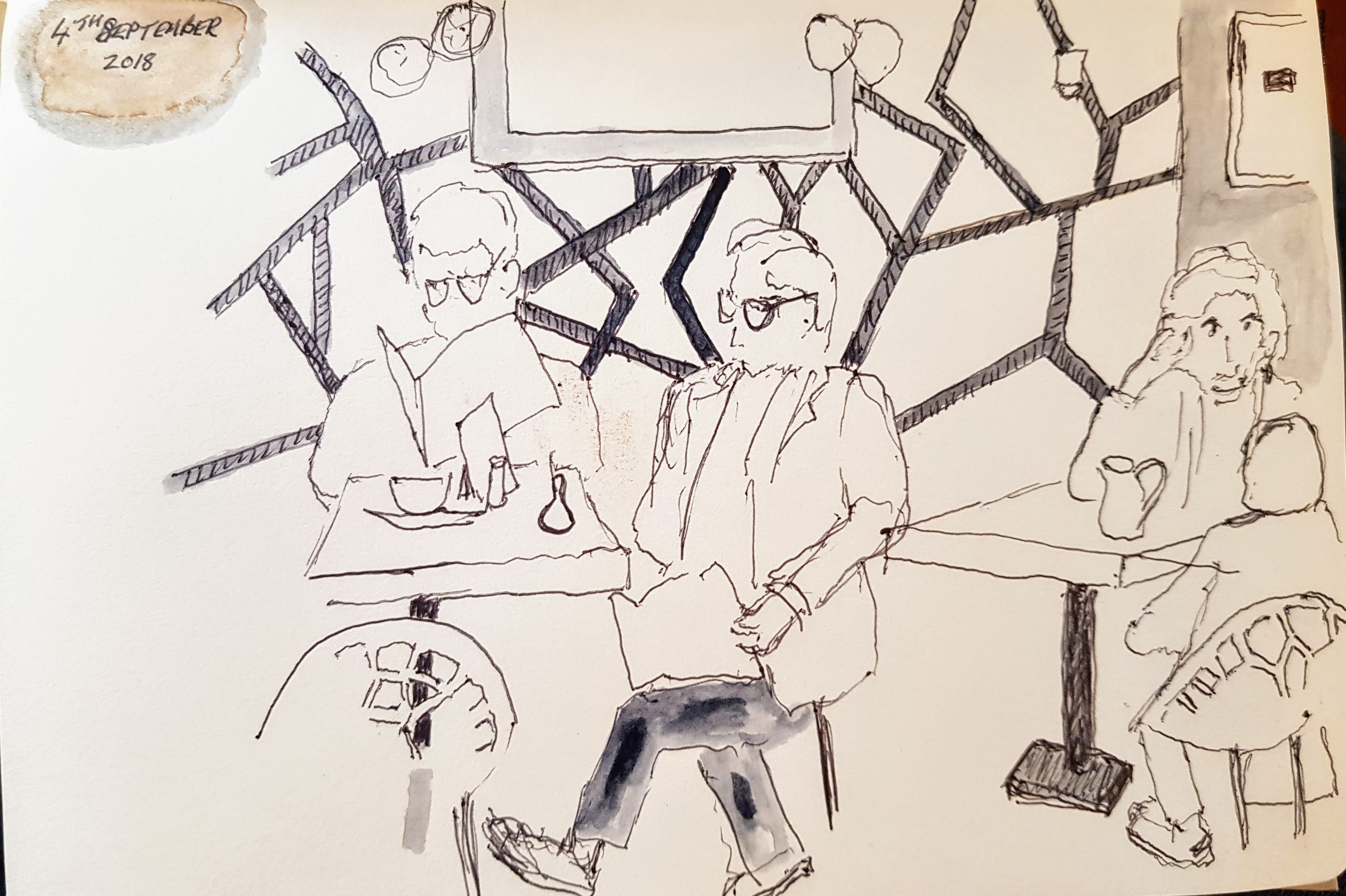
Perhaps it exists only in the imagination. I remember visiting the Cafe Central in Vienna with its wide variety of journals and literary magazines, gorgeous variety of coffees and its habitués. Mostly tourists when I visited but there were the ghosts of writers and revolutionists from Krauss to Trotsky. Then naturally the confectionary of all types and colours. Not quite Penzance but in its many transformations at lest one or two establishments have provided an atmosphere conducive to reading, talking and day-dreaming. The creative aspect of the latter sometimes under-rated.
In my youth it was a pasty on the beach with a towel before large bath towels were in vogue. Before we began to worry about the depletion of the ozone layer and the St Ives Times and Echo would boast about the town’s high monthly U.V Index statistics.
Sweet pastries filled the mouths of those who sat beside us and stayed for a while.
How the hours went by, people just passing through The descending sun ending a forever with you.
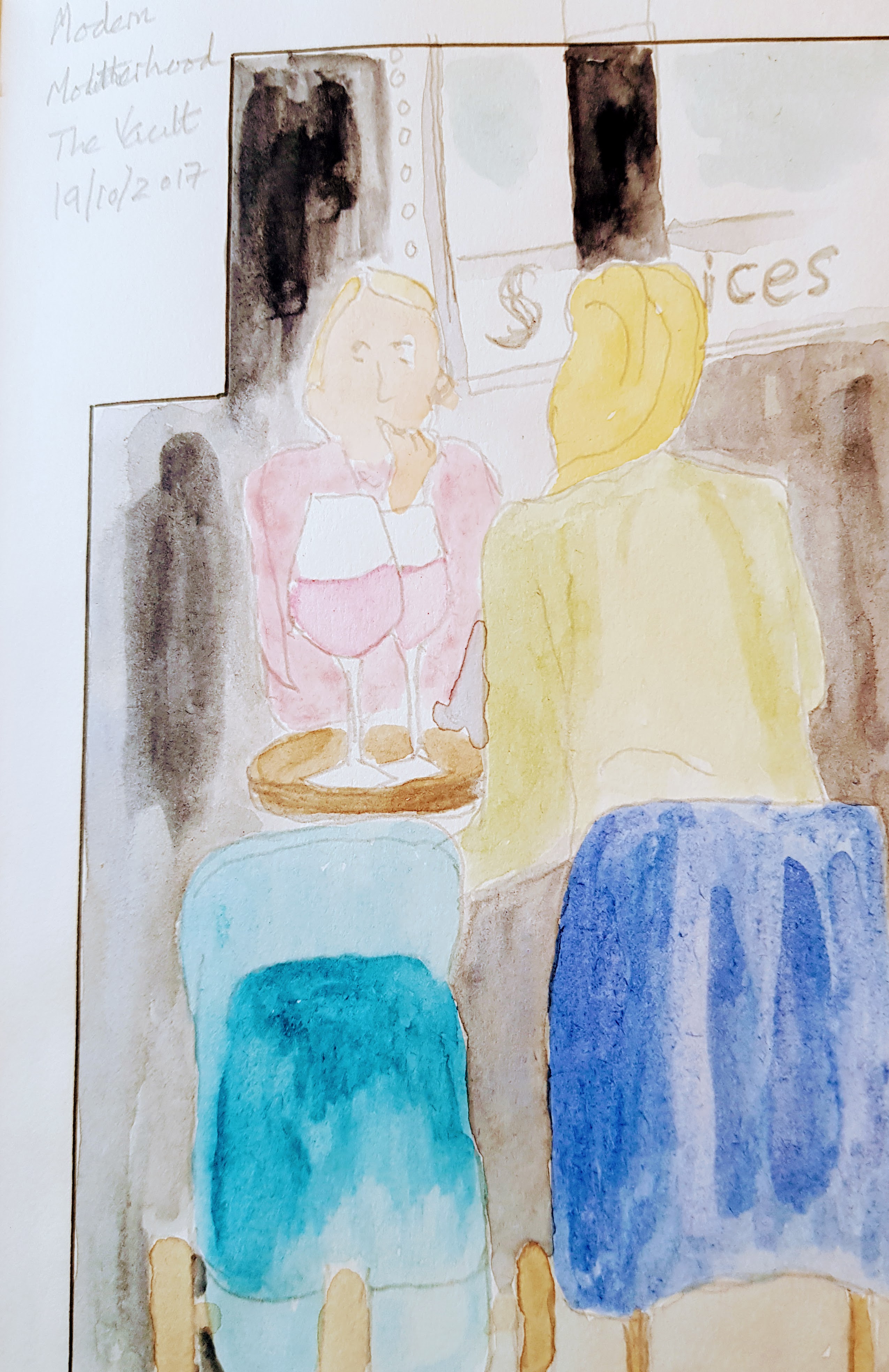
The décor seems to change frequently. Decorators and interior designers must make considerable profit with properties so frquently changing hands. Different styles come into vogue, multiple mixes of gin followed by martinis with names as hot and suggestive to suit. The patrons change as does the topics loudly conversed. The rate of change changes until suddenly they become silent, empty and inaccessible. No more ladies who lunch with sleeping babies in stylish prams.
Their salads come and their forks they deploy you can tell this is a luncheon they will enjoy.
They catch up on all the news Sharing with one another their views.
No gossip here – they are not that type But occasionally you will hear a gripe.
About a husband , son or some other man Someone who should be hit over the head with a pan.
Elections come and go and it seems the wrong people get elected over and over. Those who don’t enjoy cafes or approve of culture and provide illusions about taking back control, whose egos are inflated by a sterile nationalism that was out of date at least a hundred years ago.
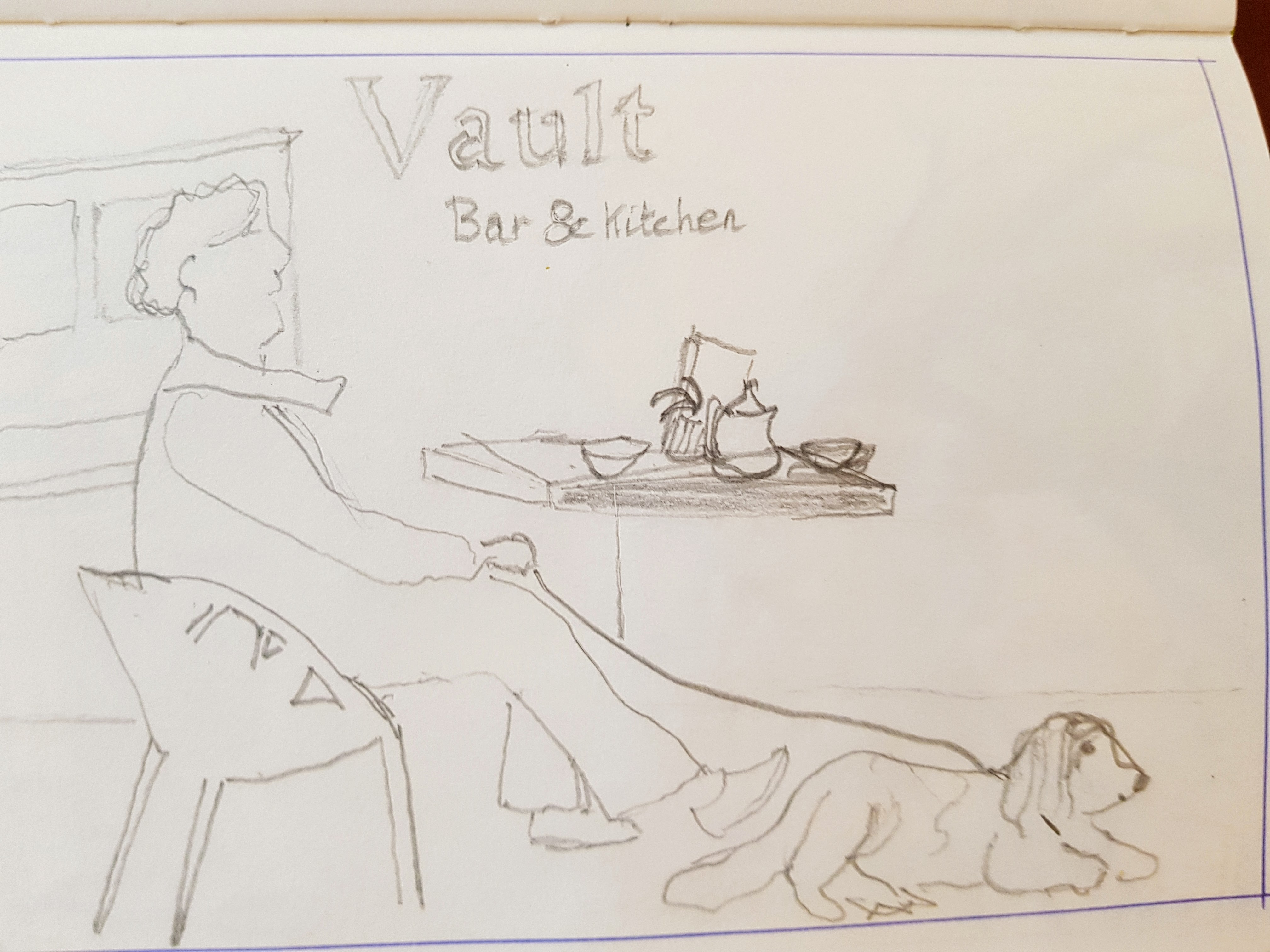
There are some animals whose presence seems to fit in with the soporific state of the nation. They represent perhaps the affectionate tranquillity which is more English than the butcher’s dogs and greased pigs of the contemporary age.
Well, perhaps I have had too much time on my hands and a surfeit of Government adverts on Classic F.M. The latter causing my blood pressure to rise despite the compensating soothing by a combination of the symphonies and the smooth and slightly manic A.A. (Alexander Armstrong). Despite the irritations of the lockdown the discovery of the variety of poetry of Christopher Reid. It is the gift that keeps on giving without the unpleasant associations of that phrase. Here is the great man talking about Ted Hughes and Seamus Heaney.
At the University of Huddersfield
Prose
Prose pays a call on poetry.
A seafaring tower block,
palatial, proud pristinely white
as if fresh from the drawing board
of some high minded architect,
has arrived to inspect
the tired old city.

From Reid's latest collection The Late Sun
There is something subtle and gentle about this poet that reminds me of the best headmaster that I taught under. He can be amusing, eloquent and engaging even with quite short poems like the following from his Selected Poems published in 2011.
Well indeed, the weather has picked up and the magnolia is in blossom in the gardens. I have just been reading the new collection of poems by Christopher Reid entitled “The Late Sun“ and finding it simply excellent. My favourite poem in his collection at the moment is a collaborative translation with Renata Senktas from the Polish of Konstanty Ildefons Gałczyński. It is called from A Trip to Świder
The poem ends with a literary allusion and is infused with a gentle melancholy-
Children in prams, woodpeckers, a birch growing at a slant, the river, and the blind man who drank beer at the station;
and this house with its pointed roof hidden among raspberry bushes, and this shadow… as in Three Sisters by Anton Chekhov.
An informative Polish Website at https://przekroj.pl/en/literature/a-playful-nostalgia-for-a-lost-world-renata-senktas-and-christop interestingly comments that, “hermetic as it sometimes appears, A Trip to Świder is carried along by its musical brio, its dream-like marriage of fantasy and truth, and its kaleidoscopic blending of dissimilar tones and images, which, to quote Czesław Miłosz, “chase one another with the speed of a hurtling train”.“
The Late Summer is replete with great poetry and well worth the effort to read over and over. As a result of reading its 79 pages and not having presently been otherwise engaged by a novel- too many new webinars-I have found much to ponder over between cafetieres of coffee- the poems open up vistas of travel and return to the delights of London. Which thought reminds me of my first encounter with Reid via the wonderful poem-play “The Song of Lunch” world-wearily but delightfully intoned by Alan Rickman with Emma Thompson.









 penwithlit