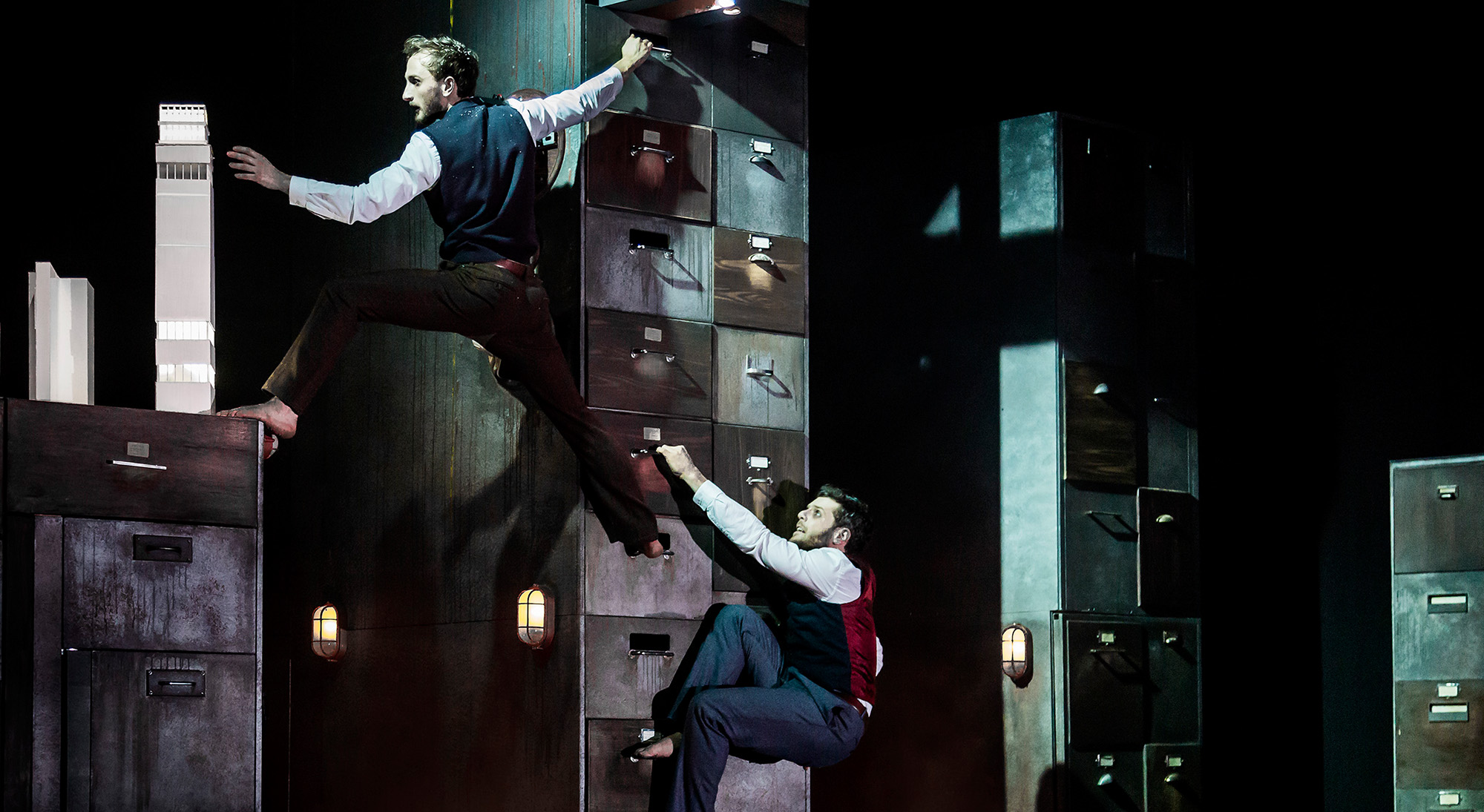
The curtain rises and we are immediately impelled into a Kafkaesque world. The imposing set comprises of a ceiling height of office drawers on either side; a dull grey-brownish limbo-land that looks like the headquarters of the Stasi. The denizens of this sub-topia, Martin and Daniel, dressed like waist-coated bureaucrats from the start of the last century creep around the stage with elaborate gestures and mincing steps. This appears to be a world where cheer must be maintained and institutional routines kept to, deadlines met and clients re-assured. In short a world where anxiety must be kept at bay.
Music and wine and romance are introduced at suitable intervals. The dancing now conveys in sudden changes possible ways in which spirits can be raised or perhaps just maintained. The adaptability of the set is revealed as a drawer is pulled out, a spot-lit crimson rose waivered and a waiter emerges to supply the wants of his nervous guest. Nervous, because the lady he awaits is just a pair of surreal hands. His imagination may be playing tricks. Perhaps he has been overworking at the office where a slight mistake can be punished by extreme changes in the environment; a spotlight, loud klaxon and flashing red lights. Here is an eerie world of lost love, heartache and miscommunication where fog prevails and anyone might suddenly need a prosthetic attachment just to keep on going. Indeed, we all realise that any support mechanism keeps you dependent and, as the expressive movements so eloquently show, subject to a new fear-being manipulated by others. Gecko’s theatre shows us just how old-age, illness and impediment bring in their wake, the burdens of dependency; powerlessness against the perilous incursions of the “system”.
Although the production concerns itself with confusion and conflict, it is not possible to overlook the quality of the dance. The splendid and remarkable co-ordination, involving thoroughgoing trust between the four male dancers, is the result of intensive training. This performance quality is clearly due to hours of training. Conversations with care givers and their clients have paid dividends. The research has resulted in a work which is not only innovative but stirringly original.
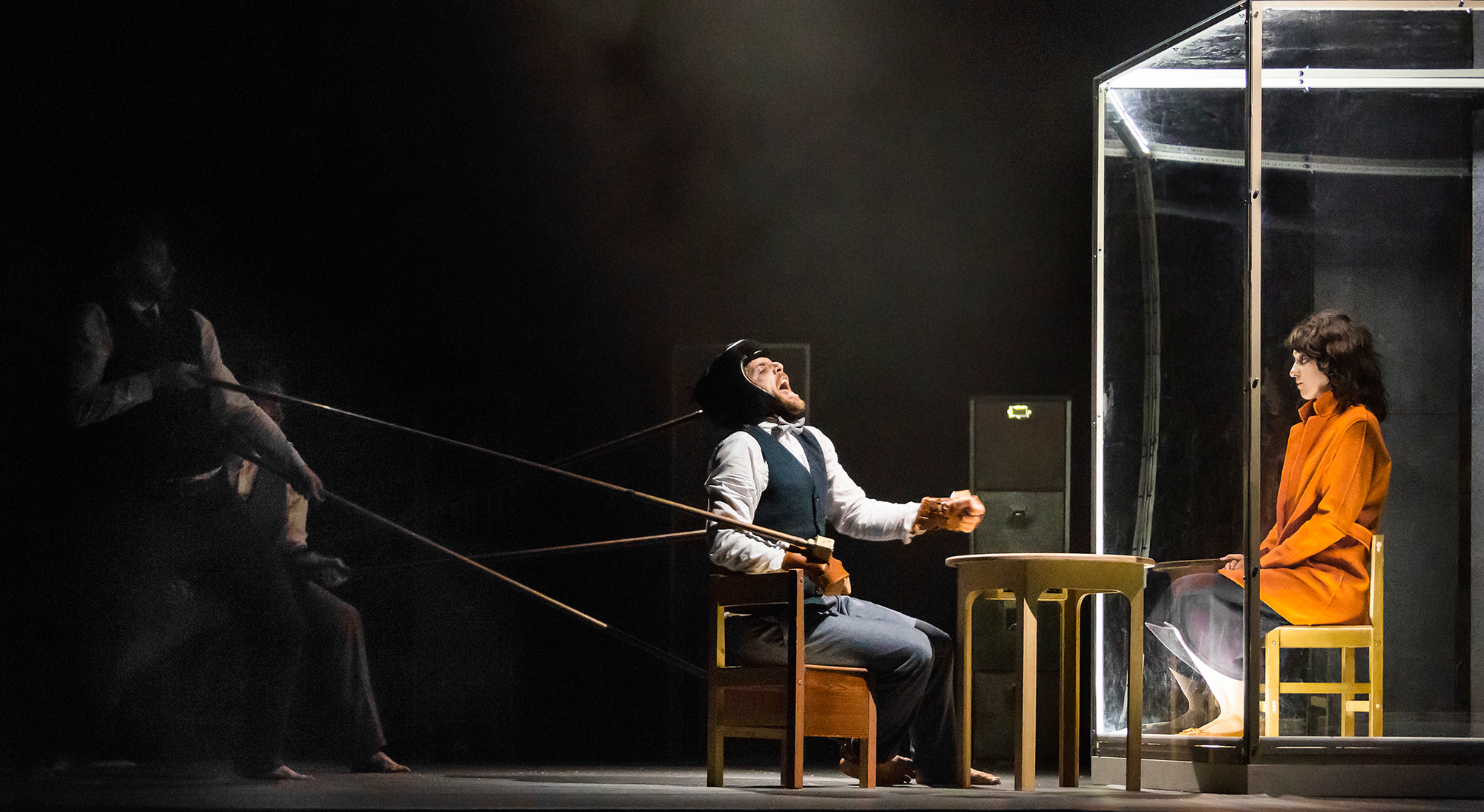
The authenticity of The Institute is evidenced by the manner in which scenes are retained in the memory. These may well be different for each member of the audience. It will deeply resonate with personal emotional experience. Lyricism is evoked when hand held lights are carried floating across a darkened stage and poetry again, at the end, when a silhouetted trio of Masai warriors stand against a setting sun. The articulated pole-linked movements of the dancers rendering support to a frightened and shattered client, in search of his distant and unavailable beloved appear, uncannily like Gregor Samsa transformed into a giant spider from the pages of Franz Kafka’s Der Verwandalung. The sub-text in many parts is the how the actions of an institution results in a control mechanism colliding with flesh, like a sharp catheter being inserted into a collapsed vein. However, moments of comedy lighten and vary the pace, as when one performer has a lampshade suspended above him like an angler-fish. This is less a mechanism for predation than an ironic re-emphasis of the isolation of the individual.
Verbal communication has a particularly interesting role in Gecko’s production. Initially starting with a restrained, cramped discourse where one half-expected Ricky Gervais to make an entrance. It finished with closed-microphone expressive panting. However, it was the use of both French and German to reassure, as it were ‘the patient’ that was particularly engaging. This multilingual exchange managed to convey that words which seem to re-assure can actually disturb and distance. If this was French it was the sort of unsettling French that would be used by Ionesco. In psychiatric distress or dementia or such similar states, there is a reawakening of a child who initially is grasping to express feelings in words. Here the double-bind was clearly illustrated and gesture conveyed frustration at being manipulated. In a thought-provoking and moving production cleverly using props and Francis Bacon-like enclosures, time and life pass onward in the background. The highest accolade is that it invigorates the problematic debate about caring and manipulation which makes Gecko’s Institute both effective and relevant to contemporary social and political concerns.
Here is a video sample from Gecko entitled “Missiing Trailer”
Als sie einander acht Jahre kannten
(Und man darf sagen: sie kannten sich gut),
Kam ihre Liebe plötzlich abhanden.
Wie andern Leuten ein Stock oder Hut.
Sie waren traurig, betrugen sich heiter,
Versuchten Küsse, als ob nichts sei,
Und sahen sich an und wußten nicht weiter.
Da weinte sie schließlich. Und er stand dabei.
Vom Fenster aus konnte man Schiffen winken.
Er sagte, es wäre schon Viertel nach vier
Und Zeit, irgendwo Kaffee zu trinken.
Nebenan übte ein Mensch Klavier.
Sie gingen ins kleinste Cafe am Ort
Und rührten in ihren Tassen.
Am Abend saßen sie immer noch dort.
Sie saßen allein, und sie sprachen kein Wort
Und konnten es einfach nicht fassen.
Du prophetscher Vogel du,
Blütensänger, o Coucou!
Bitten eines jungen Paares
In der schönsten Zeit des Jahres
Höre, liebster Vogel du;
Kann es hoffen, ruf ihm zu:
Dein Coucou, dein Coucou,
Immer mehr Coucou, Coucou.
Hörst du! ein verliebtes Paar
Sehnt sich herzlich zum Altar;
Und es ist bei seiner Jugend
Voller Treue, voller Tugend.
Ist die Stunde denn noch nicht voll?
Sag, wie lange es warten soll!
Horch! Coucou! Horch! Coucou!
Immer stille! Nichts hinzu!
Ist es doch nicht unsre Schuld!
Nur zwei Jahre noch Geduld!
Aber, wenn wir uns genommen,
Werden Pa-pa-papas kommen?
Wisse, daß du uns erfreust,
Wenn du viele prophezeist.
Eins! Coucou! Zwei! Coucou!
Immer weiter Coucou, Coucou, Cou.
Haben wir wohl recht gezählt,
Wenig am Halbdutzend fehlt.
Wenn wir gute Worte geben,
Sagst du wohl, wie lang wir leben?
Freilich, wir gestehen dirs,
Gern zum längsten trieben wirs.
Cou Coucou, Cou Coucou,
Cou, Cou, Cou, Cou, Cou, Cou, Cou, Cou, Cou.
Leben ist ein großes Fest,
Wenn sichs nicht berechnen läßt.
Sind wir nun zusammen blieben,
Bleibt denn auch das treue Lieben?
Könnte das zu Ende gehn,
Wär doch alles nicht mehr schön.
Cou Coucou, Cou Coucou :,:
Cou, Cou, Cou, Cou, Cou, Cou, Cou, Cou, Cou(Mit Grazie in infinitum)
Neben dem Bach
Den roten Weiden nach
Haben in diesen Tagen
Gelbe Blumen viel
Ihre Goldaugen aufgeschlagen.
Und mir, der längst aus der Unschuld fiel,
Rührt sich Erinnerung im Grunde
An meines Lebens goldene Morgenstunde
Und sieht mich hell aus Blumenaugen an.

Ich wollte Blumen brechen gehn;
Nun laß ich sie alle stehn
Und gehe heim, ein alter Mann.(1915)
Du lernst ihn in einer Gesellschaft kennen.
Er plaudert. Er ist zu dir nett.
Er kann dir alle Tenniscracks nennen.
Er sieht gut aus. Ohne Fett.
Er tanzt ausgezeichnet. Du siehst ihn dir an…
Dann tritt zu euch beiden dein Mann.
Und du vergleichst sie in deinem Gemüte.
Dein Mann kommt nicht gut dabei weg.
Wie er schon dasteht – du liebe Güte!
Und hinten am Hals der Speck!
Und du denks bei dir so: “eigentlich …
Der da wäre ein Mann für mich ! ”
My provisional and tentative translation for which is:-
You get to know him around and about.
He chats and seems friendly.
He knows who are the latest tennis stars.
He looks great-no fat anywhere.
He dances beautifully.
Then both of you remember your husband!
…and when you compare them in your thoughts
Your husband doesn’t come out of it very well!
Goodness, how he has become already!
The back of his neck like a lump of bacon.
You think to yourself, ”Well actually,
There goes the chap for me…”
These, however, are only the first two verses and then the implication neatly reverses again, delightfully….
Komm in den totgesagten park und schau:
Der schimmer ferner lächelnder gestade,
Der reinen wolken unverhofftes blau
Erhellt die weiher und die bunten pfade.
Dort nimm das tiefe gelb, das weiche grau
Von birken und von buchs, der wind ist lau,
Die späten rosen welkten noch nicht ganz,
Erlese küsse sie und flicht den kranz,
Vergiss auch diese lezten astern nicht,
Den purpur um die ranken wilder reben
Und auch was übrig blieb von grünem leben
Verwinde leicht im herbstlichen gesicht.
Kinder können nicht sagen wie heiß der Tag ist,
wie scharf der Duft der Sommerrose,
Kaffee und Kuchen
These evocative lines from Robert Graves indicate how some pots translate so very well. Yesterday, travelling around Vienna left me little time for reading -only perhaps for a few lines of poetry. I started by going North to the Landstrasse – and wandered Feclessly down the Hauptstrasse which had interesting markets. I tried using the Sun to navigate but wandered in a direction away from the Danube Canal. Easily distracted, as usual by a bookshop I found an excellent plastic sleeved grammar of German on three foldable sheets. Then found an excellent cafe where the small house torte was the best that I found in Vienna thus far. I then followed a friends advice and entered a Church founded after the second encirclement of Vienna by the Turkish forces.
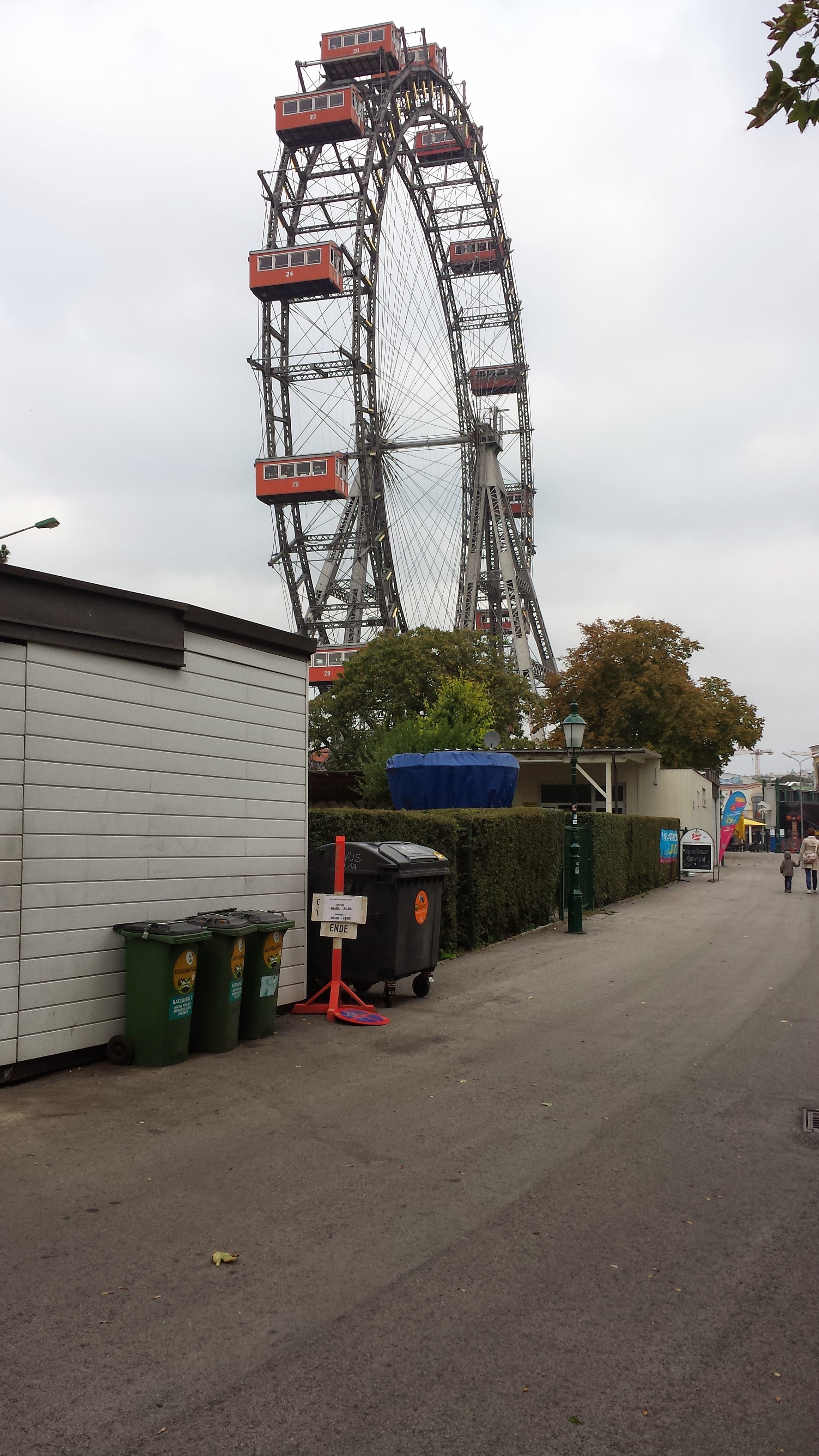
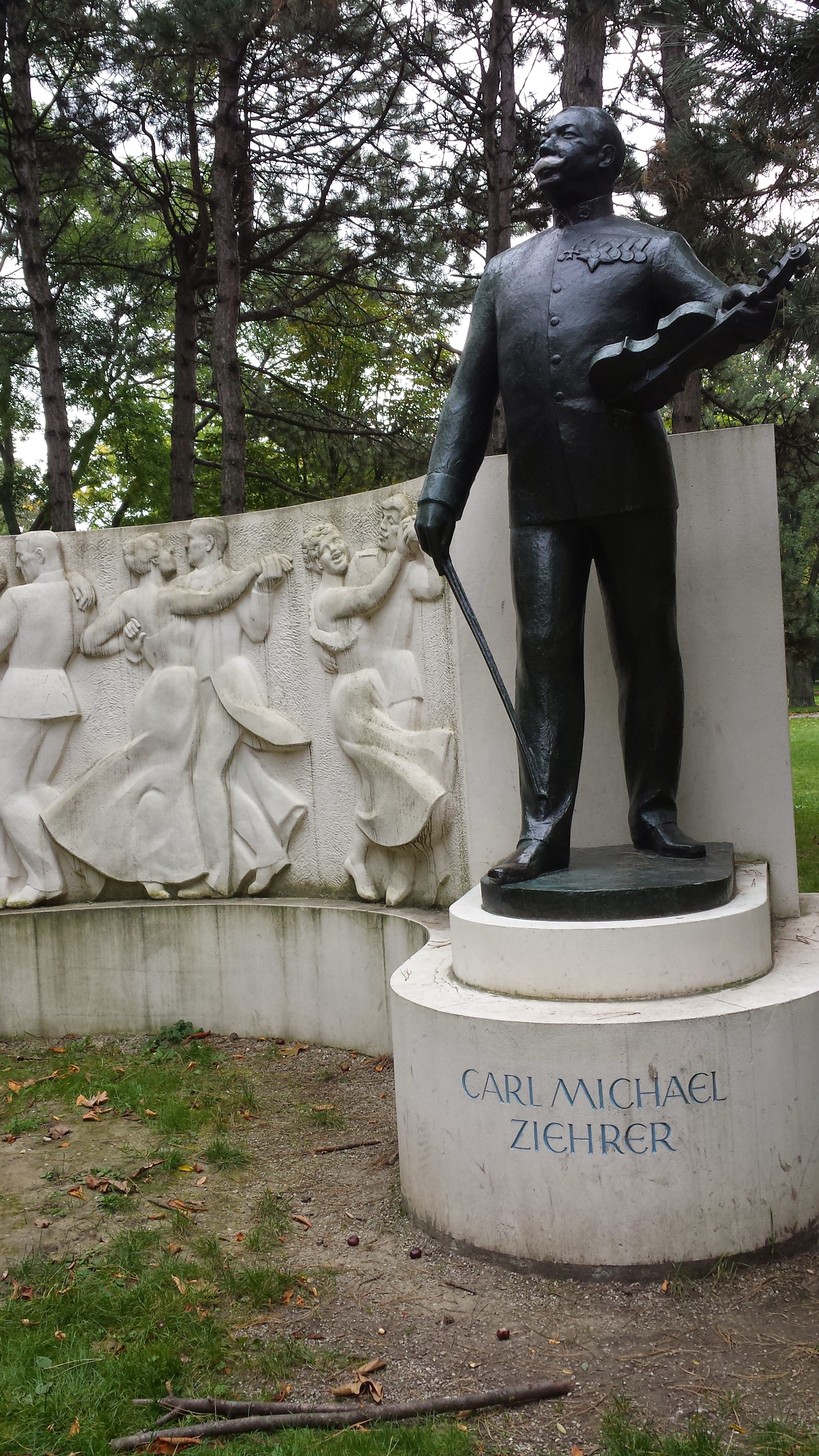
During a further digression around towards the Canal and the Prater, I discovered a pleasant Chemist/Herbal shop, bought some cough sweets for flying and generally forgot all my language skills explaining ludicrously St John’s Wort and its supposed benefits. I forgot the Latin name-hypericum.Walking over a 1950s bridge I arrived eventually in the Prater. Then there was a large tennis club and I wondered if this might be one that was referred to in Vienna by Eva Menasse. After apassing a cheerful group of blind children through tree-lined avenues, which neverthless gave thought to some reflection, I arrived at an interesting denkmal, the Habsburg composer, Carl M.Ziehrer. Finally looming out of the mid afternoon mists I saw the Prater wheel and felt Harry Lime must be about to emerge with a grotesque smile from the surrounding fun-park.
View from Hauptallee in the Prater
Karl Michael Ziehrer (also spelled as Carl Michael Ziehrer) (May 2, 1843 – November 14, 1922)[1] was an Austrian composer. In his lifetime, he was one of the fiercest rivals of the Strauss family; most notably Johann Strauss II[2] and Eduard Strauss.
Der Jahreszeit Pein, des Wirbelwinds Krachen, Eis sind vorübergehen und haben die ausgetretenen Pfade gereignet, die die schweigsamen Gärtner mit Asche bestreuten.
Die eisernen Ringe des Himmels sind vom Sturm abgeschliffen; jedoch in diesem Garten gibt es keinen Hader mehr: Des Winters Messer liegt vergraben in der Erde. Reine Musik ist der Schrei, der zerrt an den vogelverlassenen Zweigen im Wind. Keine Blüte kommt wieder.Blind ist des Teiches blau starrender Blick.
Und niemand sieht
einen ruhelosen Fremden durch der Morgen irren
über den wasserdurchtränken Rasen, dessen Augen
des Weinens müde sind, in dessen Brust
eine barbarische Sonne ihren verborgenen Tag aufzehrt.
This is the heading of an article in Die Welt 05.07.08 by Uwe Wittstock and the opinion expressed,” somewhat gruff charm”, is how the reviewer sees Wondrat’s poetry. This is from the collection, Lied von der Liebe, published in that year. This poem is about his young son, Raoulito, and his attempts to fly.
CD of the collection
“Ich kann fliegen, behauptet er,
breitet die Arme aus, holt Luft,
hüpft hoch, ein paar Zentimeter,
steht wieder und sagt, siehst du?
Um was sonst, denke ich, geht es
unter Sterblichen, wenn nicht hin
und wieder um den Zauber einer
kurzen Sekunde, am besten einer
zwischen Himmel und Erde?”
In rough translation-
“Icanfly,he boasts
Armsspreadout intoair,
and leapsafewinches high,
andsays once again, do yousee?
What more,I wonder
for mankind, but the
repeated magic of a
shortsecond,atbest,
between HeavenandEarth?
between the sky and the ground.
“Ein paar der Gedichte Wondratscheks vermitteln sekundenlang einen zugegeben: etwas ruppigen Zauber – und um was sonst geht es? ” Uwe Wittstock
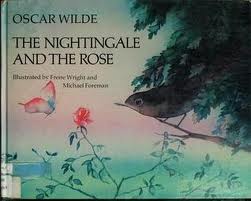
She said that she would dance with me if I brought her red roses,’ cried the young Student; ‘but in all my garden there is no red rose.’
From her nest in the holm-oak tree the Nightingale heard him, and she looked out through the leaves, and wondered.
‘No red rose in all my garden!’ he cried, and his beautiful eyes filled with tears. ‘Ah, on what little things does happiness depend! I have read all that the wise men have written, and all the secrets of philosophy are mine, yet for want of a red rose is my life made wretched.’
‘Here at last is a true lover,’ said the Nightingale. ‘Night after night have I sung of him, though I knew him not: night after night have I told his story to the stars, and now I see him. His hair is dark as the hyacinth-blossom, and his lips are red as the rose of his desire; but passion has made his lace like pale Ivory, and sorrow has set her seal upon his brow.’
‘The Prince gives a ball to-morrow night,’ murmured the young Student, ‘and my love will be of the company. If I bring her a red rose she will dance with me till dawn. If I bring her a red rose, I shall hold her in my arms, and she will lean her head upon my shoulder, and her hand will be clasped in mine. But there is no red rose in my garden, so I shall sit lonely, and she will pass me by. She will have no heed of me, and my heart will break.’
‘Here indeed is the true lover,’ said the Nightingale. ‘What I sing of he suffers: what is joy to me, to him is pain. Surely Love is a wonderful thing. It is more precious than emeralds, and dearer than fine opals. Pearls and pomegranates cannot buy it, nor is it set forth in the market-place. it may not be purchased of the merchants, ‘or can it be weighed out in the balance for gold.’
—————————————
‘The musicians will sit in their gallery,’ said the young Student, ‘and play upon their stringed instruments, and my love will dance to the sound of the harp and the violin. She will dance so lightly that her feet will not touch the floor, and the courtiers in their gay dresses will throng round her. But with me she will not dance, for I have no red rose to give her;’ and he flung himself down on the grass, and buried his face in his hands, and wept.
‘Why is he weeping?’ asked a little Green Lizard, as he ran past him with his tail in the air.
‘Why, indeed?’ said a Butterfly, who was fluttering about after a sunbeam.
‘Why, indeed?’ whispered a Daisy to his neighbour, in a soft, low voice.
‘He is weeping for a red rose,’ said the Nightingale.
‘For a red rose!’ they cried; ‘how very ridiculous!’ and the little Lizard, who was something of a cynic, laughed outright.
But the Nightingale understood the secret of the Student’s sorrow, and she sat silent in the oak-tree, and thought about the mystery of Love.
Suddenly she spread her brown wings for flight, and soared into the air. She passed through the grove like a shadow, and like a shadow she sailed across the garden.
In the centre of the grass-plot was standing a beautiful Rose-tree, and when she saw it, she flew over to it, and lit upon a spray.
‘Give me a red rose,’ she cried, ‘and I will sing you my sweetest song.’
But the Tree shook its head.
‘My roses are white,’ it answered; ‘as white as the foam of the sea, and whiter than the snow upon the mountain. But go to my brother who grows round the old sun-dial, and perhaps he will give you what you want.’
———————————–
So the Nightingale flew over to the Rose-tree that was growing round the old sun-dial.
‘Give me a red rose,’ she cried, ‘and I will sing you my sweetest song.’
But the Tree shook its head.
‘My roses are yellow,’ it answered; ‘as yellow as the hair of the mermaiden who sits upon an amber throne, and yellower than the daffodil that blooms in the meadow before the mower comes with his scythe. But go to my brother who grows beneath the Student’s window, and perhaps he will give you what you want.’
So the Nightingale flew over to the Rose-tree that was growing beneath the Student’s window.
‘Give me a red rose,’ she cried, ‘and I will sing you my sweetest song.’
But the Tree shook its head.
‘My roses are red,’ it answered, ‘as red as the feet of the dove, and redder than the great fans of coral that wave and wave in the ocean-cavern. But the winter has chilled my veins, and the frost has nipped my buds, and the storm has broken my branches, and I shall have no roses at all this year.’
‘One red rose is all I want,’ cried the Nightingale, ‘only one red rose! Is there no way by which I can get it?’
‘There is a way,’ answered the Tree; ‘but it is so terrible that I dare not tell it to you.’
‘Tell it to me,’ said the Nightingale, ‘I am not afraid.’
‘If you want a red rose,’ said the Tree, ‘you must build it out of music by moonlight, and stain it with your own heart’s-blood. You must sing to me with your breast against a thorn. All night long you must sing to me, and the thorn must pierce your heart, and your life-blood must flow into my veins, and become mine.’
——————————–
‘Death is a great price to pay for a red rose,’ cried the Nightingale, ‘and Life is very dear to all. It is pleasant to sit in the green wood, and to watch the Sun in his chariot of gold, and the Moon in her chariot of pearl. Sweet is the scent of the hawthorn, and sweet are the bluebells that hide in the valley, and the heather that blows on the hill. Yet Love is better than Life, and what is the heart of a bird compared to the heart of a man?’
So she spread her brown wings for flight, and soared into the air. She swept over the garden like a shadow, and like a shadow she sailed through the grove.
The young Student was still lying on the grass, where she had left him, and the tears were not yet dry in his beautiful eyes.
‘Be happy,’ cried the Nightingale, ‘be happy; you shall have your red rose. I will build it out of music by moonlight, and stain it with my own heart’s-blood. All that I ask of you in return is that you will be a true lover, for Love is wiser than Philosophy, though she is wise, and mightier than Power, though he is mighty. Flame-coloured are his wings, and coloured like flame is his body. His lips are sweet as honey, and his breath is like frankincense.’
The Student looked up from the grass, and listened, but he could not understand what the Nightingale was saying to him, for he only knew the things that are written down in books.
But the Oak-tree understood, and felt sad, for he was very fond of the little Nightingale who had built her nest in his branches.
‘Sing me one last song,’ he whispered; ‘I shall feel very lonely when you are gone.’
So the Nightingale sang to the Oak-tree, and her voice was like water bubbling from a silver jar.
———————————–
When she had finished her song the Student got lip, and pulled a note-book and a lead-pencil out of his pocket.
‘She has form,’ he said to himself, as he walked away through the grove – ‘that cannot be denied to her; but has she got feeling? I am afraid not. In fact, she is like most artists; she is all style, without any sincerity. She would not sacrifice herself for others. She thinks merely of music, and everybody knows that the arts are selfish. Still, it must be admitted that she has some beautiful notes in her voice. What a pity it is that they do not mean anything, or do any practical good.’ And he went into his room, and lay down on his little pallet-bed, and began to think of his love; and, after a time, he fell asleep.
And when the Moon shone in the heavens the Nightingale flew to the Rose-tree, and set her breast against the thorn. All night long she sang with her breast against the thorn, and the cold crystal Moon leaned down and listened. All night long she sang, and the thorn went deeper and deeper into her breast, and her life-blood ebbed away from her.
She sang first of the birth of love in the heart of a boy and a girl. And on the topmost spray of the Rose-tree there blossomed a marvellous rose, petal following petal, as song followed song. Yale was it, at first, as the mist that hangs over the river – pale as the feet of the morning, and silver as the wings of the dawn. As the shadow of a rose in a mirror of silver, as the shadow of a rose in a water-pool, so was the rose that blossomed on the topmost spray of the Tree.
But the Tree cried to the Nightingale to press closer against the thorn. ‘Press closer, little Nightingale,’ cried the Tree, ‘or the Day will come before the rose is finished.’
So the Nightingale pressed closer against the thorn, and louder and louder grew her song, for she sang of the birth of passion in the soul of a man and a maid.
——————————
And a delicate flush of pink came into the leaves of the rose, like the flush in the face of the bridegroom when he kisses the lips of the bride. But the thorn had not yet reached her heart, so the rose’s heart remained white, for only a Nightingale’s heart’s-blood can crimson the heart of a rose.
And the Tree cried to the Nightingale to press closer against the thorn. ‘Press closer, little Nightingale,’ cried the Tree, ‘or the Day will come before the rose is finished.’
So the Nightingale pressed closer against the thorn, and the thorn touched her heart, and a fierce pang of pain shot through her. Bitter, bitter was the pain, and wilder and wilder grew her song, for she sang of the Love that is perfected by Death, of the Love that dies not in the tomb.
And the marvellous rose became crimson, like the rose of the eastern sky. Crimson was the girdle of petals, and crimson as a ruby was the heart.
But the Nightingale’s voice grew fainter, and her little wings began to beat, and a film came over her eyes. Fainter and fainter grew her song, and she felt something choking her in her throat.
Then she gave one last burst of music. The white Moon heard it, and she forgot the dawn, and lingered on in the sky. The red rose heard it, and it trembled all over with ecstasy, and opened its petals to the cold morning air. Echo bore it to her purple cavern in the hills, and woke the sleeping shepherds from their dreams. It floated through the reeds of the river, and they carried its message to the sea.
‘Look, look!’ cried the Tree, ‘the rose is finished now;’ but the Nightingale made no answer, for she was lying dead in the long grass, with the thorn in her heart.
And at noon the Student opened his window and looked out.
————————————
‘Why, what a wonderful piece of luck! he cried; ‘here is a red rose! I have never seen any rose like it in all my life. It is so beautiful that I am sure it has a long Latin name;’ and he leaned down and plucked it.
Then he put on his hat, and ran up to the Professor’s house with the rose in his hand.
The daughter of the Professor was sitting in the doorway winding blue silk on a reel, and her little dog was lying at her feet.
‘You said that you would dance with me if I brought you a red rose,’ cried the Student. Here is the reddest rose in all the world. You will wear it to-night next your heart, and as we dance together it will tell you how I love you.’
But the girl frowned.
‘I am afraid it will not go with my dress,’ she answered; ‘and, besides, the Chamberlain’s nephew has sent me some real jewels, and everybody knows that jewels cost far more than flowers.’
‘Well, upon my word, you are very ungrateful,’ said the Student angrily; and he threw the rose into the street, where it fell into the gutter, and a cart-wheel went over it.
‘Ungrateful!’ said the girl. ‘I tell you what, you are very rude; and, after all, who are you? Only a Student. Why, I don’t believe you have even got silver buckles to your shoes as the Chamberlain’s nephew has;’ and she got up from her chair and went into the house.
‘What a silly thing Love is,’ said the Student as he walked away. ‘It is not half as useful as Logic, for it does not prove anything, and it is always telling one of things that are not going to happen, and making one believe things that are not true. In fact, it is quite unpractical, and, as in this age to be practical is everything, I shall go back to Philosophy and study Metaphysics.’
————————————-
So he returned to his room and pulled out a great dusty book, and began to read.






 penwithlit