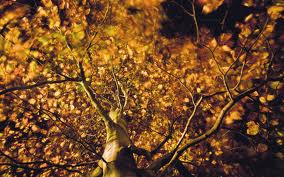
Das ist der Herbst; die Blätter fliegen,
Durch nackte Zweige fährt der Wind;
Es schwankt das Schiff, die Segel schwellen –
Leb wohl, du reizend Schifferkind! —
Sie schaute mit den klaren Augen
Vom Bord des Schiffes unverwandt,
Und Grüße einer fremden Sprache
Schickte sie wieder und wieder ans Land.
Am Ufer standen wir und hielten
Den Segler mit den Augen fest –
Das ist der Herbst! wo alles Leben
Und alle Schönheit uns verläßt.
Bientôt nous plongerons dans les froides ténèbres;
Adieu, vive clarté de nos étés trop courts!
J’entends déjà tomber avec des chocs funèbres
Le bois retentissant sur le pavé des cours.
Tout l’hiver va rentrer dans mon être: colère,
Haine, frissons, horreur, labeur dur et forcé,
Et, comme le soleil dans son enfer polaire,
Mon coeur ne sera plus qu’un bloc rouge et glacé.
J’écoute en frémissant chaque bûche qui tombe
L’échafaud qu’on bâtit n’a pas d’écho plus sourd.
Mon esprit est pareil à la tour qui succombe
Sous les coups du bélier infatigable et lourd.
II me semble, bercé par ce choc monotone,
Qu’on cloue en grande hâte un cercueil quelque part.
Pour qui? — C’était hier l’été; voici l’automne!
Ce bruit mystérieux sonne comme un départ.
II
J’aime de vos longs yeux la lumière verdâtre,
Douce beauté, mais tout aujourd’hui m’est amer,
Et rien, ni votre amour, ni le boudoir, ni l’âtre,
Ne me vaut le soleil rayonnant sur la mer.
Et pourtant aimez-moi, tendre coeur! soyez mère,
Même pour un ingrat, même pour un méchant;
Amante ou soeur, soyez la douceur éphémère
D’un glorieux automne ou d’un soleil couchant.
Courte tâche! La tombe attend; elle est avide!
Ah! laissez-moi, mon front posé sur vos genoux,
Goûter, en regrettant l’été blanc et torride,
De l’arrière-saison le rayon jaune et doux!
— Charles Baudelaire
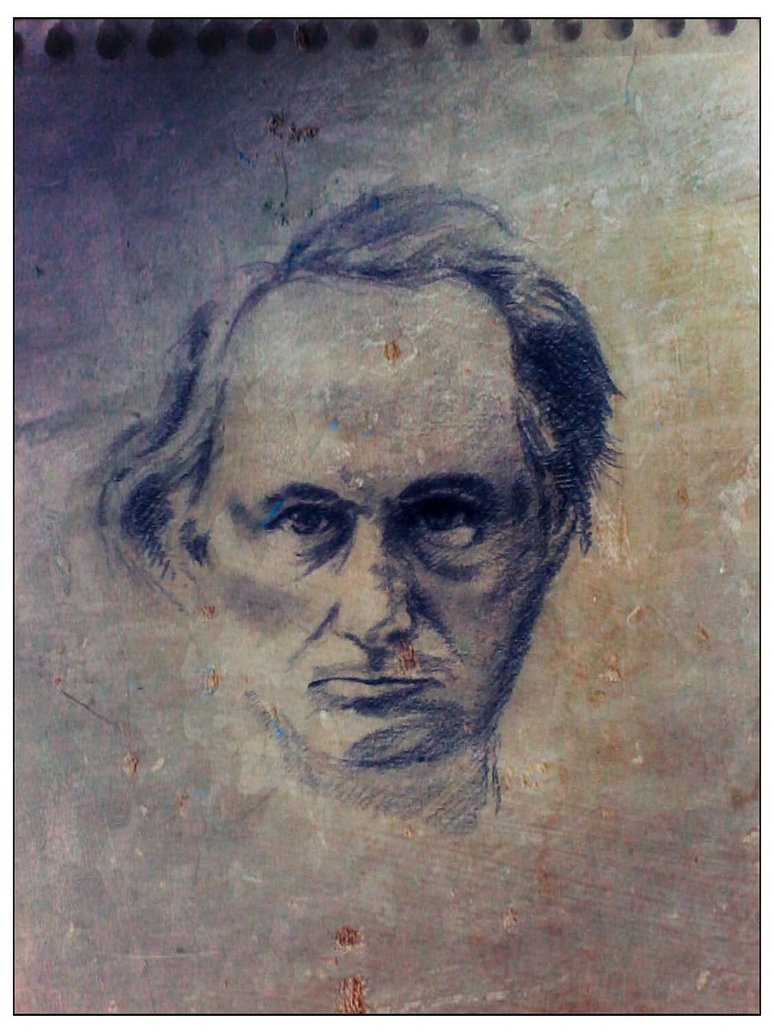
Charles Baudelaire_ by_Piccola Braci
I
Soon shall we plunge ‘neath winter’s icy pall;
farewell, bright fires of too-brief July!
even now I hear the knell funereal
of falling fire-logs in the court close by.
once more on me shall winter all unroll:
wrath, hatred, shivering dread, Toil’s cursèd vise,
and like the sun in his far hell, the pole,
my heart shall be a block of crimson ice.
I wait aghast each loud impending log;
thus, criminals ‘neath rising gibbets cower.
o dreadful battering-ram! my soul, agog,
quivers and totters like a crumbling tower,
till to my dream the cradling echoes drum
like hammers madly finishing a bier.
— for whom? — June yesterday; now fall is come!
mysterious dirge, who has departed here?
II
I love your long green eyes of slumberous fire,
my sweet, but now all things are gall to me,
and naught, your room, your hearth nor your desire
is worth the sunlight shimmering on the sea.
yet love me, tender heart! a mother be
even to an ingrate, or a wicked one;
mistress or sister, be as sweet to me
as some brief autumn or a setting sun.
’twill not be long! the hungering tomb awaits!
ah! let me — brow at peace upon your knees —
savour, regretful of June’s parching heats,
this balmy soft October, ere it flees!
— Lewis Piaget Shanks, Flowers of Evil (New York: Ives Washburn, 1931)
Bald wird man uns ins kalte dunkel flössen ·
Fort! schöner sommer der so kurz nur währt!
Schon hör ich wie mit unheilvollen stössen
Das holz erdröhnend auf das pflaster fährt.
5
Der ganze winter dringt in mich: bedrängnis
Hass zorn und schauder und erzwungner fleiss.
Der sonne gleicht im nordischen gefängnis
Mein herz · ein roter block und starr wie eis.
Ich höre zitternd jeden ast der schüttelt –
10
Ein grabgerüst giebt keinen dumpfern hall –
Und an dem turme meines geistes rüttelt
Des unermüdlich harten widders prall.
Es scheint mir von dem hohlen lärm umgeben
Dass man in einen sarg die nägel haut …
15
Für wen? gestern war sommer · herbst ist eben ·
Wie abschied klingt der rätselhafte laut.
Ich liebe deiner augen grünen schimmer ·
Du sanfte · doch nur bittres fühl ich heut ·
Nicht deine liebe nicht kamin und zimmer
20
Ersezt das sonnenlicht aufs meer verstreut.
Und dennoch · zarte seele · lieb und hüte
Auch den der undankbar mit bösem drang ·
Geliebte · schwester! sei die flüchtge güte
Von herbstesglanz und sonnenuntergang!
25
Ein kurzes werk … das grab ist gierig lauernd.
Ach ich will knieend dir zu füssen sein ·
Des weissen dürren sommers flucht bedauernd
The publication of this collection of around forty short stories from Serpent’s Tail books affords the English speaking public a unique opportunity; that of reading Walser, possibly the leading modernist writer of Swiss German in the last century. He has received high praise in A Place in the Country, W.G.Sebald’s recently published posthumous collection and he is well-known as being a significant influence on Franz Kafka. His work here dates from 1907 to 1929 and along with his poetry won him recognition with Berlin’s avant garde. He combines lyrical delicacy with detailed observation; reflective melancholy with criticism of brash commercialism. The fine writing in this volume strives to achieve a hard won integrity together with an experimental capacity for reflection. It challenges the reader and provokes him to new insights.
Referring to Walser’s ten page account, Kleist in Thun, written in 1913 Susan Sontag in her introduction states, “Wasler often writes from the point of view of a casualty of the romantic visionary imagination”. Walser describes how Kleist, an intense poet of High German Romanticism arrives in a villa in the beautiful Bernese Oberland. Kleist is overwhelmed and disturbed by his own response to what appears to him as the artificiality of his surroundings, as though it were all a sketch by a clever scene painter in an album with green covers. “Which is appropriate. The foothills at the lake’s edge are so half-and-half green, so high, so fragrant”. The changes in the weather and the seasons are portrayed as Kleist struggles with his own historical writings which he is forced to destroy over and over. This piece portrays with sensitivity Kleist’s struggle for the peaceful moments when he can feel again the outright happiness of a child. All that now remains is a plaque on the wall to commemorate the poet’s visit.
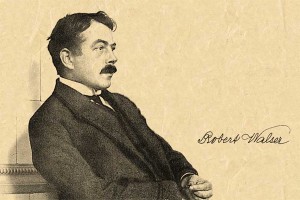
Robert Walser, Swiss poet and writer
Written over an extensive period these tales vary in tone from the surreal “Trousers” to the strange voyage of a captain, a gentleman and a young girl over the luminous course of the Elbe in “Balloon Journey”. In the more psychologically interesting “Helbling’s Story”, a bank clerk finds that he is feckless in time keeping and prefers the self-forgetfulness of dancing. His pursuit of his lively fiancée reveals that her sweetness tempered by her faithlessness. He seems caught between how he is perceived by his colleagues at the bank and his deep yearnings for isolation to the point of oblivion. There is a degree of Weltschmerz in some of these tales but worth the effort. Gradually, they repay the reader with their strange charm.
The longest story of sixty pages, “The Walk”, is an account of the writer venturing forth in his English yellow suit and recording his strongly felt impressions of the people, countryside and architecture that he encounters on a fine morning. As he gets into his stride, he remarks,” Spirits with enchanting shapes and garments emerged vast and soft, and the country road shone sky-blue, and white and precious gold”. Written in 1917, it also reveals his impressions of noisy cars passing by and of intrusive advertising in all its brashness contrasting with this rural idyll. He visits the post office, his tailor and goes to pay his taxes. Nothing escapes his eye, wild strawberry bushes, rivulets, the innocent play of children, honest black-jet dogs and he is almost hypersensitively given to reflect too upon the impression he makes upon others. Into this prose poem enter curious character like the odd lanky beanpole of a fellow called, Tomzack, who travels restlessly and devoid of human connection. Then with Swiss punctuality he dines with a cordial gracious lady that had previously been an actress. His self-justification and need for recognition attain huge and angry proportions when he negotiates his tax payments and it is at this point that his writing brings Kafka to mind. Out of this dense writing emerge passages with a sense of monumental grandeur and an awareness of transcending grace.
In addition to his value as a great writer, Robert Walser also affords the delights of entering a past world, that of Switzerland, a land isolated by the partial protection of its neutrality. The elegance of this past together with his sensitive impressions, including the already crowding and wearying pressures of commercialism, adds an extra level of piquancy. Joseph Roth, a well-known contemporary who also had a developed taste for irony, on arrival in Berlin, wrote in 1921, “The diminutive of the parts is more impressive than the monumentality of the whole”. In Walser’s writing we continually encounter this same fascination with the fine entrancing detail of small and beautiful things.
The cover image by August Sander shows three smartly dressed young farmers in Westerwald, although not entirely appropriate, makes an elegant jacket to these varied stories of imagination and vision.
Kirsten Krick-Aigner of the Jewish Women’s Archive writes of Rose Ausländer, “a German-speaking Jewish poet from Czernowitz/Bukovina who spent much of her life in exile in the United States and Germany, wrote that her true home was the word itself.”
My pores suck it up
until it’s evenly distributed
throughout my body
Days ceaselessly tattoo
lines upon my cheeks
signs none but the sibyl
can interpret
My friends are sewn up
their breath inaccessible
upon their lips there hangs a colourless flag:
a frosty smile
When I turn around
I see footprints
trailing away in the sand
The windmill on the horizon
moves its sails in time
to a lullaby
It’s time
to put an end to solitude
with bed and sleep
Rose Ausländer (translation by Vincent Homolka)
Einsamkeit I
Die Poren saugen sie auf
bis sie im ganzen Körper
gleichmäßig verteilt ist
Tage tätowieren
unablässig Linien
in die Wange
Zeichen die nur die Sibylle
deuten kann
Die Freunde sind zugenäht
man kommt nicht heran an ihren Atem
auf ihren Lippen hängt eine farblose Fahne:
frostiges Lächeln
Wenn man sich umwendet
sieht man Fußspuren die
sich verlaufen im Sand
Die Mühle am Horizont
bewegt die Arme nach dem Pulsschlag eines
Wiegenlieds
Es ist Zeit
dem Alleinsein ein Ende zu bereiten
und schlafen zu gehn
Czernowitz is situated in the area known as Bukovnia and its complex history is quite remarkable; once part of Poland-Lithuania, as Galicia, Moldavia it has an extremely varied population. For example, at http://en.wikipedia.org/wiki/Bukovina we read that in the late Eighteenth Century,” The Austrian Empire occupied Bukovina in October 1774. Following the first partition of Poland in 1772, the Austrians claimed that they needed it for a road between Galicia and Transylvania. Bukovina was formally annexed in January 1775. On 2 July 1776, at Palamutka, Austrians and Ottomans signed a border convention, Austrians giving back 59 of the previously occupied villages, and remaining with 278 villages.”
Tensions over identity, unsurprisingly, following the difficult history remain:-
Rilke’s poem seems apt for the time of the year, although the recent summer might be difficult to describe exactly as groß.
Herbsttag
Herr: es ist Zeit. Der Sommer war seht groß.
Leg deinen Schatten auf die Sonnenuhren,
und auf den Fluren laß die Winde los.
Befiehl den letzten Früchten voll zu sein;
gieb ihnen noch zwei südlichere Tage,
dränge sie zur Vollendung hin und jage
die letzte Süße in den schweren Wein.
Wer jetzt kein Haus hat, baut sich keines mehr.
Wer jetzt allein ist, wird es lange bleiben,
wird wachen, lesen, lange Briefe schreiben
und wird in den Alleen hin und her
unruhig wandern, wenn die Blätter treiben.
The phrase “picture-poems” is suggestive of imagism and Pound and Wyndham Lewis somehow seem to be current in the zeitgeist with the excellent production of Parade’s End on BBC2 adapted by Tom Stoppard in currently much in vogue. There are certainly lines which capture the visual imagination such as,” auf den Fluren laß die Winde los.” Although time and season are obviously central to the poem. This dynamic is reinforced in the second stanza with,” Befiehl den letzten Früchten voll zu sein;
gieb ihnen noch zwei südlichere Tage,
dränge sie zur Vollendung hin…..” Befiehlen here probably being an invocation so as to arrange, allow or ordain matters so that the fruits attain full ripeness.
The wind, frequently and beautifully referred to in Shakespeare’s sonnets, also connected with time for example Sonnet 54 as wanton, (” As the perfumed tincture of the roses,
Hang on such thorns, and play as wantonly
When summer’s breath their masked buds discloses:”) adds to the unruly, random, dégringole quality and to the sadness, possibly of the poet himself, in the final stanza.
Wer jetzt allein ist, wird es lange bleiben,
wird wachen, lesen, lange Briefe schreiben
und wird in den Alleen hin und her
unruhig wandern, wenn die Blätter treiben.
Of course, most English readers will immediately be reminded in this poem of Keats’s Ode to Autumn.
Season of mists and mellow fruitfulness!
Close bosom-friend of the maturing sun;
Conspiring with him how to load and bless
With fruit the vines that round the thatch-eaves run;
To bend with apples the mossed cottage-trees,
And fill all fruit with ripeness to the core;
To swell the gourd, and plump the hazel shells
With a sweet kernel; to set budding more,
And still more, later flowers for the bees,
Until they think warm days will never cease,
For Summer has o’erbrimmed their clammy cells.
Who hath not seen thee oft amid thy store?
Sometimes whoever seeks abroad may find
Thee sitting careless on a granary floor,
Thy hair soft-lifted by the winnowing wind;
Or on a half-reaped furrow sound asleep,
Drowsed with the fume of poppies, while thy hook
Spares the next swath and all its twined flowers;
And sometimes like a gleaner thou dost keep
Steady thy laden head across a brook;
Or by a cider-press, with patient look,
Thou watchest the last oozings, hours by hours.
Where are the songs of Spring? Ay, where are they?
Think not of them, thou hast thy music too, –
While barred clouds bloom the soft-dying day
And touch the stubble-plains with rosy hue;
Then in a wailful choir the small gnats mourn
Among the river sallows, borne aloft
Or sinking as the light wind lives or dies;
And full-grown lambs loud bleat from hilly bourn;
Hedge-crickets sing, and now with treble soft
The redbreast whistles from a garden-croft;
And gathering swallows twitter in the skies.
Keats wrote in 1819, ‘How beautiful the season is now–How fine the air. A temperate sharpness about it. Really, without joking, chaste weather–Dian skies–I never liked stubble-fields so much as now.”
in which the poppies are associated with the repressive/reactionary use of the Redcoats of the British Army and the grim reaper’s sickle with the cavalryman’s sword. If Rilke knew of Keats’s Ode as one imagines he did, he is unlikely to have been aware of such associations.
There is an entertaining discussion of Rilke in Clive James’s splendid collection, Cultural Amnesia: Notes in the Margin of My Time.
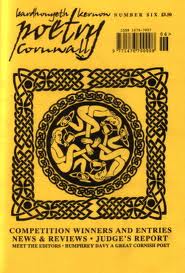
This issue contains a wide variety of contributions from over sixty poets from Scotland(which also provides the lichen encrusted wheel arch cover image from Callander) to Germany, from Wales to Spain. Naturally the emphasis are on Cornish poems and it is the landscape of Kernow which provides the inspiration for many of these verses in dialect and Kenewek with a translation and interpretation section carefully chosen by Grand Bard, Mick Paynter. It is good to see the enthusiasm for good poetry in the Duchy from such various sources as French, Scots Gaelic and even the Romany language of Gurbet. This is a collection which is not afraid to approach the edge, like Sam Harcombe, who at Warren Cliffapproached, ignoring stakes and danger signals:-
Hoping to catch sight of seal,
I wanted to look closer at the inlet far below, but
riddled with rabbit holes and
cracks it was obviously dangerous.
I went a few steps past the stakes
And still saw not enough
Bernard Jackson prefers the sylvan safety of the Sunlit Leaves as the sun sinks and he wanders entranced by the magic of a slow watered stream:-
Eternal is the flame that ne’er consumes,
Yet blazons leaves, nor shall one instant fade.
From woodland reign that readily assumes
This seasoned garb, immortally arrayed.
In traceries where sunlight shines between,
God’s glory is a miracle of green.
Bardhonyeth Kernow’s Editor Les Merton
Besides such nature poems form Perranuthnoe to Predannack, there are some moving poems inspired by the cheerful and encouraging words from the nursing staff on Geevor Ward which as Donald Rawe puts it “Restore humanity to the clinical desolation”. There are sad, human reflections on Casualty and Geriatric Wards. There are too the lifting memories of repairing with his father My Pink Bicycle by Graham Rippon:-
“Paint it any colour you like”
But the only colour we had was Pink
This little collection is a gem and a tribute to the current interest in poetry in our Duchy.
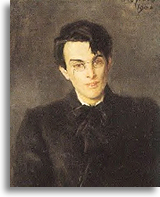
The portrait of the poet above is by his brother Jack Butler Yeats. An interesting analysis and exposition of this poem may be found at cercles.com/occasional/ops2009/noirard.pdf
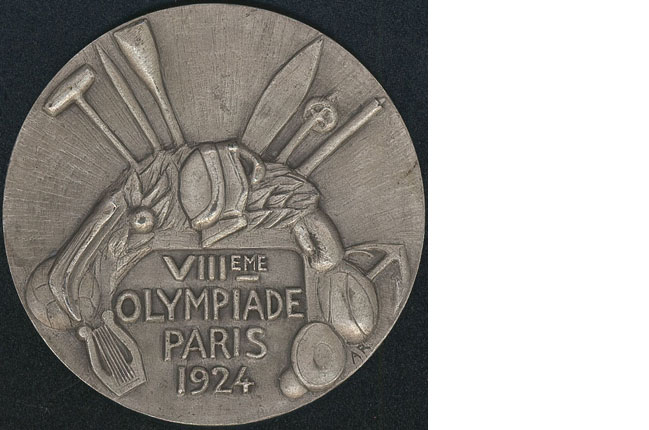
With Olympics in the news at present it is interesting to read about the Silver Olympic Medal awarded to Jack Yeats. He thus became the first Irishman to win an Olympic Medal.
Silver Olympic Medal received by Jack B. Yeats 1924
which can be found on the National Gallery, Dublin website at http://www.nationalgallery.ie/en/Research/Library_and_Archives/Libraries%20and%20Archives%20highlights/Jack%20B%20Yeats%20Olympic%20Medal%201924.aspx Here it mentions, “Jack B. Yeats (1871–1957) won this silver olympic medal for his painting ‘The Liffey Swim’ (NGI 941) in 1924. Art competitions formed part of the modern Olympic Games during its early years, from 1912 to 1948 and medals were awarded for works of art inspired by sport. Works were divided into five categories: architecture, literature, music, painting, and sculpture. The medals for the 1924 Olympic Games were designed by French medal artist André Adolphe Rivaud, (1892 – unknown).”
Jack Butler Yeats was strongly influenced by expressionism and was a friend of Samuel Beckett, J.M.Synge and the Austrian painter Oskar Kokoschka. He was a magnificent painter of horses and Dublin life in general.like the Liffey Swim (See http://en.wikipedia.org/wiki/The_Liffey_Swim). There is also an engaging video at http://www.youtube.com/watch?v=pGnbLXru-qw Here are just three paintings by Jack Yates:-
Baggot Street Bridge
Title:The Liffey Swim by Jack B. Yeats (1871-1957)Sketch of WBYeats
“O friend unseen, unborn, unknown,
Student of our sweet
English tongue,
Read out my words at night, alone:
I was a poet, I was young.” To a Poet a Thousand Years Hence
Flecker is often said to have been influenced by the Parnassians about whom Wikipedia comments:-
The Parnassians were influenced by Théophile Gautier and his doctrine of “art for art’s sake”. As a reaction to the less disciplined types of romantic poetry, and what they considered the excessive sentimentality and undue social and political activism of Romantic works, the Parnassians strove for exact and faultless workmanship, selecting exotic and classical subjects which they treated with rigidity of form and emotional detachment. Elements of this detachment were derived from the philosophical work of Arthur Schopenhauer.
These poets were French and were published in an anthology that was first issued during 1866, then again during 1869 and 1876, including poems by Charles Leconte de Lisle, Théodore de Banville, Sully Prudhomme, Stéphane Mallarmé, Paul Verlaine, François Coppée and José María de Heredia. The general style was influenced by the author Théophile Gautier as well as the philosophical work of Arthur Schopenhauer.
The Ballad Of Camden Town
I walked with Maisie long years back
The streets of Camden Town,
I splendid in my suit of black,
And she divine in brown.
Hers was a proud and noble face,
A secret heart, and eyes
Like water in a lonely place
Beneath unclouded skies.
A bed, a chest, a faded mat,
And broken chairs a few,
Were all we had to grace our flat
In Hazel Avenue.
But I could walk to Hampstead Heath,
And crown her head with daisies,
And watch the streaming world beneath,
And men with other Maisies.
When I was ill and she was pale
And empty stood our store,
She left the latchkey on its nail,
And saw me nevermore.
Perhaps she cast herself away
Lest both of us should drown:
Perhaps she feared to die, as they
Who die in Camden Town.
What came of her? The bitter nights
Destroy the rose and lily,
And souls are lost among the lights
Of painted Piccadilly.
What came of her? The river flows
So deep and wide and stilly,
And waits to catch the fallen rose
And clasp the broken lily.
I dream she dwells in London still
And breathes the evening air,
And often walk to Primrose Hill,
And hope to meet her there.
Once more together we will live,
For I will find her yet:
I have so little to forgive;
So much, I can’t forget.
Ballad of the Londoner
Evening falls on the smoky walls,
And the railings drip with rain,
And I will cross the old river
To see my girl again.
The great and solemn-gliding tram,
Love’s still-mysterious car,
Has many a light of gold and white,
And a single dark red star.
I know a garden in a street
Which no one ever knew;
I know a rose beyond the Thames,
Where flowers are pale and few.
A first attempt at translating into German
Ballade des Londoners
Die Glättung fällt auf die rauchigen Wände,
und das Geländer tropfen mit Regen,
und ich ueberquere den alten Fluss
Um mein Maedchen wiederzusehen..
Die grosse, ernstgleitende Strassenbahn,
Der ruhige geheimnisvolle Wagen der Liebe
Hat viel Licht des Goldes und weiß
und einen einzelnen dunkelroten Stern.
Ich kenne einen Garten in einer Straße
Den niemand je kannte überhaupt wussten;
Ich kenne eine Rose jenseits der Themse,
Wo Blumen bleich und wenige sind..
With Maupassant’s new version of Bel Ami portraying the belle époque, having recently been released in the UK, Forain is certainly of current interest. The trailer may be found at http://www.imdb.com/title/tt1440732/ Of course the well-known previous version was released by director, Willi Forst inGermany in 1939.
Forain was a FrenchImpressionist painter, lithographer, watercolorist and etcher and has recently been the subject of some interesting and charming exhibitions. About his drawing the Spaightwood gallery, Upton MA ( http://www.spaightwoodgalleries.com/Pages/Forain2.html) says,”A participant in the Impressionist exhibitions of 1879, 1880, 1881, and 1886 and a close friend of Manet and Degas, Forain was considered one of the most important artists of the first few decades of the twentieth century, frequently compared to Rembrandt for his emotional power as an etcher. His drawings were regularly reproduced just as Daumier’s had been in the mid-19th century, but Forain’s not only ridiculed follies but sympathisize with the poor and the unfortunate. He was one of Ambroise Vollard’s stable of artists along with Renoir, Rouault, Chagall, Dufy, and many others.”
Forain was strongly influenced by both Daumier and Degas, the latter was a friend of some fifty years and acknowledged the closeness of their styles when he said, “He paints with his hands in my pockets”. Additionally Forain attended the famous heated debates which took place Édouard Manet and Edgar Degas at the Café de la Nouvelle Athènes. There is a particularly relevant and interesting discussion on the social history of such cafés and the development of the modernist movement at http://etd.lsu.edu/docs/available/etd-0903102-153114/unrestricted/Dees_thesis.pdf
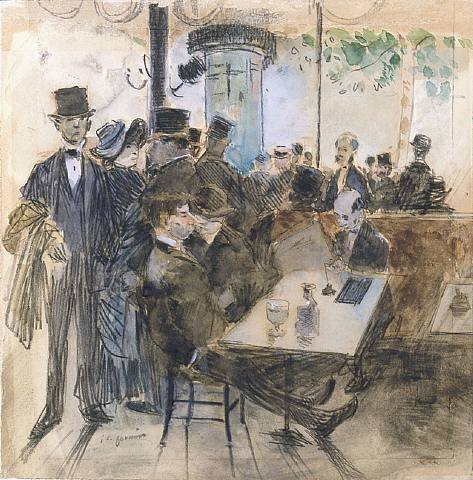
Au café circa 1872 Watercolour 19.5 x 19 cm
Certainly, Forain was an assiduous painter of the café scene as may be discerned from the early watercolour sketch “Au Café” circa 1872. The engaging atmosphere and general bonhomie of the scene, perhaps in Spring depicts clerks and businessmen taking a breather at lunchtime, lovers meeting and the overarching foliage providing the shelter to bavarder over a glass of wine. The poise indicated by the extended legs of the figure seated at the table completes the mood. The influence of Daumier is certainly present; Forain was about 22 or 23 years old.
As is well known, Jean-Louis Forain had a ready wit and was the associate of Rimbaud, Verlaine and in particular Joris-Karl Huysmans. It was Arthur Rimbaud who wrote in a fragment,” Le haut étang fume continuellement. Quelle sorcière va se dresser sur le couchant blanc? Quelles violettes frondaisons vont descendre ?” Which has been translated as.”The upland pond smokes continuously. What witch will rise against the white west sky? What violet frondescence fall?” This is reminiscent of a lovely painting by Forain entitled Young woman standing on a balcony contemplating the Paris Rooftops, 1890.It was completed in Watercolour with black Conté crayons, red chalk and brush on paper and is to be found in theVancouver Art Gallery. It is appears as an early prototype of the bandes dessinées and the woman’s left profile stance resembles the figure in Seurat’s roughly contemporaneous Sunday Afternoon on the Island of La Grand Jatte,1884–1886.
 Das ist der Herbst; die Blätter fliegen,
















 penwithlit