Donarkanal-schoene!


Last night I went for a stroll along the canal with my sweetheart. The weather is turning, so people are coming out of the woodwork, eyes blinking at the bright light. I’m looking forward to warmer temperatures this weekend. 🙂
Donarkanal-schoene!
Last night I went for a stroll along the canal with my sweetheart. The weather is turning, so people are coming out of the woodwork, eyes blinking at the bright light. I’m looking forward to warmer temperatures this weekend. 🙂
My current read…
![Thomas Mann im April 1937, zu der Zeit, in der "Lotte..." entstand Bildquelle [9]](https://penwithlit.com/wp-content/uploads/2015/03/lotte-mann.jpg) Thomas Mann im April 1937, zu der Zeit, in der “Lotte…” entstand
Thomas Mann im April 1937, zu der Zeit, in der “Lotte…” entstand
Bildquelle [9] “Lotte in Weimar” [1] ist ein Roman Thomas Manns [2], der 1939 erstveröffentlicht wurde und zwar in Schweden. Mann befand sich zu dieser Zeit schon im Exil, nachdem ihm drei Jahre zuvor aufgrund seiner Positionierung gegen das Nazi-Regime die deutsche Staatsbürgerschaft aberkannt worden war.
Ein Roman über Goethe, aufgehangen am historischen Besuch der Charlotte Kestner, geb. Buff, in Weimar, der 1816 stattfand, im September dieses Jahres. Weimar, in dessen unmittelbarer Nähe einmal das Konzentrationslager Buchenwald eingerichtet werden sollte, war zu dieser Zeit der “Weimarer Klassik” [3] ein Fixstern, ein überaus hell strahlender Fixstern am geistigen Himmel Deutschlands, ja Europas. Schiller, der ein paar Jahre zuvor gestorben war und eben Goethe, aber auch viele andere Dichter und Gelehrte waren mit der Stadt verbunden wie z.B. Wieland und Herder.
Die Zeit nach der Jahrhundertwende war aber auch eine…
View original post 2,119 more words
Looks very interesting-
28.11.2014 – 12.04.2015
What most inspiring than on Saturday morning step at Pinakothek der Moderne to see this amazing interesting small exhibition, “ Expressive El Greco”. The work ‘The Disrobing of Christ’ is the first work from the Alte Pinakothek to be shown in the Pinakothek der Moderne.. This quest appearance highlights a noteworthy art historical point: the beginning of the 20th century El Greco became a role model of central importance for many European artists. They enthusiastically examined his work and celebrated him as a prophet of Modernism.
Curators: Dr. Elisabeth Hipp, Dr. Oliver Kase
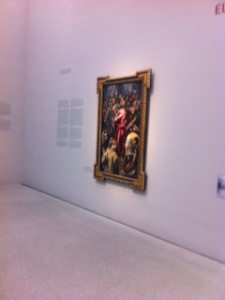
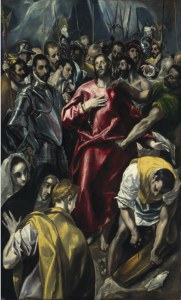
El Greco (Doménikos Theotokópoulos) (1541-1614) and workshop, The Disrobing of Christ, bet. 1580 and 1595, oil on canvas, 165 x 98,8 cm © Bayerische Staatsgemäldesammlungen, Alte Pinakothek, Munich.
‘The Disrobing of Christ’ had already been acquired for the Alte Pinakothek in 1909 by Hugo von Tschudi (1851-1911), one of the pioneering…
View original post 299 more words
Unsre Wiesen grünen wieder,
Blumen duften überall;
Fröhlich tönen Finkenlieder,
Zärtlich schlägt die Nachtigall.
Alle Wipfel dämmern grüner,
Liebe girrt und lockt darin;
Jeder Schäfer wird nun kühner,
Sanfter jede Schäferin.
Blüten, die die Knosp’ entwickeln,
Hüllt der Lenz in zartes Laub;
Färbt den Sammet der Aurikeln,
Pudert sie mit Silberstaub.
Sieh! das holde Maienreischen
Dringt aus breitem Blatt hervor,
Beut sich zum bescheidnen Sträußchen
An der Unschuld Busenflor.
Auf den zarten Stengeln wanken
Tulpenkelche, rot und gelb,
Und das Geißblatt flicht aus Ranken
Liebenden ein Laubgewölb’.
Alle Lüfte säuseln lauer
Mit der Liebe Hauch uns an;
Frühlingslust und Wonneschauer
Fühlet, was noch fühlen kann.
aus: Gedichte von Joh. Gaudenz von Salis-Seewis
Neueste vermehrte Auflage
Zürich bei Orell, Füßli und Compagnie 1829 (S. 5-6)
The curtain rises and we are immediately impelled into a Kafkaesque world. The imposing set comprises of a ceiling height of office drawers on either side; a dull grey-brownish limbo-land that looks like the headquarters of the Stasi. The denizens of this sub-topia, Martin and Daniel, dressed like waist-coated bureaucrats from the start of the last century creep around the stage with elaborate gestures and mincing steps. This appears to be a world where cheer must be maintained and institutional routines kept to, deadlines met and clients re-assured. In short a world where anxiety must be kept at bay.
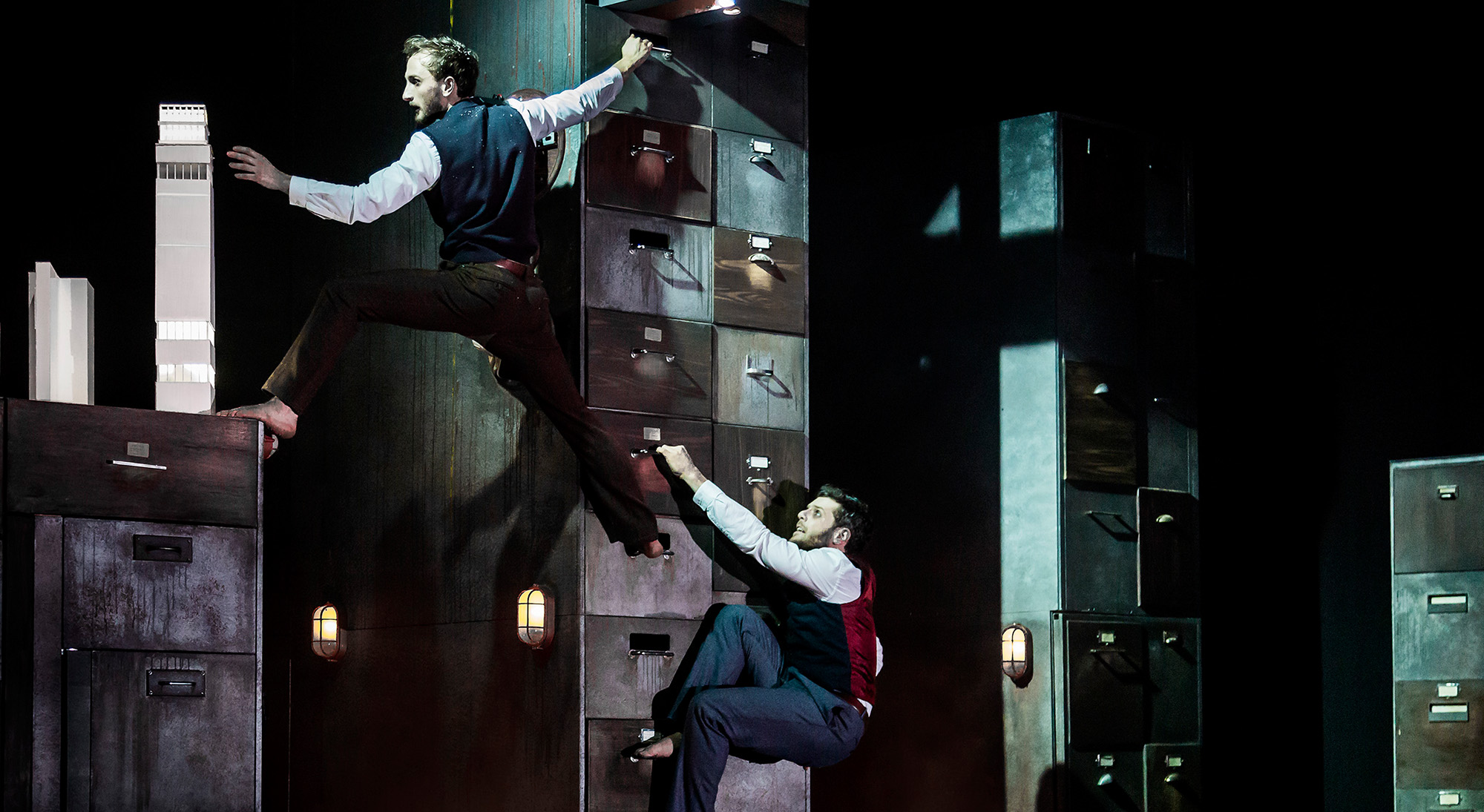
Music and wine and romance are introduced at suitable intervals. The dancing now conveys in sudden changes possible ways in which spirits can be raised or perhaps just maintained. The adaptability of the set is revealed as a drawer is pulled out, a spot-lit crimson rose waivered and a waiter emerges to supply the wants of his nervous guest. Nervous, because the lady he awaits is just a pair of surreal hands. His imagination may be playing tricks. Perhaps he has been overworking at the office where a slight mistake can be punished by extreme changes in the environment; a spotlight, loud klaxon and flashing red lights. Here is an eerie world of lost love, heartache and miscommunication where fog prevails and anyone might suddenly need a prosthetic attachment just to keep on going. Indeed, we all realise that any support mechanism keeps you dependent and, as the expressive movements so eloquently show, subject to a new fear-being manipulated by others. Gecko’s theatre shows us just how old-age, illness and impediment bring in their wake, the burdens of dependency; powerlessness against the perilous incursions of the “system”.

Although the production concerns itself with confusion and conflict, it is not possible to overlook the quality of the dance. The splendid and remarkable co-ordination, involving thoroughgoing trust between the four male dancers, is the result of intensive training. This performance quality is clearly due to hours of training. Conversations with care givers and their clients have paid dividends. The research has resulted in a work which is not only innovative but stirringly original.
The authenticity of The Institute is evidenced by the manner in which scenes are retained in the memory. These may well be different for each member of the audience. It will deeply resonate with personal emotional experience. Lyricism is evoked when hand held lights are carried floating across a darkened stage and poetry again, at the end, when a silhouetted trio of Masai warriors stand against a setting sun. The articulated pole-linked movements of the dancers rendering support to a frightened and shattered client, in search of his distant and unavailable beloved appear, uncannily like Gregor Samsa transformed into a giant spider from the pages of Franz Kafka’s Der Verwandalung. The sub-text in many parts is the how the actions of an institution results in a control mechanism colliding with flesh, like a sharp catheter being inserted into a collapsed vein. However, moments of comedy lighten and vary the pace, as when one performer has a lampshade suspended above him like an angler-fish. This is less a mechanism for predation than an ironic re-emphasis of the isolation of the individual.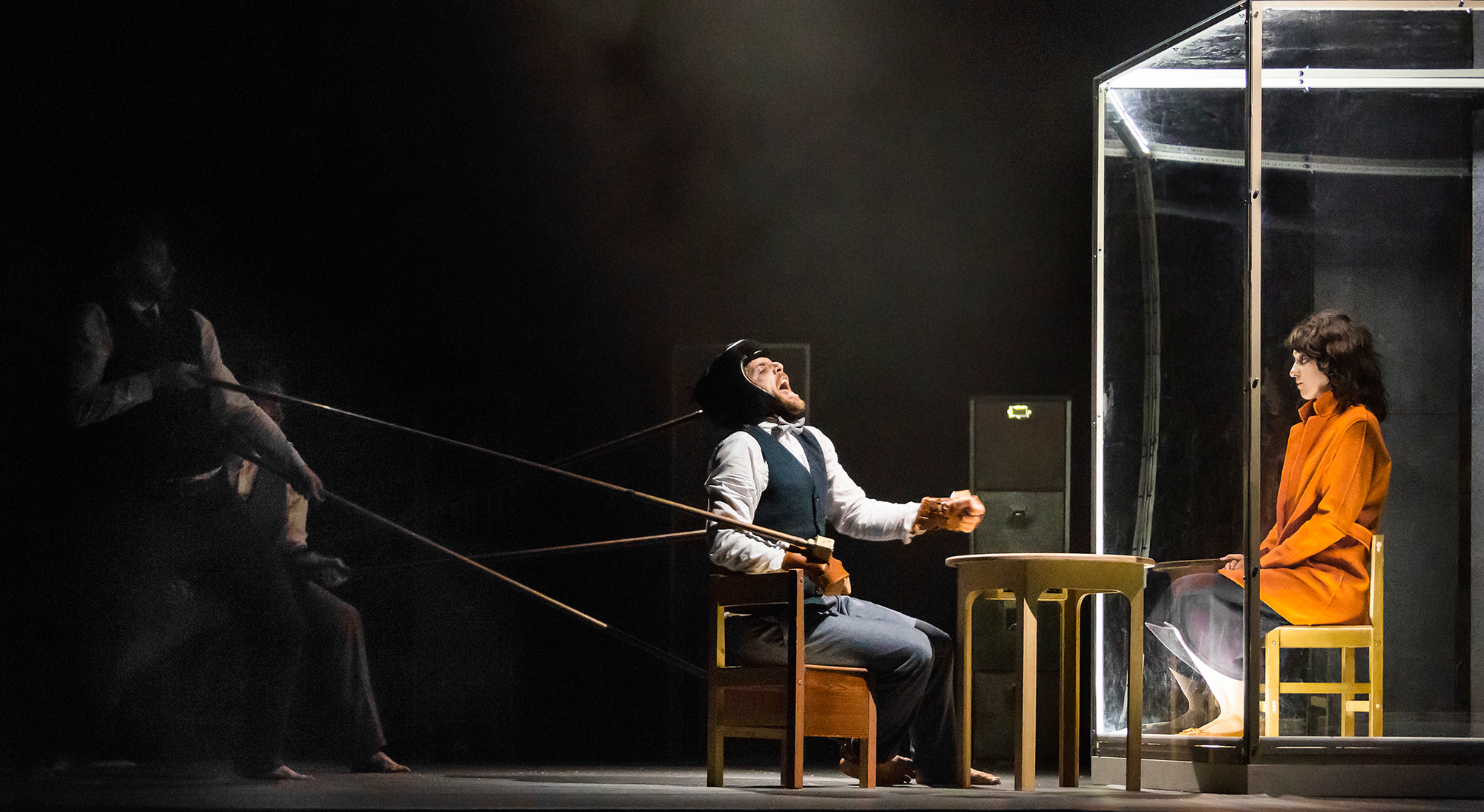
Verbal communication has a particularly interesting role in Gecko’s production. Initially starting with a restrained, cramped discourse where one half-expected Ricky Gervais to make an entrance. It finished with closed-microphone expressive panting. However, it was the use of both French and German to reassure, as it were ‘the patient’ that was particularly engaging. This multilingual exchange managed to convey that words which seem to re-assure can actually disturb and distance. If this was French it was the sort of unsettling French that would be used by Ionesco. In psychiatric distress or dementia or such similar states, there is a reawakening of a child who initially is grasping to express feelings in words. Here the double-bind was clearly illustrated and gesture conveyed frustration at being manipulated. In a thought-provoking and moving production cleverly using props and Francis Bacon-like enclosures, time and life pass onward in the background. The highest accolade is that it invigorates the problematic debate about caring and manipulation which makes Gecko’s Institute both effective and relevant to contemporary social and political concerns.
Here is a video sample from Gecko entitled “Missiing Trailer”
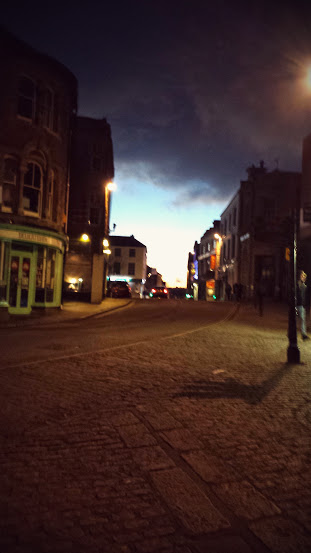
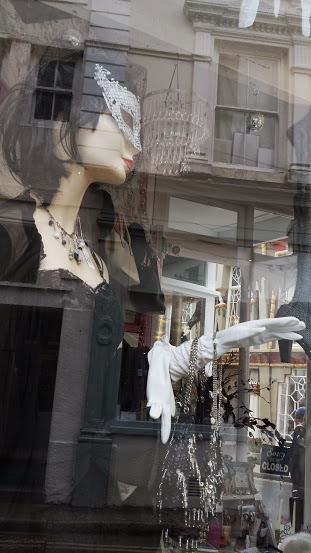
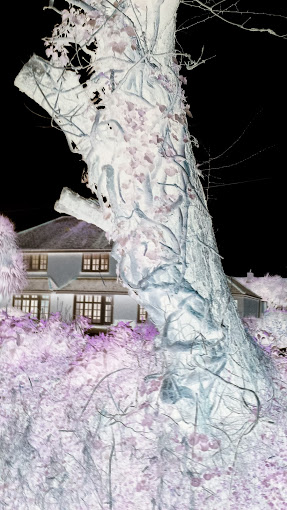
Just a few images around and about Penzance in the past few weeks.



Rose Zimmer, a feisty American communist radical, takes on many good and great causes. These include everything from feminism and racism to the changing course of Stalinism in the American C.P. but most of all; her biggest causes are the people around her. The effects upon them are diverse and devastating. She often propels them to success but at the same time they feel battered and must escape in order according to their own needs. Her affections are real but invasive. Rose keeps a shrine to Abraham Lincoln. Rose’s self-assertion within the perimeters of the German-designed 20th Century New York suburb of Queens, a multi-cultural suburb and a planned housing development similar to Hampstead Garden City provide the setting for Jonathan Lethem’s Tour de Force.
Reading Dissident Gardens is rather like taking a plane to New York and perhaps linked into a time-machine to peruse 80 years of political tensions that stress three generations. Lethem, who trained as an artist, is quite superb at visually rendering the city brown brick tenements, elevated railways, grand bridges and squares and together with their uses. Some of the latter, for instance, under the influence of socially concerned denizens like Rose, have been commandeered into communal gardens. Additionally, you even get a taste of the food from iced bear-claws, milkshakes and salt-beef sandwiches. His ear is at least as strong as his eye and the salty, saucy language carries the vigorous impact of Italian, Irish, Hispanic and Yiddish all gemischt. The reader will benefit from access to a good dictionary of urban slang to navigate this environment as much as his or her GPS so as not to lose your way in this city jungle.
As with a city break, the most interesting aspect of any visit is meeting the locals. Here Lethem provides panoply of fabulous characters. His technique is such that you he reveals not just the stream of consciousness but also the fractured and sometimes damaged nature of their sudden preoccupations. There is Cicero Lookins, the brilliant, angry, black, gay and overweight college lecturer. He has the dubious privilege of becoming Ross’s protégé and carries the burden of growing up the son of a nurse who is suffering from chronic lupus and a conventional heroic policeman from the NYPD who has become Rose’s lover. Cicero is a volatile mixture of intelligence, cynicism and compulsive sexuality. His lecturing style challenges the young and indolent yawning student audience that attend his social philosophy lectures. He is reading Robert Musil’s grand scarcely completed novel, The Man Without Qualities. He has become imprisoned by his own psychological defences and just how this developed is lucidly, believably and eloquently explained with a certain ironic sympathy.
Each chapter can almost be taken as a story within itself. This is a satisfying approach as there is little in the way of a page-turning narrative to speed the story forward. Indeed, this is a novel that casts light upon what has happened in previous chapters as well as links with other persons. It jumps around and resonates in time. This backward linking is intriguing in itself and gradually makes the relationships between the characters memorable. Dissident Gardens is not always easy to read but the detail, texture and breadth of the writing weaves a brisk believable magic as the story progresses. Idealism is often exposed in its naivety in this novel. The characters, as in real life, are often deeply wounded by losses but remain authentic in their striving.
This is a novel which spreads itself over the globe whilst embracing wide belief systems. Nicaraguan armed resistance, passive resistance, the Occupy movement, East German authoritarian Marxism are but a few of the topics encompassed. However, this is not in the usual sense a novel of ideas. It is critical of grand narratives in a manner that the renowned American pragmatic philosopher, Richard Rorty might have approved. It is the individual enclosed within the fascinating psycho-geography of New York that keeps the reader interested. For instance, there is Rose’s daughter who cannot possibly meet her mother’s expectations. Miriam Zimmer survives her mother’s physical attack and seeks an alternative belief within Hippie Greenwich Village of the 1960s. She is pursued by her hustler cousin Lenny whose interests also include chess and numismatics. She falls for an Irish protest singer who is attracted by prospects of living in a commune and attending meetings with the Society of Friends. However, in certain ways Miriam cannot easily escape her mother or her authoritarian distant father.
Reading about Lethem’s writing methods- said to be on an exercise machine using a voice operated word processor- accounts for the energy of the writing. The style is sometimes abrasive but also beguiling. This novel can be described as both tragic and comic. Tragic in the sense that the characters often seem isolated and comic because the reader will recognise some of his own impulses and be encouraged to laugh at them. I am left reminded by the words of a song from the musical Hair: – “Do you only care about the bleeding crowd? How about a needing friend? I need a friend” If there is a message from this novel, it is about our need for human closeness and how the grand systems we erect prevent us getting in touch with each other.
Frühlingsorakel
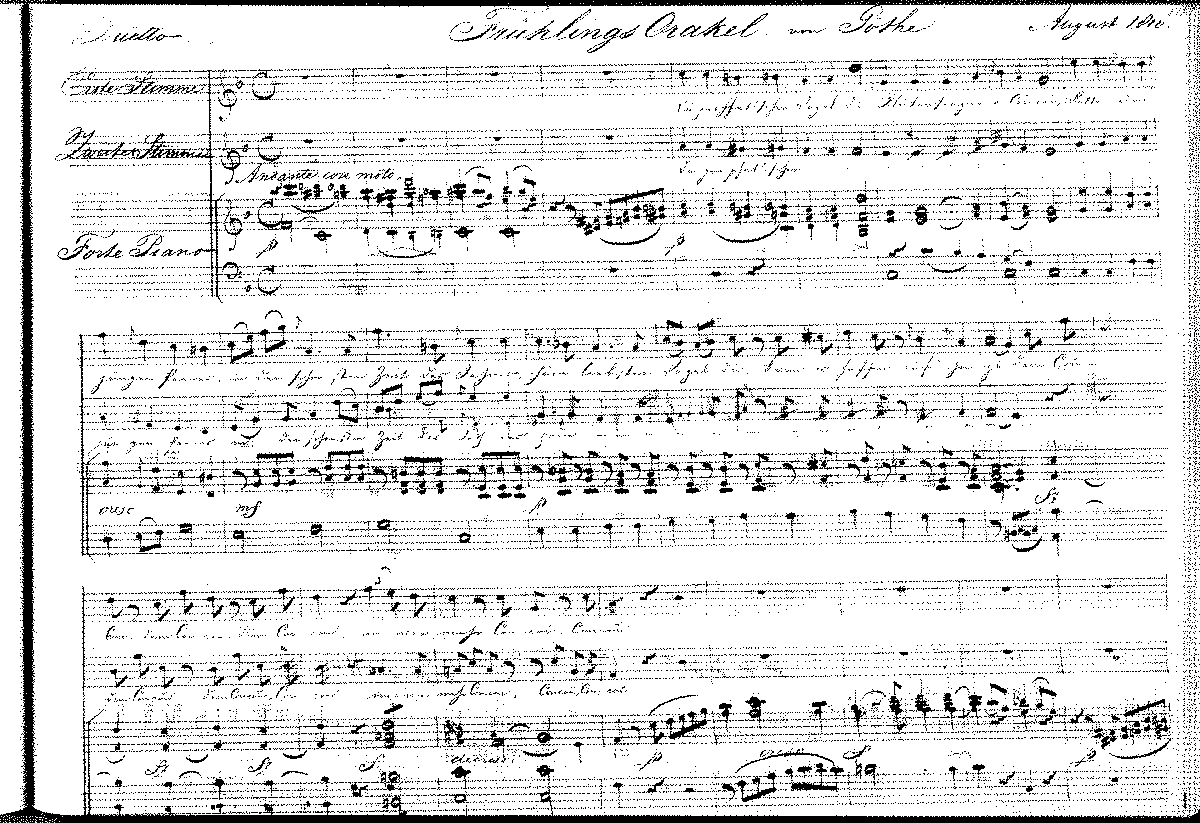
Du prophetscher Vogel du,
Blütensänger, o Coucou!
Bitten eines jungen Paares
In der schönsten Zeit des Jahres
Höre, liebster Vogel du;
Kann es hoffen, ruf ihm zu:
Dein Coucou, dein Coucou,
Immer mehr Coucou, Coucou.
Hörst du! ein verliebtes Paar
Sehnt sich herzlich zum Altar;
Und es ist bei seiner Jugend
Voller Treue, voller Tugend.
Ist die Stunde denn noch nicht voll?
Sag, wie lange es warten soll!
Horch! Coucou! Horch! Coucou!
Immer stille! Nichts hinzu!
Ist es doch nicht unsre Schuld!
Nur zwei Jahre noch Geduld!
Aber, wenn wir uns genommen,
Werden Pa-pa-papas kommen?
Wisse, daß du uns erfreust,
Wenn du viele prophezeist.
Eins! Coucou! Zwei! Coucou!
Immer weiter Coucou, Coucou, Cou.
Haben wir wohl recht gezählt,
Wenig am Halbdutzend fehlt.
Wenn wir gute Worte geben,
Sagst du wohl, wie lang wir leben?
Freilich, wir gestehen dirs,
Gern zum längsten trieben wirs.
Cou Coucou, Cou Coucou,
Cou, Cou, Cou, Cou, Cou, Cou, Cou, Cou, Cou.
Leben ist ein großes Fest,
Wenn sichs nicht berechnen läßt.
Sind wir nun zusammen blieben,
Bleibt denn auch das treue Lieben?
Könnte das zu Ende gehn,
Wär doch alles nicht mehr schön.
Cou Coucou, Cou Coucou :,:
Cou, Cou, Cou, Cou, Cou, Cou, Cou, Cou, Cou(Mit Grazie in infinitum)
Johann Wolfgang von Goethe


 penwithlit