 This brilliant and varied collection of short stories is the product of a current academic interest in cross-cultural translation. Francisco Guillen Serés is a Catalan professor of Art History from Aragon. A Russophile, he has travelled widely to collect stories from those writing during the past hundred years of Russian history. These have been translated into Catalan and then into English. These unusual and delightful stories, some 21 of them written by 5 writers read fluently and engagingly. They form an informative tapestry of Soviet and post-Soviet life, moving back in time with the older, earlier writers like Bergchenko, who died in the siege of Stalingrad, at the end. Ranging over mythic and symbolic tales to realistic portrayals of personal relationships; love Trysts in St Petersberg, ferocious bears in the deep heart of the Taiga to the perils of becoming lost in continuous orbit in space. All aspects are impressively recounted.

In the preface Russian translator, Anastasia Maximova, sets the changing scene in an industrial suburb where she grew up in the 1990s. The esplanade in front of steel blast furnaces is littered with defunct statues of Stalin and Lenin about to be reprocessed. Unforgettable, is her description of the trucked in lines of heads made from incredibly tough alloys. These are so durable that a special technique must be evolved such that the heads must be drilled with holes, and then buried below ground where inserted explosive charges are necessary to blow them apart. Throughout these stories, such descriptions also represent hazardous transitions in Russian society, the effects on individuals are sometimes stultifying, often painful but also meliorated and transformed by generosity, friendship and kindness.
The first two authors, both of whom are women, born in 1967 and 1949 respectively, deal with personal issues against the backdrop of economic failure and authoritarian misrule. In Low Cost Life, Low Cost Love, Ola Yevgueniyeva writes of the sad and drab lives of the ground staff hostesses on the Russian airline, SAS outside St Petersburg. There is a feeling of being unable to attain the attractive standards of the more fortunate western European crews. Even the bus transport to the airfield has hard wooden benches and the roads contain bumps and potholes. This disappointed sadness creeps into relationships with men; low self-esteem leading to lowered expectation of their dates. A sorrowful but somehow poetic realism penetrates this writer’s stories. She writes too of resurgent nobility in St Petersburg’s great houses by the Neva which have survived the revolution, war and famine. In “The Russian Doll’s House” the ardent but impoverished Juri must wait for years distanced from the aristocratic and beautiful Mia. She must marry an oafish industrialist in accordance with her family’s demands. The story is written in a spell bounding, elegant style that brings out the tragedy of restricted, almost unrequited love.
These stories have all been carefully chosen and reminiscent of the language and tradition in which Chekhov and Gorky once wrote. Indeed the book is dedicated to Mikhail Bulgakov. There are tragic-comic stories about the possibility that Elvis might have sung in Red Square, of the last lonely hours of an orbiting spaceman suffering the consequences of yet another system failure. Here then is a parable of a superpower in a state of freefall. The terrible ecological disasters of the Aral Sea and Chernobyl are treated. The latter portraying the return of an old, yet determined, couple to the dangers of an irradiated countryside and how their dutiful daughter is torn between fulfilling their wishes and what she thinks is their imminent demise.
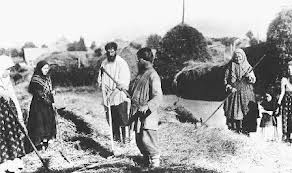
 As the tales pass backwards along the brutal path of Soviet history, misplaced idealism and naivety are revealed. “The Russian Road ” long, hot and dusty finds the exhausted revolutionary Akaki returning the many versts to his home village. When he arrives he finds that among the peasants in the countryside little if anything has changed. His attempts to persuade folk there that in exchange for their potatoes they will receive a transforming new culture are met with astonished disbelief. Curious, thought-provoking and allegorical, Volkov’s “The War against the Voromians” tells of a peculiar area where there is a gravitational field anomaly. The inhabitants are subject to a corresponding increase in weight, have thicker necks and an affection for their homeland. They sadly become subject to state sponsored research and suspicion by the authorities. Population dispersal is forced upon these unfortunate Voromians, victims of external manipulation that seems to prevail in so many of these accounts.
Kafka once wrote, “A book should become an axe for the frozen sea within us.” This collection, carefully selected, fulfils such a criterion. They have the transformative edge of original writing.
Further details at http://www.lletra.net/en/author/francesc-seres






 penwithlit