Categories
Category: Uncategorized

Unfortunately much Eastern European painting has been neglected too until relatively recently.

In the first of these two articles, I showed my favourite paintings by Gustav Klimt, the first president of the Vienna Secession, the most influential and enduring of the art revolutions to spread across Europe at the end of the nineteenth century. Today I show some examples from other painters in that movement in Austria.
The Secession’s honorary president was Rudolf von Alt (1812–1905), who had trained in Vienna and was the most respected Austrian landscape painter of the day. He had travelled extensively in Europe, as far as Crimea, and painted some superb views of Italy. He was ennobled in 1889 for his artistic achievements.
 Rudolf von Alt (1812–1905), Altaussee Lake and Face of Mount Trissel (1859), watercolour, 26.5 x 37.1 cm, Leopold Museum (Die Sammlung Leopold), Vienna, Austria. Wikimedia Commons.
His earlier and mature watercolours are rich in detail, as in his Altaussee Lake and Face of Mount…
View original post 1,095 more words

Absolutely love Klimt and his use of gold paint. A magnificent draugtsman and of course his encouraging effect on Egon Schiele.
Between the late nineteenth and early twentieth centuries, a wave of revolutions in art spread across Europe. In these, substantial groups of artists working in a wide range of media rejected the conservative standards maintained by Academies and Salons. These started in Paris and Munich, and spread quickly to Berlin and Vienna. Later movements in Poland and elsewhere, although not termed secessions, followed suit.
The most influential and enduring of them all is that in Vienna, led by the painter Gustav Klimt, which has become synonymous with Art Nouveau, and extended to glasswork, ceramics, furniture and architecture. This weekend I look at a small selection of paintings which show how diverse it was even in the graphic arts.
There is no such thing as a Vienna Secession style, but the members of the movement came together to provide an alternative to the Association of Austrian Artists, in their Vereinigung Bildender…
View original post 1,064 more words

Lovely colours and mythical enchantments.
Painting in pastels is as close as you can come to pure pigment, thus to pure colour. This week’s pastellist is perhaps the greatest exponent of this. Odilon Redon (1840–1916), who is known by his nickname acquired from his mother, Marie-Odile, didn’t turn to pastels until the middle of his career.
He tried to start with a classical training, but couldn’t gain admission to the École des Beaux-Arts in Paris, and didn’t stay long as a pupil in Jean-Léon Gérôme’s studio. He concentrated on etching and lithography during his early career, then turned to painting in oils. It wasn’t until the 1890s, when he was in his fifties, that Redon concentrated on painting. For the next twenty years he produced a series of highly original paintings in oils and pastels.
 Odilon Redon (1840–1916), Mystical Knight (Oedipus and the Sphinx) (1894), pastel, dimensions and location not known. Image by Cactus.man, via…
View original post 1,133 more words
Very interesting from many viewpoints, not least diversity.

Cultural warning to Indigenous readers: This post contains the names of people who have passed away, and uses some terminology which may offend.
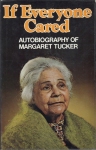 This time last year, for Indigenous Literature Week 2021, I was pleased to host a guest review by Margaret (Meg) Broughton, of Margaret Tucker’s If Everyone Cared (1977). This year, I read it myself, and share Meg’s opinion that it’s a fascinating story of an outstanding woman who was one of Australia’s earliest female Aboriginal activists in the 20th century. It’s not just an important life story—a significant first-hand account of Stolen Generations policy—it’s also interesting to explore how this book published nearly half a century ago, fits into the literary history of First Nations in Australia. This is what I have focussed on, so I recommend reading Meg’s review first, for her insights into Margaret Tucker’s life story.
Please note that I am not a scholar…
View original post 1,741 more words
Categories
Autoportrait Day 188~ Masa Feszty

A random survey of self-portraits created by women through the centuries
Hungarian painter Masa Feszty (1895-1979)
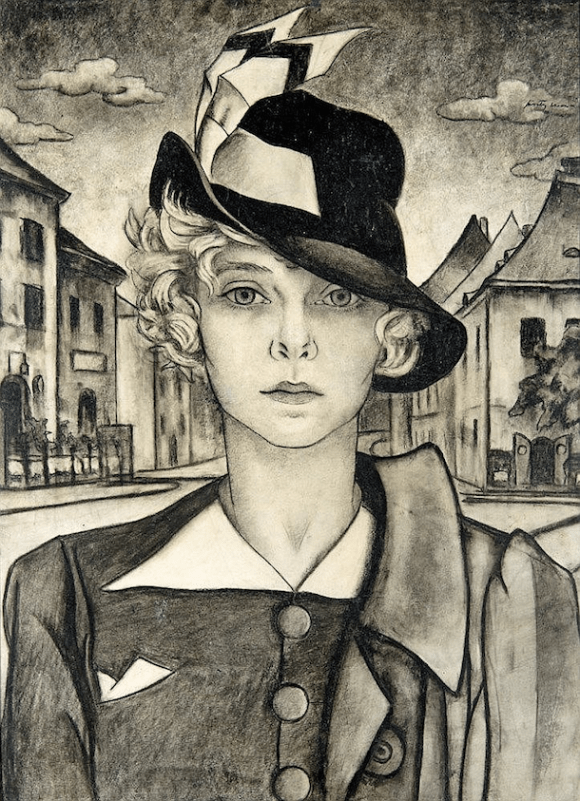
Self-portrait, ND / Charcoal on paper laid on paperboard / Private collection
[2 embedded links above]
Categories
Side Street, Paris, France
Categories
sardine and greens suggestion

Anna Tobias of Deco Cafe interviewed in The Modern House
“If I’m cooking for myself, I often make pasta. I’ll always have pasta in my cupboard, alongside tinned tomatoes, anchovies, sardines or a good tin of tuna, lemons and rice. That’s it. The basics. I’ve started making a dish that involves frying some onions, boiling some sort of greens – leeks, broccoli, chard, or whatever I have at home – and then stirring it all together with a tin of sardines. Add some lemon juice and a boiled egg and serve it with rice. It’s delicious.”
I must try this.
Categories
Fifty years on…
Well, that is all very impressive especially for someone who took Pure Maths, Applied Maths and Physics like myself. I agree that the pressures now are huge but can’t say School Days were not free of considerable pressures; Still recovering from failing Cambridge Entrance!!

The older you get, the more anniversaries there are; it recently occurred to me that it’s now 50 years since I sat my A Levels… good grief! And what a simple business it all was way back then. All exams, for a start: no continuous assessment, no coursework or anything like that. Just sit in silence and write and write and write.
English literature (well, obviously); I think we’d studied eight set books and only had to write about six, so there was a choice. Othello and King Lear, Doctor Faustus, Paradise Lost 9 & 10, Chaucer’s Merchant’s Prologue and Tale, A Portrait of the Artist as a Young Man, The Shadow of a Gunman, Andrew Marvell’s poetry… is that all of them? Don’t recall which I avoided…
French: dictation, I remember, unseen and prose translation, essay, and literature. Le Mariage de Figaro, Le Roi Se Meurt, Servitude et Grandeur…
View original post 638 more words


Who Is Odilon Redon?
Odilon Redon was a French symbolist painter, printmaker, draughtsman and pastellist.
Known for his unique blend of artistic naturalism and symbolic subject matter, Odilon Redon was highly influential among the late 19th century French avant-garde circle. Working in charcoal, pastel, oil, and lithography, Redon created imaginative scenes that, while often based in the supernatural, were nonetheless executed in a highly representational manner.
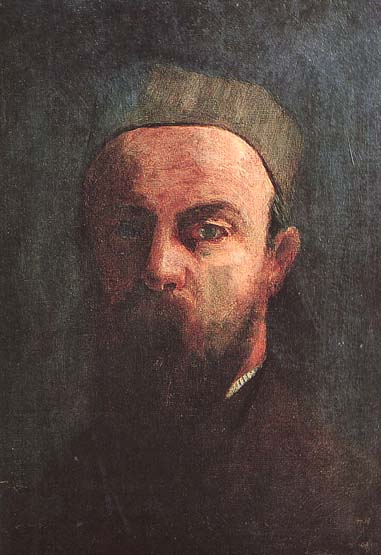
Redon considered this descriptive accuracy essential, writing
“every time that a human figure does not give the illusion that it is … about to come out of the picture frame to walk, act or think, the drawing is not a truly modern one.”
from artsy.net
What is Symbolist Art?
Symbolist artist Odilon Redon created…
View original post 208 more words
 penwithlit