Autumn, T.E. Hulme, ‘i walked abroad,/And saw the ruddy moon lean over a hedge.’
Eurydice, H.D.,’Fringe upon fringe/of blue crocuses,/crocuses, walled against blue of themselves,/blue of that upper earth,/blue of the depth upon depth of flowers,/lost;’
Blizzard, William Carlos Williams, ‘Hairy looking trees stand out/in long alleys/over a wild solitude.’
The Blue Scarf, Amy Lowell, ‘How loud clocks can tick when a room is empty, and one is alone!’
Madrigal, Richard Aldington, ‘But daylight brought no slumber to my pain.’
Baudelaire wrote of the strolling poet in the Paris crowd:-
The poet enjoys the incomparable privilege of being able to be himself of someone else, as he chooses. Like those wandering souls who go looking for a body, he enters as he likes into each man’s personality. For him alone everything is vacant; and if certain places seem closed to him, it is only because in his eyes they are not worth visiting.
The solitary and thoughtful stroller finds a singular intoxication in this universal communion. The man who loves to lose himself in a crowd enjoys feverish delights that the egoist locked up in himself as in a box, and the slothful man like a mollusk in his shell, will be eternally deprived of. He adopts as his own all the occupations, all the joys and all the sorrows that chance offers.
The Paris, a few years after Baudelaire’s passing is shown in these remarkable pictures taken between 1900 and 1917. Baudelaire died in 1867 but his remarks are interesting and pertinent to some of the following photographs, which were shot in direct colour using the Autochrome process developed by the famous Lumière brothers in 1903.
In the original French from Spleen (1869)
Le poète jouit de cet incomparable privilège, qu’il peut à sa guise être lui-même et autrui. Comme ces âmes errantes qui cherchent un corps, il entre, quand il veut, dans le personnage de chacun. Pour lui seul, tout est vacant ; et si de certaines places paraissent lui êtres fermées, c’est qu’à ses yeux elles ne valent pas la peine d’être visitées.
Le promeneur solitaire et pensif tire une singulière ivresse de cette universelle communion. Celui-là qui épouse facilement la foule connaît des jouissances fiévreuses, dont seront éternellement privés l’égoïste, fermé comme un coffre, et le paresseux, interné comme un mollusque. Il adopte comme siennes toutes les professions, toutes les joies et toutes les misères que la circonstance lui présente.
Rain, Ted Hughes, ‘Every half-ton cow/Sinks to the fetlock at every sliding stride.’
Rain, Don Paterson, ‘I love all films that start with rain:/rain, braiding a windowpane/or darkening a hung-out dress…’
Rain, Jack Gilbert, ‘Joy has been a habit./Now/Suddenly/This rain.’
Rain, Edward Thomas, ‘Blessed are the dead that the rain rains upon.’
Marengo, Mary Oliver, ‘When I have to die, I would like to die/on a day of rain.’
Rain Light, W.S. Merwin, ‘look at the old house in the dawn rain/all the flowers are forms of water’ (audio/video)
Sestina, Elizabeth Bishop, ‘the child/is watching the teakettle’s small hard tears/dance like mad on the hot black stove,/the way the rain must dance on the house.’
Spring Storm, William Carlos Williams, ‘It collects swiftly,/dappled with black/cuts a way for itself/through green ice in the gutters.’
This line from Little Gidding— ‘The first-met stranger in the waning dusk’— is always mis-read. We dusk think it means evening, but it means dawn. Eliot struggled to get this right, and sent a series of letters about it.
As he said, ‘it is surprisingly difficult to find words for the shade before morning.’ English describes the dusk better than the dawn.
Dusk can refer to the morning. It means ‘the darker stage of twilight’, which itself only ‘esp.’ applies to the evening, according to the OED. But Eliot was relying on precedent from Tennyson and knew it didn’t really work. But he was stuck.
He was going to write, ‘The first-met stranger at lantern end’, because he was thinking very specifically of the time of day when people put night lanterns out. But it was ‘too quaint’ and there ‘is so much ending at the beginning.’…
Robert Frost left Harvard due to illness and worked on a farm for nine years. During that time he wrote a lot of poetry. He didn’t get much published and he was a poor farmer. After a few years working as a teacher, he sailed for England. He was 39 when his first book of poetry was published by Ezra Pound. He had been born in the 1870s and he was published shortly before the Great War.
He was then on the track to becoming the great Robert Frost, winning his first Pulitzer Prize ten years later.
Opinions on Frost have not always been so uniformly positive. Frost is a very traditional poet who published not in his youth when the forms and styles of his poetry were current, but during the high water mark of Modernism.
His favourite anthology was the Oxford Book of Victorian Verse, full of…
How might we read such a photograph? It has a surreal quality about it that we might associate it with Magritte. The artist, musician and his instrument appear in a classical composition like the three graces. They are starkly outlined against the white Paris sky in front of the descending staircase. The two men seem isolated in their solitude and their is a feeling of expectation and a gentlemanly respect for the instrument whose feminine shape seems implied.
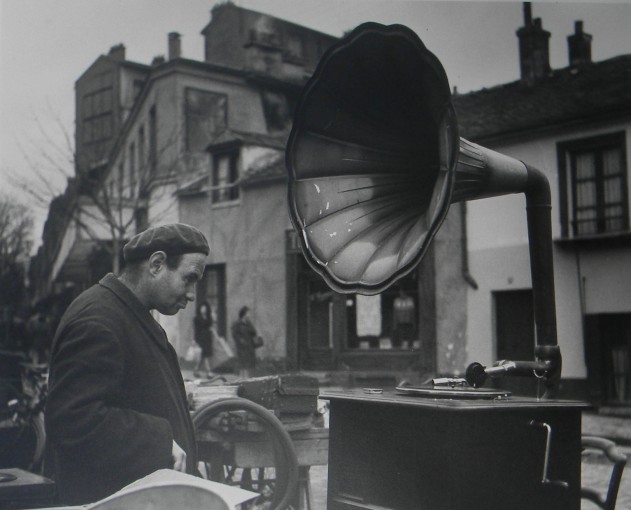
There is a humane quality which suffuses Doisneau’s work- a magical charm. The photograph makes a nice comparison with the famous HMV poster. It is impossible to say weather the subject is more enchanted by the splendid device or the music emerging from the cumbersome, jolly gramophone. Probably he is entranced by both. His posture and beret adds to the general levity of the scene.
Doisneau photographed many great artists and this photograph captures the master, Picasso in his characteristic striped jersey with his penetrating gaze. The photographer makes a marvellous joke with the distorted fingers of bread rolls. It seems likely that this was contrived between them. A morphic distortion and also an interesting game with perspective too.




 penwithlit