Categories
Uncategorized West Cornwall (and local history)

The Runcimans- Liberals in St Ives (Part two)

Viscount Runciman of Doxford

Runciman managed to slightly increase the share of the liberal vote and majority in St Ives in 1929. The total turn out had risen by some 4,700, due to the fact that this was the first election where women under the age of 30 voted; it was termed the “Flapper election” The Liberals had promised to tackle the growing levels of unemployment, with a program of public works  in these bitter years after the General Strike. Now fewer in number, the Liberals had only 59 MPs as against Labour with 287. As the Conservatives had 287, the Liberals held the balance of power if they could stay together.

Runciman acted in close concert with the other Cornish Liberal MPs. In general, they were opposed to Lloyd George-especially his Land Policy- and in favour of policies of self-reliance and were keen to alleviate unemployment, especially inCornwall. They were opposed to constraints upon business and against any development of socialism. In this second objective, they received the full support of the West Briton.  As Hilda Runciman was to comment of the Labour administration it was, “curious how Liberal they seem to become when they are in office. Their Socialism seems to fall away from them. This, indeed, is inevitable” Their common ground with Labour, especially with influential figures like Philip Snowden, as Garry Tregidga has pointed out, was over temperance, free trade and foreign policy.

Runciman’s father, a wealthy shipping magnate, loved the sea, and had written a number of popular books about sailing and shipping. These included titles like “Drake, Nelson and Napoleon”, “The Shellback’s Progress”, and “Windjammers and Sea Tramps”. These are reminiscent of the Edwardian period, the era of Georgian poetry of Walter de la Mare and Masefield. The life described in one book, “Collier Brigs and their Sailors” was very tough on the merchant sailors whose conditions were quite unregulated. His grandfather in turn had fought with Nelson at Trafalgar. He was also a founder member of the Royal National Yacht Club and  rumoured to have made a hefty profit from his   Union and Castle line during World War 1. Runciman Senior was well aquained with Hain (Lord of the Manor in St Ives.). As far back as 1910, Sir Edward Hain became Chairman of the UK Chamber of shipping in the same year as Sir Walter became Vice-Chairman.

The Hain family had been grieving the loss of his son in the 1914-18 conflict, and kept his memory alive by the building of the Edward Hain Hospital. Walter, the son, also came to own several shipping lines. The Runcimans owned a most superb yacht called  “Sunbeam 11” purchased  from Lord Brassey, she was some 535 tons and 155 feet in length and, “with her well-proportioned spars and sail plan and powerful yet graceful lines, she was one of the ablest and most comfortable –looking craft of any type”. When it arrived in St Ives Bay in 1931 it might have somewhat impressed local fishermen concerning the nautical talents of the man at the helm. The townspeople would have respected their MP as a fellow traveller on the sea; equally it would have illustrated the social distance between Runciman and his constituents. The “Sunbeam” was to be a spy-ship  employed by Special Forces in World War 11.

Hilda had carefully nursed the constituency, but Runciman now 58  had to fight hard to increase the majority, throwing himself into the task. In St Ives he told packed audiences at the Fisherman’s Institute and at the Palais de Danse of his views against protectionism, for temperance and in support of Women’s Rights. In Asquith’s cabinet before World War 1 he kept to the collective cabinet line against suffrage. There is an account of a bottle being thrown at his car by a woman demonstrator in Newcastle, with which he had many business connections and near which was the country home of Doxford.

Walter Runciman must have been used to hectoring and heckling at lively meetings. St Ives constituency kept itself well informed on political issues, a tradition that went back at least as far as the Chartists, who had held meetings on the Promenade- nearby   Oswald Moseley was to receive a memorable and vigorous rejection later in the same decade. Runciman was a keen supporter of women’s rights and his views in general were in line with the enlightened even Gladstonian opinions of the  Asquith/Grey faction of the Liberal Party against Lloyd George.There was no appeal by Runciman, along the lines that Lloyd George made to his fellow Celts at the famous meeting in Falmouth. Runciman had recently written a pamphlet on the issue of female rights. However,in the local press, the advertisments in relation to scullery maids and domestic servents show that to aspire to the status of governess was about independent as a  woman might become in the town. The influx of independent wealthy women, including art students had not yet made a significant impact upon religious belief or cultural norms. Later, Baldwin, with whom Runciman eventually reached  good terms, confided his own views on difficult women like Wallace Simpson during the divorce crisis. A point which Hilda recorded in her fascinating and busy diaries, which are in the archives of Newcastle University Library.

Categories
West Cornwall (and local history)

The Runcimans- Liberals in St Ives (Part one)

1928 was a fascinating year in politics. Lord Oxford, better known as Asquith had just died and  had just a few years been interviewed by the Editor of the St Ives Times and Echo. He gave his earnest opinion that theBayofSt Ivescould not be beaten. Given the slump in the late 20s and later in the depression, the inhabitants sadly suffering enforced idleness, were to have plenty of time to contemplate the magnificent sea views and to read about the economic situation in the newspapers. The more enterprising perhaps listened to their home built wireless sets.

In Hilda Runciman, the people of St Ives, it might be supposed were to get a fine advocate, a good speaker and an idealist. Unfortunately, although good on public platforms she did not actually speak in the male dominated House of Commons. An elegant as well as eloquent woman, she  had a ready wit and formidable determination. She demanded much of herself and  posessed a strong sense of public duty. She had become founder member of the River Tyne Commission by the age of just twenty four. However to St Ives, the political solutions she offered of free trade and self-reliance and belief in theLeague of Nationswere insufficient to bring relief from the harsh realities of the depression, let alone avert the dangers of nationalisms inEurope.

She gained the seat  of St Ives for her husband, already a wealthy, clever and able man. At this stage the Liberal influence was reduced to 43 MPs and she joked that with her husband, MP for Swansea West the electorate would have “the spectacle of a  party of two”. When she was elected, the Times and Echo recorded, “Several young fishermen had prepared a chair decked in the Liberal colours, in which Mrs Runciman was carried through the streets of the town to the Wharf where a halt was made.” Runciman, himself however was to change his approach or policy over many issues and ended his career having failed to become chancellor, a role for which he had once seemed suited, and finished by disappointing many of his friends, supporters and constituents. They were, however, the first married couple to enter the House of Commons.

Rumour has it that it was Isaac Foot who suggested that St Ives would be a suitable seat for the Runcimans. Hilda was elected in a by-election in 1928, regaining the seat again for the Liberals. There had been previously five elections at St Ives in the previous 10 years. She came from a family with links toGlasgowand the North-East. Her father, James Cochran Stevenson had himself been an MP forSouth Shields(1868-1895) and was the owner of a newspaper and also had a chemical factory in Jarrow. She was his fifth daughter. Hilda’s sister, Flora Clift Stevenson, achieved magnificent progress in the education of the poor, and in particular, the girls ofEdinburgh. She famously became Vice-president of the anti-protectionist Women’s Free Trade Union. This was the milieu into which Walter Runciman married in 1898. One in which there was a belief in individual enterprise and a respect for self-improvement.  By the time that Hilda was elected for St Ives, Walter Runciman had once defeated Winston Churchill atOldhamin 1899, and been MP for another two constituencies and  had been President of the Board of Education, President of the Board of Agriculture and finally in the fateful year of 1914 become President of the Board of Trade. This was under the Prime Ministership of Asquith, whom he had supported against Lloyd George, in the devastating quarrels that plagued and split the Liberal Party in the middle of the First World War.

Categories
Book Reviews

Seahorse – the Shyest Fish in the Sea by Chris Butterworth and illustrated by John Lawrence

Chris Butterworth lives in Penwith and loves the sea and the amazing things that live in it. “A seahorse looks as magical as a mermaid” she says, ”but while mermaids are made up, seahorses really exist.” This informative and well-designed children’s book was written with the expert advice of Colin Wells of the National Aquarium inPlymouth. The seahorse or in Latin “Hippocampus” (horse-like sea monster) is a very unusual type of fish whose tenuous existence depends upon a curious kind of gender swap. It is the male seahorse that has a pouch in which the young grow to maturity whilst his wife wanders the territory further away from home. Dad has to keep squeezing and pushing out all the little delicate seahorses all day long, and by night there may be hundreds of them! The seahorse is a light and tiny creature, who can only cope with gentle undercurrents. The movement motions are delightfully described, as are the various devices by which the little creature has evolved to avoid its predators. The text, in a gentle manner, encourages a tolerant attitude towards nature and a sense of the urgency for conservation as well as respect for marine ecology.

The illustrator, John Lawrence, has produced a fine series of dark and subtle coloured images that show the intriguing variety of life forms under the sea. This includes the variegated changes of tone during the mating dance of the seahorses. This is a well-crafted and informative book, which could be taken out and read again and again with pleasure.

Categories
Uncategorized

Historical Novels –Cornwall and Beyond


Was Lady Browning, Dame Daphne du Maurier quite reliable, from a factual viewpoint in her treatment of historical figures in her novels? Someone mentioned at a meeting this week that her portrayal of Sir Richard Grenville, the first Baronet, (1600-58), grandson of the Sir Richard Grenville who was the naval commander at the Battle of Flores when The Revenge was sunk to avoid capture off the Azores. (According to Tennyson, “Sink me the ship, Master Gunner—sink her, split her in twain! … Fall into the hands of God, not into the hands of Spain! “) The King’s General written in 1946, and there is a full review of it by Ann Wilmore at http://www.dumaurier.org/reviews-general.html.The novel is written from a Royalist viewpoint and has been recently performed at Restormel Castle as recently as just two years ago. Wilmore recognises that in the period that it was written it was intended to be an escapist romance. There is a suggestion that the Grenville character is perhaps somehow distantly linked to her own husband, a General who in April 1944 he had become commander of I Airborne Corps. He was a controversial figure and was involved in Operation Market Garden and later Mountbatten’s Chief of Staff in India. He eventually became Commander in Chief of the South East Asia Command. (He was played by Dirk Bogarde in the film A Bridge Too Far.)

Altogether Grenville was not a very nice man. He had a violent temper which put pay to his marriage and ended in two acrimonious lawsuits. He was sent by Charles! to take part in the Siege of Plymouth and eventually had to retreat from there intoCornwallwhere he was to ensure vital supplies of tin for the Royalists. He appears to have got deeply involved with maintaining Duchy and Stannary rights and attempted to attain independent rights forCornwall. He is said to have enforced discipline in an arbitrary manner and hung some men and imprisoned others. He appears to have extorted money for his own purposes and after all this reacted with rank insubordination to Lord Goring and then refused to serve under Sir Ralph Hopton. He was imprisoned on St Michael’s Mount. According to Wikipedia, he became known as “Skellum Grenville”, the term may well derive from the German “Scheim” which means a scoundrel.

Georg Lukács, (1885-1971), the Hungarian Marxist thinker and literary critic is an important figure who has written about the Historical Novel,1937 in considerable depth.( See for instance http://www.marxists.org/glossary/people/l/u.htm#lukacs-georg) Having read Kierkegaard and Weber early in life, he later turned away from Kafka and Modernism in favour of Thomas Mann. He argues that following the French Revolution and its aftermath, people became more conscious of the change itself as an important factor in individual consciousness. He went on to praise this development in the work of Sir Walter Scott, who portrayed the dissolution of feudal life and the rise of mercantile capitalism in the Highlands. This realism he saw too in the novels of Balzac and Tolstoy. Constant change becomes an explicit theme and opens up the possibility of social revolution as the proletariat enters as a factor. Hence these authors despite their conservatism are preferable to modernists and Flaubert, receives disapprobation for his historical work, Salammbo, particularly for its emphasis on style, as opposed to realism. However, it is interesting that Lukacs did not appear to much approve of Zola. He preferredGorky but this may have been influenced by that with which he was more familiar and besides Engels seems to have had reservations with respect to Zola.

This argument derives, of course from the Marxist view of ideology and the separation which exists between appearance, by which he means the character’s thoughts and feelings divorced from reality, which Lukacs which is thought by him to be the existing social relations framed by the means of production under capitalism. Realism, Lukacs believes can penetrate and uncover,” the deeper, hidden, mediated, not immediately perceptible of relationships, which go to make up society.” Influenced, it seems by Nietzsche’s writings on decadence in writing, which criticised a lack of the sense of totality; modernism is isolated from the socio-economic reality. Hence, realists penetrate depths by confining their work to a more superficial and fictional subjectivity. This obviously raises many further questions including: – the role of the imagination in literature and what Lukacs might make of magical realism.

On a lighter note, apparently The Scarlet Pimpernel novels are historically quite accurate. Baroness Emmuska Orczy (1865-1947) wrote some fifteen of these. Her full name was Emma Magdolna Rozália Mária Jozefa Borbála “Emmuska” Orczy de Orczi and came from a Hungarian aristocratic family. She was also a talented painter who exhibited her paintings in the RoyalAcademy. Her novels include Sir Percy Blakeley’s enemies, Robespierre, Collot d’Herbois and of course, Chauvelin.(The latter is an exception, Citoyen Chauvelin although based on a real figure – Bernard-François, marquis de Chauvelin is not at all accurate, but a military officer who served in the American Revolution). However, in respect of her depiction of St Just and Lambert Talien his erstwhile opponent and the conditions in the Temple prison, the treatment of the Dauphin and the assassination of the journalist Marat, the worship of Reason as a deity are all covered reasonably accurately.

British statesmen such as William Pitt, the Younger and Lord William Grenville are also portrayed and show Orczy having a pretty thorough grasp of detail. The narrative keeps the reader engaged which helps as well.

Which are your favourite historical novels and authors?

Categories
Book Reviews Uncategorized West Cornwall (and local history)

A Year in the life of Padstow, Polzeath and Rock By Joanna Jackson


This attractive and captivating book of some 112 pages chronicles the appearance of the beautiful Camel Estuary and its inhabitants over the course of a year. As is mentioned in her introduction, for some 4000 years, this has been a major trading coast, from the Bronze Ages times, with ships arriving from areas as distant as Ireland to the eastern Mediterranean. Yet, Padstow retains its Elizabethan charm whilst Polzeath is better known for its contemporary appeal to surfers. The appealing images capture vividly the variety of life in the area including foodie Padstow, with pictures of brown crab and silver mackerel ready for Rick Stein’s kitchen and the National Lobster Hatchery.

As one might expect, the most stunning images are those of the peaceful horizontal curves of the coastline, the sand banks and the rocks sloping down to the coastline and the sea. There are stunning images of field catching the sunlight at dawn, the diversity of the flora and the activity and pageantry of the Royal Cornwall show. There are depictions of ‘obby ‘oss day, sailing and surfing, vigorous watersports and the energetic exertions of the lifeboatmen of Padstow and the RNLI beach lifeguards.

There are short introductory sections of text to put the splendour of the photographs into context. That on the Age of the Saints, for instance, mentions St Petroc, his monastery and his travels to Brittany, Rome and Jerusalem. This introduces the double page spreads of the battering waves at Treyamon contrasting in the following images of the contemplative security of the quayside of the inner harbour at Padstow. These photographs of North Cornwall which inspired the poetry of Betjeman and Binyon are a collection to have on your shelf for browsing or as an incentive to tranquil recollection.

Categories
Book Reviews

Taking The Medicine by Druin Burch

Taking the Medicine

In the same week that I read this outstanding book on the development of pharmacology, the newspapers were full of issues on which this book has a bearing and something significant to say.

In 1898, Burch points out that a new drug was developed and marketed for the treatment of tuberculosis by Bayer. TB is such an ancient enemy of man that there is apparently evidence of an earlier strain to be found in Egyptian mummies. The German firm had discovered a chemical that seemed to work well, and the staff they tested it upon seemed to respond well-it was called Heroin- and its addictive effects were at first missed. Just this week a group of paediatricians from a variety of hospitals, from Great Ormond Street to St James’s in Leeds, are concerned that in 2010 pharmaceutical companies are paying too little attention to funding research for babies and children. Why? Because it is less profitable than spending an equivalent amount of money on the development of medicines for adults. The history of the development of Aspirin appears on Bayer’s website but the marketing of Heroin – initially believed therapeutic, was abandoned by them in 1913-but not all firms- is not recorded.

An outstanding aspect of this stimulating and riveting read is its description of the heroic roles played by courageous men like Lind and Cochrane. The latter’s insistence upon weighing the evidence by careful statistical analysis in comparative groups was based on bitter experience of treating his fellow prisoners in the woeful conditions imposed by sadistic German guards in Salonika. Despite the shortage of available treatments the whole experience taught him the benefits of making his own careful comparative assessments. He had already fought fascism in the Spanish civil war and seen his friend Julian Bell die from a wound in a shattered thorax. After such experiences he committed his later days to introducing methodological rigour to medical research in relation to statistics and in the author’s telling phrase, ”having a more profound effect on human health than any newly discovered drug. One of the diseases on which their ideas most quickly had an effect was tuberculosis”. Because of its latency period after infection TB is still something of a problem for elderly patients, it was said on the radio this week. Its genes also mutate. However, the structured argument that Druin Burch pursues has contemporary relevance and careful historic research. His brief and concise pen portraits have the elegance of Aubrey’s “Brief Lives” to which he makes passing reference.

In a significant recent article in the national press Hadley Freeman, characterised the noughties as an age of fakery, in both science and medicine. She refers to Mike Specter’s new commentary on the MMR and autism furore. She mentions views pronounced by personalities from Ace Ventura, Tony Blair, Jim Carey and others on an issue which is likely to mislead vulnerable members of the public away from fact and experience. In “Taking the Medicine”, Druin referring to the fascinating figure of Boston’s nineteenth century physician, Oliver Wendell Holmes, refers to this propensity of patients to grasp at straws to find a cure and to pay for it. He states with an engaging touch of irony,”Like politicians who need to be seen to be doing-something-anything-about problems that are actually beyond their control, doctors are pushed into playing a part. The danger comes when they start to believe in their own illusory importance.”

In the next year or so, genetics advances will help to identify genetic sequences that drive patient’s cancers. Such work depends upon the earlier endeavours of  figures like Paul Ehrlich who developed the effective use of chemical dyes, in haematology, to discover an effective description of the way in which living cells produce antibodies which led to a greater understanding of the immune system. The award of the first Nobel prize for medicine was, however blocked by an anti-Semitic chemist. Ehrlich went on, as Burch so clearly describes to test Salvarsan on animals with Saachiro Hata who had arrived from Tokyo in 1909. This led to the effective treatment of syphilis which, “held a position roughly equivalent to that of AIDS before the development of anti-retrovirals”. Ehrlich who was a kind and inspiring figure, Domagk his student, after a terrible time on the Western Front worked on the development of the first antibiotic which was needed to tackle puerpal fever- often lethal for women after childbirth- and meningitis until 1939. Dogmagk was to receive the Nobel prize but which under Hitler’s influence, he was made to refuse. He was still taken away by the Gestapo as his refusal was too polite.

Altogether this is an intelligent, wide ranging and stimulating read. The sort of book you hope that a sixth form biologist would find time to read and should be a supplement to the reading list in the first year at medical school-or” Knowledge Spas” they are named here in Cornwall. The author is an NHS doctor and his book is a thoroughly enjoyable, much easier than many medicines are to swallow!

Categories
Uncategorized West Cornwall (and local history)

Lelant-an unlikely village for rebellion?

St Ives Ruffians disrupt Lelant Fair (1823)

In a recent documentary concerning St Ives artists after the war, Lelant was inaccurately referred to, by a Cambridge academic as,” a dingy suburb of St Ives. In fact Lelant has usually been regarded as a prosperous and well appointed village. However, in 1823, some six years after the death of Jane Austen, the English countryside could become the venue for rebellious behaviour though perhaps without the political focus that have characterised recent demonstrations. The Bullingdon Club at this time was well established as a hunting and cricket club. William Webb Ellis was to “invent” rugby, a channel for excessive testosterone after the events described below, a few months later in that same year.

Disgraceful Outrage

“A most disgraceful outrage was committed at Lelant Fair, or rather revel, on the night of Friday last, by a gang of ruffians from the well known Borough of St Ives, Cornwall, who entered the place shortly after nightfall, armed with bludgeons; and whilst some commenced an attack upon the standings which were covered with tempting viands for the refreshment of rural beaux and belles, and the youthful miners and ball maidens; others behaved with great brutality to such of the females as came within their reach, and attacked such of the young men as attempted to rescue their female friends from the rude hands of these savages. The uproar that ensued may be more easily conceived than described; the crash of the standings, the screams of the affrighted damsels, the calls of their protectors and of the owners of the standings for assistance, produced a compound of discordant sounds not often equalled in this now peaceable county. The ruffians were, however, speedily masters of the field, and the discomfited and terrified multitude fled to the adjacent houses for shelter. The greater part rushed into the public houses which were filled with company:- here they were persued by the brutal miscreants , who commenced breaking the windows , demolishing the windows etc. They were at length opposed by a number of young men, who rallied in defence of the females and the houses; when, as cowardly as they were brutal and ferocious, the St Ives ruffians fled under cover of the darkness; but as soon as they saw an opportunity, they rallied and commenced an attack upon the windows. They were at length driven from the field ; but not before upwards of twenty of them were identified, who will have to answer for their conduct in a Court  of Justice. When it is considered that few, comparatively, are benefited and that numbers are seriously annoyed by the annual nuisance denominated Lelant Fair, its discontinuance would be regarded as a public benefit”.-(West Briton)

Reported in The Morning Post Wednesday, August 27, 1823


Categories
Art Exhibition Reviews Uncategorized

Marie Laurencin 1885-1956

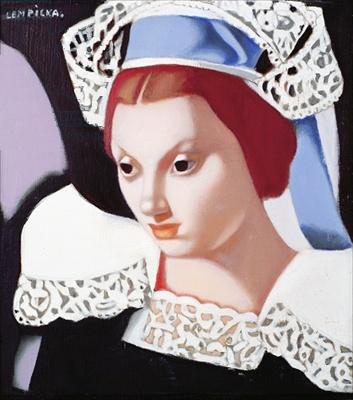
I have just discovered from a friend the lovely paintings of Marie Laurencin and think they deserve wider acclaim. Ceramicist, painter and printmaker, she also became  the mistress of Apollinaire. They have a soft and appealing, lyrical and delicate quality that can be seen in the pastel above which is called “Le Chant”. Many of her drawings are in the keeping of The Art Institute of Chicago like this one below right, executed in graphite and coloured pencils.

According to one easily accessible website on her,”Marie Laurencin was a French painter and printmaker. Laurencin was born in Paris, where she was raised by her mother and lived much of her life. At 18, she studied porcelain painting in Sevres. She then returned to Paris and continued her art education at the Academie Humbert, where she changed her focus to oil painting. During the early years of the 20th century, Laurencin was an important figure in the Parisian avant-garde and a member of the circle of Pablo Picasso. She became romantically involved with Picasso’s friend, the poet Guillaume Apollinaire, and has often been identified as his muse. In addition, Laurencin had important connections to the salon of the American expatriate and famed lesbian writer Natalie Clifford Barney. During the First World War, Laurencin left France for exile in Spain with her German-born husband, Baron Otto von Waetjen, since through her marriage she had automatically lost her French citizenship. The couple subsequently lived together briefly in Dusseldorf. After they divorced in 1920, she returned to Paris, where she lived for the rest of her life and where she achieved great success as an artist.”

Her portraits have a hieratic quality; an adjective which derives from the Greek ἱερατεία (hierateia meaning “priesthood”). By hieratic in relation to art one means very stylised, formal or restrained. The term is used particularly of figurative art with” piquantly tipped heads and mask-like faces”-as Peter Schjeldahl referred to the work of Amedeo Mondigliani.

This is a wonderful clip at http://www.youtube.com/watch?v=1CDT5whWuGM

Here is a poem from Appolonaire to Marie

Vous y dansiez petite fille
Y danserez-vous mère-grand
C’est la maclotte qui sautille
Toute les cloches sonneront
Quand donc reviendrez-vous Marie

Les masques sont silencieux
Et la musique est si lointaine
Qu’elle semble venir des cieux
Oui je veux vous aimer mais vous aimer à peine
Et mon mal est délicieux

Les brebis s’en vont dans la neige
Flocons de laine et ceux d’argent
Des soldats passent et que n’ai-je
Un cœur à moi ce coeur changeant
Changeant et puis encor que sais-je

Sais-je où s’en iront tes cheveux
Crépus comme mer qui moutonne
Sais-je où s’en iront tes cheveux
Et tes mains feuilles de l’automne
Que jonchent aussi nos aveux

Je passais au bord de la Seine
Un livre ancien sous le bras
Le fleuve est pareil à ma peine
Il s’écoule et ne tarit pas
Quand donc finira la semaine

(La maclotte est une danse ardennaise )

Marie Laurencin, c.1924 (b/w photo) by Man Ray

Categories
Uncategorized

Peretz Hirschbein, Yiddish Theatre and possible parallels with the History Plays

Hirschbein, actor and dramatist founded the first Art Theatre in Odessa in 1908 which produced plays in Yiddish. His first play, having been written in Hebrew, was Miriam. His most important plays; the Blacksmith’s Daughter (1915) and Green Fields (1919) are idylls of Jewish country life and according to the Oxford Companion to the Theatre, the second was considered to be one of the greatest works of Yiddish drama. It was translated into English by Joseph C. Landis in 1966 as The Dybbuk and other Great Yiddish plays. (In Jewish folklore, a dybbuk (Hebrew: דיבוק‎) is a malicious or benevolent possessing spirit believed to be the dislocated soul of a dead person.)

The culture of the Eastern European Jews was permeated with music, song, and dance. These latter features commonly in the Yiddish theatre, and emerged at its earliest point in Warsaw in the 1830s. During Purim, a religious holiday, plays told the story from the Book of Esther and were known as Purimspiels. Purim, is when Hamantaschen are made with many different fillings, including prunes, nut, poppy seeddateapricotapple, fruit preservescherrychocolatedulce de lechehalva, or even caramel or cheese. There was a song called, Mein Hut der hat drei Ecken, which in Hebrew school related to Hamen’s three cornered hat; the shape of the pastry.

Also, there is a fairly well known production of quite another film which is also called The Dybbuk which has been translated into Yiddish, Hebrew, German, Polish, English, Ukranian, Swedish, Bulgarian, Czech, Serbian, French and Japanese. There are several significant or interesting points about the film. Firstly, produced in 1937, it features Gerschon Sirota, whose voice was considered heavenly by Caruso. Some of Sirota’s pieces (including ‘Ata Nigleita’) are compared in quality to Traviata and Madam Butterfly. The plot involves an arranged marriage and deals with intergenerational strife interwoven with mystical themes and experiences of possession. It was written by Shloyme Zanvl Rappoport who was known as S.Ansky who also came from Odessa, was interested in folklore and ethnography, and wrote the oath or song which became the anthem of the Jewish Socialist Bund party. Ansky also was a Socialist representative in the 1917 Russian Assembly. Odessa was clearly a lively centre for the discussion of theatre, history and politics particularly in the Jewish community which also included Simon Dubnow, another person worthy of further research.

My interest in these issues was sparked by starting to read (and in the process turning to the Oxford Theatre Companion) Shakespeare’s King John and its relation to the genre described as the ‘History Play’. It occurred to me that one obvious way of thinking about the question is to compare and contrast the genre in other, mostly European, cultures. Not at all an easy task! Clearly there are links with issues such as ideology, religious practice and belief, creating a tradition and reflecting back upon its cultural memories and so developing or reinforcing earlier myths. We have also just seen the gory preview scenes from Ironclad, based on the historical King John, and reviewed in yesterday’s Daily Mail, by Chris Tookey, “Ironclad desperately wants to be a historical blockbuster along the lines of Braveheart. Sadly, it has more in common with Monty Python and the Holy Grail” Some historical facts about King John are given at http://www.middle-ages.org.uk/king-john.htm

It is striking reading in The New Cambridge Edition (L.A.Beaurline) of King John, how the play influenced what has been called the archaeology of staging. Apparently, before Charles Kemble took over Covent Garden there was little interest in getting costumes historically correct. This matter was of great importance to Kemble and with James Robinson Planché (27 February 1796 – 30 May 1880) consequently attention to scenery being historically authentic developed commenced with productions of King John.

I wonder how Yiddish plays were originally performed and with what scenery. It is very well known that Yiddish Theatre was a great influence upon Kafka. Their comparatively recent development perhaps illustrates their cosmopolitan narratives of identity, including of course, Zionism. Possibly Shakespeare’s History plays are virtually sui generis. Early History plays in Germany evolved written by men like Andreas Gryphius (1616 – 1664) a lyric poet and dramatist. A notably significant figure is Schiller who wrote historical plays with support from Goethe. For instance, he wrote an interesting and sympathetic play about Mary Stewart in which Elizabeth appears thoroughly ruthless.

To conclude with two provoking essays from the Guardian, the first written by Jonathan Bate about Shakespeare’s history plays, “As history, the plays paint a panorama of England, embracing a wider social range than any previous historical drama, as the action moves from court to tavern, council-chamber to battlefield, city to country, archbishop and lord chief justice to whore and thief.” Still more can be read and enjoyed at:-http://www.guardian.co.uk/culture/2010/may/29/shakespeare-jonathan-bate-simon-callow Of course, when it comes to knowledge of drama, languages and cultures there is the redoubtable George Steiner who gave a characteristically ironic interview at http://www.guardian.co.uk/books/2008/apr/19/society

What became of Hirschbein? Well in the early 1940s Hirschbein moved to Los Angeles, here he wrote a feature film, “Hitler’s Hangman” (1943) and generally worked on propaganda. Now what did Olivier produce in the following year? “A colourful and highly stylised version which begins in the Globe Theatre and then gradually shifts to a realistic evocation of the Battle of Agincourt”, oh yes, Henry the Fifth!

The intellectuals of Odessa

Categories
Uncategorized

Norman Levine –the view from an ethereal distance


Auden’s lines are well-known:-

As the hawk sees it or the helmeted airman:
The clouds rift suddenly –

Watching recently a video of the Canadian writer and poet, Norman Levine who lived in St Ives during the creative upsurge of painters and sculptors, the quality of observation from a distance in this man’s work became more apparent to me. It is perhaps not dissimilar to what has become known as the Martian effect as exhibited in the works of Craig Raine. In Canada Made Me”, Levine writes of his experience as an airman during the war. It is this viewpoint, from the vertical dimension, which is intriguing. That is to say, from a position of detatchment during the engagement.

He writes in the chapter entitled Ottowa, “Distance was the buffer, a way of looking that separated our action and its consequences that allowed us to repeat this performance without having any doubts, or pity, or feeling in any way involved.”

Additionally, in a Polish Jewish family living in a French district of Ottowa, gave him the perspective of being an outsider. He lived overseas from Canada and so again was imbued with the modernist condition of being an exile. Displacement and migration have impacted on populations and reinforced feelings of estrangement.(See for instance Catherine Wilson’s review http://www.a-n.co.uk/interface/reviews/single/464686 ) The sense of isolation in St Ives was perhaps relieved by the inspiration of being among artists, from whose sparse technique in sketching he sought to learn. Although, Alison Oldham who has written interestingly about Norman Levine in her Tate monograph “Everyone was working”, states in her Guardian obituary rather bleakly that “Frustration was at the centre of Levine’s art, according to the Nobel laureate Heinrich Böll, who translated the book for an enthusiastic German readership”.

It is perhaps interesting to compare Auden and Levine as transatlantic literati. Auden’s poem from 1930 was written when he was just 23 and has the assumed and assured voice, partly for effect and partly because Auden already held considerable influence over his contemporaries. This was at a stage when most of his knowledge might have been derived from the CCF at Gresham’s. Subject mattersimilar in atmosphere to that shared between Isherwood and that intriguing novelist Edward Upward in their surrealist fantasies about the English village of Mortmere. Auden was to get a closer look at the realities of conlict when he and Isherwood visited the Sino-Japanese War, working on their book Journey to a War (1939). For an analysis of Auden’s poem see http://www.saintbonaventure.com/faculty/mcelvogue/documents/Auden1Radford.pdf

At the age of 23 Norman Levine had just left service as a Lancaster pilot at an air base in North Yorkshire. He was busy making up for his time after service in the R.C.A.F. studying at McGill in Montreal and back to King’s College London having just won a scholarship there. By now with poetry published and a novel in preparation, he arrived in St Ives in the summer of 1949. Although an outsider he obviously found the experimental zeitgeist as well as the working methods of the painters of interest in his own work. He became renowned for his sparse, lean prose and an examination of his personal library discloses his deep interest in Checkhov. He came to evolve a literary technique which he writes about as being the written equivalent of the quick sketch. Stimulated by the landscape, conversation in his short stories start to show affection for the colourful characters whom he was now meeting; Lanyon, Frost, Weschke and a few years later, Francis Bacon.

In a poem,While Waiting for the Birth of a Child, written for his daughter Rachel in late March 1957 he writes:-

I sat there and listened to the suffering in a human voice

And watched the sky become a lighter blue

Until the houses stopped being black and I could see the windows.

And then, suddenly, out of nowhere, a small black toy thing,

A bird, fell against the blue sky, caught the telephone wire

Outside my window, balanced itself, and burst into song.