Categories
Uncategorized

Book look: Martin Schmidt and Kurt Schwarzer

Come on up for the rising's avatarAUSTRIAN CULTURE CHANNEL

“Farbe für die Republik” is the title of an eagerly awaited exhibition set to take place at one of Germany’s most prestigious museums.

The exhibit – which will be presented at the Deutsches Historisches Museum Berlin between March and August 2014 – features hundreds of colour photographs taken during four decades in the German Democratic Republic (GDR). The concept is extraordinary since most images from the country and are black and white photographs of mediocre quality.

Martin Schmidt and Kurt Schwarzer searched the archive of the museum for the best of their 1pictures. The photographers, who worked in the GDR, selected images showing women working in factories, youth football teams on the pitch, elderly hikers during an outing on a sunny day, people at the hairdresser’s and many more subjects and themes. The brilliant quality of their photographs – of which all seem to sparkle in the brightest colours –…

View original post 66 more words

Categories
Uncategorized

W. H. Auden–In Memory of Ernst Toller

matt's avatargolempoem


IN MEMORY OF ERNST TOLLER
(d. May 1939)
The shining neutral summer has no voice
To judge America, or ask how a man dies;
And the friends who are sad and the enemies who rejoice

Are chased by their shadows lightly away from the grave
Of one who was egotistical and brave,
Lest they should learn without suffering how to forgive.

What was it, Ernst, that your shadow unwittingly said?
O did the child see something horrid in the woodshed
Long ago? Or had the Europe which took refuge in your head

Already been too injured to get well?
O for how long,like the swallows in that other cell,
Had the bright little longings been flying in to tell

About the big friendly death outside,
Where people do not occupy or hide;
No towns like Munich; no need to write?

Dear Ernst, lie shadowless at last among
The other…

View original post 81 more words

Categories
Uncategorized

Review – ‘A Concise History of Britain,’ by F. E. Halliday

Been looking at F.E.H. and his friendship with C Day-Lewis:-

hagalenz's avatarハガレンズ

ハガレンズ
コロンビア国立大学
英文献学

‘A Concise History of Britain’ by F. E. Halliday is a useful, summarizing overview of the British Isles history. By using comprehensible and deeply argued explanations, the study of Halliday encompasses interesting topics such as ‘Early Invaders,’‘Three Centuries of Peace –43 to 410–,’ ‘The Rise and Fall of Wessex –410 to 1066–,’ ‘From Despotism to Anarchy –1066 to 1154–,’ and ‘The Making of the Nation –1154 to 1307.’ Additionally, charts, photographs, maps, and paintings make the reader feel he or she is closer to the subject matter. The book is indeed an astonishing touch on British history for civilisation investigators.

The first chapter, ‘Early Invaders,’ describes how England is, how it is gradually peopled by humans, and how the then invasions take place. After general features of the English territory –flat land, lower ground with uplands and valleys–, the story begins with Stone Age hunters arriving…

View original post 992 more words

Categories
Literature Poetry

Lorca-La guitarra

Language: SpanishLorc1

Empieza el llanto
de la guitarra.
Se rompen las copas
de la madrugada.
Empieza el llanto
de la guitarra.
Es inútil callarla.
Es imposible
callarla.
Llora monótona
como llora el agua,
como llora el viento
sobre la nevada.
Es imposible
callarla.
Llora por cosas
lejanas.
Arena del Sur caliente
que pide camelias blancas.
Llora flecha sin blanco,
la tarde sin mañana,
y el primer pájaro muerto
sobre la rama.
¡Oh, guitarra!
Corazón malherido
por cinco espadas.

Lorc2

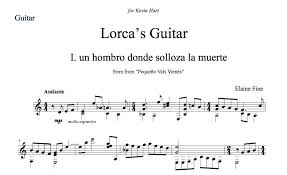
An introductory video may be found at http://www.youtube.com/watch?v=eCwqZjku16A

The Guitar

by Federico García Lorca
translated by Cola Franzen
The weeping of the guitar
begins.
The goblets of dawn
are smashed.
The weeping of the guitar              Lorc3
begins.
Useless
to silence it.
Impossible 
to silence it.
It weeps monotonously
as water weeps
as the wind weeps
over snowfields.
Impossible
to silence it.
It weeps for distant 
things.
Hot southern sands
yearning for white camellias.
Weeps arrow without target
evening without morning
and the first dead bird
on the branch.
Oh, guitar!
Heart mortally wounded
by five swords.

– See more at: http://www.poets.org/viewmedia.php/prmMID/16742#sthash.7H5zqTMS.dpuf

Categories
Uncategorized

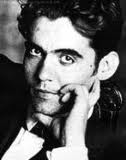
A Word About Federico García Lorca

Just been reading Blood Wedding

theARXXIDUC's avatartheARXXIDUC

lorca_family.jpg

I keep telling you about all these people, like Kahlo and Picasso, Hemingway and Graves, plus my bits about Gandhi, and Elvis, and I do not even know whether you are interested in the slightest.

Oh well, never mind. I wouldn’t tell you, if I wasn’t interested. I suppose that has to be my guideline.

Today I’ll offer you an entry about Federico García Lorca. He was born in Fuente Vaqueros, Granada, Spain, 5th June,1898; he died near Granada, 19th August,1936. Killed. Executed. Murdered. That is 71 years ago, today.

One does not know who killed him, or why. Perhaps it was a political murder, because García Lorca was considered left-leaning. Or it was a Fascist murder, because Lorca stood for the arts and the intellect and for freedom of the mind. Or it was, because Lorca was said to be more interested in men than in the opposite…

View original post 530 more words

Categories
Literature Poetry

Georg Trakl -Die schöne Stadt

Die schöne StadtGeorg2

Alte Plätze sonnig schweigen.
Tief in Blau und Gold versponnen
Traumhaft hasten sanfte Nonnen
Unter schwüler Buchen Schweigen.

Aus den braun erhellten Kirchen
Schaun des Todes reine Bilder,
Großer Fürsten schöne Schilder.
Kronen schimmern in den Kirchen.

Rösser tauchen aus dem Brunnen.
Blütenkrallen drohn aus Bäumen.
Knaben spielen wirr von Träumen
Abends leise dort am Brunnen.

Mädchen stehen an den Toren,
Schauen scheu ins farbige Leben.
Ihre feuchten Lippen beben
Und sie warten an den Toren.

Zitternd flattern Glockenklänge,
Marschtakt hallt und Wacherufen.
Fremde lauschen auf den Stufen.
Hoch im Blau sind Orgelklänge.

Helle Instrumente singen.
Durch der Garten Blätterrahmen
Schwirrt das Lachen schöner Damen.
Leise junge Mütter singen.

Heimlich haucht an blumigen Fenstern
Duft von Weihrauch, Teer und Flieder.
Silbern flimmern müde Lider
Durch die Blumen an den Fenstern.

Georg Trakl
Aus der Sammlung Gedichte 1913

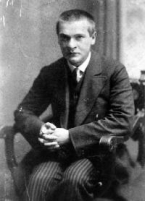
Georg5

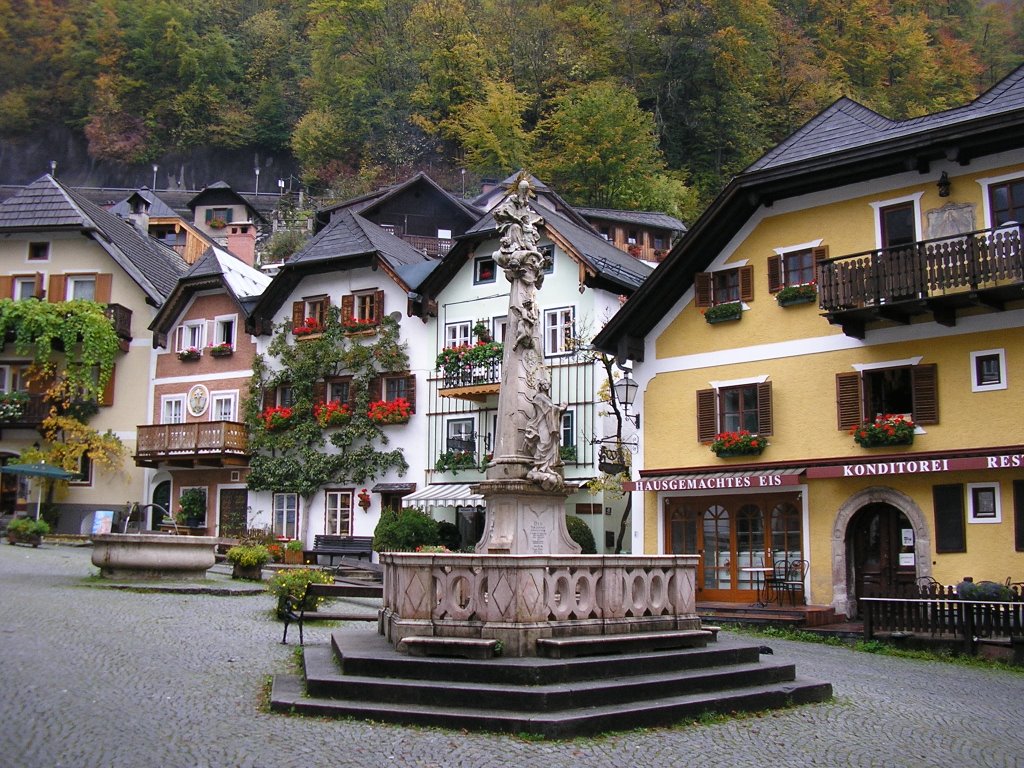
Here is my  translation:-

The Old Square

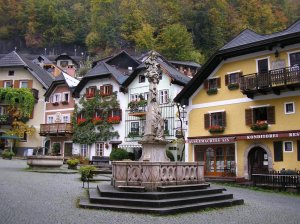
The ancient square sleeps in sunlight

making deep blue and golden threads

like a spiderweb.

Nuns come and go, gliding gently,

under the sultry silent beech trees.

From inside the illuminated church glimpses

show pure images of Death,

grand princes and magnificent shields.

Crowns gleam down above the aisles.

Horses heads appear from the ancient spring,

Sharp thorns threaten and bristle beneath the trees.

Young men confused with crazy dreams

in the evening gently approach the fountain.

Girls stand in doorways,

appearing shyly into the colourful square.

Their moist lips tremble

as they wait in their doorways.

Resounding, trembling bells

beat out the march with waking calls.

Strangers eavesdrop to their stirring calls.

High into the blue air the organ sounds.

Musical instruments sing high and clear

through the gardens and their leafed surrounds

The laughter of beautiful women sounds

and softly a young mother sings.

Breathe in the fragrance at the flowered sills,

Scents and incense, tar and lilac.

Silver glints through tired eyelids

through the flowers on the window ledges.
Georg4

Trakl’s poetry is haunting, symbolist and expressionist. His story is to be found at http://www.kulturvereinigung.com/en/georg-trakl/brief-biography/ and many clips may be found at http://www.youtube.com/results?search_query=Georg%20Trakl&sm=3Georg7
Categories
Literature Poetry

Frühlingsglaube von Johann Ludwig Uhland (26 April 1787 – 13 November 1862 – Tübingen)

Frühlingsglaube (Faith In Spring)

images (1)

Die linden Lüfte sind erwacht,
Sie säuseln und wehen Tag und Nacht,
Sie schaffen an allen Enden.
O frischer Duft, o neuer Klang!
Nun, armes Herze, sei nicht bang!
Nun muß sich alles, alles wenden.
Die Welt wird schöner mit jedem Tag,
Man weiß nicht, was noch werden mag,
Das Blühen will nicht enden.
Es blüht das fernste, tiefste Tal:
Nun, armes Herz, vergiß der Qual!
Nun muß sich alles, alles wenden.

Faith In Spring

The gentle winds are awakened,
They murmur and waft day and night,
They create in every corner.
Oh fresh scent, oh new sound!
Now, poor dear, fear not!
Now everything, everything must change.
The world becomes more beautiful with each day,
One does not know what may yet happen,
The blooming doesn’t want to end.
The farthest, deepest valley blooms:
Now, poor dear, forget the pain!
Now everything, everything must change.

Johann Ludwig Uhland
images
Categories
Uncategorized

Cello

The Thomas Eakin’s cellist looks late in his work?

kihm's avatarRead, Seen, Heard

augustus john guilhermina suggia

Guilhermina Suggia by Welsh artist Augustus John (1878-1971)

Cello HA Weiss

Postcard by H.A. Weiss, circa 1900

Thomas Eakins, Woman Playing Cello, c. 1880s

Photograph by Thomas Eakins (1844-1916)

M. Frank

Miss M. Frank of Vienna

DeCamp_Joseph_The_Cellist

By American painter Joseph DeCamp (1858-1923)

Lilla Cabot Perry

By American painter Lilla Cabot Perry (1848-1933)

John White Alexander

By American artist John White Alexander (1856-1915)

View original post

Categories
Uncategorized

The Fortune of the Rougons, by Emile Zola, translated by Brian Nelson

Reading Zola’s fascinating L’Ouevre (The Masterpiece)-

Lisa Hill's avatarThe Books of Émile Zola

The Fortune of the RougonsAfter I read Germinal a couple of years ago (see my review), Émile Zola became one of those authors that I really wanted to read more of, but it was not until I saw the BBC series based on The Ladies’ Paradiseand read the novel (see my review) that I decided to begin a long-term project to read them all. I’ve enjoyed reading this one, The Fortune of the Rougons, which puts the whole sequence into perspective.

With Les Rougon-Macquart, Zola apparently set out to emulate Balzac’s La Comedie Humaine but his 20-volume cycle differs in two significant ways: it consists of novels rather than short stories and novellas, and it focusses on a single family rather than a whole society. Zola believed in the fatalistic effects of heredity and environment, and so the novels trace three branches of the Rougon-Macquart family: the aspirational…

View original post 830 more words

Categories
Uncategorized

Domestic Architecture of Pre-Revolutionary Moscow 1

Looks elegant must read “Natasha’s Dance” properly.

Fëanor's avatarArt of the Russias

This series of posts comprises a few loosely translated extracts from Bolshoi Gorod, a fine Russian magazine of art and culture. In April this year, they did a small series on pre-Revolutionary private dwellings in Moscow, and these seemed of artistic interest in this blog. The tragedy is that it’s impossible for the average man-on-the-street to enter these residences, which are closed to the public even on the two days of the year (April 18, May 18) that are named Days of Culture, and it took nearly half a year of attrition and persuasion for Bolshoi Gorod to obtain access.

Alexandrinsky Palace

In 1754, Matryona Demidova, the wife of Prokofy Demidov, son of the Ural-based factory-man, bought lands from the Countess Repnin. Two years later, the baroque Demidov palace was constructed under the aegis of the Prague-based architect Jecht (I’m not sure I’m spelling this right and can’t find any…

View original post 299 more words