Categories
Uncategorized

Erich Kästner – Gedicht

durchleser's avatarDurchleser

Wintersport

Wohin man sieht, sieht man Hotels.
Und ringsherum liegt Schnee.
Die Tannen tragen weissen Pelz,
Die Damen Seal und Feh.

Die Leute fahren Bob und Ski
am Hange hinterm Haus.
Ja, und von weitem sehen sie
wie Sommersprossen aus.

Das Publikum ist möglichst laut.
Was tut das der Natur?
sie wurde nicht für es gebaut.
und schweigt. Und lächelt nur.

Im Kreise ihres Damenflors
sind alle Mann im Schnee:
Direktors, Doktors und Majors.
und Blubbers-Übersee.
Of course!

Wohin man sieht, sieht man Hotels.
Für Schnee ist kaum noch Platz.
Die Luft ist dick von Ouis und Well’s
Und Five o’clocks mit Jazz.

Die Berge und der Wasserfall
verlieren jeden Sinn.
Am Donnerstag ist Lumpenball.
Da passen manche hin!

Sie können nie bescheiden sein
und finden alles nett.
Und glauben, die Natur sei ein
Komfort wie das Klosett.

Lawinen sausen dann und wann
und werden sehr gerügt.
Was gehn den…

View original post 9 more words

Categories
Uncategorized

Karl Henckell – Gedicht

durchleser's avatarDurchleser

Seinestimmung in Paris

Es schwanken im Flusse die roten
Lichter von kreuzenden Booten,
Die zitternde Spiralen
In tiefschwarze Wasser malen,
Mit glimmenden Spuren die Ufer verbinden,
Von Brücke zu Brücke hinhuschen und schwinden.

Durch hundert Brücken und Bogen
Geheimnisschauernd geflogen,
Wo die Laute rauschend verschwimmen
Und von wirrphantastischen Stimmen
Hohldunkle Wölbungen wiederhallen
Wie von Opfern, der schweigenden Tiefe verfallen.

Dumpf Murmeln, Flüstern und Raunen
Von Kronos rasenden Launen,
Von Glorias glühendem Kosen
Mit bleichen, blutigen Rosen,
Von Höllentriumph, gotttrunkener Macht
Ein Echo, hinsterbend in Schatten der Nacht …

View original post

Categories
Uncategorized

Soul Reaction

thomaspeebles's avatartomsbooks

marks.good

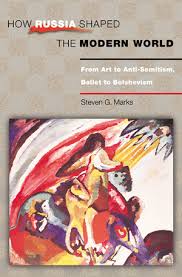
Steven Marks, How Russia Shaped the Modern World:
From Art to Anti-Semitism, Ballet to Bolshevism 

                   From the autocracy of the Tsars to the totalitarianism of Stalinist communism, and on to the authoritarianism of Vladimir Putin, over the last two centuries, Russia (and the Soviet Union, when it existed), have charted a path politically well removed from that of the democracies of Western Europe and North America. But if Russia has been depressingly resistant to the democratizing currents of the West, I have always assumed and never doubted for a moment that Russia was a indispensable part of European culture, a huge contributor to its every aspect, literature and art, music and dance and more. Steven Marks’ “How Russia Shaped the Modern World: From Art to Anti-Semitism, Ballet to Bolshevism,” which first appeared in 2003, did not dispel that assumption but added…

View original post 2,679 more words

Categories
Art and Photographic History German Matters

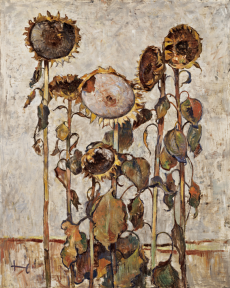
Leopold Hauer 1896-1984- a singular talent.

Sonnenblumen 1963
Sonnenblumen 1963

Between 1918 and 1924 Hauer studied at the Academy of Fine Arts in Vienna with Josef Jungwirth and Karl Sterrer . In 1927 he had his first solo exhibition at the Neue Galerie Vienna (with Otto Nirenstein-Kallir).

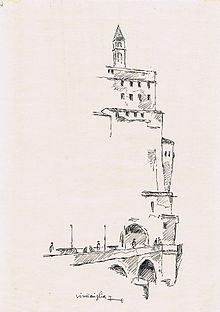
Ventimiglia 1955
Ventimiglia 1955

Arthur Roessler the Austrian art historian (http://de.wikipedia.org/wiki/Arthur_Roessler) wrote in 1927 in an essay in “Austrian Art” about Leopold Hauer: “Finally, once again, we have a man that is not only painter, but a painter that is a true artist , A creative artist endowed with instinct and intelligence, one that does not just produce “Decorate your home with Pictures”. Rather a man who shows himself to us as a gifted or talented artist and an individualist, without as immediate predecessor to showed the way. He is not a naturalist nor is he doctrainaire, he promotes originality and translates his impressions. He has achieved this already with so much skill that anyone who views his pictures is capable of experiencing both their sensual captivating charm and the pure spiritual enjoyment which they induce.”

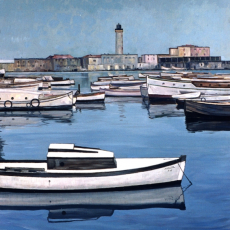
Weiße Boote, 1956
Weiße Boote, 1956


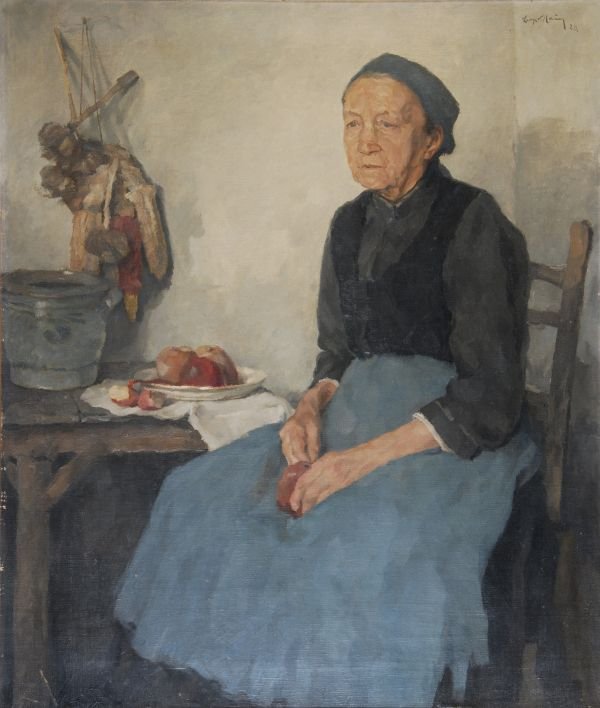
Apfelschalerin 1920?


Categories
Uncategorized

On Eduard von Keyserling’s – Schwüle Tage (Sultry Days) – (1916)

Sounds interesting,,,,,,,

Caroline's avatarBeauty is a Sleeping Cat

Schwüle Tage

Today we had the first snow. I woke to a fine layer of white in the morning. I don’t think it will stay, it’s already raining. Nonetheless it is strange to write about a book set during a sultry, sweltering summer.

Occasionally critics wonder why Eduard von Keyserling is not as widely read in Germany as Theodor Fontane. I often wonder why he isn’t translated into English. After having read the novella Schwüle Tage (Sultry Days) I think I can say with great certainty that being compared to Fontane may be the reason for both. Not because he isn’t as good and the comparison would be unfavorable, no, just because it’s wrong or, at least, not entirely correct. There is another important author whose work is far closer to Keyserling and that is Arthur Schnitzler. The subconscious plays a far greater role in Keyserling than in Fontane. Suppressed emotions and…

View original post 444 more words

Categories
Uncategorized

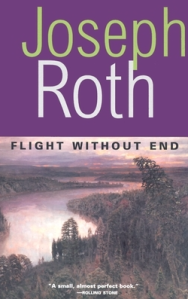
Literature and War Readalong November 30 2014 Meets German Literature Month: Flight Without End – Die Flucht ohne Ende by Joseph Roth

More Roth -great…..

Caroline's avatarBeauty is a Sleeping Cat

Screen Shot 2014-10-19 at 10.18.51

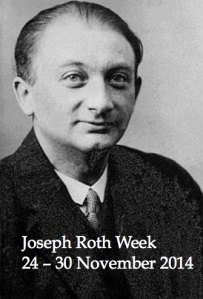
Jospeh Roth, one of the greats of Austrian literature, seemed like a wonderful choice, not only for the Literature and War Readalong in which we focus on WWI, but also as part of German Literature Month. And because he’s such a fine author, there will not only be a readalong but the last week of GLM ( 24 – 30 November) is dedicated to his work. After some rather unfortunate readalong choices, I’m confident this one will not disappoint.

Joseph Roth

Joseph Roth was an Austrian-Jewish writer and journalist. He died at the age of forty-seven in Paris. His early death was probably brought on by his alcoholism. His last book, called The Legend of the Holy Drinker, is inspired by his own battle with alcohol.

Some of his books deal with the end of the Austro-Hungarian Empire (The Radetzky March, The Emperor’s Tomb), others like Job focus on Judaism…

View original post 269 more words

Categories
Art and Photographic History Art Exhibition Reviews

Reviewing “Mr Turner ” by Mike Leigh

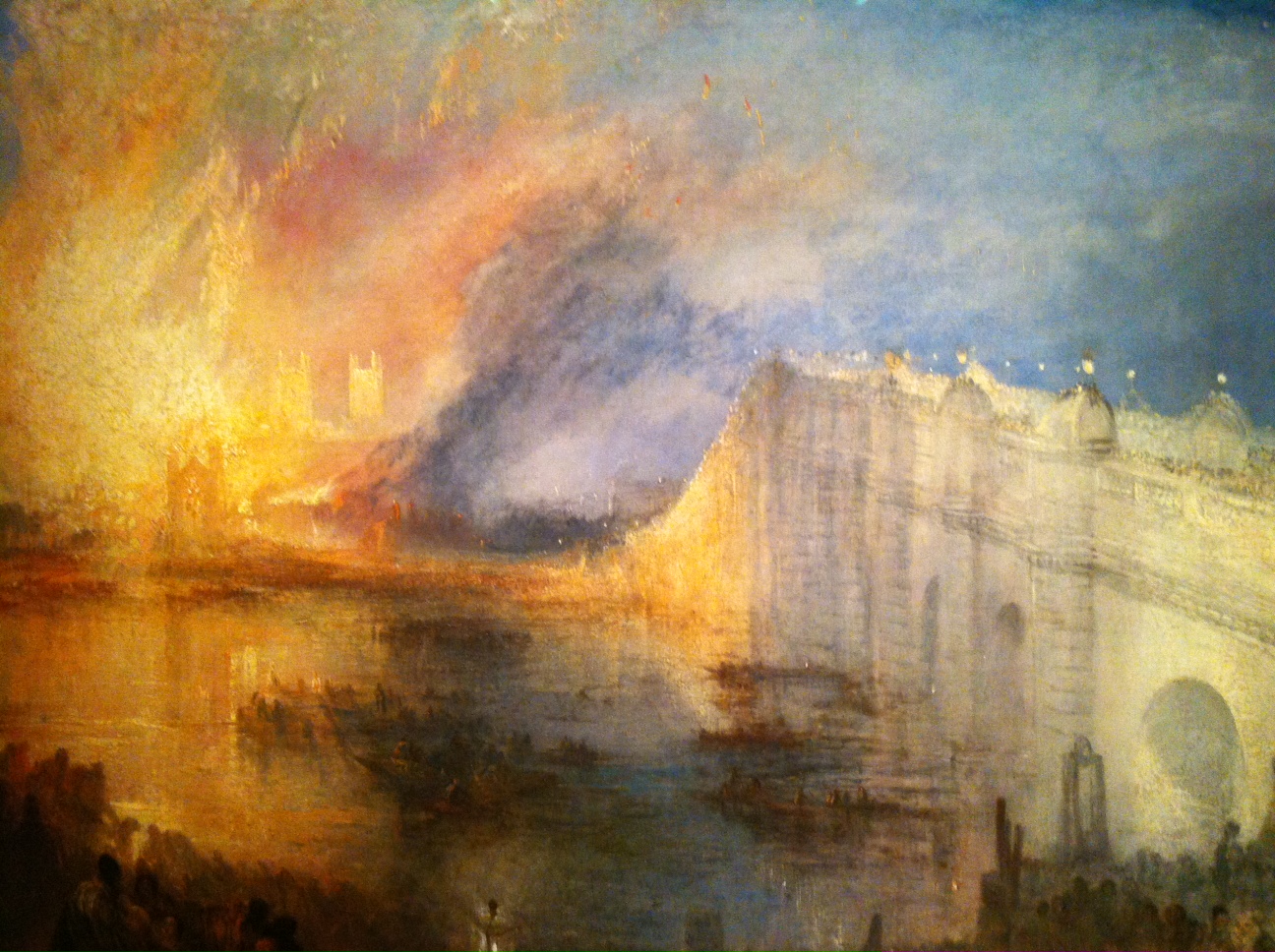
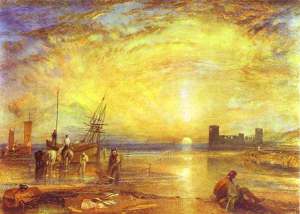
In my personal view, some of the most interesting aspects of “Mr Turner” was his constant interest in all types of scientific investigation. The development of new colours in laboratory conditions and his interest in photography were parts of the recent film that I found deeply engaging and in particular the cameo scene with Mrs Sommerville. This Eighteenth Century background has been splendidly covered by Richard Holmes in his “The Age of Wonder: How the Romantic Generation Discovered the Beauty and Terror of Science” 2009.(Shortlisted for the Samuel Johnson Prize and winner of the Royal Society Prize for Science Books). I am reliably informed that Turner read Goethe’s tremendous work on colour theory. How JMW Turner may have eavesdropped on the Royal Academy next door is interestingly discussed at http://www.bbc.co.uk/news/entertainment-arts-15719338 and his probable interest in the work of William Herschel is considered here.turner46 Flint Castle
Two typical reviews of Mike Leigh’s production can be read at The Guardian -http://www.theguardian.com/film/2014/oct/30/mr-turner-review-mike-leigh-timothy-spall

and The Telegraph -http://www.telegraph.co.uk/culture/film/filmreviews/10833174/Mr-Turner-review-supremely-enjoyable.html where Robbie Collin makes reference to Spall  as “like a mouthing, phlegmy Gruffalo”.

Here is a review (unedited) from my friend Vaughan Warren whose prolific work, inspired by Turner, appears at Penzance Public Library:-

‘Mr. Turner’, a film by Mike Leigh; a review by ‘Mr. Warren’.20140927_151818

Rated: 10+/10; perhaps?


Painting is a ‘rum’ business… of ‘nothingness’ and the like!


If one was unfamiliar with the mythology surrounding JMW Turner, or indeed oblivious to whom he was, then the film might appear meaningless and self- indulgent, even despite the fascinating but unlovable depiction by Timothy Spall; yet as a testament to ‘Englishness’ this film is sublime in all its mastery of misery and beauty but some have complained it is too long; it was not long enough! As it turns out I will argue that this film hides a lot more than it reveals at first glance, and its episodic nature has resulted in a rather fragmented view of the man, the painter, the myth?

Like JMW Turner, I was a student of the Royal Academy Schools, which moved from Somerset House to Burlington House, being there myself from 1978-1984, in Piccadilly, London; so I was bound to be rather hyper-critical yet responsive to such a homage to one of our greatest painters. The interactions at the Royal Academy Exhibition, as it was then, were bang on! Poor John Constable was born after Turner and died before Turner’s demise in 1851 and his whole life was overshadowed by this ‘monster’! Turner’s generosity in sharing ‘observations for improvements’  in others work was his gift to teaching; far removed from his disastrous lectures on Perspective at the Academy which were not for want of knowledge but the problem of communicating something so innate!

Travel in Turner’s time appeared idealistic; ferries along the Thames stopping at the new railway stations or venturing even further to the mouth of the Thames and Margate where of course he met Mrs. Booth whom he subsequently ‘bedded’ and lived as a harmonious family life as Turner possibly could have; but the restlessness continued… Turner never married but had two daughters by another woman, one Sarah Danby!

In reality JMW Turner was a short stocky rather shabby man who appeared to lack any social graces especially when it came to women and any concept of family, excepting his father William Turner, Turner’s ‘Daddy’,  whose resulting and inevitable death, was subtly hinted at by the scene of mixing Chrome Yellow oil pigment without protection as was the way in many painters studios, and upon reflection the skin condition of ‘the maid’ was probably a result of ‘Painters disease’, a result of exposure to lead and arsenic ever present in paints even to this day; not within the EU of course but still available in cheap but authentic pigments available from China.

The sumptuous filming caught well the tensions of the period with civilised facades hiding squalor and debauchery behind closed doors. In this respect and most others Timothy Spall was a perfect cast for the role, and Mike Leigh’s directing may have been drawing more upon his own families ‘trauma’. Indeed it is the way the sexual promiscuity of Turner was handled, sometimes with innuendo but at other times with a truly threatening behaviour and scenes of blatant groping. Is it for this reason that many women who have seen the film find Spall and by proxy Turner disgusting and ‘pig like,’ and would not recommend it!p-unframed

To address this Turner’s encounter with ‘Jessica’ at Petworth should have been extended to reveal a more tender and cultured side to his personality. It would have also drawn focus away from Turner as a typically landscape based artist, as his figures at Petworth are abstractions in a mannerist style far in advance of his landscapes which flourished later, and are some of the greatest depictions of figures in interiors we have in English Painting.

It was poor research that suggested that Turner made way for the Pre Raphaelites and photography, however the depiction of John Ruskin, the critic and champion of Turner, was a triumph and the film should have ended with Ruskin burning almost a third of Turner’s erotic figurative output, which we will now never know about. Instead the film ended with the realisation that, “The Sun is God”, and the wry smile of ‘Mrs’ Turner compared with the desolation of Turner’s lifelong companion in the form of his cousin as  maid / relative / sexually abused female! Indeed it was suggested that it was for Turner’s attentions that she appeared to live and endure knowing nothing else presumably, and this made her the victim of the man as ‘monster’?

One last technical point; although Turner was at the cutting edge of pigment use, his use, (even if available commercially before 1851), of Cobalt Blue over his preferred pigment known as Smalt is still a question of conjecture. Although Cobalt Blue was a known pigment used in ceramics it is a question of stability and lightfastness in oils that leads many conservationists and dealers to question the authenticity of alleged works by JMW Turner if elements of this material are found after chemical analysis.

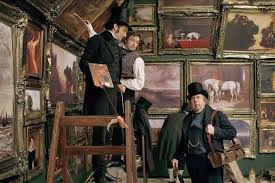
Painting, art, film; is a ‘rum’ business indeed; or was it Sherry?Mr T at RA
—————————————————————————————————————————————————–

Another friend comments:-

Thank you for sharing the Cannes film festival review of  ‘ Mr Turner’. I’m going to see it on Tuesday so will be able to judge whether all the publicity has been accurate or otherwise. Around the time of his bi-centenary Leo McKern made a valiant attempt to portray the artist in the drama-documentary ‘ The Sun is God’ (supposedly his dying words
as bright sunlight burst through an overcast sky moments before his last breath at precisely 10 am on December 19 1851.) Though typically low budget that production admirably succeeded in conveying both the social conditions and prevailing atmosphere alongside the convincing character study itself. Were Mike Leigh to go one better he will have done well.
This is in reply to the following review from the BFI on Leigh’s success at Cannes:- www.bfi.org.uk/news-opinion/sight-sound-magazine/comment/festivals/cannes-2014-savouring-mr-turner


Categories
Art and Photographic History Art Exhibition Reviews German Matters

Otto Rudolf Schatz (Austria, 1900 – 1961)

Ballonverkäufer
Ballonverkäufer

Schatz came from a family of civil servants and attended the Vienna School of Applied Arts. With 22 years of commitment to the political left, the artist had already appeared as a book illustrator for Arthur Roessler and also for Josef Luitpold Stern. Schatz illustrated  books in the interwar period, especially literature from theStrom-Verlag(including Stefan Zweig , Jack LondonUpton Sinclair’s “Co-op” and Peter Roseggers “Jakob the Last”).

"The Hope," by Otto Rudolf Schatz.
“The Hope,” by Otto Rudolf Schatz.

1925 was the Great Treasure State Award, 1928-38 he was a member of the Hagenbund . He lived during the Second World War treasure in Brno, Prague and later in a sub-camp of Gross-Rosen concentration camp in Graditz admitted that he “jüdisch-versippt” -which apparently meant that by his marriage he was considered part of the Jewish “clan”. Schatz became, on his return, by the City Councillor for Culture. His first prize for the design of the Wiener Westbahnhofs  remained unrealized.

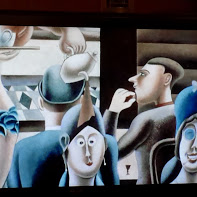
“Die Hoffnung” has the erotic interest that figures in much of Schatz’s work and is vaguely reminiscent of the sardonic style of Edward Burra, who has recently been the subject of a programme by Andrew Graham-Dixon called “I never tell anyone, anything”. This intriguing programme is available on You-Tube at https://www.youtube.com/watch?v=4BoLh8xgOdI

Extract from a painting by Edward Burra
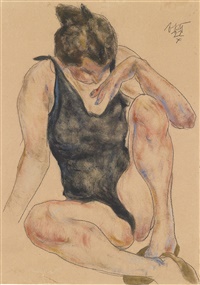
Sitzende im schwarzgrüne Trikot


Categories
Uncategorized

All Saints’ Day at St. Marx Friedhof

An interesting and charming post about All Saint’s Day im Wien

Tina's avatarEveryday life in Vienna

Today is the day when most Austrians make their way to a graveyard nearby, and light candles in remembrance of their departed. I decided to take my camera and tripod out to see what could be found at St. Marx Friedhof, which is one of the nicest ones (imho) in Vienna. Without a remote trigger though, I was very handicapped…..
1 november-15
The centre of the graveyard was full of lights that were put down by people. I’m fairly certain that Zentralfriedhof would have been more impressive, but this one is quite intimate, and holds the remains of Mozart. Somewhere.
1 november-10Seeing as Mozart was put to rest in an unmarked grave, they have put up a stone in his honour. So, we don’t know exactly where he was put down, only that it was at this graveyard. This wasn’t because he was a baddie or anything, it was just the custom of…

View original post 180 more words

Categories
Art and Photographic History Art Exhibition Reviews German Matters Uncategorized

Two Painters from Vienna and Bohemia- Sergius Pauser and Josef Dobrowsky

_sergius_pauser_86I came across this lovely painting by Sergius Pauser in the Leopold Museum in Vienna. Mädchen vor dem Spiegel was painted in 1931 and Öl auf Leinwand, 92×73 cm, so oil on linen. The limited range of colour, the tone and the style, that is to say, The New Objectivity (in German: Neue Sachlichkeit), along with the model’s expression give this painting an attractive and contemplative feeling. The subject is, of course, a common one for artists including Lovis Corinth (1918) and famously Picasso (1932). It is also similarly the subject of the self-portrait by Zenadia Serebryakova as mentioned in my earlier posting http://penwithlit.wordpress.com/2011/12/19/self-portraits-1900-1912-3-zinaida-serebryakova/. Other paintings by Pauser will be found at http://www.sergius-pauser.at/20141006_103104

Quoting from the above link, this passage is of considerable interest,”The writer Thomas Bernhard (1931-1989) wrote of Pauser: “Sergius Pauser uttered thoughts about people – Adalbert Stifter, for example – that I have never heard before or since; he succeeded in revealing the most concealed corners of poetic sensitivity; he was a tender and vigilant diviner on the landscape of world literature, a philosopher and an artist through and through.” And yet a painter like Sergius Pauser is barely known today; only a few of his works hang in Austrian galleries and many of his paintings cannot be traced due to the emigration of their owners.”

Pauser was considered unreliable by the Nazis and had a tough time as recorded by Wikipedia.de:-“In seiner Monographie berichtet Rupert Feuchtmüller (S. 22), dass Sergius Pauser im Herbst 1944 mit fünftausend sogenannten „Politisch Unzuverlässigen“ in ein Schanz-Lager bei Radkersburg gebracht wurde. Der Schauspieler Curd Jürgens, der auch bei diesem Transport war, schreibt über diese Zeit: „… Ich weiß, dass Sergius sowohl als auch Boeckl … recht viel Unangenehmes durchmachen mussten, da die SA-Bewacher mehr und mehr die Nerven verloren und dies an den Gefangenen ausließen.“ (Curd Jürgens in seinen „Erinnerungen“, Autobiographischer Roman, Droemer Knaur Verlag 1976)”

Here are three more paintings by Pauser that appeal to me. Amerikanerin 1948,

Luis Trenker mit Kamera, 1938
Amerikanerin
Amerikanerin

has an appealing delicacy and an optimistic and conversational appeal. The hardboard realism of Luis Trenker mit Kamera, 1938,Mischtechnik auf Hartplatte from an earlier period reminds me of a favourite painter, Christian Schad. I cannot find a colour image for Mädchen mit rotem Hut, 1942 Agathe Prinzessin von Ratibor but am intrigued to find that she was a Princess of a Polish town called Racibórz in Polish but very close to the Czech border and called Ratiboř.2010-07-12-18-06-00_wv_387_gallery_sergius_pauser


Josef Dobrowsky (* 22. September 1889 in Karlsbad, Böhmen; † 9. Januar 1964 in Tullnerbach) was a painter who worked in Vienna with Pauser and his work is currently on display as “Perception and Colour” in the Upper Belvedere http://www.belvedere.at/de/ausstellungen/ausstellungsvorschau/josef-dobrowsky—wahrnehmung-und-farbe-e152593

Dobrowsky-selbstportraet