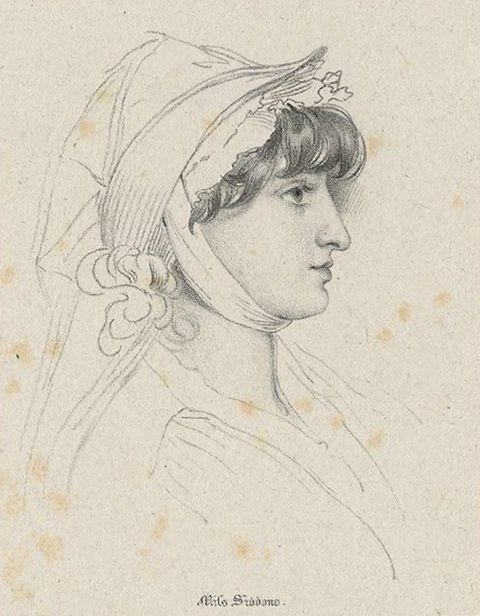
The subject of my blog today is not an artist, although many would term her a theatrical artist, and in fact she was looked upon as one of the greatest English tragic actors of the eighteenth century. She was a Shakespearean actor of great renown and particularly famous for her interpretations of Lady Macbeth. She was a lady who was so popular that her portrait was painted a number of times by leading portraitists of the time. Let me introduce you to Sarae Kemble, later known as Sarah Siddons.
Sarae Kemble was born in the Welsh town of Brecon in July 1755. She was the eldest of twelve children of Roger Kemble and his wife Sarah Ward. Her father, who was a theatre manager, managed a troupe of travelling actors, the Warwickshire Company of Comedians. Sarah was fortunate to be the eldest child as her…
The King of China’s daughter,
She never would love me
Though I hung my cap and bells upon
Her nutmeg tree.
For oranges and lemons,
The stars in bright blue air,
(I stole them long ago, my dear)
Were dangling there.
The Moon did give me silver pence,
The sun did give me gold,
And both together softly blew
And made my porridge cold;
But the King of China’s daughter
Pretended not to see
When I hung my cap and bells upon
Her nutmeg tree.
The King of China’s daughter
So beautiful to see
With her face like yellow water, left
Her nutmeg tree.
Her little rope for skipping
She kissed and gave to me –
Made of painted notes of singing-birds
Among the fields of tea
I skipped across the nutmeg grove, –
I skipped across the sea;
But neither sun nor moon, my dear,
Has yet caught me.
The same day I saw the Popkov exhibition at Somerset House, I also nipped into the St Petersburg Gallery where there was a display of Russian avant-garde works. I took a few a pictures with my Moto G, and as you can see, the picture quality isn’t great.
The curators of this show (Russian Revolution in Art, Russian Avant-Garde: 1910 – 1932) focused on a major dichotomy of the modernist period – figurative vs non-figurative art. While artists, joined up in a multitude of movements, claimed that art was separate from the real world, they continued to investigate abstraction and rhythm, and created new colour and plastic compositions.
The exhibition has more than sixty pieces: paintings, drawings, craft and sculptures. There are suprematists and constructivists, ceramicists and non-objectivists. There is a St Petersburg circle, a Malevich circle, a Moscow circle. There even is a set of Kandinskys before that worthy legged…
– Frag´ mich nicht, ob ich Dich liebe (tango)
Musik: Ludwig Schmidseder, Text: Hans Fritz Beckmann, Dirigent: Freddy Alberti can be seen at www.youtube.com/watch?v=weF_0QScy5c
Frag’ mich nicht,
Ob ich dich liebe
Frag’ mich nicht,
Denn was heute Wahrheit ist,
kann morgen Lüge sein.
Heut’ ist heut’
musst du dir denken.
Heut’ ist heut’,
denn das was Morgen ist,
ob du noch glücklich bist,
das weiß nur Gott allein.
Morgen schon,
könnt ich mein Herz einem anderen schenken.
Morgen schon,
will ich vielleicht schon gar nicht mehr an dich denken.
Drum bitt’ ich dich,
frag’ mich nicht,
ob ich dich liebe.
Frag’ mich nicht,
Denn was heute Wahrheit ist,
kann morgen Lüge sein.
Nur in den Märchen
Gibt es Glück für alle Zeit.
Nur in den Märchen
Hält die Seligkeit bleibt man zu zweit.
Frag’ mich nicht,
ob ich dich liebe.
Frag’ mich nicht,
Denn was heute Wahrheit ist,
kann morgen Lüge sein.
Heut’ ist heut’
musst du dir denken.
Heut’ ist heut’,
denn das was morgen ist,
ob du noch glücklich bist,
das weiß nur Gott allein.
Morgen schon
könnt ich mein Herz einem anderen schenken.
Morgen schon
will ich vielleicht gar nicht mehr an dich denken.
Drum bitt’ ich dich,
frag mich nicht,
ob ich dich liebe.
Frag’ mich nicht,
Denn was heute Wahrheit ist,
kann morgen Lüge sein.
This song also reminds me of Carole King’s similar but related feelings as expressed at www.youtube.com/watch?v=m8KlYc0xG80 with “Will you still love me tomorrow?”
Advanced writing workshops in a hotel where Charles Dickens and Oscar Wilde once stayed. Eye-opening information about Cornish medieval drama. Advice on getting published from a bestseller. A fascination with the exotic.
Writers and readers (myself included) flocked to Penzance over the weekend for the annual Literary Festival, expertly organised by a team of volunteers and run over four days in some of the best buildings in town.
From the ultra-modern surroundings of The Exchange to the refined, historical setting of The Union Hotel and the artistic delights of the Acorn Theatre, there were a whopping 85 events on offer to tempt visitors and locals from the delightful sunshine and into a world of bookishness and learning.
I didn’t manage to attend anything like all of the sessions, but here’s a brief rundown of my favourites:
Author Branding – tips from international writer and ex-pat Liz Fenwick on how to create…
There are a surprising number of car boot sales in Cornwall as may be clearly seen by looking at the maps and search on www.intocornwall.com/ .Probably the two most popular in West Cornwall are the Sunday event at Hayle which starts as early as at 8am. Hayle Rugby Club R.F.C, Memorial Park, Marsh Lane, Hayle. In the recent fine weather the Wednesday market at Roseudgeon between Penzance and Helston fromthe beginning of April to end of October.
Visiting the Roseudgeon event recently, I discovered a nexus of vibrant activity and fun. In summer, parking might take 10 minutes or so but the fields to which the cars are guided is close to the sea and affords expansive views down to the cliffs on the south coast itself. The stallholders must arrive as early as six in the morning to get a decent pitch . However, revived by a strong cup of tea and an hour of quick sales puts them into good humour. As well as cash, useful information changes hands in relation to where things can be sourced, how to look after a pot plant and keep it in good condition and so forth.
Rosudgeon Car Boot Sale
There are a wide range of flowers and potted bushes on sale making for a colourful display. There is a mass of cheap fruit and vegetables. (I was cheered by a large bag of cherries, probably about 1.5kg, cost just a £1). Naturally, as is my wont -an interesting word deriving from the same stem as the German verb wohnen to live in a place- I headed for the books, DVDs and CDs. There is a rich vein of books on photography-e.g Peace Snapped by Rupert Hopkins 1986 about the Greenham Common Peace Camp.http://www.ruperthopkins.com/gallery.php. I also found an Art book valued new at £383-09 and in pretty good condition for just £8. This is the place to come if you are in search of your favourite type of music, I rather regret not spending £2 on the nostalgia of Manfred Mann! As Tony Benn once remarked,”There is nothing like finding something you have lost-it gives you more pleasure than anything else.”
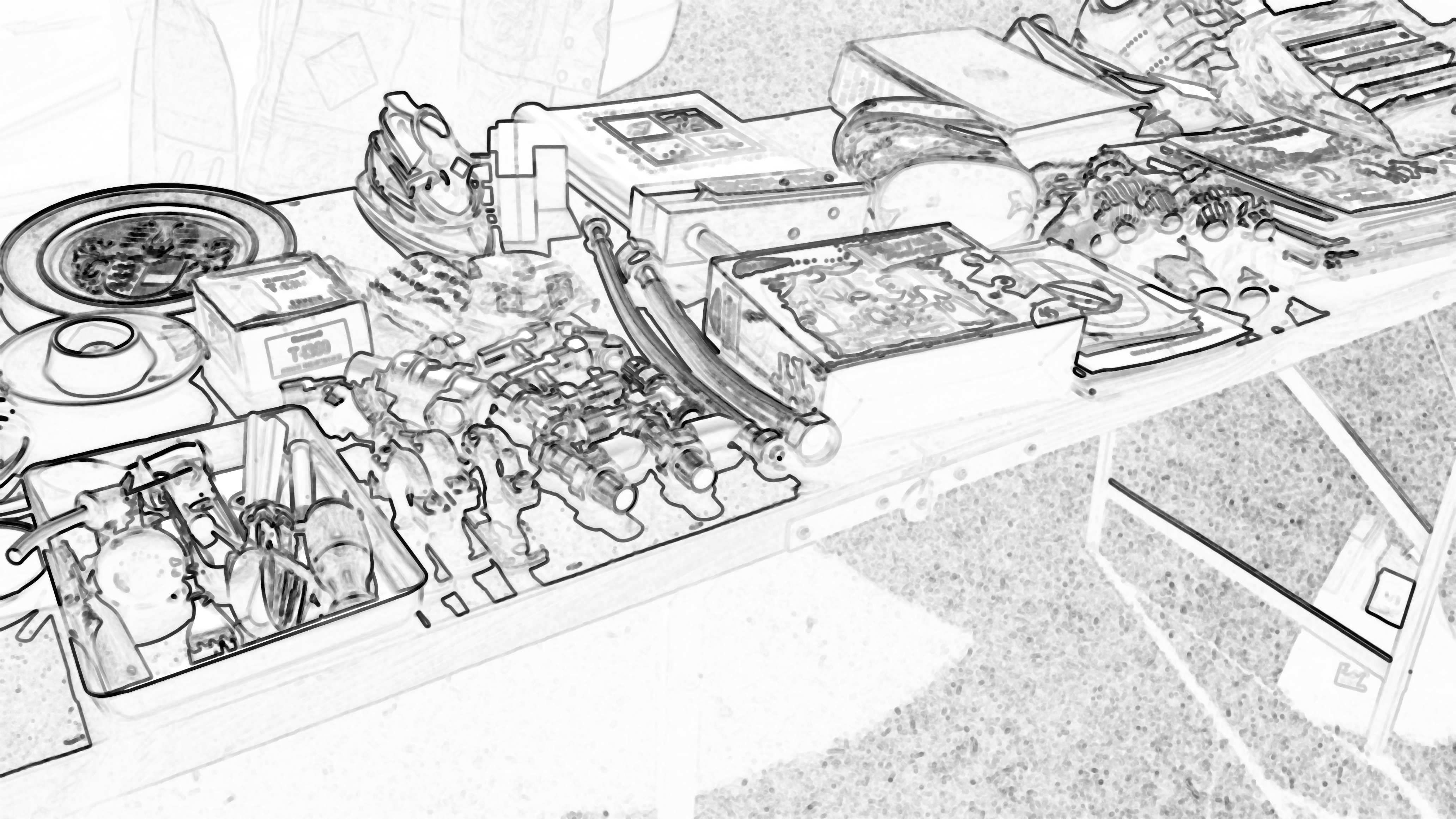
Car components etc!
There are rolls, cakes and drinks for sale and in the hall next to the field tea, sandwiches, scones and fairy cakes are on sale at very reasonable prices. There is something rather typically English and sempiternal about the ambiance, rather like a dance hall frozen into the 1960s with jovial and friendly staff presiding. After taking a break, it is interesting to note that the crowds of punters are a cosmopolitan group. There are locals picking up cheap supplies but also groups of visitors from abroad, discovering facets of popular culture by rooting through shed-loads of cheap DVDs. Everyone wanders through makeshift alleyways, surveying the more specialist stalls providing fishing rods, leather goods and cowboy hats and sturdy, wooden garden furniture.
It was a great pleasure to discover an old friend, MVB- www.rainydaygallery.co.uk– selling off the stock remaining from his recently closed gallery. This included postcards with various intriguing local artists and his family biographies. The latter containing an account of his grandfather; an early pioneer of flying machines. If you are looking for presents for children you will find everything from bags of lego in all shapes and sizes, strategy games and kids DVDs. A Bagpuss DVD retailed for £1 and two lego kits in good condition were about £5. It is a good idea to plan your budget before you start, although I don’t myself regret buying an unaccountably attractive Welsh vase for £1 and a cafitiere in fresh condition for £4 -at least £10 cheaper than on Amazon, say.
Als ich als junger Mann den Mädchen den Hof machte
Spielte ich ein Wartespiel
Wenn ein Mädchen mit wallenden Locken mich zurückwieß
Ließ ich die alte Erde ein paar Umdrehungen machen
Während ich sie mit Tränen anstatt Perlen bearbeitete
Und mit der Zeit kam sie zu mir
Mit der Zeit kam sie
Wenn du dich mit den jungen Mädchen im Frühling triffst
Machst du ihnen mit Liedern und Reimen den Hof
Sie antworten dir mit Worten und einem Kleeblatt-Ring
Aber wenn du die Dinge, die sie bringen, unter die Lupe nimmst
Haben sie wenig zu bieten, außer der Lieder, die sie singen
Und reichlich verschwendeter Zeit
Reichlich verschwendeter Zeit
Oh, es ist eine lange, lange Zeit
von Mai bis Dezember
Aber die Tagen werden kürzer
Wenn der September eintrifft
Wenn das Herbstwetter
Die Blätter rötlich färbt
Bleibt keine Zeit
für das Wartespiel
Oh, die Tage schwinden
Zu wenigen zusammen
September, November
Und diese wenigen kostbaren Tage
Werde ich mit dir verbringen
Diese kostbaren Tage
Werde ich mit dir verbringen
Übersetzung: Marc Rothballer für Sinatra
Das vielleicht schönste Lied aus Andersons und Weills „Knickerbocker Holiday“ ist der „September Song“, der bei der Erstaufführung von Walter Houston interpretiert wurde, und der auf Wunsch von Alexej unser neues Wochenthema sein soll.
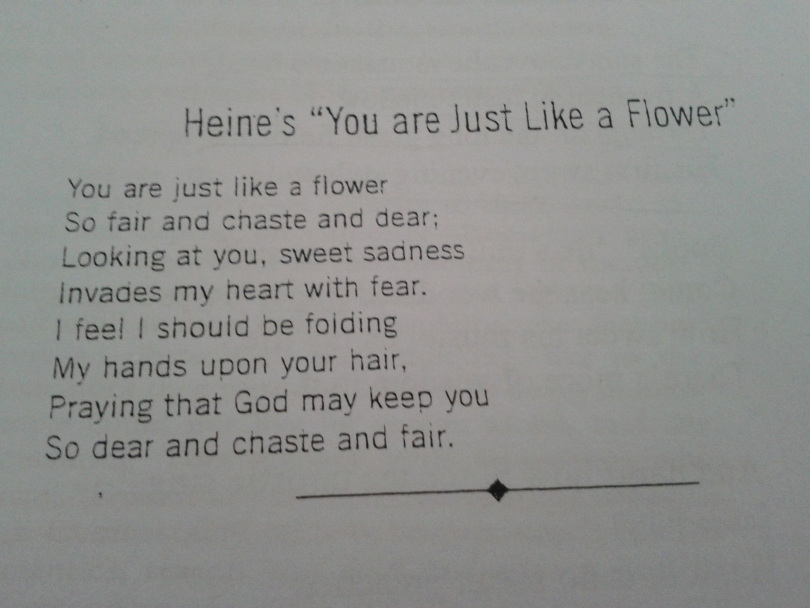
Du bist wie eine Blume
So hold und schön und rein;
Ich schau’ dich an,
Und Wehmut schleicht mir ins Herz hinein.
Mir ist, als ob ich die Hände
Aufs Haupt dir legen sollt’,
Betend, daß Gott dich erhalte
So rein und schön und hold,
Betend, daß Gott dich erhalte
So rein und schön und hold.
I
Ich trete in die dunkelblaue Stunde –
da ist der Flur, die Kette schließt sich zu
und nun im Raum ein Rot auf einem Munde
und eine Schale später Rosen – Du!
Wir wissen beide, jene Worte,
die jeder oft zu anderen sprach und trug,
sind zwischen uns wie nichts und fehl am Orte:
dies ist das Ganze und der letzte Zug.
Das Schweigende ist so weit fortgeschritten
und füllt den Raum und denkt sich selber zu
die Stunde – nichts gehofft und nichts gelitten –
mit ihrer Schale später Rosen – Du.
II
Dein Haupt verfließt, ist weiß und will sich hüten,
indessen sammelt sich auf deinem Mund;
die ganze Lust, der Purpur und die Blüten
aus deinem angestammten Ahnengrund.
Du bist so weiß, man denkt, du wirst zerfallen
vor lauter Schnee, vor lauter Blütenlos,
totweiße Rosen, Glied für Glied – Korallen
nur auf den Lippen, schwer und wundengroß.
Du bist so weich, du gibst von etwas Kunde,
von einem Glück aus Sinken und Gefahr
in einer blauen, dunkelblauen Stunde
und wenn sie ging, weiß keiner, ob sie war.
III
Ich frage dich, du bist doch eines andern,
was trägst du mir die späten Rosen zu?
Du sagst, die Träume gehn, die Stunden wandern,
was ist das alles: er und ich und du?
«Was sich erhebt, das will auch wieder enden,
was sich erlebt – wer weiß denn das genau,
die Kette schließt, man schweigt in diesen Wänden
und dort die Weite, hoch und dunkelblau.»
This very lovely poem appears in the useful collection “The Faber Book of 20th Century German Poems” where it has been translated by Michael Hofmann:-
Blue Hour
I
I enter the deep blue hour-
here is the landing, the chain shuts behind
and now in the room only carmine on a mouth
and a bowl of late roses-you!
We both know, those words
we both spoke and often offered others
are of no account and out of place between us:
this is everything and endgame.
Silence has advanced so far
it fills the room and seals it shut
the hour-nothing hoped and nothing suffered-
with its bowl of late roses-you.
II
Your face blurs, is white and fragile,
meanwhile there collects on your mouth
all of desire, the purple and the blossoms
from some ancestral flotsam stock.
You are so pale, I think you might disintegrate
in a snowdrift, in unblooming
deathly white roses, one by one-coral
only your lips, heavy and like a wound.
You are so soft, you portend something
of happiness, of submersion and danger
in a blue, a deep blue hour
and when it is gone, no one knows if it was.
III
I remind you, you are another’s,
what are you doing bearing me these late roses?
You say dreams bleach, hours wander.
what is all this: he and I and you?
‘What arises and arouses, it all comes to an end,
what happens- who exactly knows,
the chain falls shut, we are silent in these walls,
and outside is all of space, lofty and dark blue.’
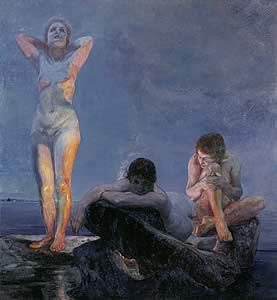
Die blaue Stunde (L’heure bleue), 1890; Öl auf Leinwand. Leihgeber: Museum der bildenden Künste Leipzig.
There is an interesting analysis of this poem by the Italian translator and scholar, Stefanie Golisch at http://www.fixpoetry.com/feuilleton/lesarten/gottfried-benn/blaue-stunde/ingeborg-bachmann/die-blaue-stunde
A new translation of Benn’s poems by Michael Hofmann called “Impromtus” is reviewed at http://www.theguardian.com/books/2014/jan/31/impromptu-selected-poems-gottfried-benn-review
There is also a You Tube reading at https://www.youtube.com/watch?v=RAs1t3evQW4

 Sarah Siddons by J. Dickinson







 penwithlit