Abend atmete aus Blumenblüten,
Als im fernen Winde wer die Flöte blies.
Laßt mich eine Gerte von den Zweigen brechen,
Flöte schnitzen und wie jene Flöte tun.
Wenn die Nächte nun
Ihren Schlaf behüten,
Hören Vögel, wie zwei Flöten süß
Ihre Sprache sprechen.
(Li-tai-pe)
(Alfred Henschke) Klabund
Aus der Sammlung Chinesische Gedichte
The Distant Flutes by Li Tai Pe -a free translation
The evening is seeped in the heavy scent of rose blossom
As the distant winds catch the notes of flutes.
Let me carve a such a flute myself
from this overhanging branch
May the night guard you
as you sleep,
Lulled listening to the birds, as two sweet melancholy
flutes whisper to you in your own secret language.
In dem künstlich angelegten Teiche
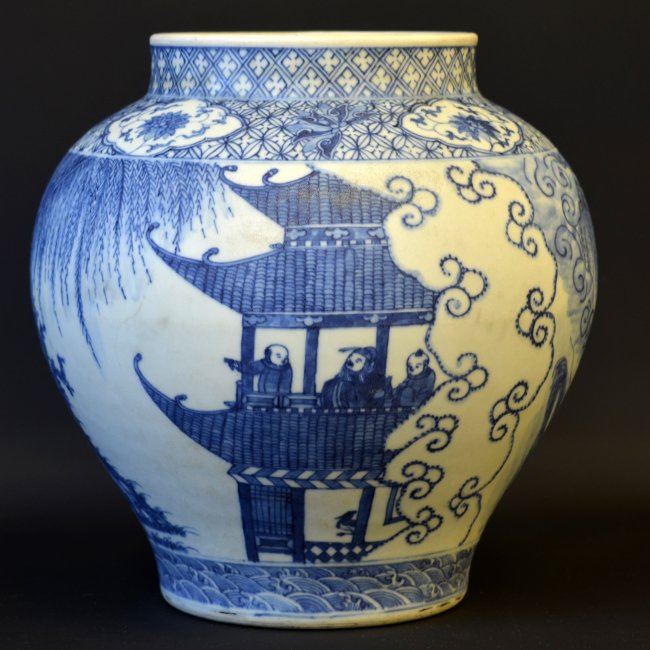
Auf der Insel steht der Pavillon von grün und weißem Porzellan.
Man gelangt in seine gläsernen Bereiche
Über eines weißen Tigers Rücken, der sich hier als Brücke aufgetan.
Dort sitzen Freunde froh beim Weine. Licht
Ist der Gewänder Farbe, die sich nicht im Staub der Wochentage placken.
Die Freunde plaudern oder schweigen heiter. Einer schreibt ein Gedicht,
Streift die Ärmel zurück und wirft das Haupt in den Nacken.
Sieh: in dem Teich, in dem die Jadebrücke, in den Wellen leise wehend,
Sich wie ein Halbmond wölbt, der Freunde trunknen Wahn!
Die Kleider zitternd! Auf dem Kopfe stehend
In einem Pavillon von Porzellan!
Li-tai-pe
A free translation of this, is as follows:-
The Porcelain Pavilion
A white and green pavilion made out of porcelain
depicts beautifully elaborate pools.
See how these glassy dominions spring from
the white back of a tiger
that here, serves as a bridge.
On one side the company enjoy their wine. The colour
of their garments radiates as white.
These are not grimy from their daily labours.
The friends chat or just sink into a cheerful silence.
One writes a poem
as another stretches up his arm and scratches
the back of his neck.
See just how above the pools and the jade bridge
and the gently plashing waves,
how the curving crescent of the moon arches
over the drunken folly of these friends.
Their very clothes seem to shiver as one man stands on his head
You have to admire the lady. This rather awkward and shy daughter of a staunch Lutheran pastor who himself had been born as a Polish Catholic. His daughter, Angela Merkel, studied with such intelligence and application that soon brought her academic success particularly in Russian and finally in Quantum Chemistry. At the age of 26, she obtained her doctorate and in passing, it rather seems her first husband, the physicist Ulrike Merkel. Her rise to power was rapid and took place through the period in which the DDR collapsed as Russian policy under Gorbachev changed. Along with a wry and dry sense of humour Angela Merkel’s personality is the embodiment of the characteristic known in German as “fleissig”. This means hardworking, sedulous, diligent and assiduous.
Notably, the international journalist, Stefan Kornelius from the “Süddeutsche Zeitung”, describes how by 1998 her party, the CDU suffered defeat, she had reached the point where she was relishing the nitty-gritty of political strife and delivering sharp exchanges with her political opponent from the SPD, the extrovert German Chancellor, Gerhard Fritz Kurt Schröder. These sharpened acutely when, Merkel became her party’s General Secretary. She now began to invest her formidable skills into the arena of Foreign Policy and especially in European politics.
By 2004, the EU Commission was reformed after the elections, which yielded a majority for the conservative faction, and the question of who would be President, crucial. The European Socialists including Schröder were effectively sidelined and Merkel disliked the strong advocacy by Chirac of the Belgian, Verhofstadt. She manoeuvred with the British conservative, Michael Howard to put forward Chris Patten, to whom the then British PM, Tony Blair had to give support. In the end a compromise emerged which delivered a severe blow to Schröder and gave Merkel most of what she wanted. Compromise for Merkel is a strength she possesses and that Margaret Thatcher so obviously lacked. In the current selection of Jean-Claude Juncker presently in 2014, Merkel has had to compromise under attack from the German press. However, she has left the situation having once again achieved the best attainable solution from her viewpoint, seeking to reassure the isolated David Cameron.
Stefan Kornelius
It must be remembered, however, that this is an authorised biography which is written by a political ally from East Berlin, when both were involved in the Democratic Awakening movement in the DDR. Despite this, for a book which might have been just dry European politics, it contains both useful insights and a lively light touch. It clearly shows the degree of repression in the DDR where even a school play was harshly censored by Stasi agents, travel abroad for a woman was possible only when she reached sixty and remaining “stumm” in a cabin fever society was necessary for survival. As Kornelius points out, retaining a deeper sense of strategy and also of irony would serve Merkel well as she rose to the highest echelon of power.
In this fluent translation, topics examined include the compromises of handling the coalitions that are thrown up by Germany’s federal system and the relation between the Chancellor’s role and Foreign policy objectives. These also cover the direction of American strategy, led by a leader whom Merkel finds inscrutable. Both she and her partner, the eminent quantum chemist, Joachim Sauer, on a personal level love the Pacific coast; such affection contrasts on the politically with, for instance, what she sees as Osama’s dysfunctional domestic policy. Another area of concern lies in her dealings with Israel. She has espoused a policy of “never again” towards the Nazi past attempting to tackle concerns over racism and in Israel attacking speaking against anti-Semitism. Merkel probably has as good a historical understanding of the complexity of issues in this area as any world leader. Trust between extremists is clearly very difficult to establish. Germany tacitly supported the Palestinian access to the United Nations with observer, non-member status. Other chapters relate the developing relations with China, Russia and Chancellor Merkel’s continuing concern with ensuring peace within Europe. Since Kornelius’s book was written last year, the emergencies in Ukraine have strained these concerns to the utmost limit.
Kornelius’s account touches upon hagiography. Certainly it has patches of humour as in the account of Merkel’s famous trouser suited pose about which she has publicly joked with Hilary Clinton. It is also interesting to hear of the appeal that Wagner has for Merkel and the importance signified in “Der Ring des Nibelungen” of getting the first step just right. Unquestionably, the concept of freedom plays a dominant role in her thinking and associated with it, those of responsibility and tolerance. No wonder then that she must be concerned as Germany’s chief prosecutor currently investigates suspected U.S. monitoring of Chancellor Angela Merkel’s cellular phone, an intrusion which has dominated headlines in Berlin for months and stretched trans-Atlantic ties.
Interview in German at https://www.youtube.com/watch?v=eMvhcUAl7SE
and from The Guardian http://www.theguardian.com/profile/stefan-kornelius
and unhappy Albert, the hard-working Saxon Elector.
-The relaxed, navy-cut beard of the one,
hysterical, bristling moustaches of the other…….
The Expressionists were Rupert Brooke’s generation.
Their hold on life was weaker than a baby’s.
Their deaths, at whatever age, were infant mortality-
a bad joke in this century. Suddenly become sleepy,
they dropped like flies, whimsical, sizzling,
ecstatic, from a hot light-bulb. Even before the War,
George Heym and a friend died from a skating accident.
From 1914, they died in battle and of disease-
or suicide like Trakl. Drugs Alcohol Little Sister.
One was a student at Oxford and died, weeks later,
on the other side……..Later they ran from the Nazis.
Benjamin was turned back at the Spanish border-
his history of the streets of Paris unfinished-
deflected into an autistic suicide. In 1938,
Ödön von Horváth, author of naturalistic comidies,
was struck by a falling tree. In Paris.
At the time
my anthology was compiled, there were still a few left:
unexplained survivors,
psychoanalysts in the New World.
From the collection of Michael Hoffmann’s selected poems at http://www.amazon.co.uk/Selected-Poems-Michael-Hofmann/dp/0374532230/ref=sr_1_fkmr2_2?ie=UTF8&qid=1403993437&sr=8-2-fkmr2&keywords=michael+hoffman+Selected++poems- This web-address also contains two useful reviews.
Mascha Kaléko (1907 – 1975) wurde als Tochter jüdischer Eltern in Galizien geboren und wuchs in Berlin auf. Sie wurde als Dichterin bekannt und verkehrte im berühmten »Romanischen Café«. Doch 1935 erhielt Mascha Kaléko Publikationsverbot und musste mit Mann und Sohn nach New York emigrieren. Nach dem Krieg fand sie mit ihren so spielerisch eleganten wie spöttisch scharfsinnigen Texten wieder ein großes Publikum.
Mein schönstes Gedicht
Mascha Kaléko
Mein schönstes Gedicht ?
Ich schrieb es nicht.
Aus tiefsten Tiefen stieg es.
Ich schwieg es.
Das Ende vom Lied
Ich säh dich gern noch einmal, wie vor Jahren
Zum erstenmal. – Jetzt kann ich es nicht mehr.
Ich säh dich gern noch einmal wie vorher,
Als wir uns herrlich fremd und sonst nichts waren.
Ich hört dich gern noch einmal wieder fragen,
Wie jung ich sei … was ich des Abends tu –
Und später dann im kaumgebornen «Du»
Mir jene tausend Worte Liebe sagen.
Ich würde mich so gerne wieder sehnen,
Dich lange ansehn stumm und so verliebt –
Und wieder weinen, wenn du mich betrübt,
Die vielzuoft geweinten dummen Tränen.
– Das alles ist vorbei … Es ist zum Lachen!
Bist du ein andrer oder liegts an mir?
Vielleicht kann keiner von uns zwein dafür.
Man glaubt oft nicht, was ein paar Jahre machen.
Ich möchte wieder deine Briefe lesen,
Die Worte, die man liebend nur versteht.
Jedoch mir scheint, heut ist es schon zu spät.
Wie unbarmherzig ist das Wort: «Gewesen!»
“Diese eigentümliche Mischung aus Melancholie und Witz, steter Aktualität und politischer Schärfe ist es, die Mascha Kalékos Lyrik so unwiderstehlich und zeitlos macht.”
Wiedersehen mit Berlin
Seit man von tausend Jahren mich verbannt.Ich seh die Stadt auf eine neue Weise,So mit dem Fremdenführer in der Hand.Der Himmel blaut. Die Föhren lauschen leise.In Steglitz sprach mich gestern eine MeiseIm Schloßpark an. Die hatte mich erkannt.
There is an interesting discussion of the concept of Sehnsucht at http://en.wikipedia.org/wiki/Sehnsucht#In_psychology where it rather neatly states from Scheibe, S.; Freund, A. M., & Baltes, P. B. (2007). “Toward a developmental psychology of Sehnsucht (life longings): The optimal (utopian) life”.Developmental Psychology (43): 778–795;(Psychologists have worked to capture the essence of Sehnsucht by identifying its six core characteristics: “(a) utopian conceptions of ideal development; (b) sense of incompleteness and imperfection of life; (c) conjoint time focus on the past, present, and future; (d) ambivalent (bittersweet) emotions; (e) reflection and evaluation of one’s life; and (f) symbolic richness.”
Janet Lynch Woman
It is not quite nostalgia but clearly a term that can be associated with Romanticism. The above link makes clear that, ” Sehnsucht is a compound word, originating from an ardent longing or yearning (das Sehnen) and addiction (die Sucht)”. Hence, Schiller writes:-
O zarte Sehnsucht, süßes Hoffen,
Der ersten Liebe goldne Zeit!
Das Auge sieht den Himmel offen,
Es schwelgt das Herz in Seligkeit.
O dass sie ewig grünen bliebe,
Die schöne Zeit der jungen Liebe.
( O tender yearning, sweet hope, the first love golden time! The eye sees the heavens open, it revels in the heart of bliss. O that they would remain ever green, The beautiful time of young love.)
JanetLynch Knowing
Indeed, zarte is another lovely word indicating great tenderness. Collins large dictionary gives this example- der dritte Satz hat etwas Sehnsüchtiges – the third movement has a strangely yearning quality.
Here is Hartmann’s Poem-
Und kommst du nicht am Tage
Und kommst du nicht am Tage,
So komm im Traum zu mir;
Gewiß, gewiß ich sage
Dir tausend Dank dafür.
Komm immer so wie heute,
Da ich entschlummert kaum,
Wie holdes Brautgeläute
Erklang mein ganzer Traum.
Wohl sind noch meine Lider,
Wenn ich erwache, feucht –
Doch komme immer wieder,
Vor Glück weint’ ich vielleicht.
Ich fleh’ es, wie mit Kosen
Der Nachtigall Gebet
Vom jungen Frühling Rosen
In kalter Nacht erfleht.
O komm mit aller Plage,
Die du mir schon gebracht,
Und kommst du nicht am Tage,
So komm im Traum der Nacht.
Hartmann (1821 – 1872), was an Austrian writer and a radical politician, member of the Frankfurt National Assembly, wrote among other things, “Chalice and Sword”-»Kelch und Schwert« More information may be found at http://de.wikisource.org/wiki/BLK%C3%96:Hartmann,_Moriz
JanetLynch In the Clear
Don’t come in daytime
Don’t come in daytime
but come to me in my dreams.
Confidently, certainly, gladly
I thank you again one thousand times
Always come like you did today,
since I can scarcely slumber.
Lovely wedding bell chimes echo
through all my dreams
Even my eyelids are refreshed
when I awake with tears.
Always come back again
blissfully crying, “I might”.
I beg you with a tender caress
like the nightingale’s plaintive song
amidst young spring roses
yearning into the chill of the night.
Come again with all the trouble you have already brought
But don’t come by daytime
But come in dreams by night!
As usual there is much to learn from Goethe, particularly at -http://en.wikipedia.org/wiki/Nur_wer_die_Sehnsucht_kennt and perhaps another time is needed to tease out the meanings of Leidenschaft but here is as good a start as any :-http://synonyme.woxikon.de/synonyme/leidenschaft.php
JanetLynch Forgetting
There is a great exhibition of Janet Lynch’s beautiful paintings from Cornwall Contemporary at the moment and they go rather well I hope with the poem. Please see http://www.cornwallcontemporary.com/JanetLynch_JaneMuir53.html
Flügelt ein kleiner blauer
Falter vom Wind geweht,
Ein perlmutterner Schauer,
Glitzert,flimmert,vergeht.
So mit Augenblicksblinken,
So im Vorüberwehn
Sah ich das Glück mir winken,
Glitzern,flimmern,vergehn.
The Aftermath is set amongst the devastated ruins in the fire-bombed city of Hamburg in 1946. The British have occupied the ruined city and Colonel Lewis Morgan, an officer and a gentleman, is charged with overseeing the restoration of order. However, Colonel Morgan must first deal with the human cost of the bombing including remnants of fanatic Nazis, the trummerkind – children of the rubble, and the starving civil populace. He also, in 1943, lost a child due to a Luftwaffe bomb and he must support his deeply grieving wife, Rachel, when she arrives after months of separation with their surviving twelve year old boy, the impressionable Edmund.
The drama is intensified when Colonel Lewis has to requisition a splendid villa for his own use and allows the owner, Herr Lubert, a German architect and significantly, a widower, to remain in the house with his own surly, indoctrinated daughter, Freda. There is also a retinue of domestic staff somewhat resentfully having to deal with a new English lady directing their activities. Morgan’s decisions look somewhat naïve but he feels he must set his men a positive example in forging the peace. Has he taken on the personal equivalent of ‘A Bridge Too Far’?
The novel begins with a German youth wearing a British helmet as he claws his way through the pulverised city heaps. He is dressed in an assortment of clothes pilfered and purloined from both the invading and defeated forces. The boy weaves his way with his wild gang of friends, the ferals, through the fractured cityscape. His face is dirty, his limbs are numb with the cold and he is hungry to the point of collapse. He represents the incipient future of Germany and is seeking to destroy the beast of the Nazi past.
In more comfortable surroundings, Colonel Lewes is allocated a house towards the ancient fishing suburb of Blankenese in sight of the winding, partially frozen expanse of the lower Elbe, situated in the grand and historic avenue of the Elbchaussee. His junior aide describes it as, A bloody great palace by the river. Originally, this belonged to the family of the deceased wife of the current owner; they were prosperous people who ran a number of flour mills. Lubert, the Hamburg citizen to whom the villa now belongs, is mourning intensely for his lost wife and appears a civilised man, an architect of considerable imagination. However, he has not yet received his certificate of clearance. This is the so-called Persilschein, which must show him to be free of Nazi connections. Lubert has yet to supply his answers to the 133 questions of the Fragebogen before he can obtain clearance from the Control Commissions Intelligence Branch. Will he be categorised as Black, Grey or White? What about his unhappy daughter, indoctrinated as a Hitler Madel and exploring her developing sexuality by bitterly taunting the English boy, Edmund, when he arrives with his own distraught and emotionally unavailable mother.
The novel which Rhidian Brooks has written has three qualities to recommend it. Firstly it has a narrative with a cinematic pace to it, giving an irresistibly engaging insight into the troubled times immediately after the war. It is informative about events as various as the firestorm raids, the details of how officer’s wives socialised and did their shopping which is compared with the shortages and rationing under the Attlee Government back in Britain. It is compelling too on the process of démontage by which German war industries and other factories were destroyed partly in accordance with agreements negotiated with Soviet forces. This was not to prevent the building of the Berlin Wall and the division of Germany which, as is pointed out, takes place shortly afterwards.
Secondly, beyond this engaging portrayal on the military and political level, Brook has written a novel which is emotionally intriguing, sometimes uncomfortably so as it deals with the betrayals and unforeseen effects of individuals trying to struggle with painful feelings of love and loss in a period of mistrust and change. This is an honest attempt to show sympathy for individuals caught up in a whirl of actions with unintended consequences. A world into which Brook, the author, has a personal insight; his own Grandfather had been involved in a very similar situation to that of Colonel Lewis and family.
Ausgabe der Schulspeisung
Finally this well-constructed novel is interesting for the manner in which it reflects upon contemporary concerns. Some of these relate to the honourable Army officer. There is, for instance, some measure of Christopher Tiejens about Colonel Lewis Morgan from Maddox Ford’s great novel recently adapted for television, Parade’s End. There is also a renewed interest in the culpability of the enemy and also some of the rough justice meted out in the initial phase of the occupation – subject too of the currently intriguing film, Lore adapted fromThe Dark Room by Rachel Seiffert. This novel raises the question of how a defeated country might be re-established and the deeper personal meaning of loyalty, forgiveness and restitution. As we continue to ask ourselves if we have maintained and protected that fair society on which security might be built since 1945, this thoughtful book makes a sincere contribution to an ongoing debate.










 penwithlit