Jessica’s own website is at http://www.jessicacooper.co.uk/
 Further information on Jessica and her work may be seen at http://www.edgarmodern.com/Artist-Info.cfm?ArtistsID=188&Collection=&info=CV&ppage=6
Jessica’s own website is at http://www.jessicacooper.co.uk/
Further information on Jessica and her work may be seen at http://www.edgarmodern.com/Artist-Info.cfm?ArtistsID=188&Collection=&info=CV&ppage=6

Alone on stage, ennervating the audience mostly with the voice and a glance or a gesture has a singularly dramatic effect. This is what the Falmouth theatre-studies graduate, Jak Stringer achieved with her performance of “Walks with Wilkie” at the now well-established literary festival in Penzance in mid-June last year. The venue in the Acorn, once a Victorian chapel added an extra ambience to the subject, Wilkie Collins the eccentric friend of Charles Dickens and author of classics like “The Moonstone” and “The Woman in White”. Less remembered are his plays and less for his travel writings in Cornwall by means of which he initially gained fame. Curmudgeonly in some respects and daring in others, Jak Stringer has fell for him hook, line and sinker.
Jak Stringer, who has also received rave reviews from the NME as a musical impresario, shows herself to be an assured and energetic performer. In the year previous to this performance she retraced the footsteps of Wilkie Collins, bringing the stories from his somewhat forgotten classic, ”Rambles beyond Railways subtitled ‘Notes on Cornwall taken a-foot’, to life on the Acorn stage. This she does with verve and alacrity. Jak displays a range of emotions; at first sounding like a naive and almost, but not-quite, over-enthusiastic primary school teacher and rising to the eeriness of a Macbeth Witch into her recollection of an ancient lynching or parochial haunting. She poses Wilkie’s dilemmas from the 1850s-“Did the people of Looe consume their rats?”and “What made the women of Saltash clean the boots of strangers for sixpennyworth of beer?” and dauntingly examines the evidence for his finding a tavern filled with babies at the Lizard.
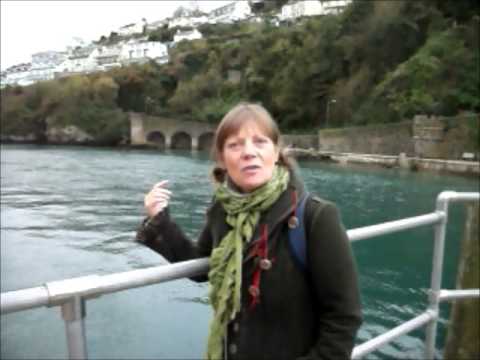
Creeping around the stage and sometimes not averse to a little appropriate melodrama, this performance was a continuous pleasure to watch-not least because Stringer varied the tempo and maintained a narrative pace throughout. She also used humour. She also showed her initial pleasure at receiving Collin’s bound volumes through the post. These she waived invitingly at the audience. In fact she used few props, none more effective than her woollen shawl sometimes drawn around her to convey poverty or want, at others spread to show joy at the reception which Collin’s work eventually received.
St Ives-based multi media artist Mary Fletcher has co-ordinated an interesting exhibition in The Redwing Gallery, Penzance on behalf of volunteers at the venue. This runs until the end of January and has already received positive reviews such as that by the well-known local poet and commentator, Frank Ruhrmund. Writing in the Cornishman at http://www.westbriton.co.uk/Volunteers-thanked-gallery-assistance/story-25852842-detail/story.html, he states about the exhibition and the co-ordinator herself, “A gallery renowned for its support and promotion of outsider art, it is not all that surprising that Mary Fletcher should feel at home there. It is only two years since, for the first time in her long career, that she has been able to enjoy a working space outside of her house, at White’s Old Workshops in Porthmeor Road, St Ives. Many will recall her solo show held last year in the St Ives Arts Club Arts which celebrated her first year in her new working space.”
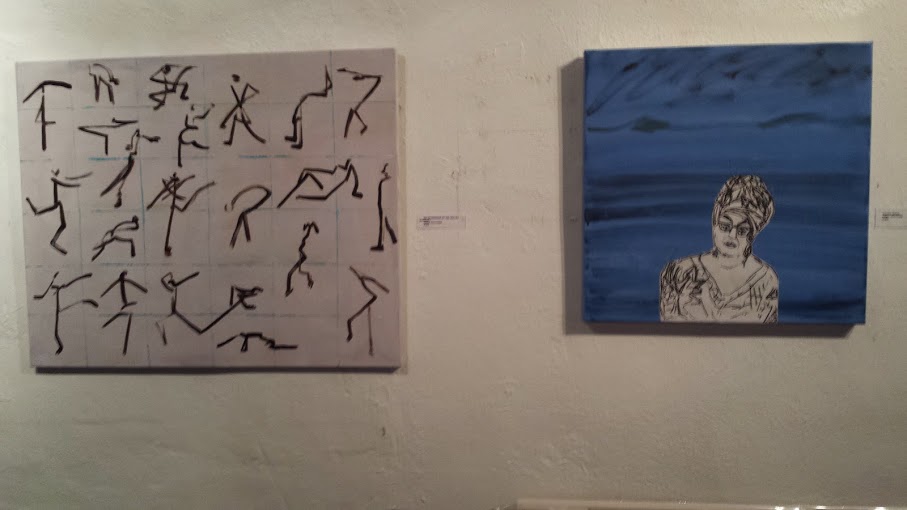
The relaxed atmosphere in The Redwing owes something to its bohemian ambience and partly due to its secluded location. The comfortable seating, bookstands and available refreshments all add to the effect. Here, Peter Fox and Ros Williams, co-directors of the Redwing Gallery, have created a space which is primarily concerned with outsider art. The current exhibition certainly adds to the general comfortable charm of the space. Mary Fletcher’s lyrical canvases remind me of an excellent and memorable exhibition by Litz Pisk who had worked at the Old Vic Theatre School (b.1909 in Vienna) many years ago at Newlyn Art Gallery. Interestingly, a student of Max Reinhardt, Pisk designed for Brecht and Weil’s first

production. http://www.baacorsham.co.uk/mparkin/p65.htm and also her film work for Isodora is at http://www.imdb.com/name/nm0685496/ Mary Fletcher’s paintings too look a little like dancing musical characters against a colourful background grid.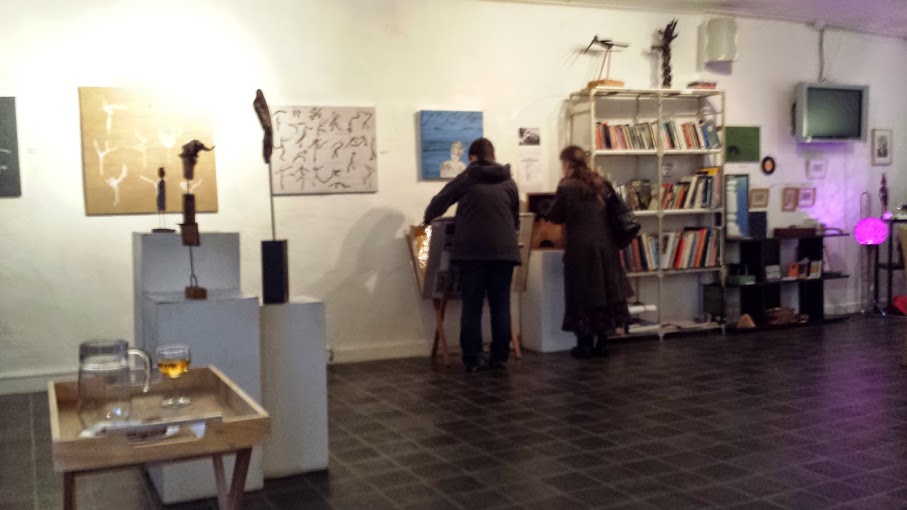 There are also a number of interesting sculptures and small figurines in the exhibition which are also worthy of attention.
Once again, Vaughan Warren, educated at the Royal Academy Schools (The RA Schools was founded in 1769, and remains independent to this day. This independence enables the Schools to offer the only three-year postgraduate programme in Europe.) has turned in a range of varied and intriguing work. Two of his pictures, I found particularly appealing, although it is worth remarking that all his paintings, like his self-portrait in the manner of Cezanne, benefit from his wide knowledge of art history. The first portrays a sleeping head surmounted delicately above a breast in a transport of lovely colours. This evocative duo puts one in mind of those lovely lines from W.H.Auden:-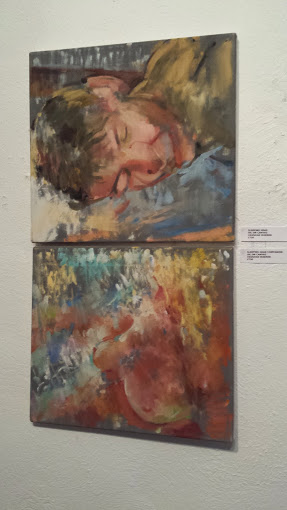
“Lay your sleeping head, my love,
Human on my faithless arm;
Time and fevers burn away
Individual beauty from
Thoughtful children, and the grave
Proves the child ephermeral:
But in my arms till break of day
Let the living creature lie,
Mortal, guilty, but to me
The entirely beautiful.”
The second painting,energetic and interesting, executed in black, white and greys shows a view above St Just and looks down literally upon, in the distance, the Great Western Hunt in progress. As Wilde once remarked, ” The Unspeakable in Pursuit of the Uneatable”. The unspeakable in this context means appalling, horrendous, wretched and indeed may remind one of another poem of Auden’s in quite another way:-
From Musée des Beaux Arts (1940)
 “Anyhow in a corner, some untidy spot
Where the dogs go on with their doggy
life and the torturer’s horse
Scratches its innocent behind on a tree.”

Kerry Harding’s soft and evocative canvases take the natural world around the North

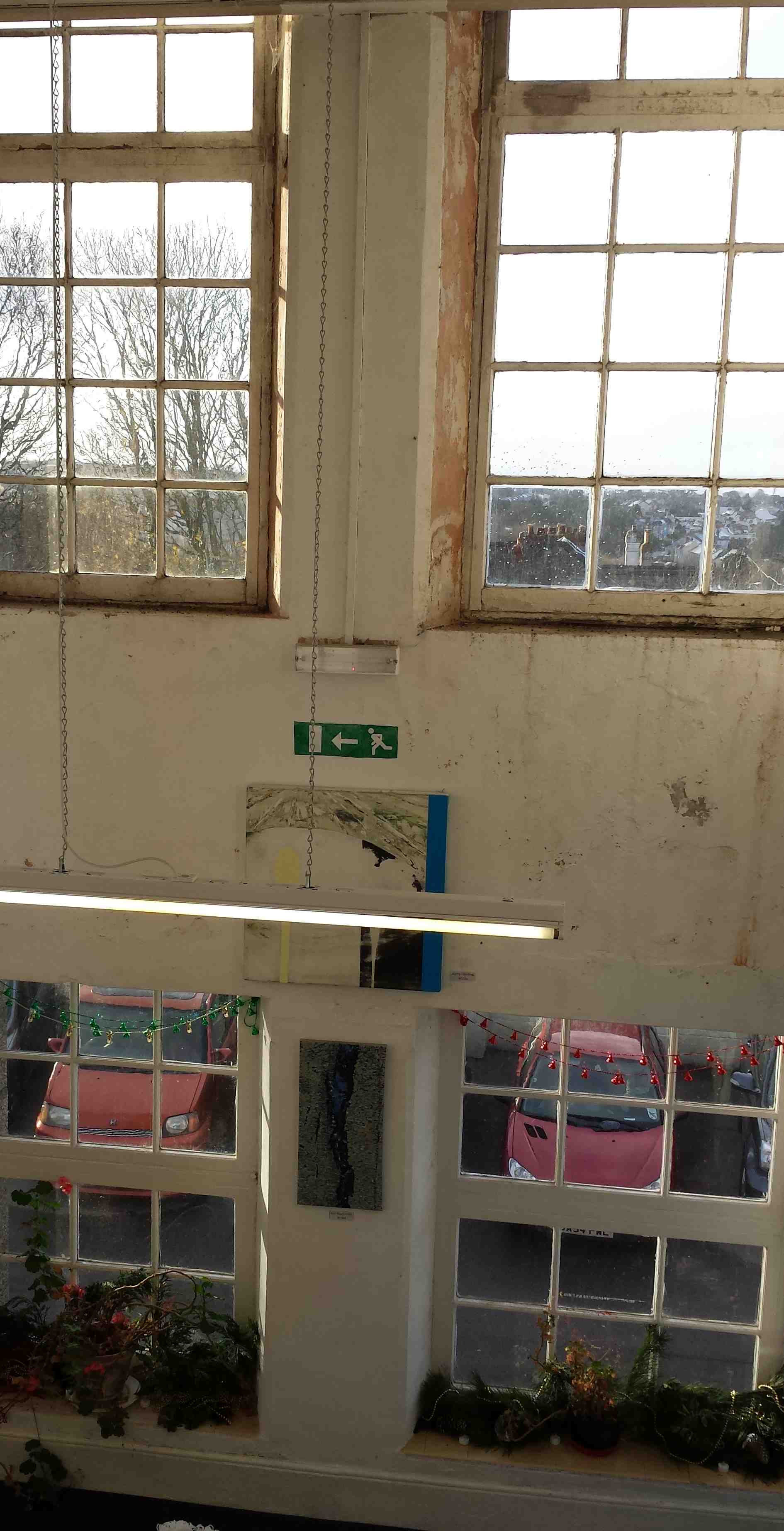
Coast with it’s trees, hedges and seasonal variations as a starting point. Her website may be found at http://www.kerryharding.co.uk/. Kerry was very interesting on the topic of the famous Dresden artist, Gerhard Richter https://www.gerhard-richter.com/en/ mentioning his process, his photographic work and his continuous experimentation using a wide variety of methods and sometimes controversial subject matter. She also mentioned his ability to work on different projects simultaneously. She worked very hard to create a welcoming atmosphere in her space- as she says on Twitter, “studio almost ready, tinsel and fairy lights then its done.” A lovely 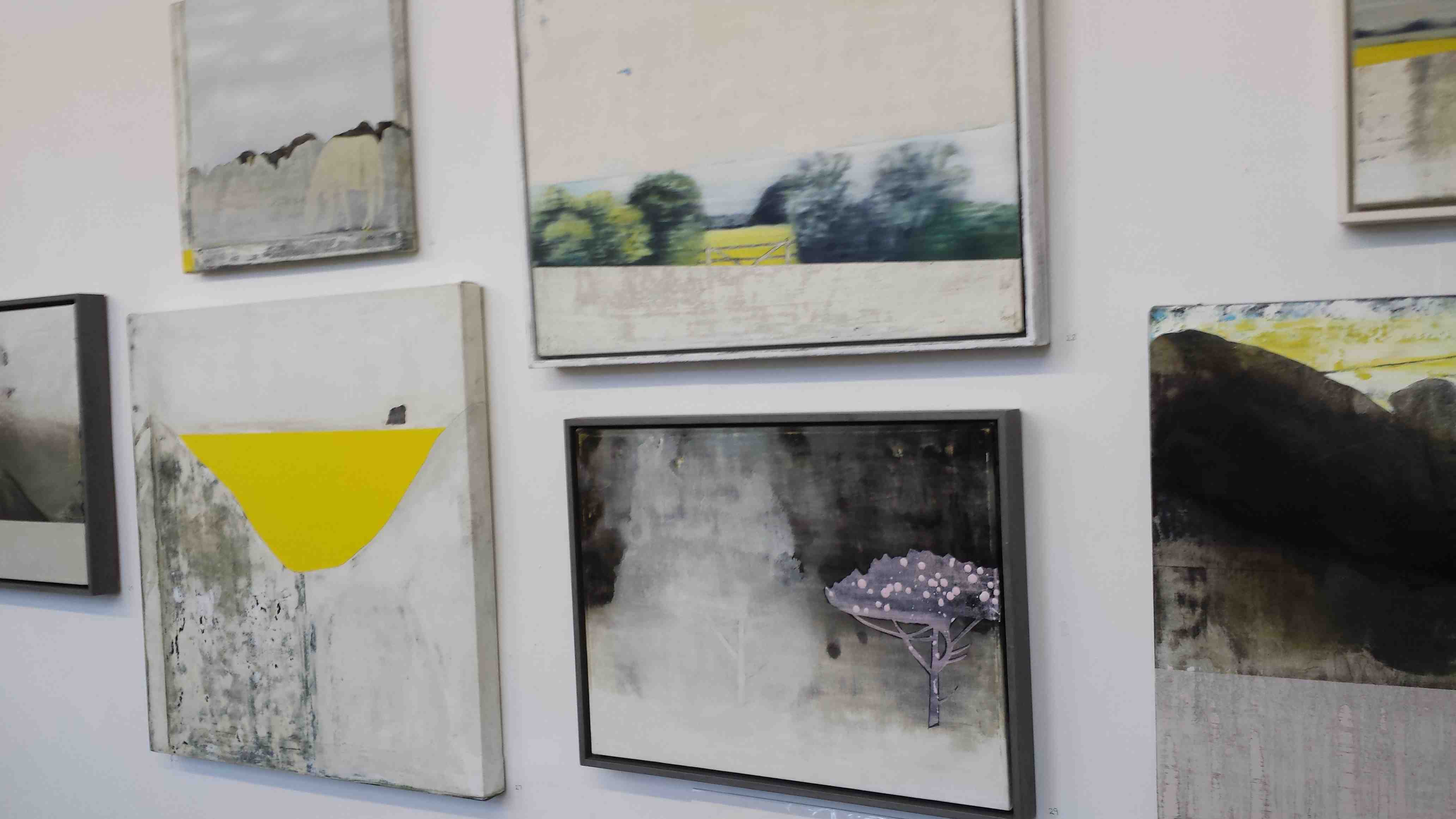 range of paintings that I found so interesting that I
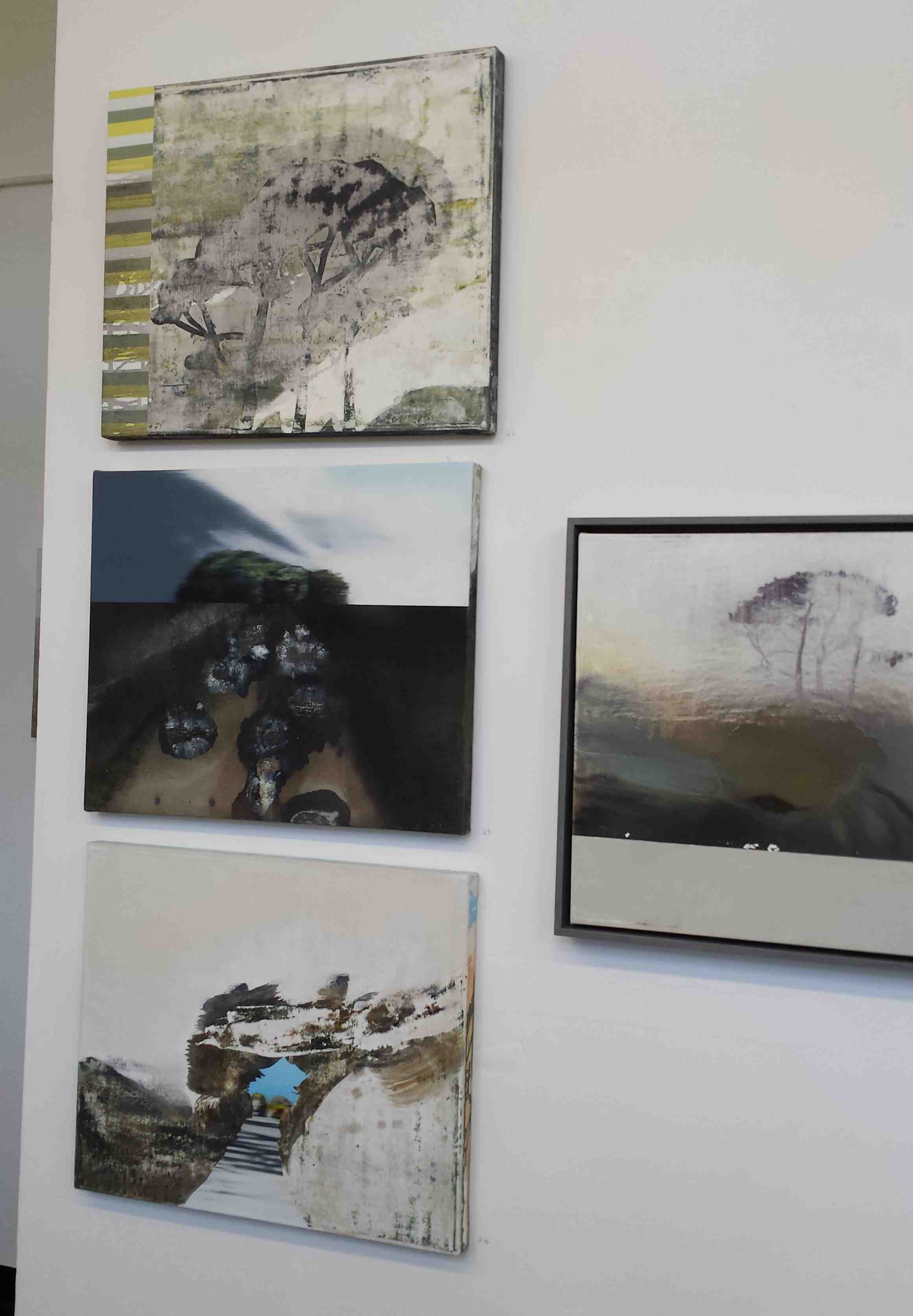 came back to browse them for a second time. It was also informative to hear how some canvases were composed of many underpaintings-up to ten or more layers.
Kathryn Stevens, http://kathrynstevens.co.uk/, clearly rejoices in the freedom of working on a large scale. The billowing colours of her canvases express the joy of painting in bright colours. Some of them have a feathery and eloquent quality that puts one in mind of Georgia 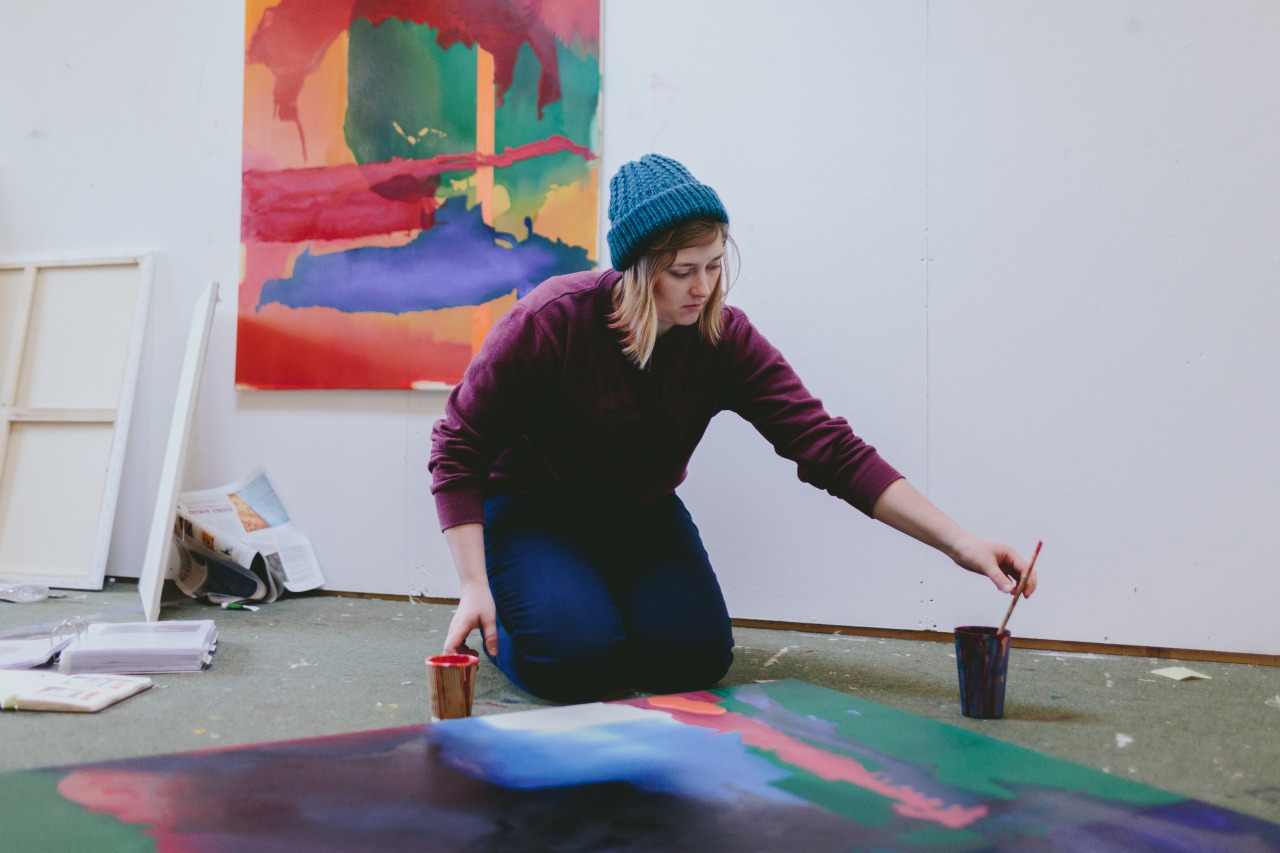 O’Keeffe (or perhaps Otto Gottlieb) but here we have an abstract expressionism with an upbeat and optimistic feel. She told me how she works freely, sometimes with music and chatted with the same exuberance that her work conveys. I was particularly taken by a study in
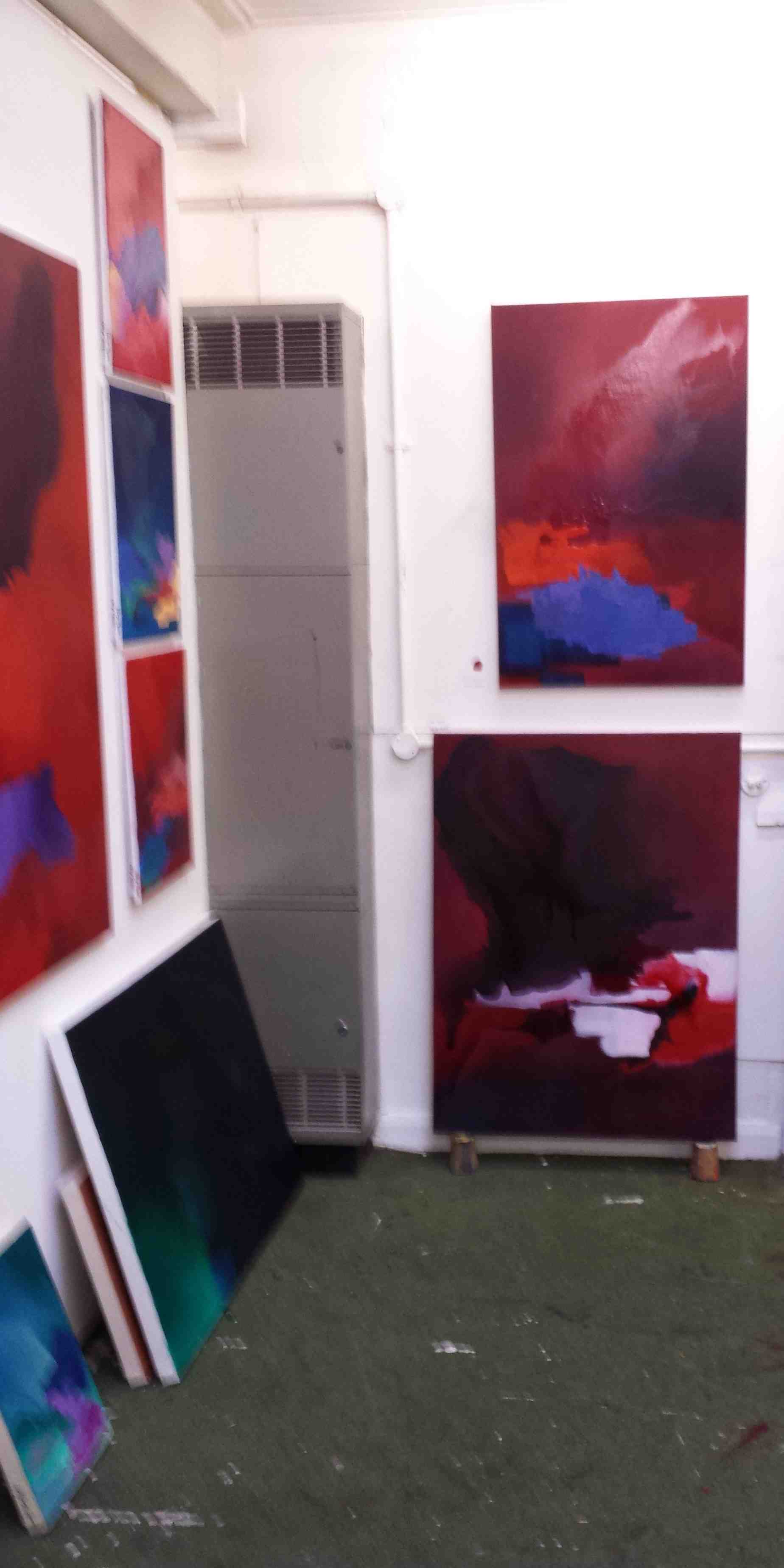
crimson, scarlet and white. She hails from St Ives and her paintings exhibit the wondrous light for which the town has become famous.
In short there was much to add cheer on a cold Sunday. It was good to see the Siobhan Purdy’s work again- which adorns the wall opposite as I write, the Mexican and Maya themed prints in the Apex space and to talk again with Naomi Singer whose glass works continue to thrive. Interesting too were the textile pieces by Zoe Wright.
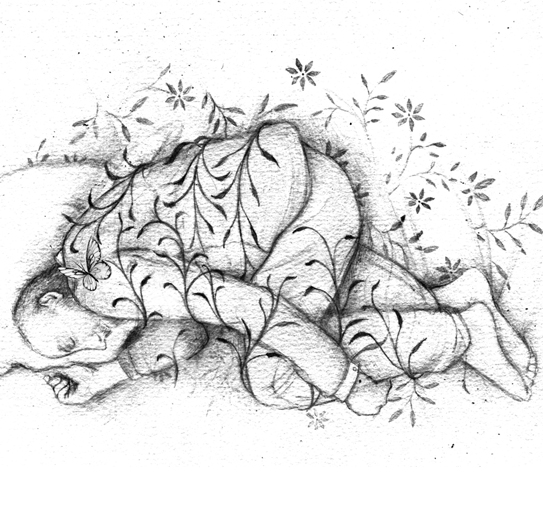
Before returning to the Melting Pot once again, I went into see the illustration work of Esther Connon and was much taken by her story of The White Butterfly which can be seen on http://www.estherconnon.co.uk/stories.html?s=5. I wondered if it would be possible to animate some of this according to the methods of http://thepapercinema.com/ and this fascinating method may be seen both on videos on the papercinema site and on the community project in St Ives filmed earlier this year by my friend Alban. Altogether with the new building project at Krowji already under-way, great developments can be expected from this artistic phoenix rising from the ashes of the Grammar School at Redruth.
Click on Loop the Loop here:-http://stivestv.co.uk/category/art/

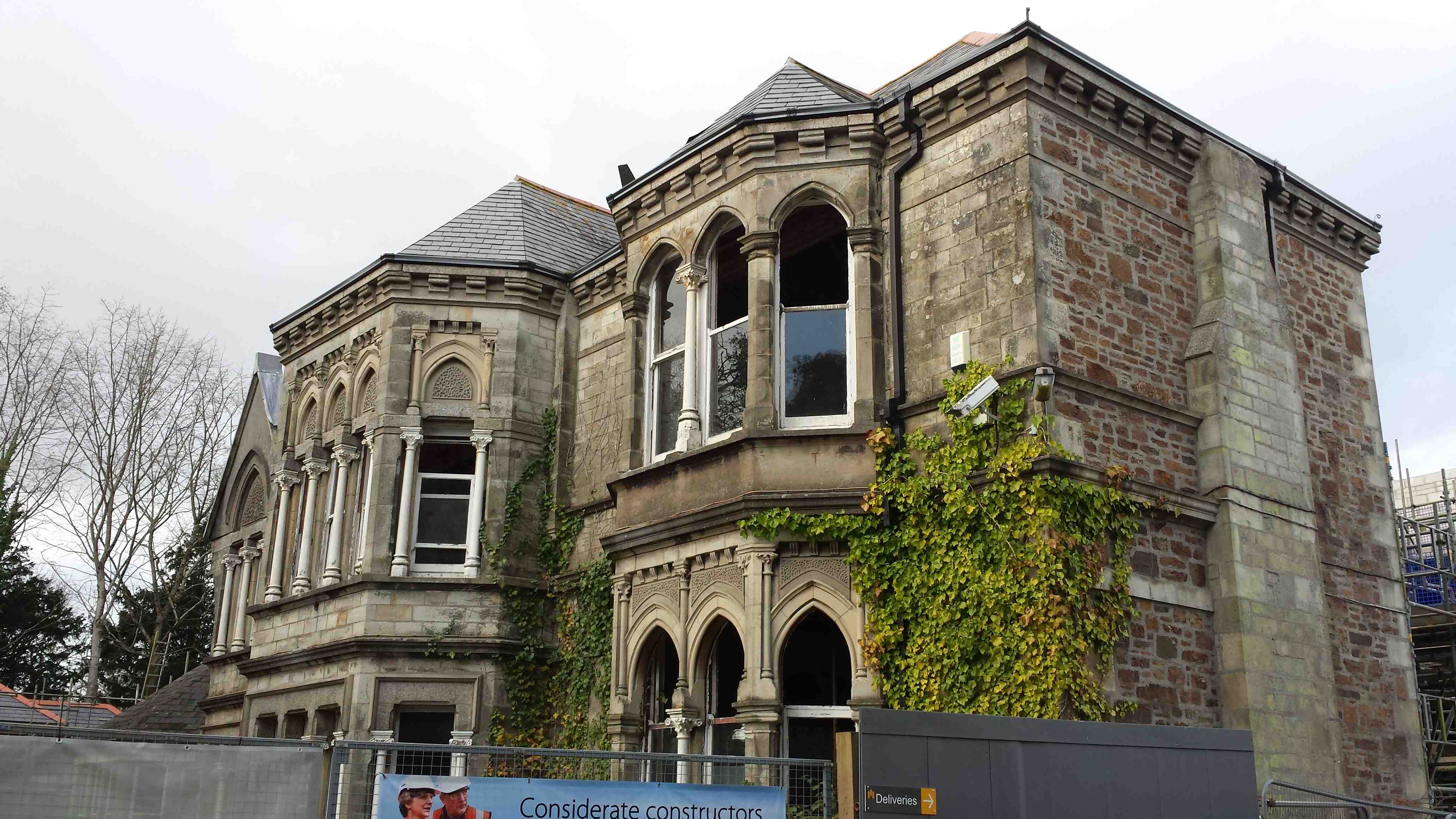
 Getting to Krowji on a Sunday in December by public transport is a time-consuming business. Servicing the railway and circuitous bus routes turn a simple trip into an epic voyage. At least it affords time to see more new supermarkets, innovative centres in Pool and glimpses of neo-classical architecture in the grand manner. The upper stories of the façades remind one of the prosperity of this area in its heyday.
Upon arrival, the bohemian atmosphere in The Melting Pot Cafe, the warmth and the leek and potato soup help to revive after the lengthy journey. The wall of clocks and masques and surreal paraphernalia suggest that a cabaret is about to begin and indeed there is a pianist in cap and bells already upon the stage. This has a timeless and dreamy ambience quite unique and sui generis.


Moving around the crowded studios, there was a buzz which always seems stronger here where the art is being produced than visiting a gallery. I was particularly attracted to the work of Linda Crane -printmaking and painting but also small sculptures -including a small head which I thought reminiscent of Giacometti. The angular and elongated forms, the expressionist use of paint and the dramatic drawings were intriguing and attractive. My impression too was as though I felt a resonance both with Kokoschka and El Greco. Her work may be seen at http://www.sulisfineart.com/search/page/2?q=Linda+Crane and also at http://www.outsidein.org.uk/linda-crane where I was surprised to read of her work being in Penzance at the Redwing Gallery.
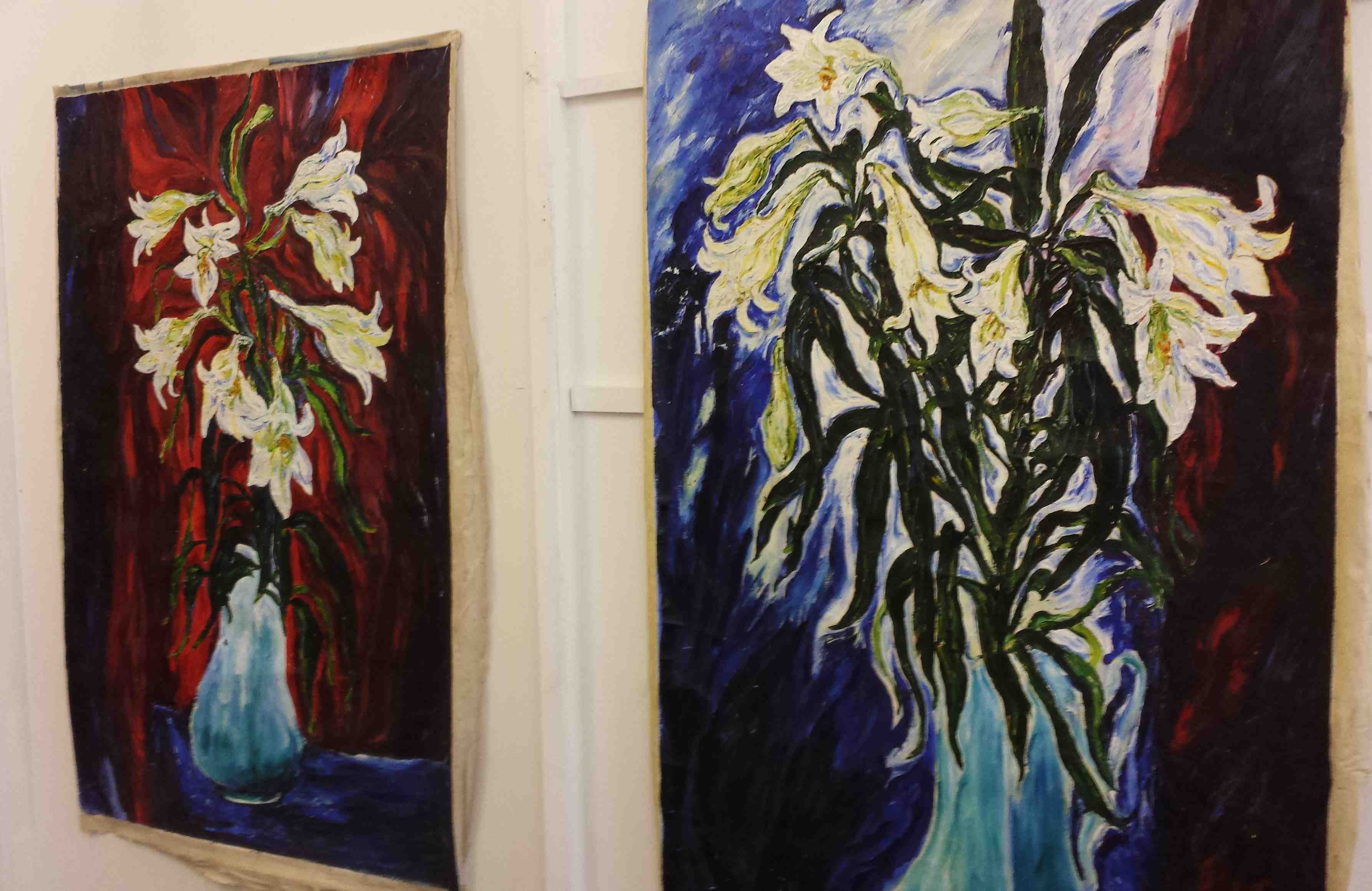
I think the fact that her atelier was empty increased my fascination with her display and her portfolio.I think my recent travels may also have influenced my susceptibilities. It is also interesting to research the influence of El Greco on Expressionism- as in the recent exhibition El Greco und die Moderne.(Dusseldorf 2012 http://www.smkp.de/en/exhibitions/archive/2012/el-greco.html)
There was, of course, Robert Morton Nance…..

ORIGIN:
Medieval diminutive of “Annis”, or of “Ann” / “Anne” (via “Nan”).
VARIATIONS and NICKNAMES:
Ann, Anne, Annie, Anny, Nainsi, Nan, Nancie, Nana, Nance, Nandag, Nanette, Nanice, Nanine, Nannie, Nanny, Nanse, Nansi, Nansie, Nansy, Nenci, Nensi, Neske, Nest, Nesta, Nina, Ninette, Ninon, Nona, Nonna, etc.
REFERENCES IN LITERATURE:
– Aunt Nancy, who might be a fallback matron for Hope should something happen to Mrs. Bell, in “What Hope Bell Found in Her Stocking”, from The Youngest Miss Lorton, and Other Stories by Nora Perry (1889).
– Nancy (Annie) Ridd (sometimes called “Nanny“), John’s favorite sister, a sweet little homemaker, in Lorna Doone, by R.D. Blackmore (written in 1869, set in the final decades of the 17th century).
– Nancy (Anne) Steele, Lucy’s well-intentioned but empty-headed ninny of an older sister, a woman of “vulgar freedom and folly”, in Jane Austen’s Sense and Sensibility (set between 1792-1797, published in…
View original post 167 more words
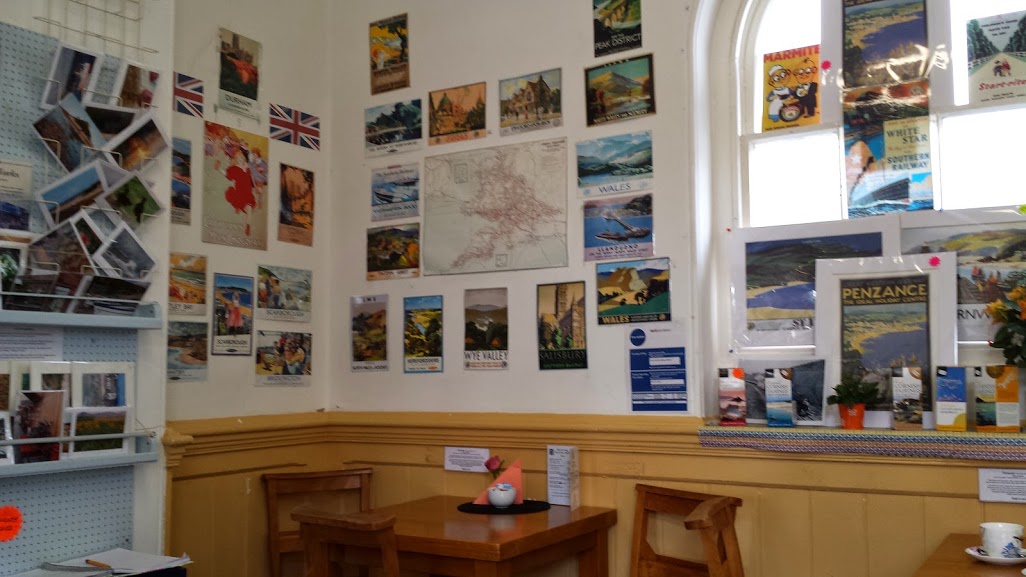
This is a favourite stopping off place where in the midst of all the travel you might enjoy either quiet or a brief encounter; perhaps both. Perhaps, one of the few actual benefits of privatisation, it is filled with transport posters from the 1930s. You can so easily imagine the billowing steam from the last trains which ran on the St Ives Branch line up until the 1970s.https://www.youtube.com/watch?v=a3O7uSD2qlk
Then the music begins, a gentle voice from the past:-
Sometimes I love you, sometimes I hate you

Ah, but when I hate you
Don’t you know it’s ’cause I love you
That’s how I am, so what can I do?
I’m happy when I’m with you
I never mind the rain from the skies,
As long as I see the sun shinging in your eyes
Don’t you know that
Sometimes I love you, sometimes I hate you
Ah, but when I hate you
That’s because I love you
That’s how I am, so what can I do?
I’m happy when I’m with
So happy when I’m with
I’m happy when I’m with you
(Read more: http://muzikum.eu/en/123-14654-197076/kathy-kirby/sometimes-im-happy-lyrics.html#ixzz3DUJ6zRWl)
 There are a surprising number of car boot sales in Cornwall as may be clearly seen by looking at the maps and search on www.intocornwall.com/ .Probably the two most popular in West Cornwall are the Sunday event at Hayle which starts as early as at 8am. Hayle Rugby Club R.F.C, Memorial Park, Marsh Lane, Hayle. In the recent fine weather the Wednesday market at Roseudgeon between Penzance and Helston fromthe beginning of April to end of October.
Visiting the Roseudgeon event recently, I discovered a nexus of vibrant activity and fun. In summer, parking might take 10 minutes or so but the fields to which the cars are guided is close to the sea and affords expansive views down to the cliffs on the south coast itself. The stallholders must arrive as early as six in the morning to get a decent pitch . However, revived by a strong cup of tea and an hour of quick sales puts them into good humour. As well as cash, useful information changes hands in relation to where things can be sourced, how to look after a pot plant and keep it in good condition and so forth.

There are a wide range of flowers and potted bushes on sale making for a colourful display. There is a mass of cheap fruit and vegetables. (I was cheered by a large bag of cherries, probably about 1.5kg, cost just a £1). Naturally, as is my wont -an interesting word deriving from the same stem as the German verb wohnen to live in a place- I headed for the books, DVDs and CDs. There is a rich vein of books on photography-e.g Peace Snapped by Rupert Hopkins 1986 about the Greenham Common Peace Camp.http://www.ruperthopkins.com/gallery.php. I also found an Art book valued new at £383-09 and in pretty good condition for just £8. This is the place to come if you are in search of your favourite type of music, I rather regret not spending £2 on the nostalgia of Manfred Mann! As Tony Benn once remarked,”There is nothing like finding something you have lost-it gives you more pleasure than anything else.”
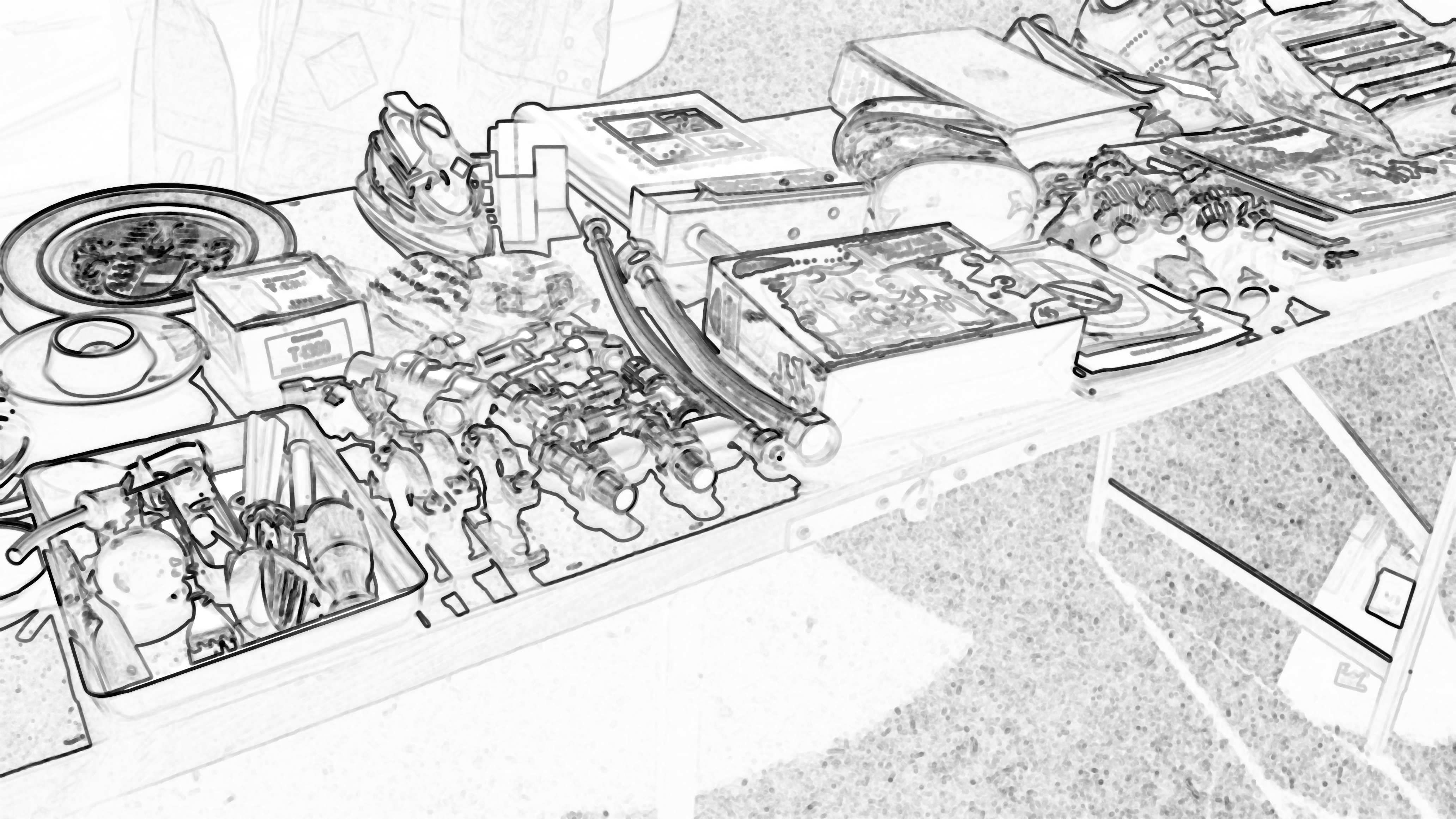
There are rolls, cakes and drinks for sale and in the hall next to the field tea, sandwiches, scones and fairy cakes are on sale at very reasonable prices. There is something rather typically English and sempiternal about the ambiance, rather like a dance hall frozen into the 1960s with jovial and friendly staff presiding. After taking a break, it is interesting to note that the crowds of punters are a cosmopolitan group. There are locals picking up cheap supplies but also groups of visitors from abroad, discovering facets of popular culture by rooting through shed-loads of cheap DVDs. Everyone wanders through makeshift alleyways, surveying the more specialist stalls providing fishing rods, leather goods and cowboy hats and sturdy, wooden garden furniture.
It was a great pleasure to discover an old friend, MVB- www.rainydaygallery.co.uk– selling off the stock remaining from his recently closed gallery. This included postcards with various intriguing local artists and his family biographies. The latter containing an account of his grandfather; an early pioneer of flying machines. If you are looking for presents for children you will find everything from bags of lego in all shapes and sizes, strategy games and kids DVDs. A Bagpuss DVD retailed for £1 and two lego kits in good condition were about £5. It is a good idea to plan your budget before you start, although I don’t myself regret buying an unaccountably attractive Welsh vase for £1 and a cafitiere in fresh condition for £4 -at least £10 cheaper than on Amazon, say.

1) http://www.cornishman.co.uk/entertainment
2) http://www.whatsoncornwall.co.uk/
3) http://www.artcornwall.org/
5) http://feastcornwall.org/projects/new-projects/
6) http://www.royalcornwallmuseum.org.uk/
7) http://west-penwith.org.uk/
8) http://www.godolphinhill.com/
9) http://morrablibrary.org.uk/
10) http://www.penleehouse.org.uk/
13) http://www.stivesarchive.co.uk/
14) http://www.museumsincornwall.org.uk/St-Ives-Museum/Cornwall-Museums/
15) http://www.leachpottery.com/
16) http://www.museumsincornwall.org.uk/Helston-Folk-Museum/Cornwall-Museums/
17) http://www.cornwall.gov.uk/environment-and-planning/conservation/world-heritage-site/
19) http://www.historic-cornwall.org.uk/a2m/maps.htm
20) https://www.facebook.com/steineracademytruro
21) http://www.cornwallmusic.co.uk/
22) http://www.penwithfilmsociety.co.uk/
23) http://www.cornwallcommunitynews.co.uk/
24) http://www.cornwallwildlifetrust.org.uk/
25) http://www.cornwall24.co.uk/discussion/
Ich habe gerade eine neue App entdeckt, was sehr nützlich ist – www.appforcornwall.com
Ausserdem auf Deutsch http://www.intocornwall.com/ und auch http://www.visitcornwall.com/
Zu lesen Julia Kaufhold: St Ives und Trips in die Umgebung. goldfinch verlag, Hamburg 2007, ISBN 978-3-940258-00-7
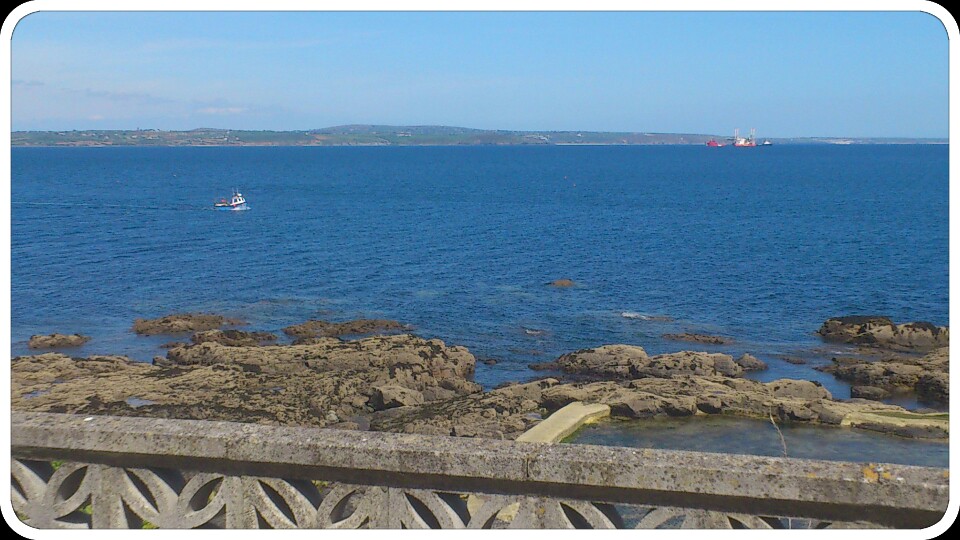

West Cornwall has many literary connections and famous writers have been attracted to its scenery and its people. In an idle moment I was thinking about how useful it might be to give an account of some of the significant figures that are associated with the Penwith peninsula. In her magical notes, “Moments of Being” Virginia Woolf writes of the evocative inspiration which waking in Talland House gave to her. Not only was it a source of inspiration for her great modernist novel,“To the Lighthouse” but to remember that once Henry James took tea on the lawn recalls once again the long Edwardian summer and the echoes of the conversations between him and Virginia’s father, the formidable Leslie Stephen. Links include http://www.woolfonline.com/timepasses/?q=node/271
and
http://fernham.blogspot.co.uk/2009/07/virginia-woolf-on-henry-james.html
Books about Virginia and her sister in St Ives include “Virginia Woolf, Vanessa Bell and Remembering St Ives” by Marion Whybrow (currently unavailable on Amazon) and the novel “Virginia and Vanessa” said to be;”…a chronicle of love and revenge, madness, genius, and the compulsion to create beauty in the face of relentless difficulty and deep grief”. In addition there is Dell, Marion. Peering Through the Escallonia: Virginia Woolf, Talland House and St. Ives. No. 23. 1999. ISBN 1-897967-47-0. Price £7.00
There are more websites to peruse and pursue, should you have the time. Namely, http://www.glennhorowitz.com/featured/virginia_woolf_goes_to_the_beach
And
https://bloggingwoolf.wordpress.com/books/
It is interesting, though unsurprising, how Woolf keeps turning up as a factional character in novels. My personal favourite as I have mentioned on here before is “House of Exile” by Evelyn Juers –mostly about Thomas Mann-which contains an interesting and memorable incident where Virginia and Leonard visit a restaurant in the Funkturm in Berlin and loses her elegant scarf which is recovered by another leading character.” Some moments of exhilarating coincidence in these pages are reminiscent of Stoppard’s Travesties.” According to the reviewer, Robert McCrum at http://www.theguardian.com/books/2011/may/22/house-of-exile-juers-review. Although not associated with St Ives, Virginia Woolf turns fictional in the film “The Hours” based on the novel by Michael Cunningham, which came out in 2002 directed by Stephen Daldry (who also filmed The Reader). Her bent-nosed appearance, which some critics found rather hilarious, won Nicole Kidman the best actress award that year. Recently I came across Alison Macleod at this year’s Jewish Book Week, where she was talking about her haunting and remarkable novel, “Unexploded”. She is Professor of Contemporary Fiction at the University of Chichester and a lively and engaging speaker who talked about her research into the background of the novel which is set in Brighton, where she herself lives, during the hazardous summer of 1940. The novel was long-listed for the Man Booker Prize in 2013 and deals with, among other sensitive issues, anti-Semitism in wartime Britain. Virginia Woolf lectured in Brighton during this period and she and her novels turn up as one leitmotiv in this persuasively constructed story. Many of the issues are based on a thoroughgoing examination of the archives. http:/www.telegraph.co.uk/culture/books/bookreviews/10244729/Unexploded-by-Alison-MacLeod-review.html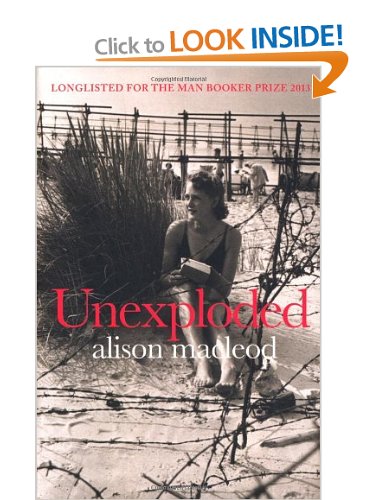

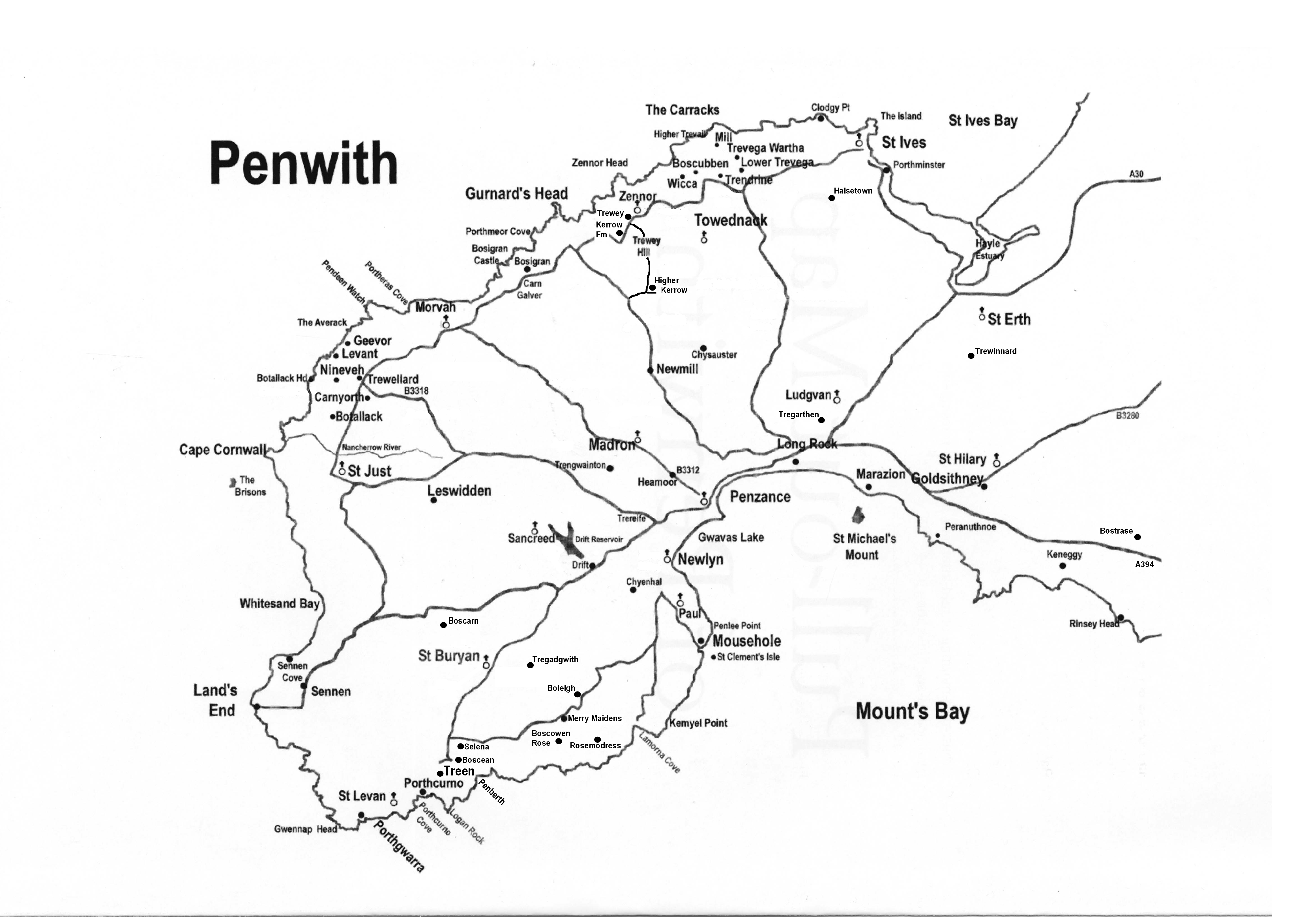
Returning along the coast in a westerly direction to West Penwith, a glance at A Literary Atlas and Gazeteer reveals that many fascinating littérateurs lived or visited from Truro and to the west. Here are a list of just ten whose connections may not be very well known. At Zennor at Higher Tregarthen from 1916-1917, D.H.Lawrence, J.Middleton Murray and Katherine Mansfield. In Truro, Samuel Foote (1720-1777 became celebrated as much for his acting as his didactic diatribes)-his story has just been magnificently told by Ian Kelly see- http://www.theguardian.com/books/2012/oct/05/mr-footes-other-leg-review. Sir William Golding lived nearby at Perranaworthal from 1985 until his death in 1993-where he became a great friend of the controversial novelist and translator of Russian Poetry, D.M.Thomas. He has recently published a poetry collection, Light and Smoke.http://www.dmthomasonline.net/

In St Ives, Mrs Havelock Ellis wrote Cornish Idyll in 1898. Much later, after the War in 1945 Norman Levine found the town conducive to his stories, poetry and travel writing. At Madron, the inspirational poet’s poet, penned his charmed verses:-http://www.scottishpoetrylibrary.org.uk/poetry/poems/listen-put-morning
Listen. Put on morning.
Waken into falling light.
A man's imagining
Suddenly may inherit
The handclapping centuries
Of his one minute on earth.
And hear the virgin juries
Talk with his own breath
To the corner boys of his street.
And hear the Black Maria
Searching the town at night.
]Daphne Du Maurier arrived here in Penwith before her time at Menabilly -for more details see http://www.intocornwall.com/features/literature.asp

 penwithlit