Quand, les deux yeux fermés, en un soir chaud d’automne,
Je respire l’odeur de ton sein chaleureux,
Je vois se dérouler des rivages heureux
Qu’éblouissent les feux d’un soleil monotone ;
Une île paresseuse où la nature donne
Des arbres singuliers et des fruits savoureux ;
Des hommes dont le corps est mince et vigoureux,
Et des femmes dont l’œil par sa franchise étonne.
Guidé par ton odeur vers de charmants climats,
Je vois un port rempli de voiles et de mâts
Encor tout fatigués par la vague marine,
Pendant que le parfum des verts tamariniers,
Qui circule dans l’air et m’enfle la narine,
Se mêle dans mon âme au chant des mariniers.
Although people seem to be unaware of it today, the development of the faculty of attention forms the real object and almost the sole interest of studies. Most school tasks have a certain intrinsic interest as well, but such an interest is secondary. All tasks that really call upon the power of attention are interesting for the same reason and to an almost equal degree. ( On the right use of School Studies with a view to the Love of God)
My place is on the left and I must go to my seat
I don’t get why they never turn on the heat
Don’t know my neighbor, though it’s now been a year
And we’re sinking, although shallow water is near
And we stare at the ceiling, with a hopeful unease,
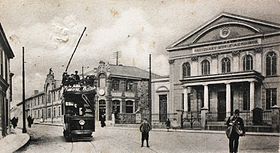
On the old trolley-bus that is traveling east
On the old trolley-bus that is traveling east
On the old trolley-bus…
All people are brothers, we’re all six degrees…
And nobody knows why we’re traveling east
My neighbor can’t take it, he wants to break free
But he cannot escape, he doesn’t know where to flee
So we sit and we wonder if we’ll find our peace
On the old trolley-bus that is traveling east
The bus keeps on driving through the driver has fled
And the engine is rusty but we’re moving ahead
And we’re holding our breath, as we stare at the night
Where, for a moment, a star was lit bright
We stay silent, we know that the reason for this
Is the old trolley-bus that is traveling east…
By Victor Tsoi
Translation by Andrey Kneller
In the original Russian:-
Мое место слева, и я должен там сесть,
Не пойму, почему мне так холодно здесь,
Я не знаком с соседом, хоть мы вместе уж год.
И мы тонем, хотя каждый знает, где брод.
И каждый с надеждой глядит в потолок
Троллейбуса, который идет на восток.
Троллейбуса, который идет на восток.
Троллейбуса, который…
Все люди – братья, мы – седьмая вода,
И мы едем, не знаю, зачем и куда.
Мой сосед не может, он хочет уйти,
Но он не может уйти, он не знает пути,
И вот мы гадаем, какой может быть прок
В троллейбусе, который идет на восток.
В кабине нет шофера, но троллейбус идет,
И мотор заржавел, но мы едем вперед,
Мы сидим не дыша, смотрим туда,
Где на долю секунды показалась звезда,
Мы молчим, но мы знаем, нам в этом помог,
Троллейбус, который идет на восток.
Viktor Robertovich Tsoi was a Soviet-Korean singer and songwriter who co-founded Kino, one of the most popular and musically influential bands in the history of Russian music. Born and raised in Leningrad, Tsoi started writing songs as a teenager.
Und sagte gähnend: »Steigen Sie ein, wenn es Ihnen beliebt.«
Die Schnecke wehrte: »Danke, mir pressiert es.«
Da gab die Bahn ein Abfahrtssignal und noch eins und
ein drittes und viertes.
Und wirklich begann sie allmählich weiter zu fahren,
Um noch vor Sonntag die nächste Station zu erreichen.
Dort lagen an dreihundert Leichen,
Lauter Leute, die über dem Warten verhungert waren.
Joachim Ringelnatz wurde als jüngstes von drei Geschwistern in einem Wohn- und Geschäftshaus am Crostigall 14 in Wurzen bei Leipzig um „11 ¾ Uhr“ in einem Zimmer über dem Flur geboren, wie der Geburtsschein der Hebamme belegt. Seine Eltern waren beide künstlerisch tätig. Sein Vater Georg Bötticher, der einer thüringischen Gelehrtenfamilie entstammte, war ein Musterzeichner und später hauptberuflicher Verfasser von humoristischen Versen und Kinderbüchern. Er veröffentlichte vierzig Bücher, unter anderem in Reclams Universal-Bibliothek. Die Mutter Rosa Marie, Tochter eines Sägewerksbesitzers, zeichnete ebenfalls, entwarf Muster für Perlstickereien und stellte Puppenbekleidung her. Ringelnatz wuchs in bescheidenem Wohlstand auf: Die Familie beschäftigte zwei Dienstmädchen.
In the parched path
I have seen the good lizard
(one drop of crocodile)
meditating.
With his green frock-coat
of an abbot of the devil,
his correct bearing
and his stiff collar,
he has the sad air
of an old professor.
Those faded eyes
of a broken artist,
how they watch the afternoon
in dismay!

Is this, my friend,
your twilight constitutional?
Please use your cane,
you are very old, Mr. Lizard,
and the children of the village
may startle you.
What are you seeking in the path,
my near-sighted philosopher,
if the wavering phantasm
of the parched afternoon
has broken the horizon?

Are you seeking the blue alms
of the moribund heaven?
A penny of a star?
Or perhaps
you’ve been reading a volume
of Lamartine, and you relish
the plateresque trills
of the birds?

(You watch the setting sun,
and your eyes shine,
oh, dragon of the frogs,
with a human radiance.
Ideas, gondolas without oars,
cross the shadowy
waters of your
burnt-out eyes.)

Have you come looking
for that lovely lady lizard,
green as the wheatfields
of May,
as the long locks
of sleeping pools,
who scorned you, and then
left you in your field?
Oh, sweet idyll, broken
among the sweet sedges!
But, live! What the devil!
I like you.
The motto “I oppose
the serpent” triumphs
in that grand double chin
of a Christian archbishop.

Now the sun has dissolved
in the cup of the mountains,
and the flocks
cloud the roadway.
It is the hour to depart:
leave the dry path
and your meditations.
You will have time
to look at the stars
when the worms are eating you
at their leisure.


Go home to your house
by the village, of the crickets!
Good night, my friend
Mr. Lizard!

Now the field is empty,
the mountains dim,
the roadway deserted.
Only, now and again,
a cuckoo sings in the darkness
of the poplar trees.


From the website www.poets.org/poetsorg/poem/old-lizard









 From the website www.poets.org/poetsorg/poem/old-lizard
 penwithlit