Alone on stage, ennervating the audience mostly with the voice and a glance or a gesture has a singularly dramatic effect. This is what the Falmouth theatre-studies graduate, Jak Stringer achieved with her performance of “Walks with Wilkie” at the now well-established literary festival in Penzance in mid-June last year. The venue in the Acorn, once a Victorian chapel added an extra ambience to the subject, Wilkie Collins the eccentric friend of Charles Dickens and author of classics like “The Moonstone” and “The Woman in White”. Less remembered are his plays and less for his travel writings in Cornwall by means of which he initially gained fame. Curmudgeonly in some respects and daring in others, Jak Stringer has fell for him hook, line and sinker.
Jak Stringer, who has also received rave reviews from the NME as a musical impresario, shows herself to be an assured and energetic performer. In the year previous to this performance she retraced the footsteps of Wilkie Collins, bringing the stories from his somewhat forgotten classic, ”Rambles beyond Railways subtitled ‘Notes on Cornwall taken a-foot’, to life on the Acorn stage. This she does with verve and alacrity. Jak displays a range of emotions; at first sounding like a naive and almost, but not-quite, over-enthusiastic primary school teacher and rising to the eeriness of a Macbeth Witch into her recollection of an ancient lynching or parochial haunting. She poses Wilkie’s dilemmas from the 1850s-“Did the people of Looe consume their rats?”and “What made the women of Saltash clean the boots of strangers for sixpennyworth of beer?” and dauntingly examines the evidence for his finding a tavern filled with babies at the Lizard.
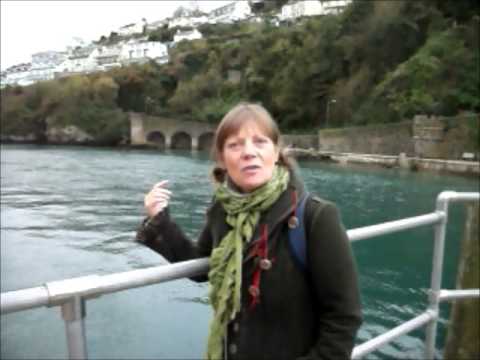
Jak Stringer
Creeping around the stage and sometimes not averse to a little appropriate melodrama, this performance was a continuous pleasure to watch-not least because Stringer varied the tempo and maintained a narrative pace throughout. She also used humour. She also showed her initial pleasure at receiving Collin’s bound volumes through the post. These she waived invitingly at the audience. In fact she used few props, none more effective than her woollen shawl sometimes drawn around her to convey poverty or want, at others spread to show joy at the reception which Collin’s work eventually received.
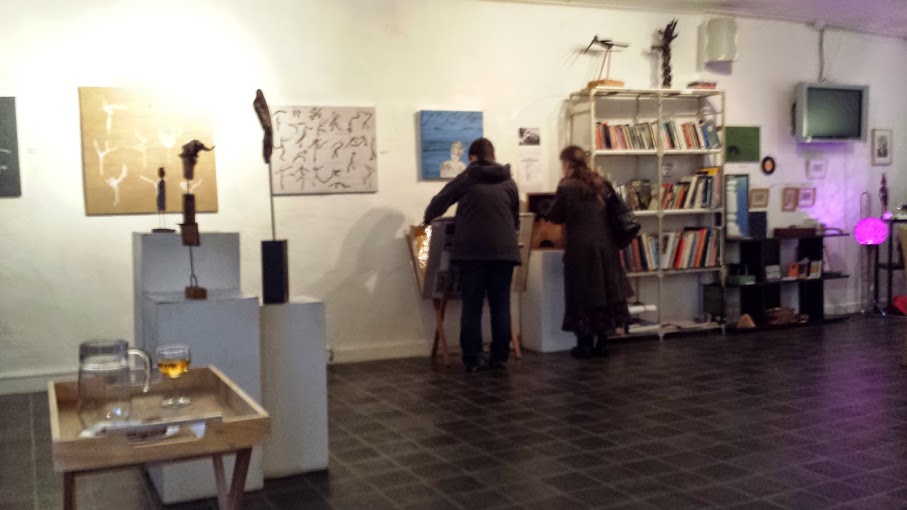
St Ives-based multi media artist Mary Fletcher has co-ordinated an interesting exhibition in The Redwing Gallery, Penzance on behalf of volunteers at the venue. This runs until the end of January and has already received positive reviews such as that by the well-known local poet and commentator, Frank Ruhrmund. Writing in the Cornishman at http://www.westbriton.co.uk/Volunteers-thanked-gallery-assistance/story-25852842-detail/story.html, he states about the exhibition and the co-ordinator herself, “A gallery renowned for its support and promotion of outsider art, it is not all that surprising that Mary Fletcher should feel at home there. It is only two years since, for the first time in her long career, that she has been able to enjoy a working space outside of her house, at White’s Old Workshops in Porthmeor Road, St Ives. Many will recall her solo show held last year in the St Ives Arts Club Arts which celebrated her first year in her new working space.”
Mary Fletcher at The Redwing
The relaxed atmosphere in The Redwing owes something to its bohemian ambience and partly due to its secluded location. The comfortable seating, bookstands and available refreshments all add to the effect. Here, Peter Fox and Ros Williams, co-directors of the Redwing Gallery, have created a space which is primarily concerned with outsider art. The current exhibition certainly adds to the general comfortable charm of the space. Mary Fletcher’s lyrical canvases remind me of an excellent and memorable exhibition by Litz Pisk who had worked at the Old Vic Theatre School (b.1909 in Vienna) many years ago at Newlyn Art Gallery. Interestingly, a student of Max Reinhardt, Pisk designed for Brecht and Weil’s first
Figures by Litz Pisk (not at The Redwing)
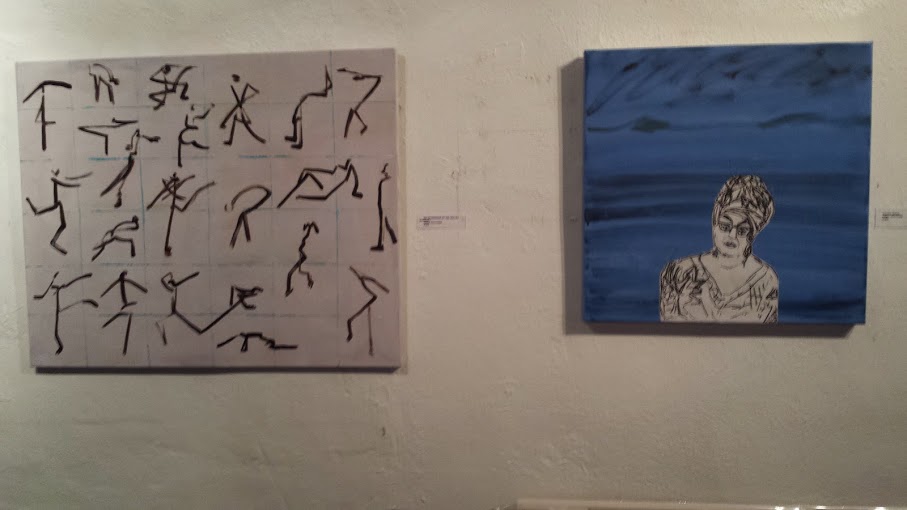
production. http://www.baacorsham.co.uk/mparkin/p65.htm and also her film work for Isodora is at http://www.imdb.com/name/nm0685496/ Mary Fletcher’s paintings too look a little like dancing musical characters against a colourful background grid. There are also a number of interesting sculptures and small figurines in the exhibition which are also worthy of attention.
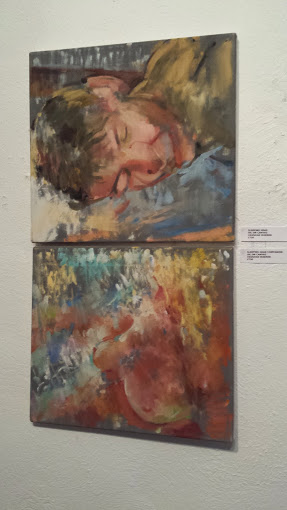
Once again, Vaughan Warren, educated at the Royal Academy Schools (The RA Schools was founded in 1769, and remains independent to this day. This independence enables the Schools to offer the only three-year postgraduate programme in Europe.) has turned in a range of varied and intriguing work. Two of his pictures, I found particularly appealing, although it is worth remarking that all his paintings, like his self-portrait in the manner of Cezanne, benefit from his wide knowledge of art history. The first portrays a sleeping head surmounted delicately above a breast in a transport of lovely colours. This evocative duo puts one in mind of those lovely lines from W.H.Auden:-
“Lay your sleeping head, my love,
Human on my faithless arm;
Time and fevers burn away
Individual beauty from
Thoughtful children, and the grave
Proves the child ephermeral:
But in my arms till break of day
Let the living creature lie,
Mortal, guilty, but to me
The entirely beautiful.”
The second painting,energetic and interesting, executed in black, white and greys shows a view above St Just and looks down literally upon, in the distance, the Great Western Hunt in progress. As Wilde once remarked, ” The Unspeakable in Pursuit of the Uneatable”. The unspeakable in this context means appalling, horrendous, wretched and indeed may remind one of another poem of Auden’s in quite another way:-
From Musée des Beaux Arts (1940)
“Anyhow in a corner, some untidy spot
Where the dogs go on with their doggy
life and the torturer’s horse
Scratches its innocent behind on a tree.”
Mr Vaughan Warrent Admission is free, and this show by the gallery’s volunteers can be seen in the Redwing Gallery, Wood Street, off Market Jew Street, Penzance, 11am to 4pm.
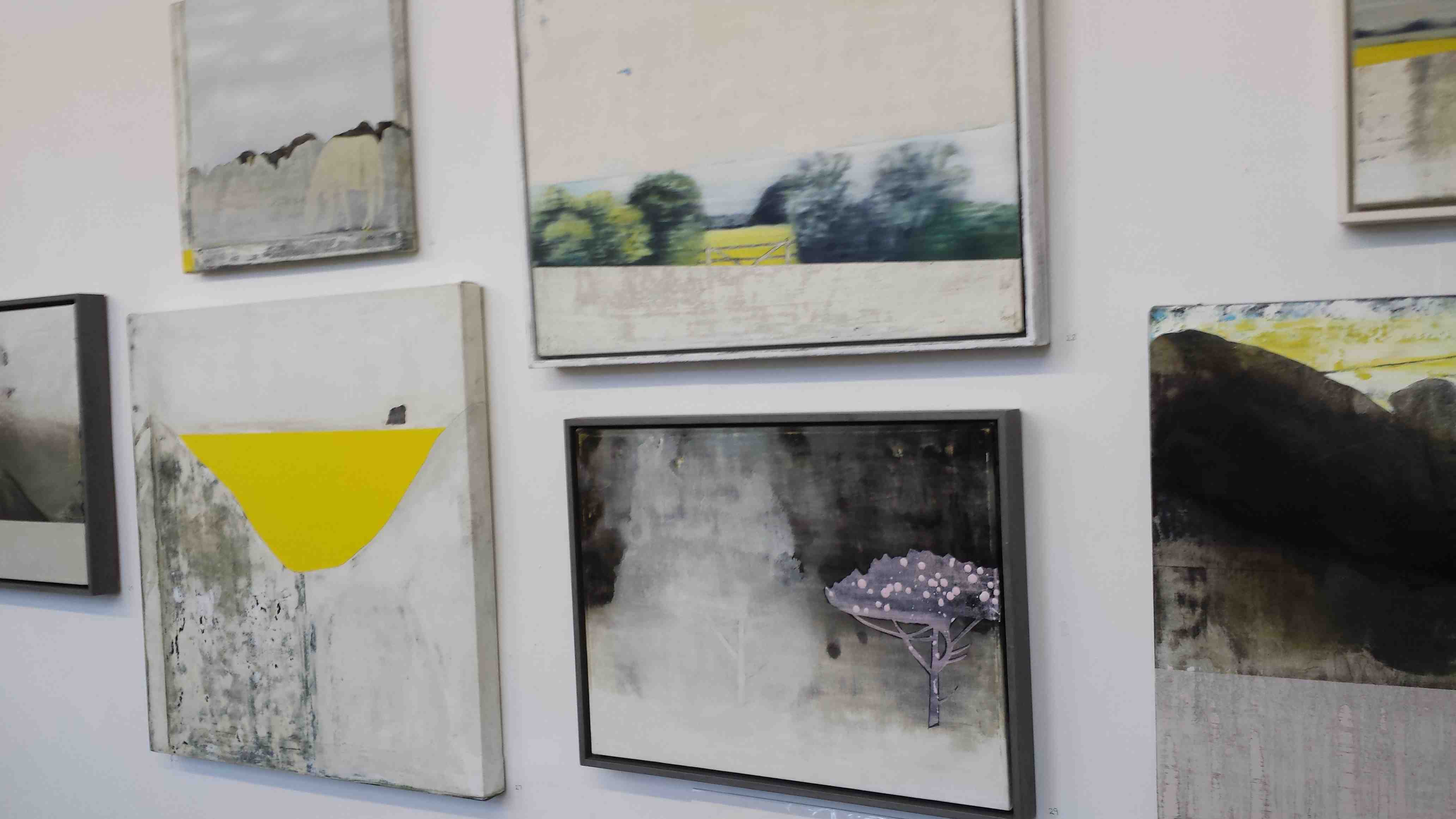
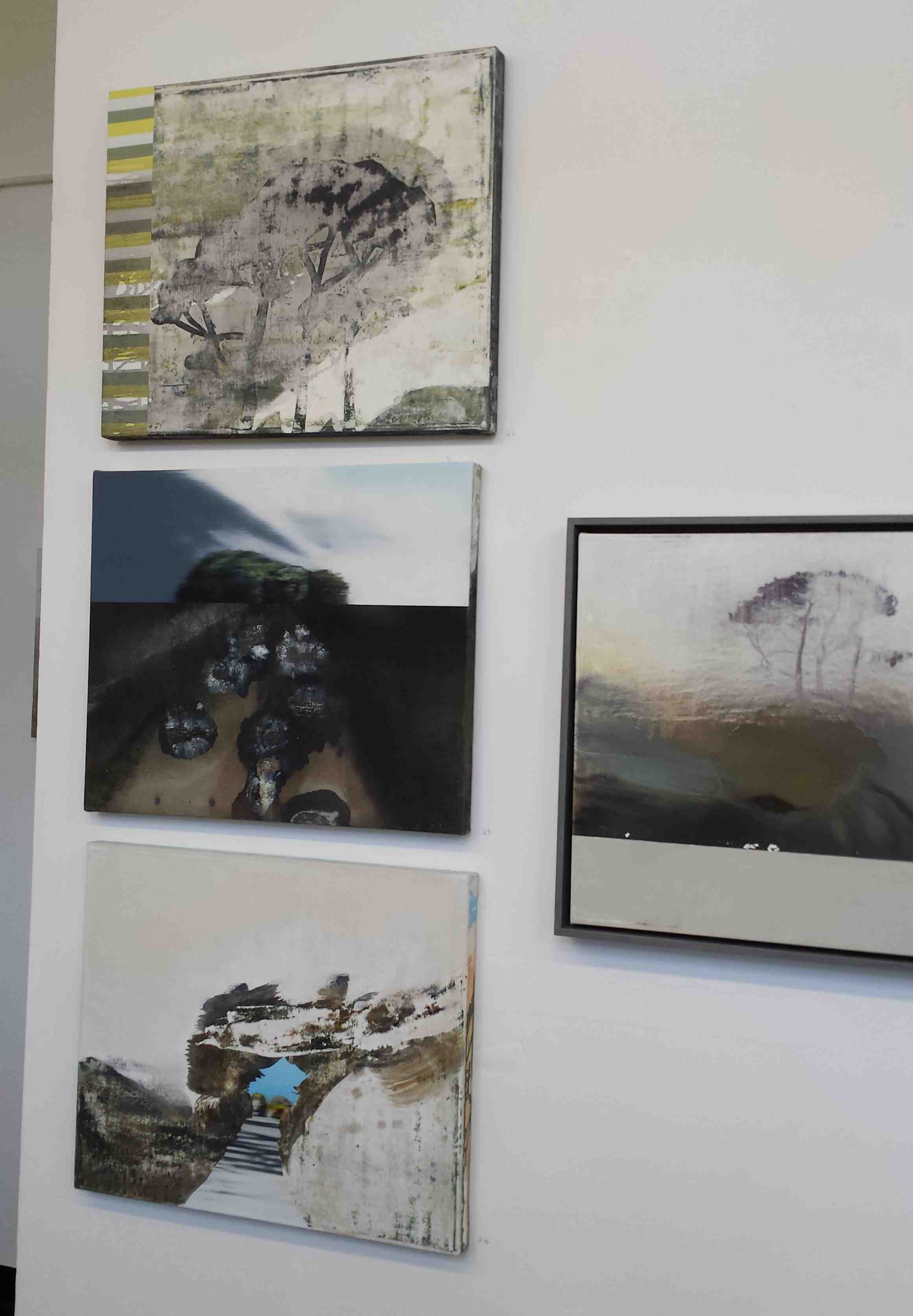
Kerry Harding’s soft and evocative canvases take the natural world around the North
Kerry Harding at work in her studio at Krowji
Coast with it’s trees, hedges and seasonal variations as a starting point. Her website may be found at http://www.kerryharding.co.uk/. Kerry was very interesting on the topic of the famous Dresden artist, Gerhard Richter https://www.gerhard-richter.com/en/ mentioning his process, his photographic work and his continuous experimentation using a wide variety of methods and sometimes controversial subject matter. She also mentioned his ability to work on different projects simultaneously. She worked very hard to create a welcoming atmosphere in her space- as she says on Twitter, “studio almost ready, tinsel and fairy lights then its done.” A lovely range of paintings that I found so interesting that I came back to browse them for a second time. It was also informative to hear how some canvases were composed of many underpaintings-up to ten or more layers.
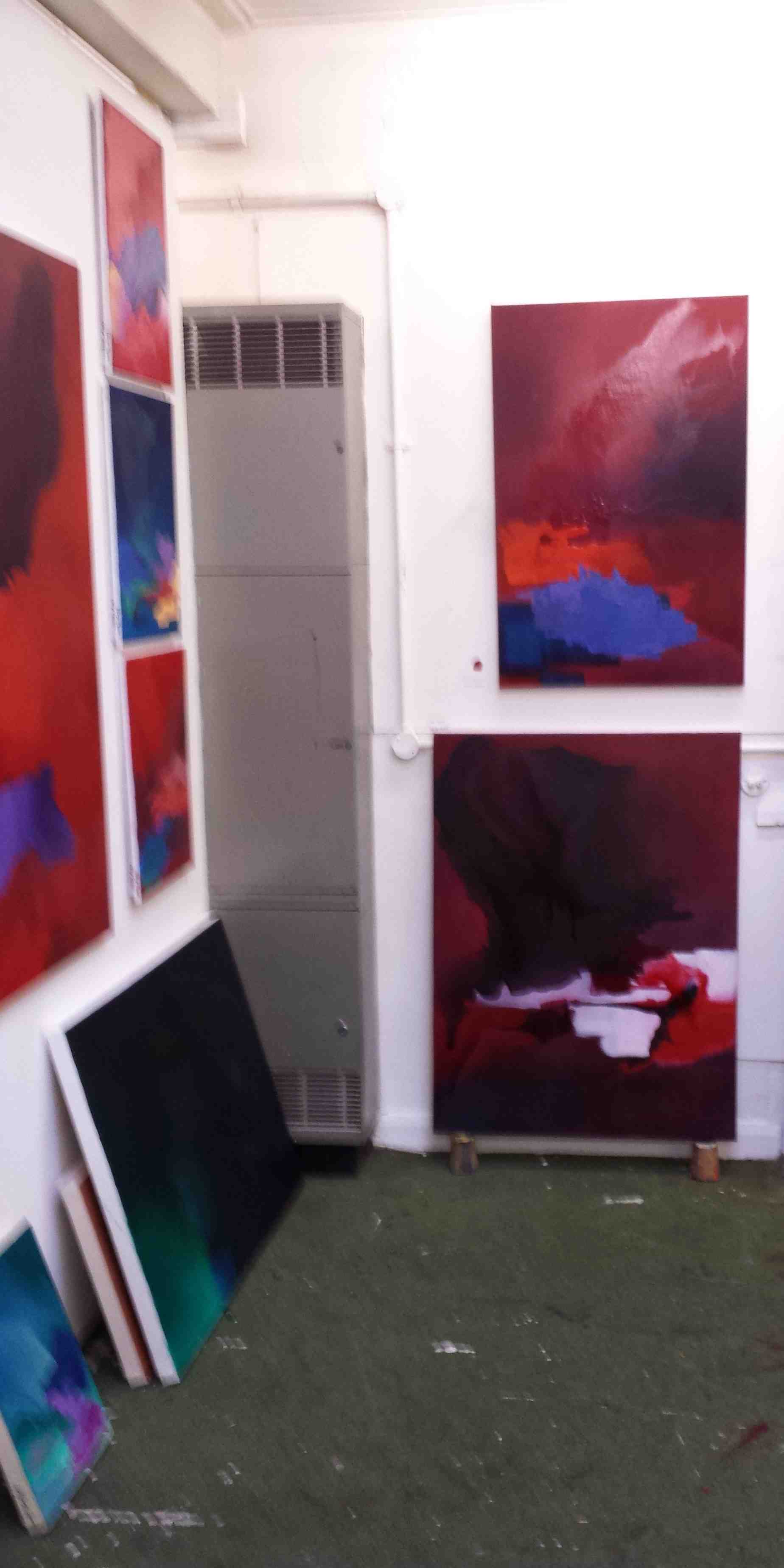
Kathryn Stevens, http://kathrynstevens.co.uk/, clearly rejoices in the freedom of working on a large scale. The billowing colours of her canvases express the joy of painting in bright colours. Some of them have a feathery and eloquent quality that puts one in mind of Georgia O’Keeffe (or perhaps Otto Gottlieb) but here we have an abstract expressionism with an upbeat and optimistic feel. She told me how she works freely, sometimes with music and chatted with the same exuberance that her work conveys. I was particularly taken by a study in
Kathryn Stevens’s studio
crimson, scarlet and white. She hails from St Ives and her paintings exhibit the wondrous light for which the town has become famous.
In short there was much to add cheer on a cold Sunday. It was good to see the Siobhan Purdy’s work again- which adorns the wall opposite as I write, the Mexican and Maya themed prints in the Apex space and to talk again with Naomi Singer whose glass works continue to thrive. Interesting too were the textile pieces by Zoe Wright.
Esther Connon -Work in progress
Before returning to the Melting Pot once again, I went into see the illustration work of Esther Connon and was much taken by her story of TheWhite Butterfly which can be seen on http://www.estherconnon.co.uk/stories.html?s=5. I wondered if it would be possible to animate some of this according to the methods of http://thepapercinema.com/ and this fascinating method may be seen both on videos on the papercinema site and on the community project in St Ives filmed earlier this year by my friend Alban. Altogether with the new building project at Krowji already under-way, great developments can be expected from this artistic phoenix rising from the ashes of the Grammar School at Redruth.
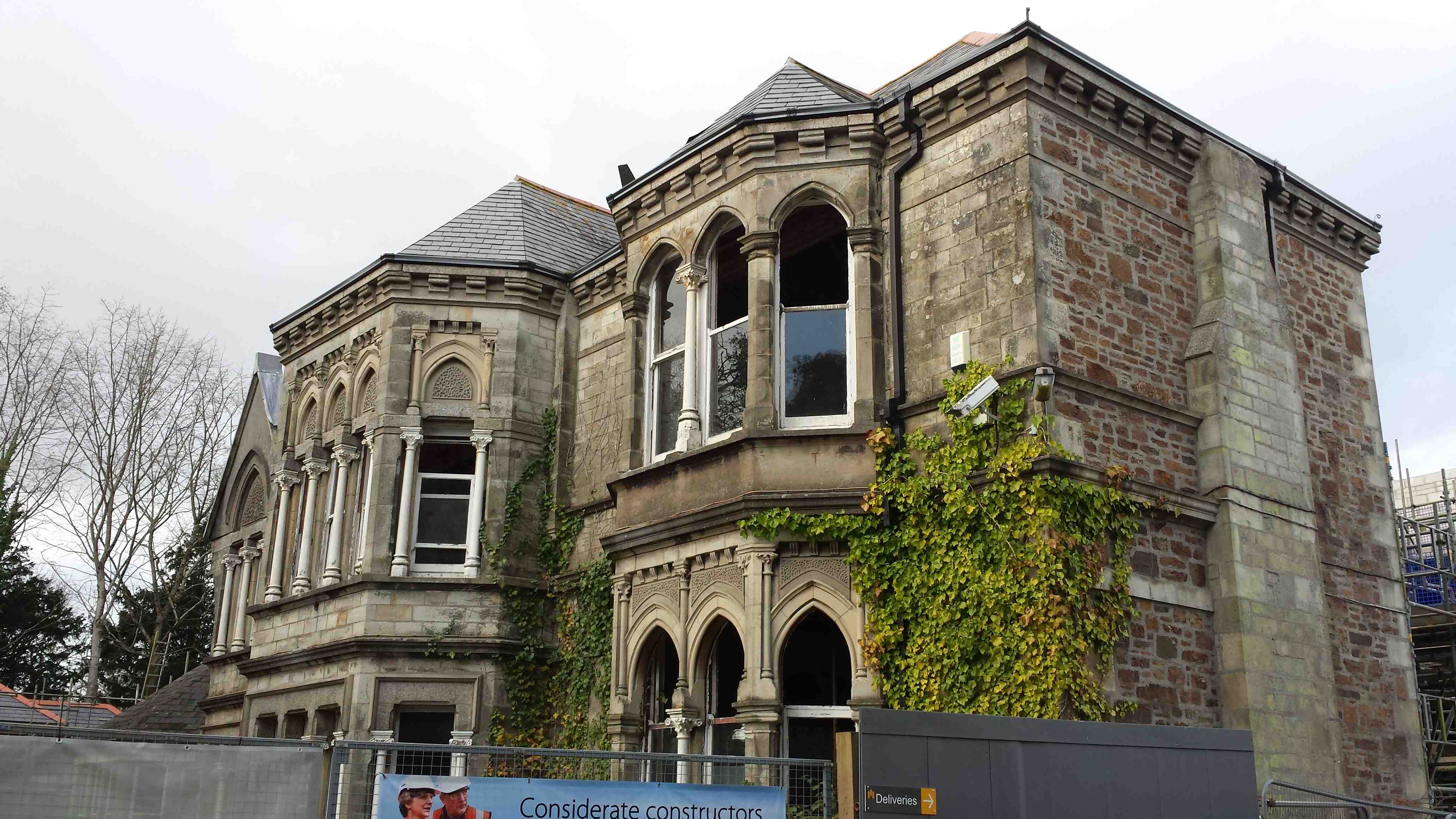
Getting to Krowji on a Sunday in December by public transport is a time-consuming business. Servicing the railway and circuitous bus routes turn a simple trip into an epic voyage. At least it affords time to see more new supermarkets, innovative centres in Pool and glimpses of neo-classical architecture in the grand manner. The upper stories of the façades remind one of the prosperity of this area in its heyday.
Under reconstruction in Redruth
Upon arrival, the bohemian atmosphere in The Melting Pot Cafe, the warmth and the leek and potato soup help to revive after the lengthy journey. The wall of clocks and masques and surreal paraphernalia suggest that a cabaret is about to begin and indeed there is a pianist in cap and bells already upon the stage. This has a timeless and dreamy ambience quite unique and sui generis.
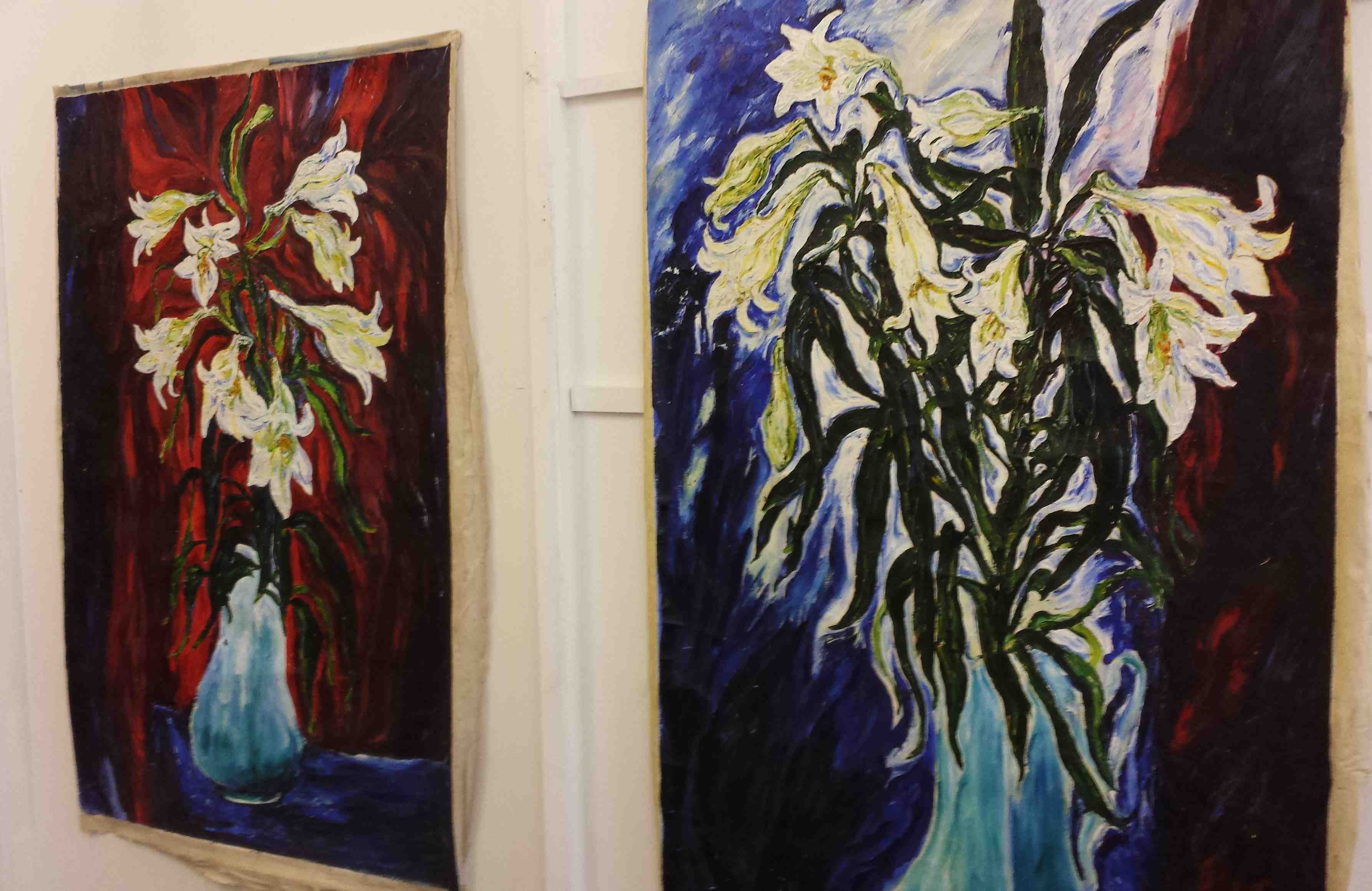
Moving around the crowded studios, there was a buzz which always seems stronger here where the art is being produced than visiting a gallery. I was particularly attracted to the work of Linda Crane -printmaking and painting but also small sculptures -including a small head which I thought reminiscent of Giacometti. The angular and elongated forms, the expressionist use of paint and the dramatic drawings were intriguing and attractive. My impression too was as though I felt a resonance both with Kokoschka and El Greco. Her work may be seen at http://www.sulisfineart.com/search/page/2?q=Linda+Crane and also at http://www.outsidein.org.uk/linda-crane where I was surprised to read of her work being in Penzance at the Redwing Gallery.
Flower Studies by Linda Crane
I think the fact that her atelier was empty increased my fascination with her display and her portfolio.I think my recent travels may also have influenced my susceptibilities. It is also interesting to research the influence of El Greco on Expressionism- as in the recent exhibition El Greco und die Moderne.(Dusseldorf 2012 http://www.smkp.de/en/exhibitions/archive/2012/el-greco.html)
As the winter storms hit Penzance, so does that great painter of storms, steam and whirling chaos, Joseph Mallord William Turner. Not the great English Romantic himself of course, whose late works are currently at the Tate Britain in London until January 25th next year, but as a film, Mr Turner, by Mike Leigh and in the form of an exhibition currently on view in Penzance Public Library, Turner and Me painted by Vaughan Warren R.A.S. Ancillary works by Vaughan are also on view on the first floor of The Arcade in Chapel Street.
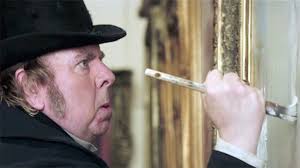
Timothy Spall in Mr Turner
In a year of sombre reflection upon the futility of war, the appearance of original films like Loach’s Jimmy’s Hall and Mr Turner, are inspiring visually. The technique of Loach and Leigh, both of whom use improvisation as a means to authenticity, is inspiring and instructive. Mr Turner has renewed interest in a rumbustious, querulous figure and promises to be exciting viewing. Turner was a protean traveller and visited Cornwall and painted the local landscape including Mounts Bay and the Tamar Valley. Sketches at St Ives established him, according to some authorities, as the founder of the painting tradition there. http://www.tate.org.uk/art/artworks/turner-st-ives-from-porthminster-beach-d41327 Timothy Spall, an exceptional actor and a keen sailor brings his talent and determination to portraying Turner in both his vitality and in his melancholy moods.
Vaughan Warren http://vaughanwarren.weebly.com/ has a tremendous enthusiasm for Turner and has won the Turner Award himself, as well as the Reynolds Medal and Landseer Award. He also has a track record of interest in the history of art which informs his work at a deep level. He also has an interest in local history. He and his partner Melanie Camp share an enthusiasm for Daphne Du Maurier’s novels and in particular Rebecca and its associated film which was, of course a Hitchcock classic. This has provided the inspiration for an Acrylic, a medium which Vaughan assures us Turner would have loved, The Wreck of the Rebecca, which appears in the current show. Vaughan Warren has found much inspiration too in the work of Julius Olsson, whose contribution in St Ives is the subject of much intriguing study by David Tovey, as well as Whistler, Mondrian and Kandinsky. The latter was an acquaintance of Naum Gabo, who also worked locally, is famous for his writings on the spiritual in art. Warren declares too his intention to strive,” towards an abstract beauty through paint and the image”.
The Victorian restrained grandeur of the public library in Penzance makes for a suitable context for Vaughan’s Turner inspirations. However, because they have to be mounted so high up above the installed illumination, they are not as visible as they might be. It is a reminder that despite the town having many galleries there is limited space in which even experienced artists can display. Turner’s palette is of great interest to Vaughan Warren and more details can be found at http://www.winsornewton.com/uk/discover/articles-and-inspiration/palettes-of-the-masters-jmw-turner
Self-portrait by Vaughan WarrenMr Warren RAS
In the current display three works particularly appealed to me. The acrylic on canvas of St Michael’s Mount predominates because of its free use of colour. I also greatly liked small watercolour called Turneresque. It almost goes without saying that this painter shows great facility in all three mediums. The two pictures which are mounted in oval frames make a refreshing change here too. The small painting in the corner which appeals to me most however is Red Interior; Music Room whose contrasting colours remind me a little of Sickert and a little of Gwen John. Anyone who has the opportunity should see the film and Vaughan Warren’s work in Penzance.
In addition to the works displayed in the library there is an opportunity to view Vaughan’s drawing of Nelson’s death mask at the Redwing Gallery, Wood Street in Penzance. The display in Penzance Library may be viewed until mid-December.
On View at Penzance Library, Morrab Road, Penzance
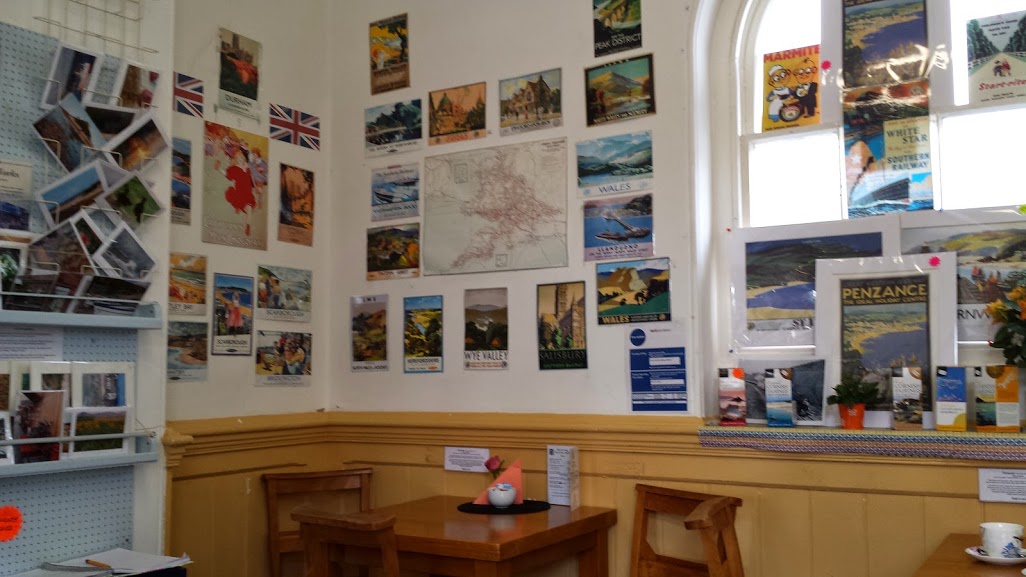
This is a favourite stopping off place where in the midst of all the travel you might enjoy either quiet or a brief encounter; perhaps both. Perhaps, one of the few actual benefits of privatisation, it is filled with transport posters from the 1930s. You can so easily imagine the billowing steam from the last trains which ran on the St Ives Branch line up until the 1970s.https://www.youtube.com/watch?v=a3O7uSD2qlk
Then the music begins, a gentle voice from the past:-
Ah, but when I hate you
Don’t you know it’s ’cause I love you
That’s how I am, so what can I do?
I’m happy when I’m with you
I never mind the rain from the skies,
As long as I see the sun shinging in your eyes
Don’t you know that
Sometimes I love you, sometimes I hate you
Ah, but when I hate you
That’s because I love you
That’s how I am, so what can I do?
I’m happy when I’m with
So happy when I’m with
I’m happy when I’m with you
Außerhalb Lilly Schönauer und Rosamunde Pilcher (1) Virginia Woolf
The Cornish Review Edited by Denys Val Baker
West Cornwall has many literary connections and famous writers have been attracted to its scenery and its people. In an idle moment I was thinking about how useful it might be to give an account of some of the significant figures that are associated with the Penwith peninsula. In her magical notes, “Moments of Being” Virginia Woolf writes of the evocative inspiration which waking in Talland House gave to her. Not only was it a source of inspiration for her great modernist novel,“To the Lighthouse” but to remember that once Henry James took tea on the lawn recalls once again the long Edwardian summer and the echoes of the conversations between him and Virginia’s father, the formidable Leslie Stephen. Links include http://www.woolfonline.com/timepasses/?q=node/271
Books about Virginia and her sister in St Ives include “Virginia Woolf, Vanessa Bell and Remembering St Ives” by Marion Whybrow (currently unavailable on Amazon) and the novel “Virginia and Vanessa” said to be;”…a chronicle of love and revenge, madness, genius, and the compulsion to create beauty in the face of relentless difficulty and deep grief”. In addition there is Dell, Marion. Peering Through the Escallonia: Virginia Woolf, Talland House and St. Ives. No. 23. 1999. ISBN 1-897967-47-0. Price £7.00
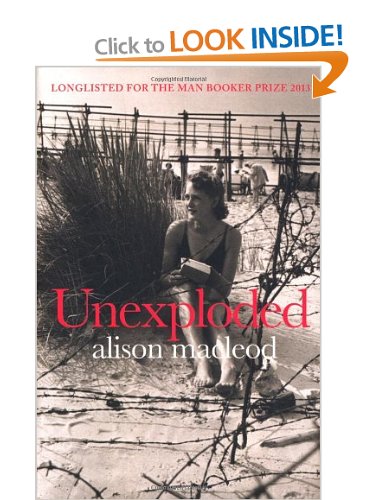
It is interesting, though unsurprising, how Woolf keeps turning up as a factional character in novels. My personal favourite as I have mentioned on here before is “House of Exile” by Evelyn Juers –mostly about Thomas Mann-which contains an interesting and memorable incident where Virginia and Leonard visit a restaurant in the Funkturm in Berlin and loses her elegant scarf which is recovered by another leading character.” Some moments of exhilarating coincidence in these pages are reminiscent of Stoppard’s Travesties.” According to the reviewer, Robert McCrum at http://www.theguardian.com/books/2011/may/22/house-of-exile-juers-review. Although not associated with St Ives, Virginia Woolf turns fictional in the film “The Hours” based on the novel by Michael Cunningham, which came out in 2002 directed by Stephen Daldry (who also filmed The Reader). Her bent-nosed appearance, which some critics found rather hilarious, won Nicole Kidman the best actress award that year. Recently I came across Alison Macleod at this year’s Jewish Book Week, where she was talking about her haunting and remarkable novel, “Unexploded”. She is Professor of Contemporary Fiction at the University of Chichester and a lively and engaging speaker who talked about her research into the background of the novel which is set in Brighton, where she herself lives, during the hazardous summer of 1940. The novel was long-listed for the Man Booker Prize in 2013 and deals with, among other sensitive issues, anti-Semitism in wartime Britain. Virginia Woolf lectured in Brighton during this period and she and her novels turn up as one leitmotiv in this persuasively constructed story. Many of the issues are based on a thoroughgoing examination of the archives. http:/www.telegraph.co.uk/culture/books/bookreviews/10244729/Unexploded-by-Alison-MacLeod-review.html
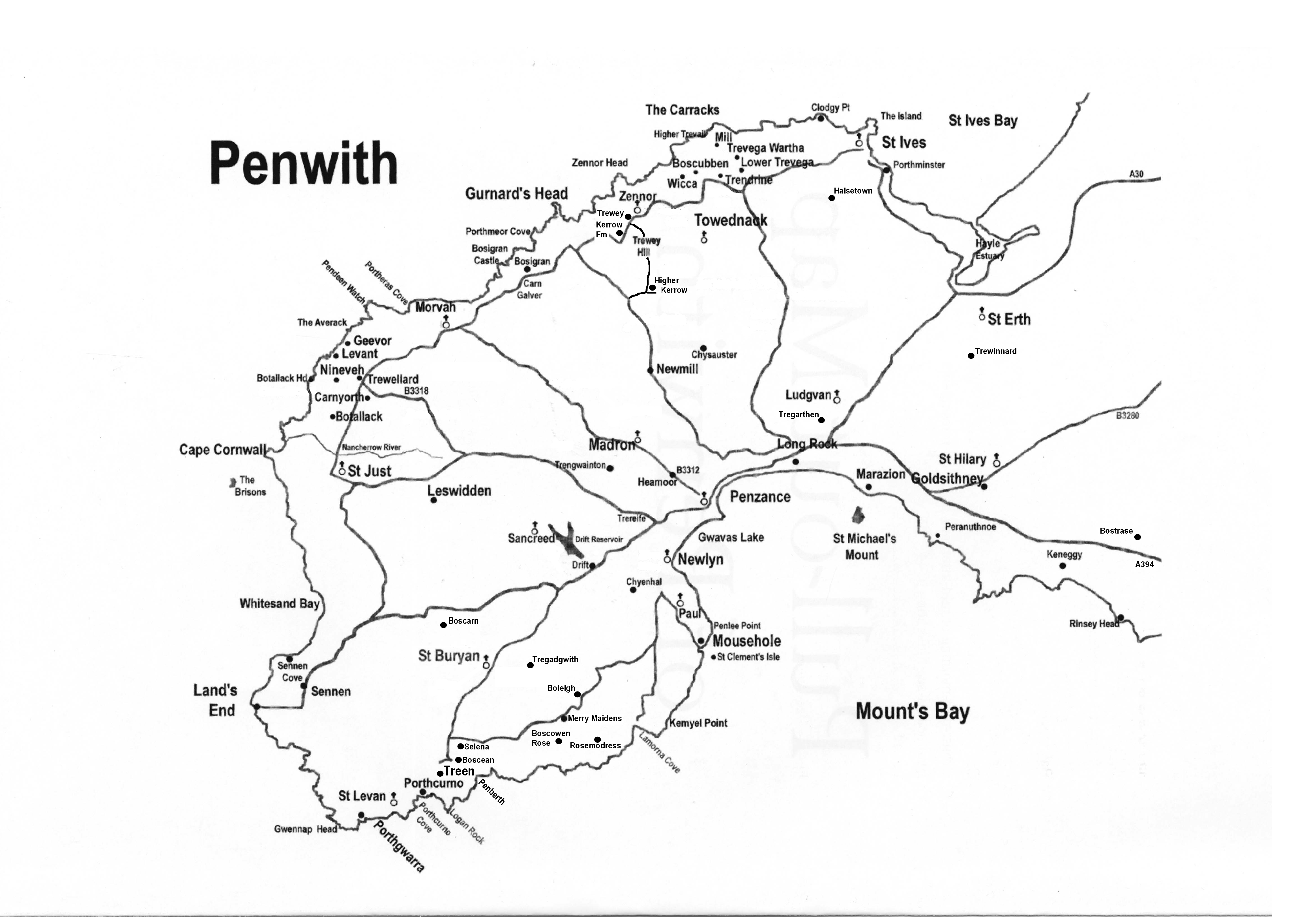
Returning along the coast in a westerly direction to West Penwith, a glance at A Literary Atlas and Gazeteer reveals that many fascinating littérateurs lived or visited from Truro and to the west. Here are a list of just ten whose connections may not be very well known. At Zennor at Higher Tregarthen from 1916-1917, D.H.Lawrence, J.Middleton Murray and Katherine Mansfield. In Truro, Samuel Foote (1720-1777 became celebrated as much for his acting as his didactic diatribes)-his story has just been magnificently told by Ian Kelly see- http://www.theguardian.com/books/2012/oct/05/mr-footes-other-leg-review. Sir William Golding lived nearby at Perranaworthal from 1985 until his death in 1993-where he became a great friend of the controversial novelist and translator of Russian Poetry, D.M.Thomas. He has recently published a poetry collection, Light and Smoke.http://www.dmthomasonline.net/
Samuel Foote
In St Ives, Mrs Havelock Ellis wrote Cornish Idyll in 1898. Much later, after the War in 1945 Norman Levine found the town conducive to his stories, poetry and travel writing. At Madron, the inspirational poet’s poet, penned his charmed verses:-http://www.scottishpoetrylibrary.org.uk/poetry/poems/listen-put-morning
Listen. Put on morning.
Waken into falling light.
A man's imagining
Suddenly may inherit
The handclapping centuries
Of his one minute on earth.
And hear the virgin juries
Talk with his own breath
To the corner boys of his street.
And hear the Black Maria
Searching the town at night.
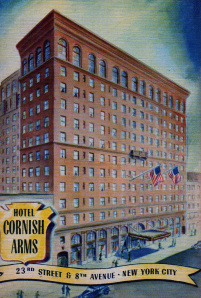
A postcard of The Cornish Arms Hotel in New York-frequently advertised in The Cornishman
Up until August 1914, The Cornishman and the St Ives Weekly Report contain many detailed reports from abroad. These include the Cornish in America, Canada, South Africa. Many Cornish people travelling to the States will have responded to the large adverts in the Cornishman for the famous hotel in New York https://ephemeralnewyork.wordpress.com/tag/hotel-cornish-arms/
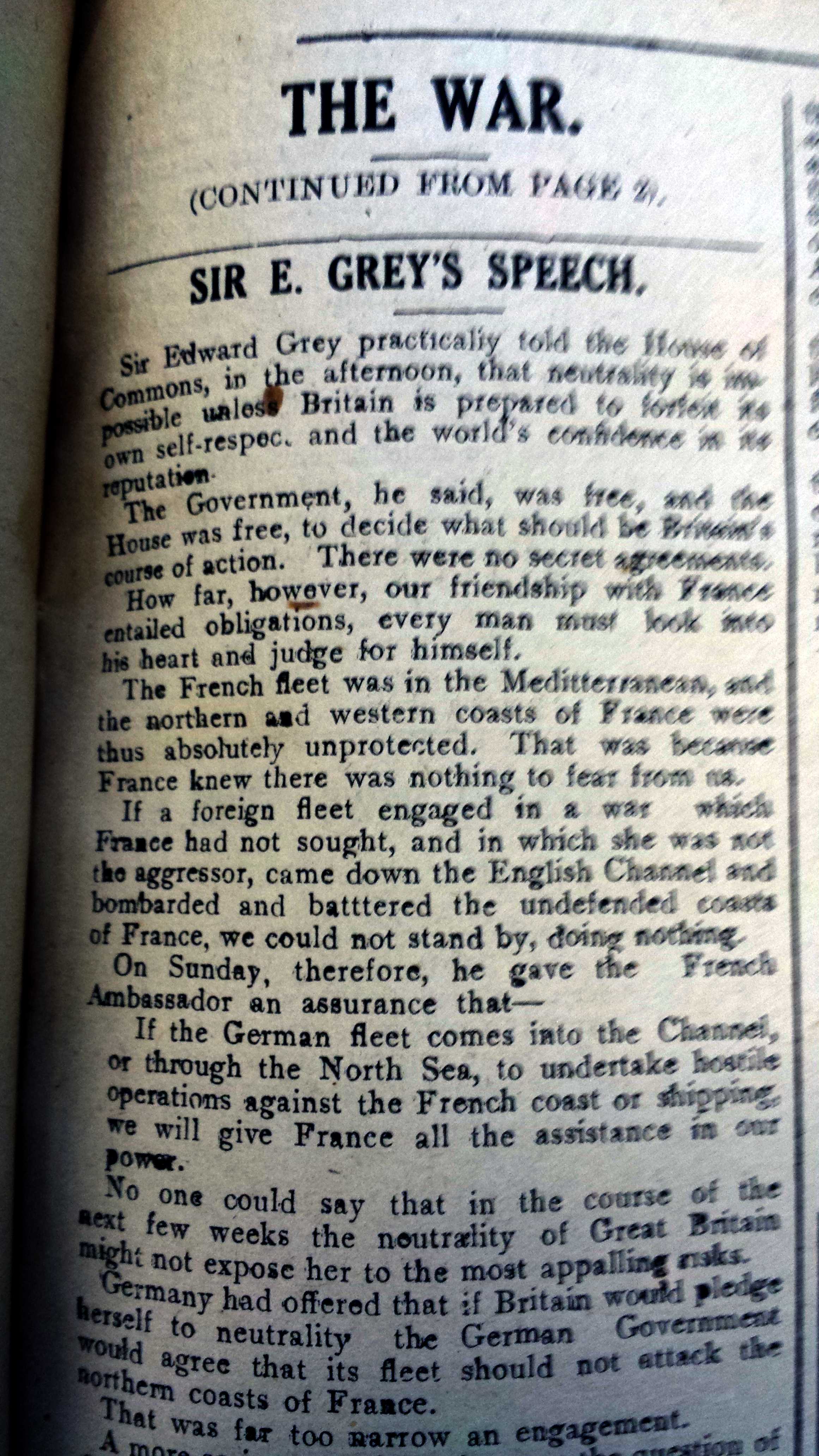
Without doubt, however, the greatest concern appears to be about Nationalist Rebellions in Ireland.http://www.bbc.co.uk/history/british/britain_wwone/ireland_wwone_01.shtml The only reference to the possibility of an outbreak of war- reading between the lines- concerns the speeches in support of building more dreadnoughts. Money appeared to be of no real concern to the advocates of building more battleships.
The effect on the Fishermen and Families
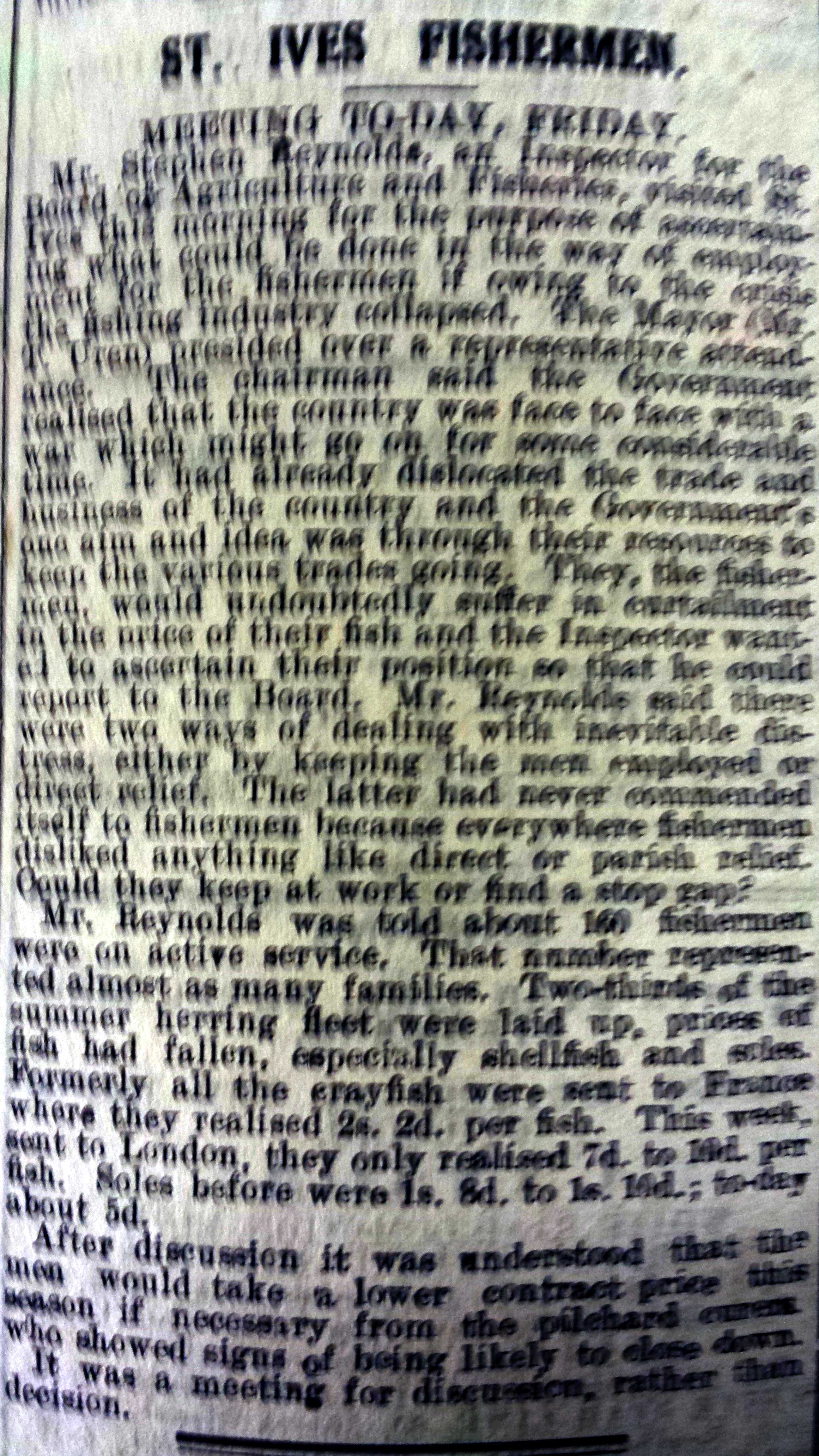
When war broke out many fishermen in St Ives were immediately affected and the effect on many of them, their families and the price of fish was very soon to follow. Many were called up within hours and summoned as members of the Royal Naval Reserve to Davenport and had to leave by train for that destination. A newspaper report states that when addressed by Mr Stephen Reynolds, Inspector for the Board of Agriculture and Fisheries, he was told that some 160 fisherman were on active service with about the same numbers of families affected. Two-thirds of the summer Herring Fleet were laid up and the price of fish and particularly Crayfish that would otherwise have fetched a fine price in Paris were catastrophically affected.
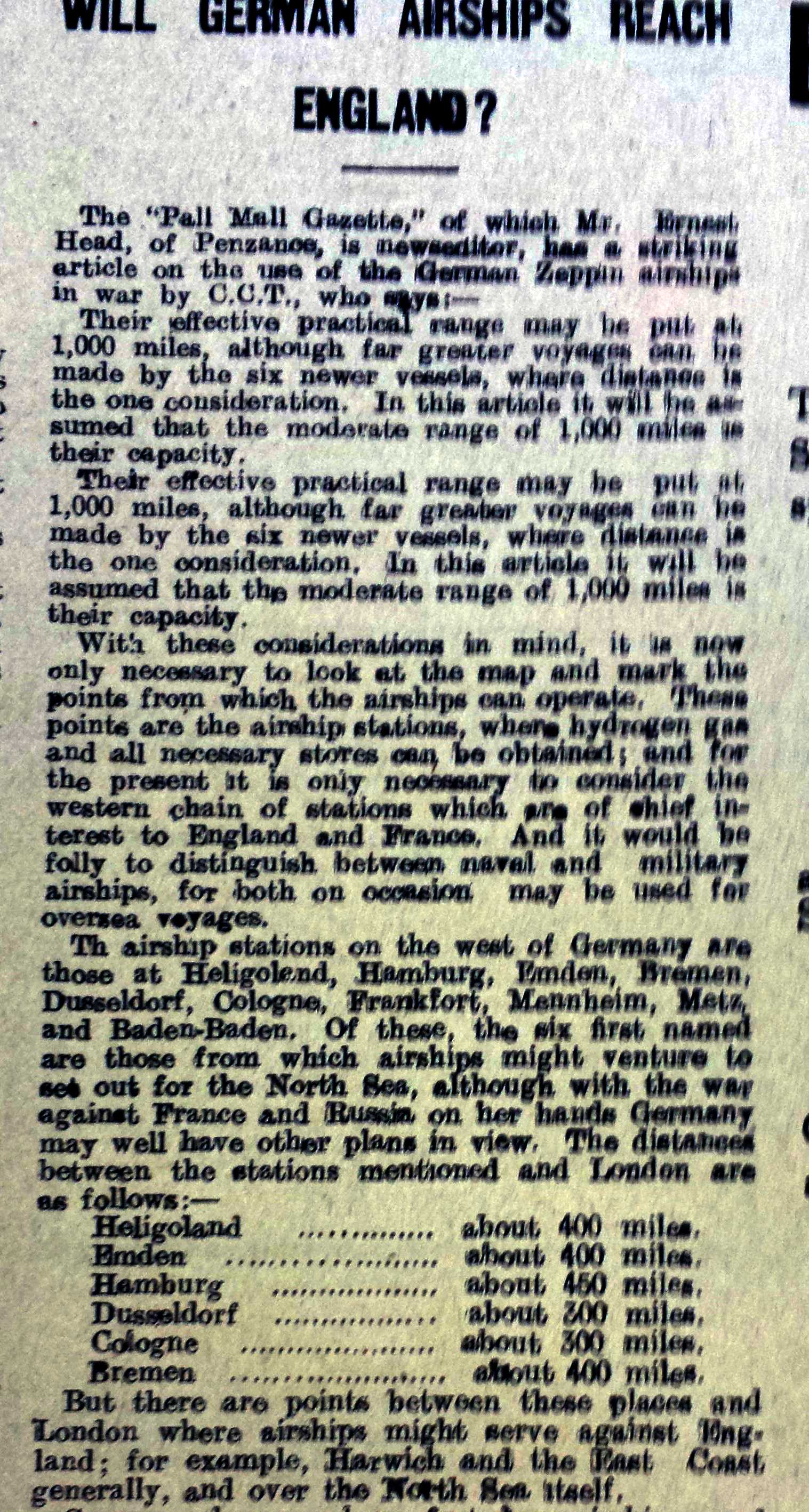
The details of this call=up are very moving since we only have to turn to the next couple of weeks to learn how many will have been aboard ships which sank or been caught in the first defeat later at Mons. The accounts of farewells said above the peaceful beaches and the brass bands playing can still be imagined by anyone walking out of the town. There is a strange mixture of fear and jingoism apparent in the newspapers. There were worries about the supply of wheat which caused fears about starvation; there were food riots in Camborne. Other articles show a concern about possibilities of aerial attack from Zeppelins and tables showing their limited range were the subject of articles in the press.
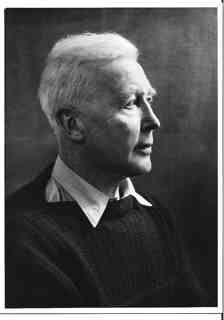
Frank Ernest Halliday was a very enthusiastic walker. Tall with a mane of beautiful white hair and reserved, his elegant stride cut a figure, like a distinguished prophet or poet. He was when, first I became aware of his reputation as a historian and a Shakespearian scholar, hurrying down Back Road West in the general direction of Clodgy where he frequently seemed inclined to walk, frequently at this formidable pace. At about this time, he had already retired from school mastering at Cheltenham College where he had become a friend of Cecil Day-Lewis years before. That was in the early Thirties and the time to which I am referring was somewhere around 1960.
F.E.Halliday
In 1953, Halliday wrote in History Today of the famous Cornish Historian, Richard Carew, a Member of Parliament and a friend of Philip Sydney,” The importance of Richard Carew has never been appreciated. Few, indeed, are even aware of the writer who, while Shakespeare was writing for the London stage, was quietly at work in his Cornish country house. This neglect is the result of his own modesty, the remoteness of his dwelling, and the multitude of his great contemporaries in and about the capital, and not of any lack of merit…..” Much of what Halliday wrote here about Carew is now equally true about himself and the extensive range of his own work. It is time to remember Halliday’s work, much of it written in his house next to the sea, downalong in St Ives. (Those interested in Carew will find a brief entry at http://en.wikipedia.org/wiki/Richard_Carew_(antiquary))
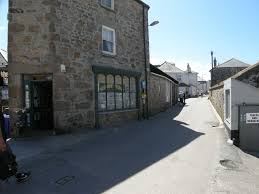
Back Road West, St Ives
When Halliday’s Shakespeare appeared in an American edition in 1961, it was reviewed in the Renaissance News a little later;-
“Mr F.E.Halliday’s life of Shakespeare is the product of a widely read, fully informed, and prolific mind. After twenty years as head of the English Department at Cheltenham College he retired in 1948 to devote himself solely to writing. He is one of the few scholars today who have taken all Shakespearean knowledge as their province. For a period of over fifteen years he has been turning out studies which give an ever broadening view of the great dramatist. In 1946 he published Shakespeare in his Age. Then came Shakespeare and his Critics which although completed in 1947, first appeared in 1949.”
Halliday was educated in North Yorkshire at Giggleswick School where he learnt to cherish Latin poetry, including Horace and his reflections on the seasons, mutability and loss grew up in its unique atmosphere. He was growing up in the dark and difficult days of World War 1 which deeply affected both staff and boys. There is a useful short biography of him included in Cornwall’s People – A Biographical Dictionary by Carolyn Martinand Paul White (Tamar Books). He then went on to King’s College, Cambridge and later entered teaching himself. It was at Cheltenham College that he met and became a supportive friend to Cecil Day-Lewis, the famous thirties poet. Indeed, Halliday, who was an English master and became Head of Department, painted Day-Lewis’s portrait which is in the National Portrait Gallery and may be seen at http://www.npg.org.uk/collections/search/portraitLarge/mw07276/Cecil-Day-Lewis?LinkID=mp01220&search=sas&sText=Day-Lewis&role=sit&rNo=0
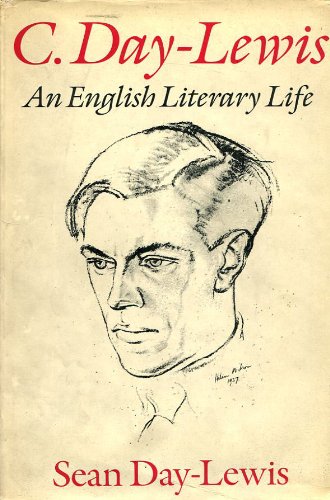
This portrait captures the refined appearance of the poet in a contemplative mood in profile but whether marking an essay or composing a splendid poem is not clear. Day-Lewis’s meeting and friendship in 1931 with Frank Halliday is recorded in some detail in Sean Day-Lewis’s biography of his father C. Day-Lewis, An English Literary Life. It appears that the dress code at Cheltenham was somewhat severe. Also Day-Lewis’s poetry was considered risqué when discovered by the self-appointed proctors of moral rectitude among the other masters. He was accused in a letter from the Headmaster of Bohemian tendencies!
“An Assistant Master at the school had seen him wearing a green shirt, while whitewashing the
walls of his flat, and another observer had reported the poet attending a concert with a stock about his neck under his dinner jacket: this was intolerable conduct, the staff must be properly dressed at all times.
Before replying he took the advice of a college master who, unlike the colleagues who had reported all departures from convention, was a friend. Frank Halliday was a sensitive Yorkshireman who loved literature and eventually became a writer himself. His autobiography tells how he first heard of Cecil as ‘a young married man who liked Beethoven and César Frank’ and was ‘said to write poetry’. He met the newcomers during their second term and registered Mary ‘with ballet dancer’s hair and figure and a dairy maid’s complexion’ and Cecil ‘reserved and almost severe with the trace of an Irish brogue’. Halliday was also a shy man and his mask was an offhand manner, at first discouraging. The discouragement had been overcome and by this March, Cecil and Mary had become friends with Frank and his wife Nancie, and they spent a long time discussing the best response to the headmaster’s outburst.” (Sean Day-Lewis on his father- Halliday’s own biography is called Indifferent Honest, Duckworth 1960)
Halliday’s friendship with Day-Lewis was to last over forty years and much of it conducted by letters from St Ives where he seems to have lived first at Five Fields, Dynas Ia and later when they were completed in Barnaloft Flats, overlooking Porthmeor Beach. Day-Lewis was deeply interested in Marxism and wrote, somewhat ironically to Halliday about the class war and the colourful inhabitants of his local pub at Brinclose, near Axminster, of the News Chronicle, Liberalism and of course in 1938 of Chamberlin and the approach of the Second World War. Day-Lewis moved in an interesting circle of thirties poets and writers and it seems likely that Halliday too might have met such figures as Rex Warner and W.H.Auden. F.E.Halliday seems to have continued as an amateur artist and painted Brinclose in 1939. By 1942 Day-Lewis is working some sixty hours a week at the Ministry of Information and became a close associate of Charles Fenby, journalist and assistant editor of The Picture Post. Day-Lewis records an encounter at this time with another somewhat severe character, Arthur Koestler whom he mentions in his correspondence with Halliday. Day-Lewis’s letters have recently, in 2012, been donated to the Bodleian Library http://www.theguardian.com/books/2012/oct/30/cecil-day-lewis-letters-oxford.
The Wreck of The Firebrand
By the 1960s after the suppression of the Hungarian uprising, which had incidentally also prompted Halliday to sign a letter to the Times, Day-Lewis vigorously renounced his earlier communist views. By 1968, Day-Lewis, who also wrote detective novels as Nicholas Blake, became Poet Laureate. However, in 1971 Day-Lewis mentions to Halliday, a searing review he received from another Cornish poet in the TLS. He correctly identifies the critic as Geoffrey Grigson who having been born in Pelynt was a Cornishman, and held somewhat negative views on Cecil Day-Lewis’s poetry although unlike his earlier Headmaster, regarded him on the single occasion they met at the BBC, as elegantly dressed!
In addition to his Shakespearian Studies, Halliday was active with regard to social and political concerns. In 1963, he signs a letter to the Times along with John Betjeman, A.L.Rowse, Brian Wynter and more than thirty other prominent citizens against the Admiralty’s proposal to take some 355 acres for troop and helicopter training on the lovely Zennor moors. This was a major concern in Penwith at the time. This upset many local people and not least as the land had been placed under a special covenant by the National Trust. In 1975, just over 67% of voters supported the Labour government’s campaign to stay in the EEC, or Common Market and Halliday was writing to the Times again to advocate full political union; not just an economic agreement. Halliday was advocating a Yes vote because he strongly believed in the idealism needed to bring about an effective World government.
There was also a wryly amusing letter written at the end of December 1964(Shakespeare’s quatercentenary) with regard to a production by Lindsey Anderson of Julius Caesar. Anderson was a pupil of Halliday at Cheltenham, where the former also met the future novelist, Gavin Lambert. Halliday gently chides his former pupil for trying to ‘improve Shakespeare’, essentially by excising nine revealing lines of a speech by Brutus. These lines reveal much about the republican’s character. He compares this with how in the Restoration, much was made of Caesar’s ghost who was made to appear at Phillipi. Halliday proceeds to regret the trend towards displaying gratuitous violence in the History plays, whilst making it clear that he is not referring thus to Anderson and expressing his sorrow that Falstaff is being reduced to a sinister figure. He remarks that although he had tickets at Stratford for seven plays he could actually only stomach attending five and a half! The previous year, in another letter to the Times he had taken on the subject of the identity of W.H. of the Dark Lady Sonnets, an unknown William, he surmises, and disagrees somewhat daringly with the inimitable A.L.Rowse.
The walk past Man’Head to Clodgy, St Ives
Recently, while reading my own copy of A History of Cornwall, published by Gerald Duckworth in 1959, I became intrigued by a fine chapter on the Eighteenth Century; a generally neglected period but here there was a rich variety of detail. I was particularly interested in the earlier part of the Century, essentially before the mineral wealth of the Duchy had been much exploited. This was an unsettled period of rebellions and Halliday points out, “ Impoverished by the Civil War, the Cornish people took little interest in the events that followed the death of Charles II- the Monmouth Rebellion, the Revolution of 1688, the Jacobite Rebellion of 1715-…” In St Ives, which had had a Parliamentary army garrisoned there, the inhabitants might keenly have felt ravages of occupation. There are also records showing that Monmouth was blown off course there on his way to Weymouth and his future defeat at the Battle of Sedgemoor. The Treaty of Utrecht which interestingly, has recently escaped much notice upon its 300th Anniversary provided a temporary peace to the Wars of the Spanish Succession and its signature was celebrated in St Ives at the time. Travel then was most easily carried out by sea although as the experience of Sir Cloudesley Shovell wrecked on the Scillies suggests, navigation was a hazardous affair particularly in determining longitude. http://en.wikipedia.org/wiki/Scilly_naval_disaster_of_1707
Halliday remarks that this period around 1700 was characterized by a change in land ownership. Lawyers, merchants and businessmen started to invest in land that might be valuable more for the materials beneath the surface than as a source of food that gave it value to the gentry. This is a period where speculation starts to become important and clashes between the older aristocracy and the emerging entrepreneurs. This was particularly true in the western part of the Duchy where the known lodes existed. Halliday points to Celia Fiennes travel diary. He quotes her references to the shortage of timber for mine construction and the shortage of fuel. She writes, “They burn mostly turffs, which is an unpleasant smell; it makes one smell as if smoaked by bacon.” Fiennes, as Halliday points out, had to travel by horse because the roads were in such a poor condition. Copper was mined alongside tin but because of the shortage of fuel it was shipped to Bristol and South Wales for smelting. Little Cornish horses, she tells us were used to carry fish and the corn which was being cut.
The early C18, which Halliday covers in about thirty pages, sees the introduction of the first steam engine in about 1710. It was the very inefficient Newcomen engine, although state of the art at the time, and was used at the Godolphin mine at Wheal Vor. It used vast quantities of fuel. Even by 1740 there were just three steam pumps at work. It was not until the early Nineteenth Century that Cornish engineers greatly improved the efficiency of those engines that had be designed by Watt, Trevithick and others http://en.wikipedia.org/wiki/Cornish_engine. Thus in effect this would henceforth reduce the cost of coal which had to be imported from South Wales, a trade in the hands of merchants and businessmen. Incidentally, it was a German Chemist, a proponent of the celebrated but misguided Phlogiston theory, Johann Joachim Becker (1635-1682) from Speyer near Heidelburg, who visiting Cornwall in the 1680s made an important discovery. At Treloweth, St.Erth, that Becher was said to have built a furnace for the smelting of tin using pit coal as opposed to charcoal. http://de.wikipedia.org/wiki/Johann_Joachim_Becher
The celebrated Tory politician who rose to become Marlborough’s confrere and the First Lord of the Treasury, Sidney Godolphin, 1st Earl of Godolphin, KG, PC (15 June 1645 – 15 September 1712) might well be remembered for the work he did in passing the Act of Union with Scotland which created the united kingdom of Great Britain. He also established sound finances for Queen Anne and made possible the founding of the Bank of England. The Cornish might, however, have other reasons for remembering him as Halliday points out:-
…..”some of the old charcoal-using blowing houses were retained for smelting stream tin, which was of a finer quality than that from the mines. The use of coal probably saved Cornwall from being completely denuded of timber, the demand for which for shoring up the workings was enormous, and one of the last services that Godolphin did for his native county was to cheapen the price of coal by securing a drawback of the duty on that used for smelting. A few years before, in 1703, he had been responsible for the favourable terms of pre-emption granted to the Cornish tinners.” This unfortunately ended when Walpole came to power.
Frank Halliday was not only an author with broad interests, having written books on Chaucer, Dr Johnson, Wordsworth, Hardy and Browning besides Shakespeare; he was also a committed intellectual who was active as a School Governor, interested in social action and helped to set up with Bernard Leach and Barbara Hepworth in 1967, the St Ives Trust http://www.stivestrust.org/ which has been instrumental in developing conservation projects and working in alongside the St Ives Archive Centre. http://www.stivesarchive.co.uk/resource/
F.E.Halliday was an experienced lecturer and I can still recall a historical talk which he gave when I was a young lad in The Labour Party Rooms upstairs behind the back of the Union Hotel at the bottom of Ayr Lane. This is currently a rather chic restaurant but in the Sixties, a quite barely furnished room at the top of a steep winding wooden staircase. The subject concerned the early history of Cornwall and was concerned the Early Bronze Age and I particular recall much mention of the Beaker Folk (Glockenbecherkultur). Halliday’s tall figure loomed over slides showing the migrations of these people over Southern England at a time when Britain’s only significant export material was in fact Cornish tin. http://en.wikipedia.org/wiki/Beaker_culture. He mentions in a chapter on the Bronze Age in “A History of Cornwall” that, “Beakers are rare, but two have been found as far west as Land’s End, both of them in cists, and one, now in St Buryan church, accompanied by a flint knife.” It would be interesting to know if it is still located there.
Spread of the Beaker Culture
Speaking about Cornwall he says,” And I loved it for its character: for its strength, although an outcast among counties; for its appearance of having known and suffered so much, yet without any trace of disillusionment, but having rather an air of expectancy; for its human virtues of patience and endurance; for its mystery…”

























 penwithlit